本文へスキップ

Keytalk オリジナル · 場面 25 · チャプター 5

Break the Bells

cute Komon Snake 48premiumクリエイターページ

In 1348, a widow who scrapes a living illuminating prayer books is ordered to join a mountain abbey after half the brothers die in a single week and the abbot goes blind.

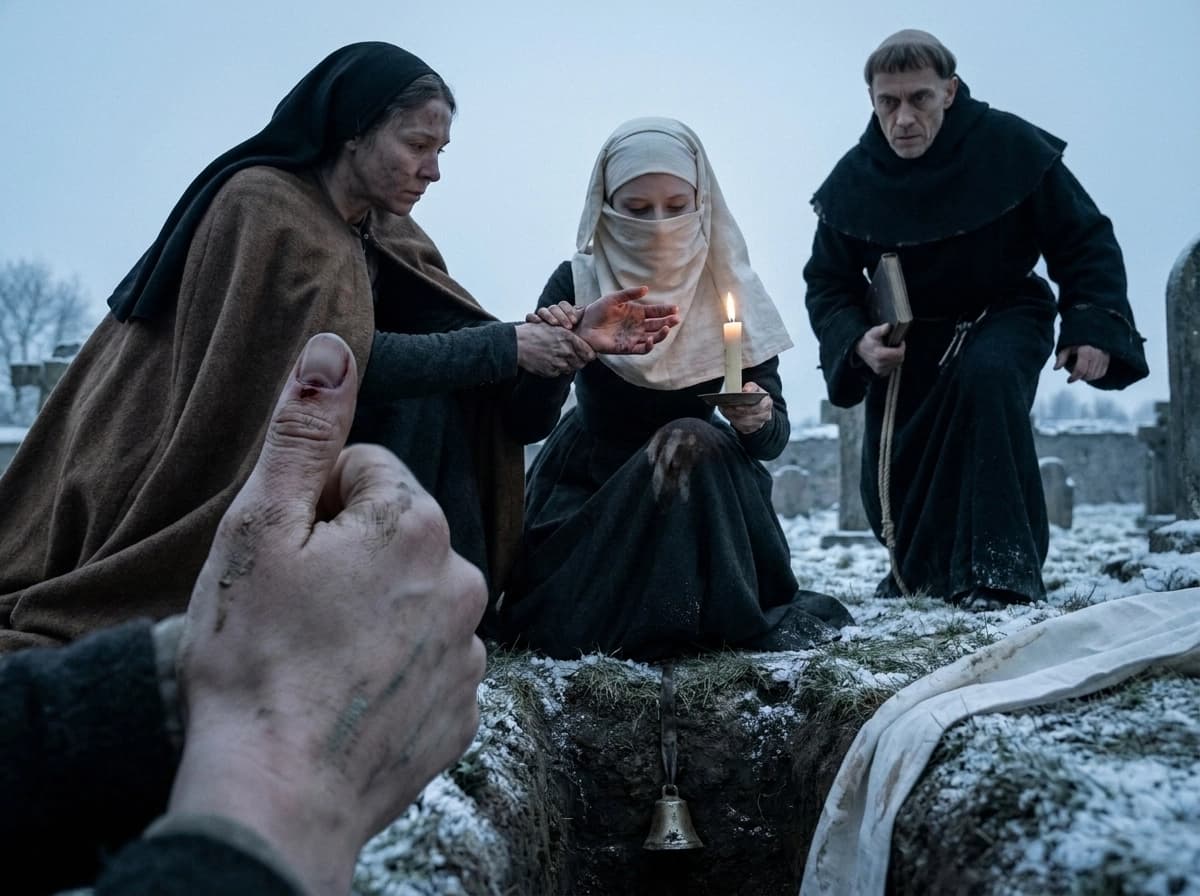
The dead are being buried with little clay bells tied to their wrists, because twice now the graveyard has coughed one back up at dawn, nails black with wet soil and teeth packed with wool from the burial shroud.

While snow seals the pass and the ink in her horn freezes solid, she finds the bells were cast from silver shaved off the abbey’s altar, and the blind abbot is sending novices into the crypt each night with a hammer and a

  • 人物 5
  • 場所 7
  • 場面 25
  • あらすじ 14,934字
Break the Bells cover image

人物 · Characters

登場人物たち

Ysabeau de Falaise

女性

A widowed illuminator compelled to leave her market stall and copyroom for a snowbound abbey whose books are rotting faster than its brothers

プロフィール

Ysabeau de Falaise means to learn whether the abbey's dead are rising from sickness, fraud, or something holier and fouler before winter closes the pass so completely that obedience becomes her only roof. Every clean page she finishes for Abbot Matthieu earns her broth, fire, and a bed while binding her more tightly to his rule and to whatever he is hiding below the chapter house. With Brother Lucien holding her lamp at the crypt stairs, she begins trading her skill at reading stains, weights, and hands for his frightened knowledge of the night errands he cannot refuse.

When other people cross themselves, Ysabeau de Falaise leans closer: she lifts a corpse's lip with her penknife, holds a clay bell to her ear before she weighs it in her palm, and tests ink on her thumbnail even when her fingers are blue with cold. She keeps her face still while men with authority speak, then scratches tiny marks in the margin or under a table with the nail of her little finger, as if every room must be copied before it can trap her. Put a command in front of her and she obeys just enough to stay indoors, but she turns each task sideways until it yields one more fact than she was meant to have.

背景

Before the summons up the mountain, Ysabeau de Falaise made her living finishing saints' faces and border vines in other people's books after her husband's death left her with his debts, his tools, and none of his guild standing.

She learned early that pious men paid late, watched closely, and lied most often when they said a thing was for her own protection, so she taught herself to notice where silver had been shaved, where wax had been reheated, and where a trembling hand had copied from fear instead of faith.

The abbey called for her because plague and terror had spoiled the brothers' script; she came because winter on the road kills as surely as walls do, and because a house that buries men with bells tied to their wrists is already writing a story she does not trust others to read for her.

描写

Ysabeau de Falaise is a lean woman of thirty-one with the guarded stillness of someone used to working under watch: dark wool gown belted close for warmth, ink-stained fingers half-hidden in frayed cuffs, a widow’s veil pinned back from practical brown hair that has escaped in damp curls at her temples.

She stands as if bracing against cold and command alike, chin slightly lowered, one shoulder turned as though no room will have her full back, and her sharp gray gaze fixes on things other people avoid.

The detail that catches and stays is the small penknife she keeps ready in her hand like another writing tool, its plain bone handle worn smooth by use.

Matthieu d'Aubrac

男性

The half-starved head of a mountain abbey, hearing confessions in darkness while others guide his hand to seals he can no longer see

プロフィール

Matthieu d'Aubrac means to carry the abbey through winter with its relics, rents, and obedience unbroken, and he will pare silver from the altar, recast it into burial bells, and keep boys moving in the dark below rather than let panic strip the house before spring. Blindness has made every order costlier: he must lean on Ysabeau de Falaise to read ledgers, charters, and scripture into his ear, while each page she speaks aloud gives her another measure of what he has altered. What most threatens him is not the snow or the graves but Prior Anselm of Mirepoix, whose exact memory can weigh an altar edge more sharply than any scale.

When brothers speak in his chamber, Matthieu d'Aubrac turns his blind face a finger's width past them and counts on the table with his thumb, as if tallying grain while he listens for the lie in a breath. He blesses a novice with one hand and closes the same fingers around the boy's wrist before sending him below, holding on just long enough to make refusal feel like sacrilege. With Ysabeau, his voice softens into patient requests for one more line, one more account, yet the room goes still whenever she pauses in the wrong place, because he hears hesitation like a dropped spoon on stone.

背景

Before darkness took his eyes, Matthieu d'Aubrac spent three decades turning a poor mountain abbey into a hard, orderly lordship of tithe barns, grazing rights, and a famous altar that drew gifts from the pass.

The blindness came in the same season as the fever deaths, and he learned too quickly how men begin to measure an abbot's weakness by the scrape of chairs, the delay before obedience, the length of silence after a command.

Prior Anselm once kept his stores for him and admired his thrift; now Matthieu d'Aubrac keeps the prior close, the keys closer, and the crypt busiest at night.

描写

Matthieu d'Aubrac is a gaunt man of fifty-eight in a black wool abbot's habit gone shiny at the cuffs, the fur lining at his collar worn thin, as if even his rank has been rubbed down by winter and use.

He holds himself upright with the rigid economy of someone who refuses to let blindness be mistaken for frailty, his blind face angled just past the speaker while his thumb counts softly against the edge of a table or rosary bead; the gesture is small, but it makes the room feel measured and trapped.

A pale, milk-white film clouds his eyes beneath heavy lids, and on his right hand he wears a large silver abbot's ring, its edge visibly pared and uneven, a holy emblem thinned by the same hunger he means to outlast.

Lucien Varet

男性

A novice assigned to night burials, bell-tying, and the abbot's secret errands beneath the chapter house

プロフィール

Lucien Varet wants release from his vows before another winter fixes him to the abbey for life, but every order he swallows from Matthieu d'Aubrac buys grain for the two younger sisters he left below the pass. After Lucien Varet watches Ysabeau de Falaise kneel in the frost and scrape burial wool from a dead man's teeth without flinching, he begins bringing her what he sees and hears in the graveyard, hoping she can name the thing that is happening here before it takes him too. He does not tell her that one of the bodies hauled up from the earth turned its mud-stiff face toward him and spoke his name.

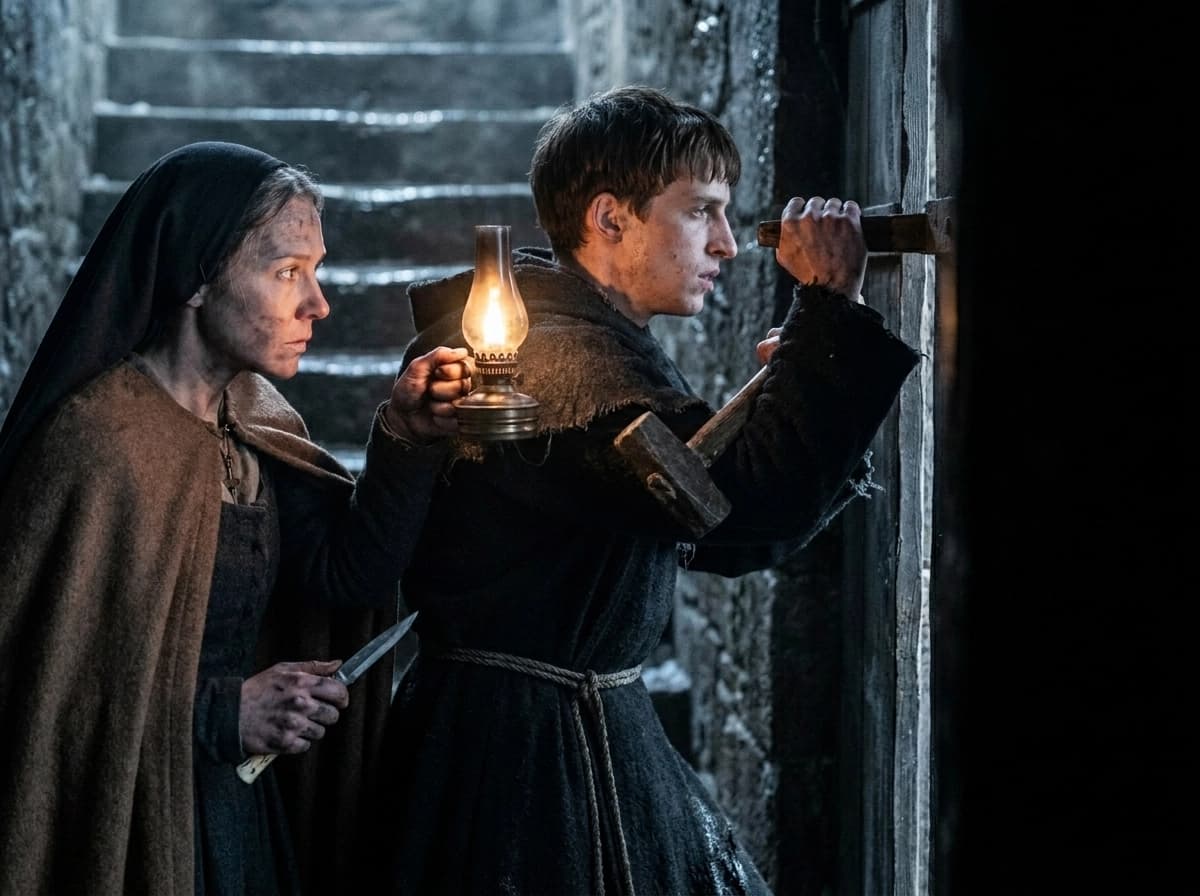
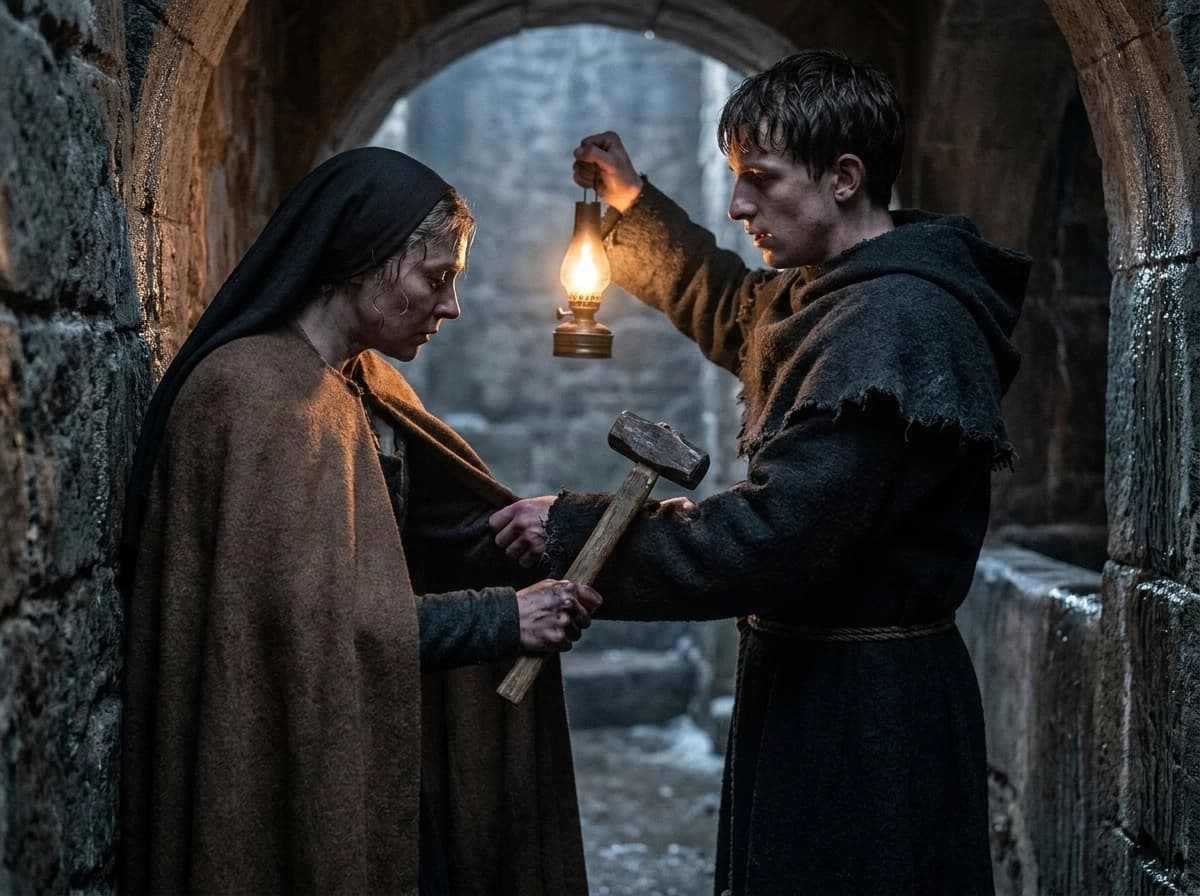
At funerals, Lucien Varet knots the clay bells too tight, then loosens them with shaking fingers as if he cannot decide whether he means to hold the dead down or spare their wrists. He trails Ysabeau with a lamp held high and answers her questions too quickly, but when she asks what waits below the crypt steps, his mouth locks and his thumb worries the splintered hammer haft until the skin opens. In daylight he startles at every bell in the abbey, yet at night he goes where Matthieu sends him, jaw set hard enough to make his young face look borrowed from an older man.

背景

Lucien Varet was given to the abbey after a late frost killed his father's vines and a coughing sickness took the man before Lent; the brothers promised bread, letters, and winter grain sent down to the widow's house if the boy stayed obedient.

Grave duty fell to him because he was small enough to climb between tilted stones and light enough to cross fresh-dug ground without sinking to the knee.

The first time the earth heaved back a shrouded body by dawn, Lucien Varet helped drag it in before the lay servants woke, and since then Matthieu has used his fear as if it were another tool hanging on the wall.

描写

Lucien Varet is a narrow-shouldered farm boy stretched into a novice's black wool, the hem damp with graveyard slush and the sleeves polished shiny where his hands keep worrying the cloth.

His tonsure has grown in unevenly, leaving dark brown hair rough around a pale scalp, and his young face goes rigid too fast, as if fear keeps borrowing it and returning it older; he holds a lamp high in one hand and a splintered hammer haft in the other, thumb split and raw where he rubs it whenever anyone mentions the crypt.

The thing one remembers is how he leans half a step toward the person beside him while his eyes stay fixed on the dark behind them, like a boy already trying to flee without daring to turn his back.

Anselm of Mirepoix

男性

The abbey's keeper of stores, keys, and burial accounts, measuring turnips, lamp oil, and grave depth with the same dry hand

プロフィール

Anselm of Mirepoix means to keep the abbey standing through winter by putting every loss into a ledger plain enough to outlast visions, panic, and the abbot's orders; when the numbers begin to match the shaved edge of the altar to the silver hidden inside the grave bells, that same ledger turns him against his own house. Brothers stop speaking when he enters the warming room, and Matthieu answers his inventories with piety and delay, so Anselm of Mirepoix quietly draws Ysabeau de Falaise to his table and asks her to judge what his scales cannot: whether the bells' weight answers the altar's wound.

At meals he breaks a loaf with both thumbs, sets the larger half aside, and only then begins asking who opened which store jar, who drew extra tallow, who came late from the crypt with mud on his hem. He keeps his keys looped under his scapular and touches them when Matthieu speaks, as if metal could steady him better than prayer. When frightened, Anselm of Mirepoix grows more exact, not less; his voice drops, his columns sharpen, and mercy starts to look, in his hands, like a form of false reckoning.

背景

Before he came up the mountain, Anselm of Mirepoix served in a priory that starved one Lent because a beloved superior swore the granary was fuller than the tally said; Anselm of Mirepoix helped carry out the dead and afterward learned to trust ink, weights, and locked doors over any holy man's certainty.

Matthieu once prized that hardness and raised him over stores and rents when the abbey still had tenants enough to fill its bins. Then the sickness took brothers, snow cut the pass, and silver began to vanish in filings so fine that only a man already trained by one famine would think to save them on his fingertip.

描写

Anselm of Mirepoix is a lean man worn to forty-six by cold stores, bad harvests, and the habit of mistrusting any comfort that cannot be counted.

His black wool habit is clean but rubbed pale at cuff and hem, the scapular hanging straight over a belt burdened by a ring of iron keys; one thumb hooks that ring as if he means to keep the whole abbey from slipping loose, while his other hand steadies a ledger against his ribs.

He holds himself with the stiff caution of someone forever measuring loss before it arrives, mouth pinched, gaze sharp and unsparing, and the remembered thing about him is the dusting of silver filings caught in the whorls of his fingertips.

Aélis de Montvert

女性

A noblewoman lodged at the abbey as an oblate, tending the infirmary and financing candles, linen, and silence from her dead mother's dowry

プロフィール

Aélis de Montvert wants one grave opened before dawn prayers, because she saw her brother stop breathing on the mule track and cannot bear the abbey calling his return a wonder when his body may have been handled by living hands. To force Anselm of Mirepoix to permit it, she empties her own purse on clean burial cloth, lamp oil, and physic for the sick brothers, making herself too useful to refuse while drawing the abbey tighter around her. She asks Ysabeau de Falaise to look at the bells as a craftswoman rather than a penitent, but keeps back the fact that the clay came from her father's abandoned kiln below the pass.

At funerals, Aélis de Montvert kneels without wavering until everyone else rises, then reaches to straighten the shroud corners with bare fingers, as if neat linen could still command the dead. She gives away silver with a steady hand and lies with a stiller face; when Ysabeau asks a direct question, Aélis answers by setting down another folded cloth, another jar of salve, another reason not to press her yet. Around Abbot Matthieu she is all obedience and lowered eyes, but with Anselm of Mirepoix she counts out coins on the table one by one until his silence has to answer her.

背景

Aélis de Montvert was promised to the abbey young as part piety, part bargain, and after her mother's death her visits became longer, her father's gifts heavier, and her freedom smaller each season.

She came up this winter beside her brother's litter, watched the snow gather in his lashes before the gate opened, and heard the first bell tied on his wrist with her own hands still numb from holding the cloth.

The clay in those bells was no abbey clay: as a child she played in the red spoil heaps at her father's kiln below the pass, where failed vessels cracked in the cold and rang when struck.

描写

Aélis de Montvert carries her rank like something she has chosen to put to use rather than display: a young woman in a dark wool gown cut well but worn hard at the cuffs, a linen wimple pinned with severe neatness, and a fur-lined mantle gone damp at the hem from graveyard snow.

She stands very still even when others flinch, one gloveless hand resting on a folded burial cloth or a medicine jar as if either could compel obedience, her lowered lashes and composed mouth making room for no argument while a thin red clay stain at the edge of one thumb betrays what she knows and will not yet say.

Her face is fine-boned and pale from mountain winter, but there is nothing fragile in the way she leans slightly forward, intent and unsparing, as though she means to have the earth opened before dawn if silver, silence, and prayer will not do it.


あらすじ · Synopsis

あらすじ

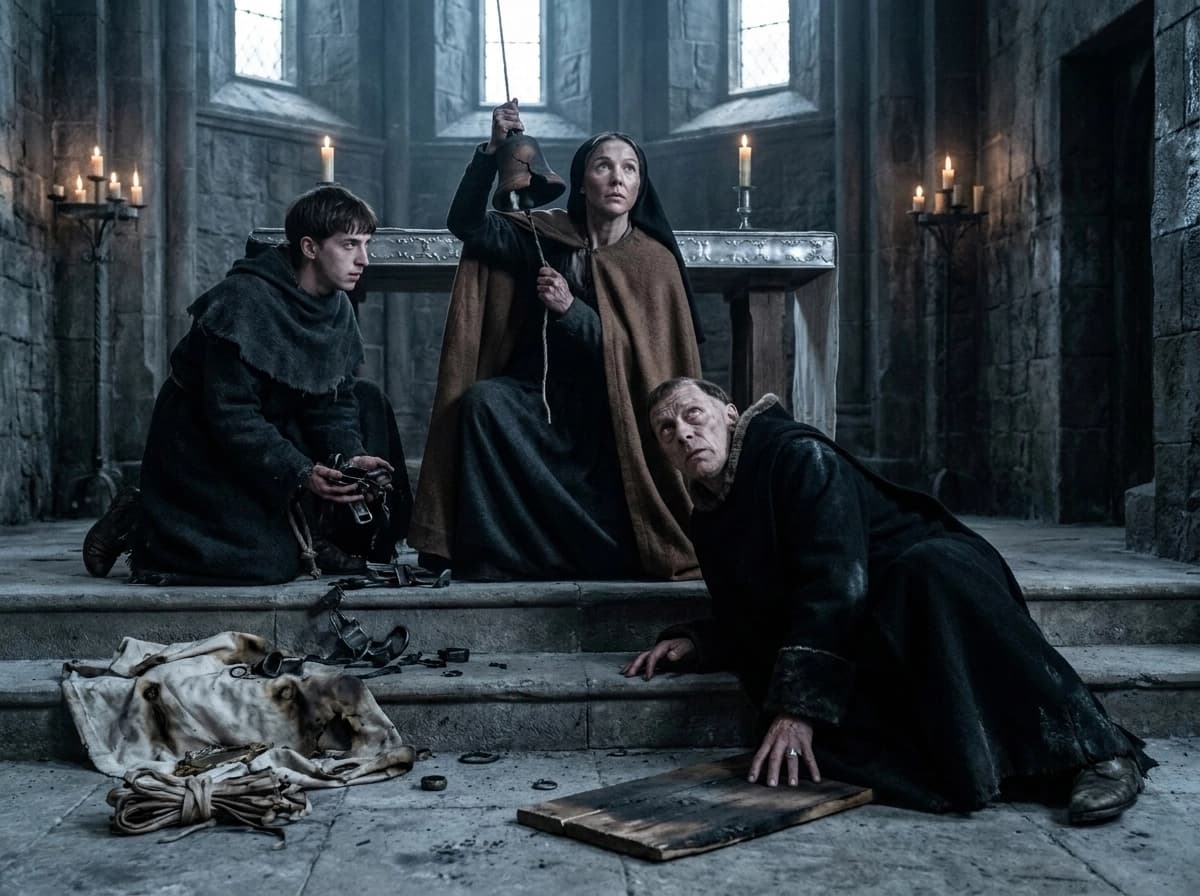
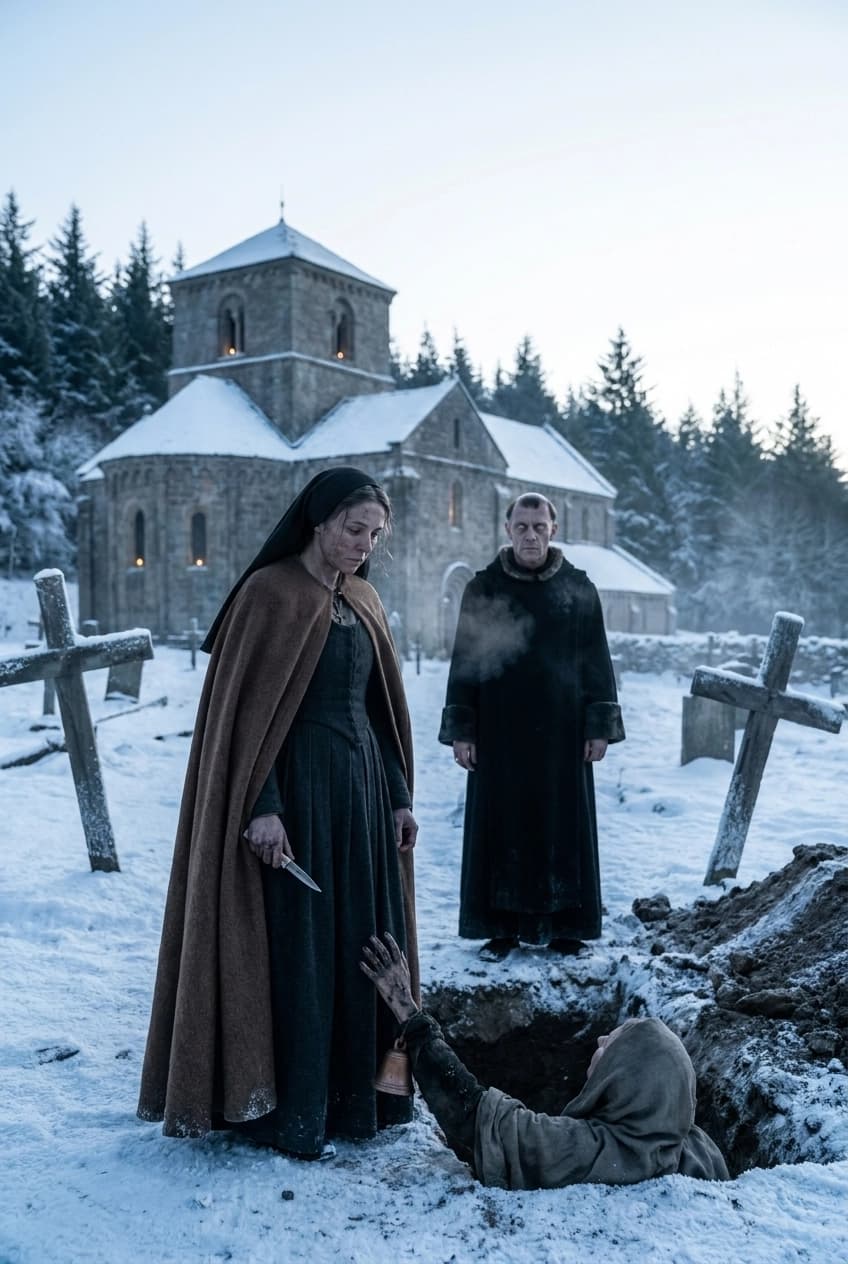
When Ysabeau de Falaise is brought up through the storm to replace dead hands in the abbey scriptorium, she expects mildew, hunger, and pious concealment. The first morning gives her worse. In the graveyard at dawn she sees a fresh grave split open at one edge, the shroud dragged tight across the dead man’s face as if he had strained upward before freezing still. A clay bell hangs from his wrist. His teeth are packed with burial wool. Brother Lucien Varet, white with cold and terror, cannot stop staring at the bell as though he expects it to ring. Abbot Matthieu d'Aubrac orders the body reburied before Prime and has Ysabeau read the burial office aloud because his own sight is gone. While she speaks, she feels the shaved unevenness of his silver ring against the page and notices that the little bell in Lucien’s hand is heavier than its clay should allow.

Matthieu keeps Ysabeau close at once. He sets her to copying charters, mending damp books, and reading inventories into his ear in a chamber warm enough to thaw her ink. Each favor is shelter bought with obedience. Each page gives her another glimpse of strain in the house: lamp oil gone missing, burial cloth consumed twice as fast as before, altar plate listed in older accounts at a greater weight than it bears now. Matthieu’s requests are soft, but he holds Lucien by the wrist when he sends him below the chapter house after Compline, and the novice returns with mud on his hem and a splintered hammer in his hand. When Ysabeau asks what lies under the crypt stairs, Lucien says only that the dead do not stay quiet there, then flinches at his own words.

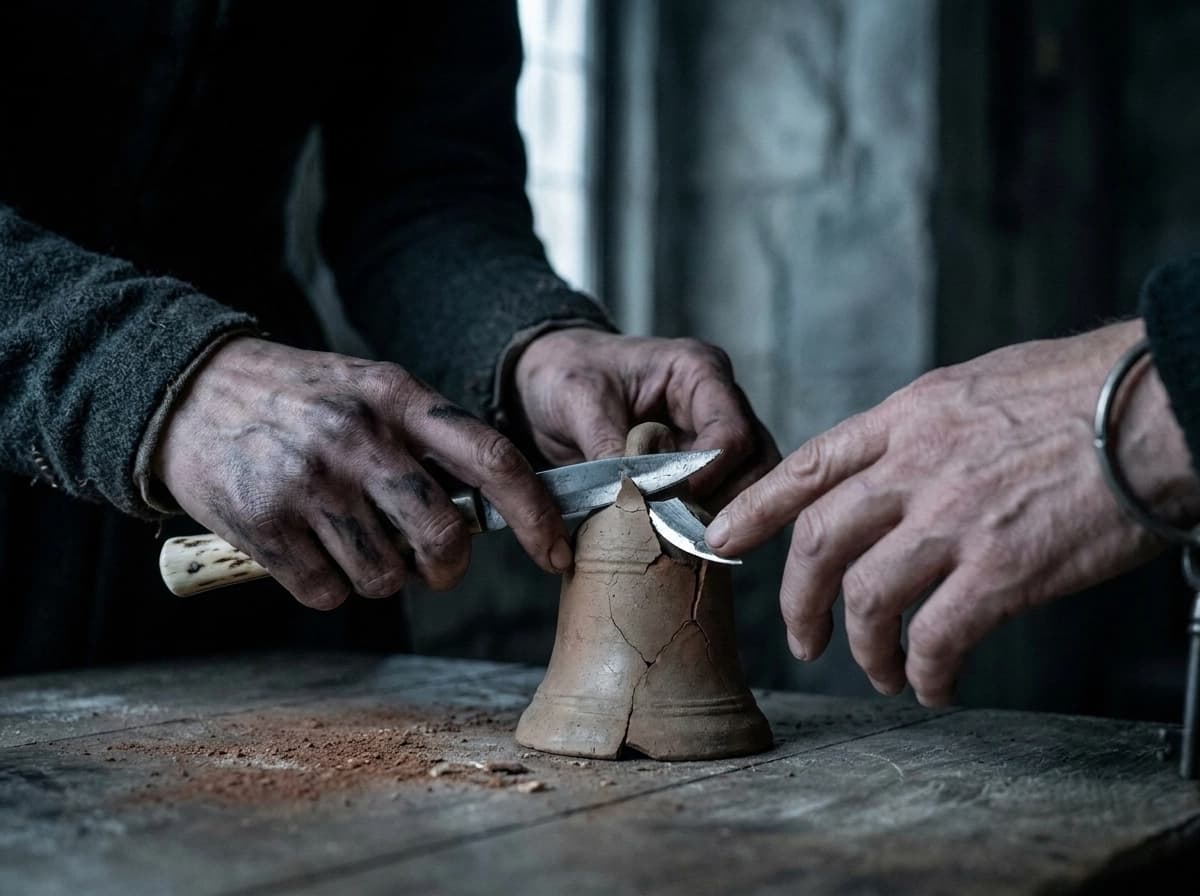
The abbey’s fear has rules. Every corpse must go into the ground with its jaw bound, its mouth packed, and a bell tied to the wrist. Ysabeau begins testing the bells like a craftswoman rather than a penitent. She warms one stolen from the washhouse under her sleeve, scrapes its base with her penknife, and finds silver bright under the red clay. Prior Anselm of Mirepoix catches her at it in the storeroom. Instead of accusing her, he shuts the door with his back, lays the bell on his grain scale, and then leads her by candlelight to the altar after Vespers. He puts her fingers on the cloth-covered edge where silver has been shaved away in tiny patient bites. His exact ledgers and her exact eye answer each other. Someone has been feeding holy metal into the graves.

Aélis de Montvert enters the struggle not as a mourner but as a patron who makes refusal expensive. She pays for linen, physic, and candles from her own purse until the infirmary and graveyard both depend on her. Then she asks, in the graveyard with snow blowing into the open earth, that her brother’s grave be opened before dawn prayers. She says she saw him die on the mule track and will not have his return called a wonder. Anselm resists because exhumation without authority will tear the house apart. Matthieu forbids it outright. Ysabeau sees Aélis kneel by the grave after everyone leaves and straighten the shroud corners with bare hands through the crusted snow. On one finger there is a red clay stain that does not wash away. Pressed hard, Aélis admits only one piece of truth: the bells’ clay comes from her father’s abandoned kiln below the pass, and someone in the abbey has reopened that lower work.

The next dawn another grave has heaved. This time Lucien swears he heard his own name spoken from inside the earth before the brothers hauled the body out. His fear makes him reckless. He leads Ysabeau into the crypt after Compline with a lamp cupped in both hands and shows her what he has been made to do. In the old bell-casting room beyond the Roman cistern stand fresh molds, ash not yet cold, a cracked furnace coaxed back into service, and a row of unfinished clay bells drying on boards. There are also narrow burial niches with mismatched mortar, some old, some newly opened and sealed again. Lucien confesses that Matthieu has sent novices down to move bodies in the night, hammer open niches, and fetch silver shavings hidden in a reliquary chest. He has obeyed because Matthieu promised grain to his sisters in the town below. Then he says the thing he has not dared say: one body they dragged from a niche was not newly dead. It wore a wool shroud years old and still had a bell at its wrist.

Ysabeau’s first theory breaks. The risen dead are not all plague burials disturbed by frost or panic. Some are older bodies drawn back into the traffic of the crypt because Matthieu has run out of safe places to hide what he is doing. The bells are not merely disguises for stolen silver. They are markers. Each weight corresponds to a niche, each niche to a dead patron or prior whose burial gifts were hidden with him when roads failed and wars shifted. Matthieu, blind and pressed by famine, has been mining the abbey’s own dead. The novices open sealed burials, strip silver from old offerings, recast it into bells, and tie the bells to fresh corpses so sacred metal can leave one grave and enter another without any inventory naming the theft. When the graveyard “coughs one back up,” it is often because a body has been exhumed below, shifted, and reburied in haste above to conceal the emptied niche. The wool in the mouths comes from rough handling, not resurrection.

That answer should end the terror, but it makes the house more dangerous. Anselm confronts Matthieu in the chapter house with the shaved altar edge under his fingers and one of the bells on the table between them. Matthieu does not deny the theft. He says the abbey would have been stripped by creditors, villagers, and frightened brothers alike if he had let sanctity sit idle while winter closed. He says dead patrons need no silver. Living men need broth. He says obedience has kept panic from becoming pillage. Anselm answers that once sacred metal is hidden on corpses, every burial becomes suspect and every grave a purse. The argument ends when Matthieu orders Lucien back below that same night to open Aélis’s brother’s niche in the old crypt and move what lies with him before dawn. Aélis hears enough from the passage to understand that her brother’s body has been used. Her composure breaks for the first time. She strikes Matthieu across the face with her bare hand.

From then on the abbey splits into open camps but cannot separate physically; snow and rule keep everyone inside the same walls. Matthieu tightens silence. He has the outer crypt door barred except by his order, and he keeps Ysabeau in his chamber longer each day, making her read old charters and burial donations aloud while his thumb counts against the table. He is listening not to the words but to where her breath catches. Ysabeau starts marking what she learns not in books he can seize but in the abbey itself: a nick on a shelf, soot rubbed on a lintel, tiny cuts in wax drippings near the chapter-house stair. She copies the house into physical signs so that if she is searched, the map remains in place. Lucien, seeing her method, begins leaving hammer marks in the crypt passages to match hers. Together they turn the abbey’s silence into a hidden script.

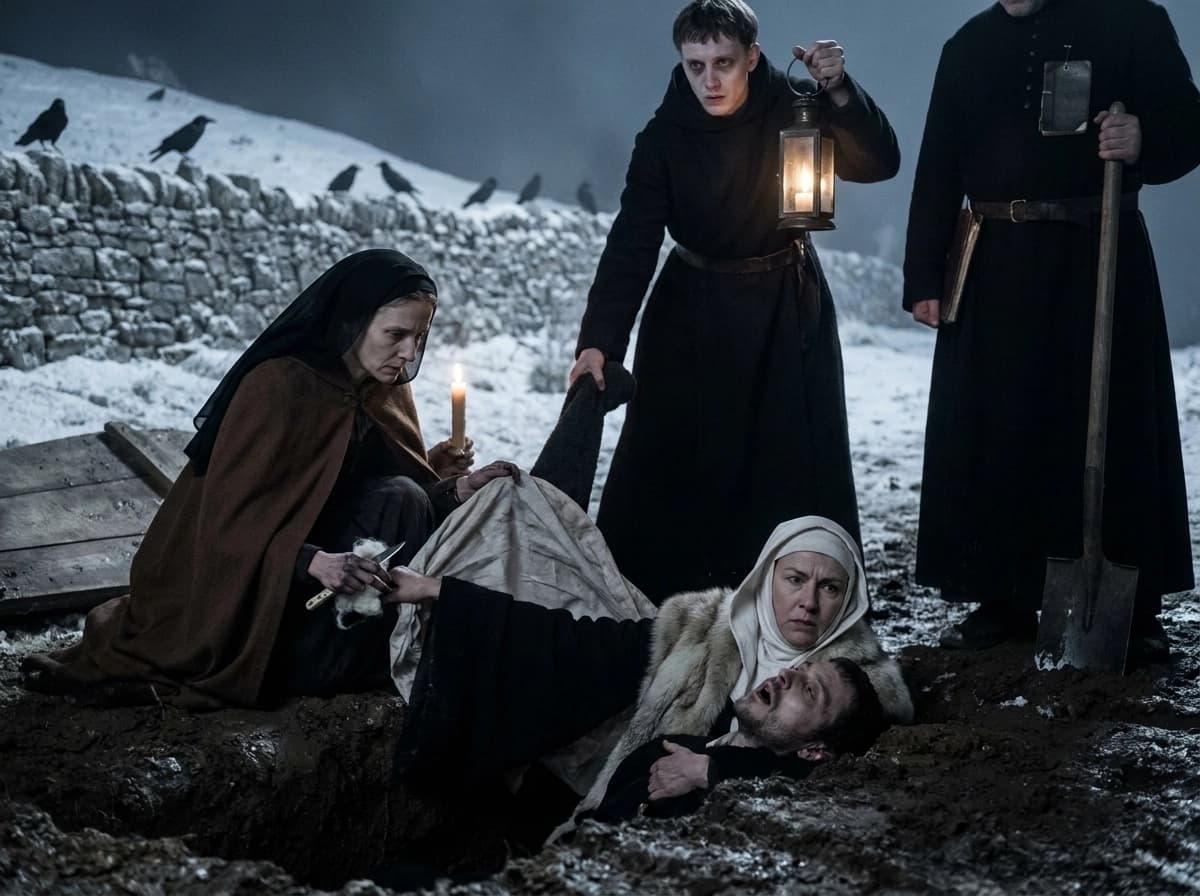
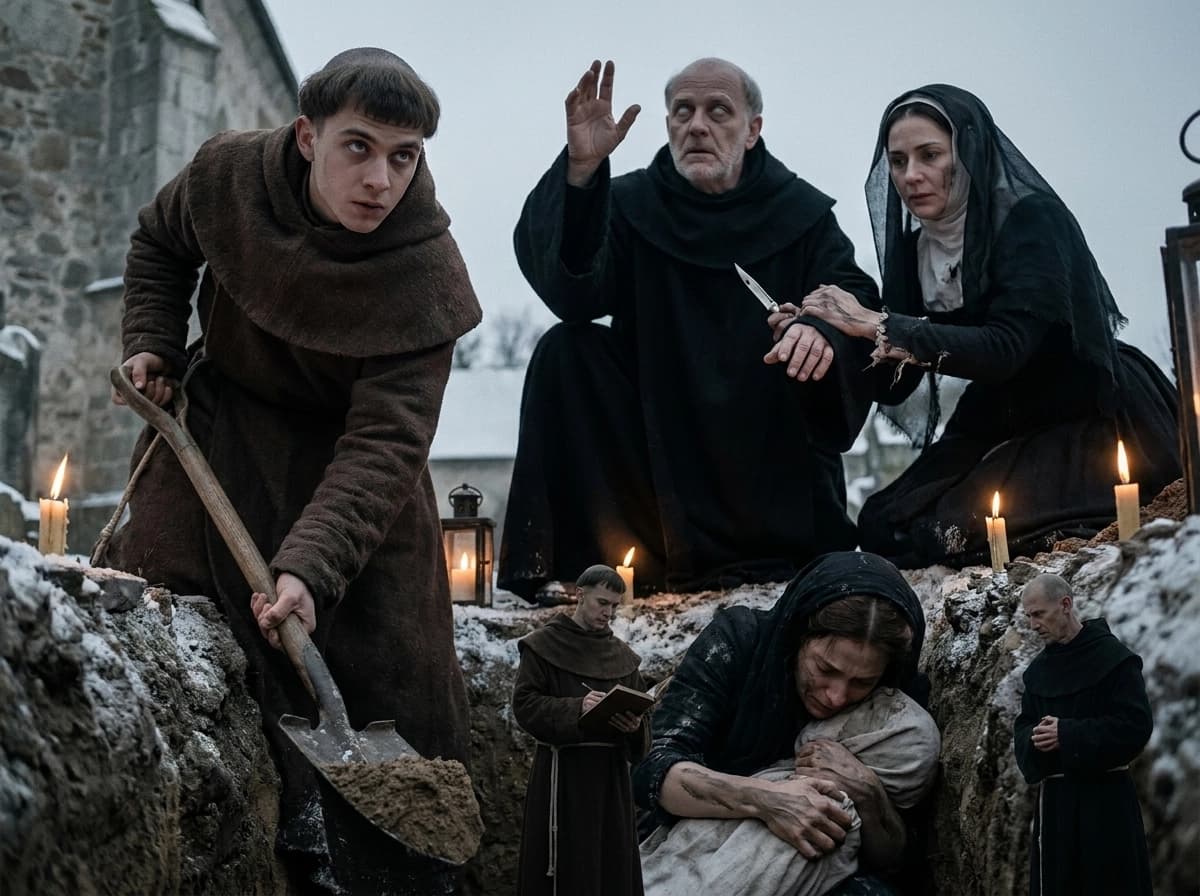
Aélis forces action. She gives Anselm the last of her silver and demands spades, lamp oil, and two witnesses. Before dawn she, Ysabeau, Lucien, and Anselm go to the graveyard and open her brother’s grave in the hard ground while crows shout from the wall. They find the body not miraculous and not whole. The wrist is raw where a bell was tied and retied. The shroud has been replaced. More damning, the mouth is packed not with the coarse burial wool Aélis herself tucked there on the mule track, but with fresh carded wool from the abbey stores. Someone reopened him after burial. Aélis climbs into the grave with her skirts darkening in the slush and cradles the body while Anselm stands over them with the ledger tucked under one arm like a shield. Matthieu arrives led by two remaining brothers, hears the shovel strikes, and orders them all to stand away. No one obeys.

The standoff turns violent not because anyone wants blood but because the house has run out of room for contained lies. Matthieu seizes Lucien’s wrist to drag him from the pit and the novice jerks back so hard he falls against a stone. Ysabeau steps between them. Matthieu, unable to see her, grips her shoulder and mistakes resistance for insolence. She feels how light he has become under the wool, how much of his authority is now carried by others’ fear. She tells him plainly that if another corpse is moved in darkness, she will read the altered burial accounts aloud at Mass. Matthieu answers by ordering her locked in the scriptorium. Anselm does not stop it. His mercy has narrowed into bookkeeping. He wants proof arranged so perfectly that no accusation can be denied. That delay costs them. In the night Lucien is sent below again, this time under guard, to break open the sealed niche of Aélis’s brother in the old crypt and remove what remains hidden there.

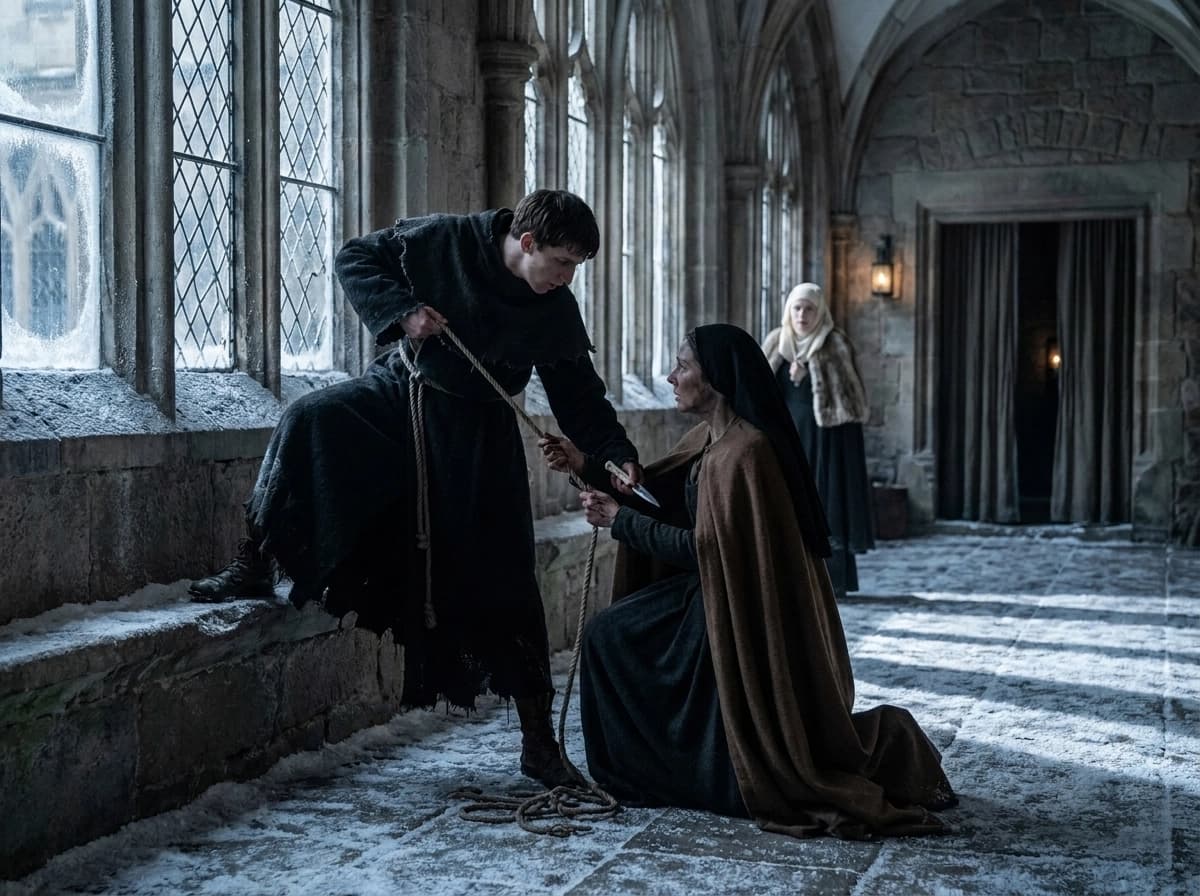
Lucien chooses at last whom to betray. Instead of obeying, he doubles back through the cistern passage and frees Ysabeau from the scriptorium window by lowering her a rope of knotted binding cords. Together they race through the cloister, collect Aélis from the infirmary, and force Anselm to come by pounding on his door until he opens with keys in hand. They go below as a body, not as whisperers, carrying lamps, a pry bar, and one of the heavy grave spades. In the lower crypt they find Matthieu already there, one hand on the wall, the other clamped around Lucien’s abandoned hammer. Two frightened brothers stand with him over a niche broken open to the knees. Inside lies Aélis’s brother and, beneath his shoulders, a wrapped bundle of altar silver, reliquary fittings, and rings taken from older dead. Matthieu had hidden the abbey’s emergency wealth inside the patron burial most protected from suspicion, then shifted the corpse whenever rumor drew near.

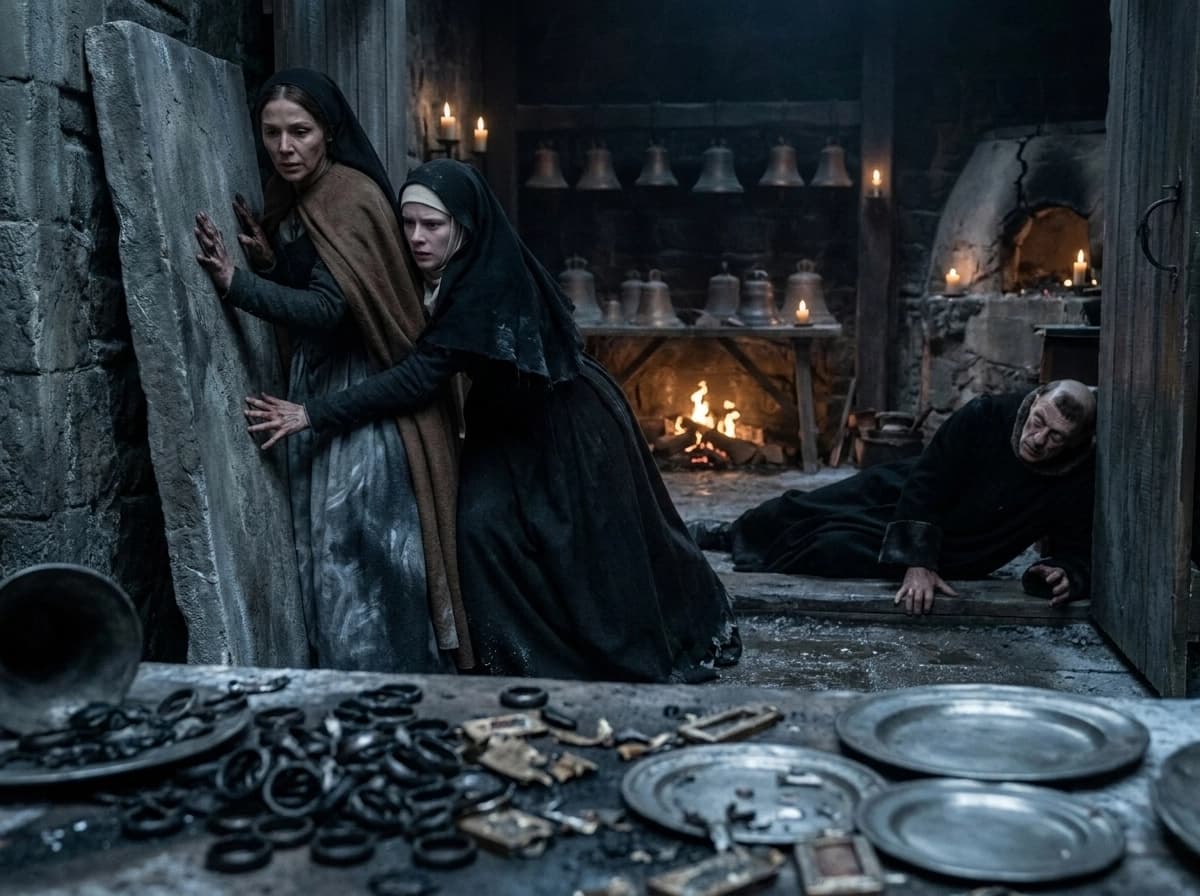
The climax comes in the crush of bodies, smoke, and stone. Aélis lunges for the niche. Matthieu catches her sleeve and nearly tears her back. Anselm grabs the abbot around the chest to pull him off her. One lamp goes over and oil runs fire across the old boards stacked by the furnace. Lucien drags one of the younger brothers clear while Ysabeau climbs into the half-open niche itself to keep anyone from closing it again. Matthieu, blind and coughing, still tries to command the room. He says if the silver is shown, the abbey will be ruined, its lands contested, its poor unfed, its dead desecrated by every claimant in spring. Anselm, choking on smoke, says the ruin has already happened. Then the cracked kiln wall, heated too fast too many nights, gives way. Stones crash down and pin Matthieu’s legs across the threshold of the casting room.

What follows is not a clean judgment but a hard human scramble. Fire pushes smoke low along the ceiling. The younger brothers flee. Aélis can either drag out her brother’s body or help free the man who used it. Lucien can either seize the silver bundle that would feed his sisters or use both hands on the fallen stones. Anselm can either save his ledger from the sparks or leave it to blacken while he hauls at the rubble. Ysabeau, wedged in the niche beside the dead, makes the choice that breaks the pattern for all of them: she throws the silver bundle out into the passage where everyone can see it and then orders them to pull Matthieu free first, because if he dies buried with the hoard, the abbey will make him a martyr and the truth will be sealed under his body. Her command lands because she is the only one not speaking for office, inheritance, or accounts. Lucien obeys first. Aélis, shaking with rage, obeys second. Anselm drops his ledger into slush from an overturned water jar and gets both hands under the stone.

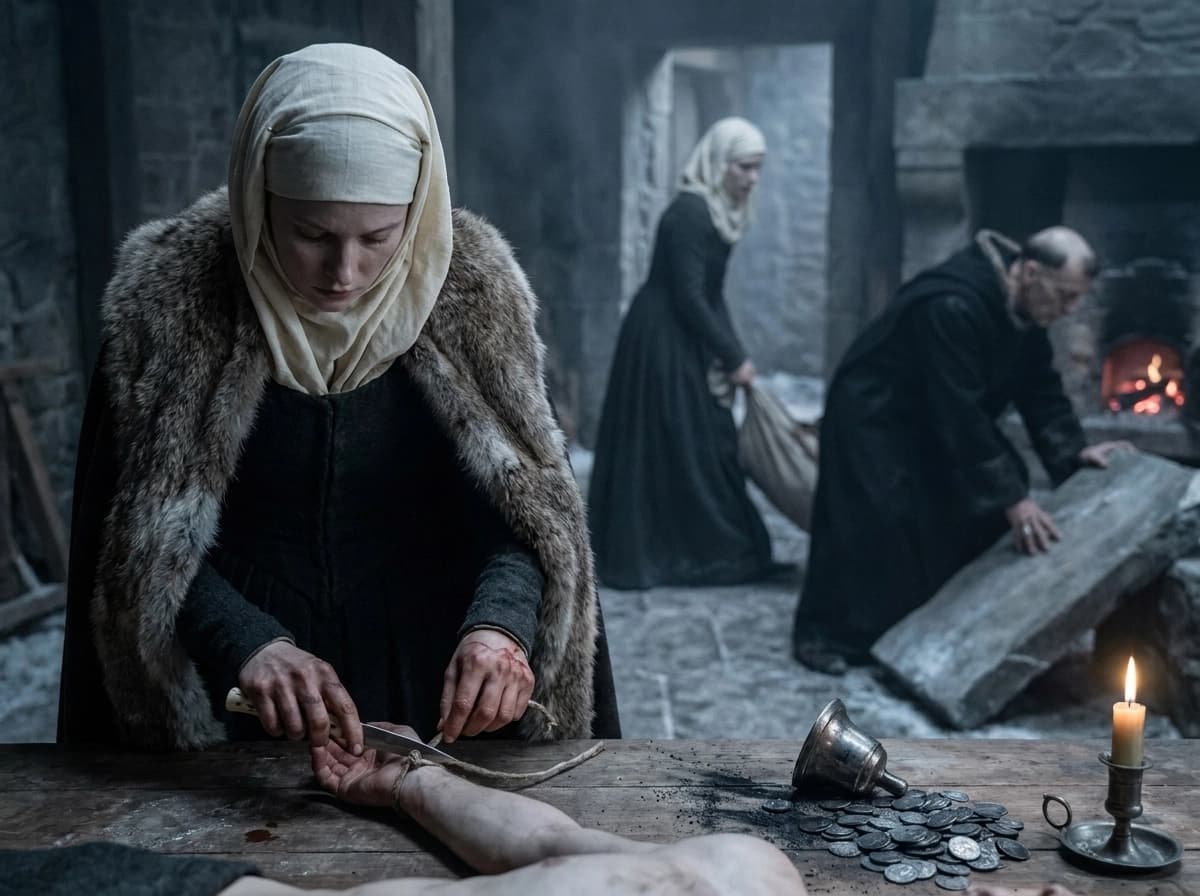
They drag Matthieu clear just before the furnace roof collapses. His legs are crushed. The silver lies in the passage blackened with soot, no longer deniable as bells, alms, or rumor. Aélis kneels by her brother and cuts away the false bindings with Ysabeau’s penknife. Lucien stands over the exposed hoard with the hammer hanging loose in his hand and does not take a single ring. Anselm, wet ledger ruined against his chest, hears the brothers gathering above and understands that memory kept in columns can burn as quickly as kindling. So he does the one thing his whole nature has resisted: he leaves the ruined book and carries the silver itself upstairs in both arms, making the evidence bodily and public.

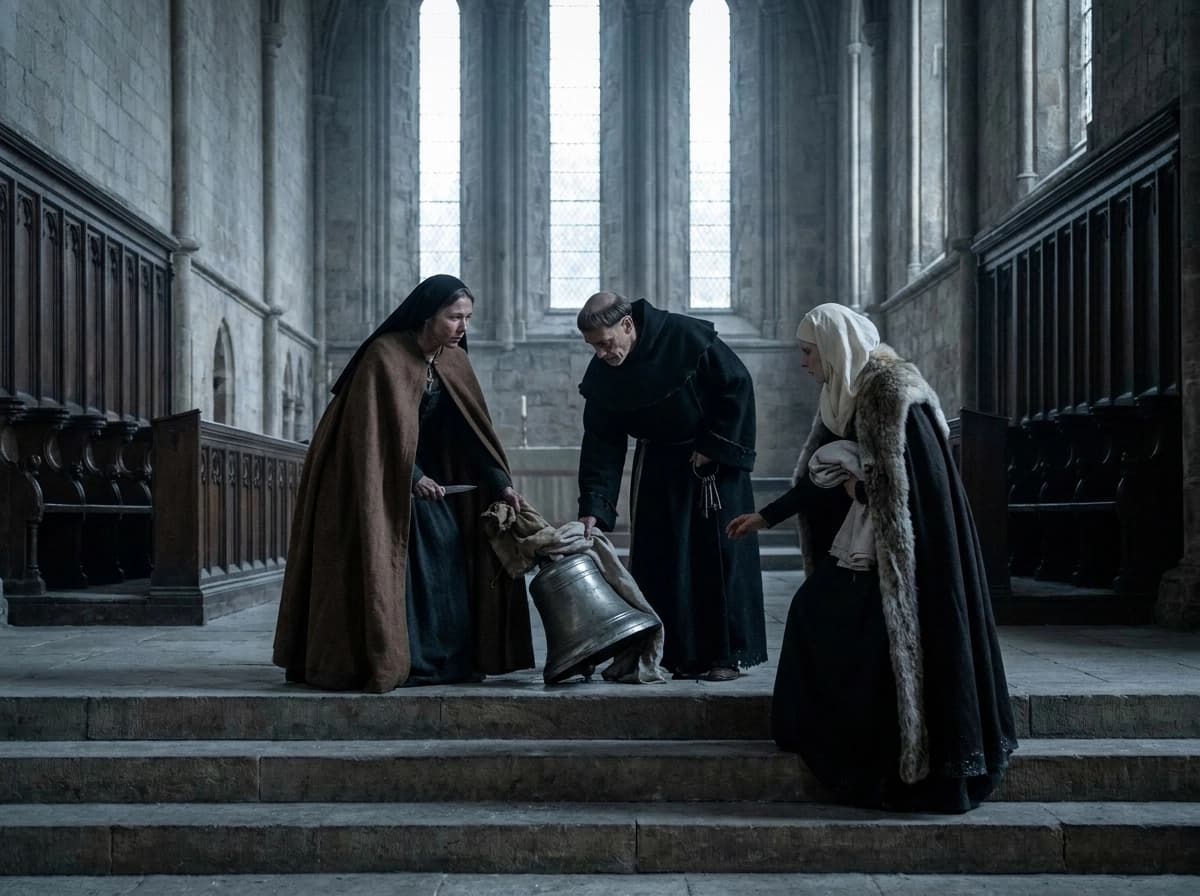
At Lauds, with smoke still in the church and snowlight coming thin through the high windows, the abbey sees what has been hidden. The altar silver, reliquary scraps, patron rings, and clay bells are laid out on the steps before the shaved altar edge. Matthieu, feverish and broken-legged, is brought on a litter and made to hear Ysabeau read not a ledger but the names of the dead whose graves were opened, including Aélis’s brother. She does not accuse him of sorcery or miracle. She names acts: who was moved, what was tied, what was taken, where it was found. In a house built on controlling memory, speaking the sequence aloud before witnesses becomes the one punishment that cannot be buried again. Matthieu does not repent cleanly. He says he would do it again to keep the abbey alive. That answer prevents anyone from turning him into either monster or saint.

When the pass opens weeks later, the abbey is not destroyed, only changed in ways no one can fully master. Matthieu is removed from rule but not cast out; he remains alive, blind, and dependent in the infirmary, forced to hear bells with no power to assign them. Anselm takes temporary charge of stores and burials, but the loss of his ledger cures him of trusting numbers alone; he orders every grave witnessed by two pairs of hands and every bell broken after burial so no metal can travel twice under clay. Aélis funds a stone marker for her brother and for the older unnamed dead disturbed in the crypt, binding her inheritance to exposure rather than silence. Lucien asks release from vows and receives it, but before he leaves he spends three dawns helping Ysabeau reopen the false graves and set each body back where it belongs. They work with numb fingers, in mud and thin light, tying no bells at all until new ones can be made from honest clay.

Ysabeau stays through the thaw long enough to copy a fresh mortuary roll and a plain account of the winter for the house and for herself. She does not write wonders into it. She writes weights, cuts, shroud changes, names, and the day the kiln fell. Then she leaves by the reopened pass with her ink horn thawed under her mantle and the bone-handled penknife at her belt. Behind her, the abbey remains what it always was: a place of prayer, hunger, fear, and human hands. But the graves no longer speak with borrowed silver in their mouths.
世界観 · World

世界

representative image

設定

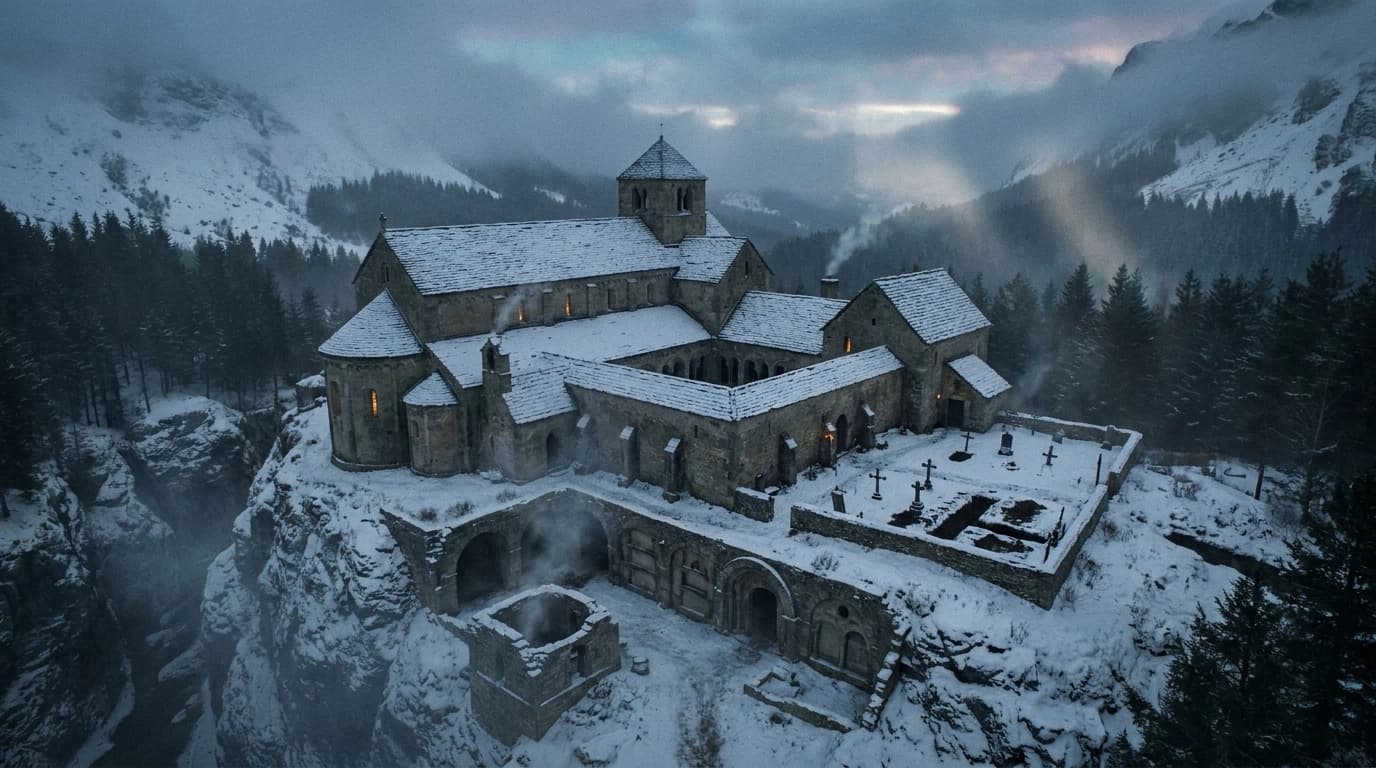
A Benedictine abbey clings to a limestone shoulder high in the mountains of southern France, two days above the last winter market town and one storm away from being cut off entirely. Its church, chapter house, dormitory, infirmary, and kitchens are built around a cramped cloister where meltwater freezes in the gutters and black crows peck at crusts in the snow. Below the main buildings lies an older stratum of the place: a Roman cistern turned crypt, narrow bone-dry passages cut into the rock, sealed burial niches, and a bell-casting room abandoned when the lower kiln cracked and the patron road failed. The graveyard pitches downhill behind a low wall, its earth thin over stone; graves must be hacked deep with iron in summer and opened with picks in winter.

Nothing here is level except the refectory tables. The path to the gate bends along a ravine where pack mules slip. The pass below disappears under snowdrift by evening and may not open again until thaw. Woodsmoke hangs low. Lamp oil is rationed. Ink freezes in the horn unless kept under a sleeve or against the skin. Books mildew at the spine from chapel damp, and wool burial shrouds never quite lose the smell of lye, tallow, and old sickness.

The abbey survives by storing grain, copying charters, tending a few relics important enough to draw gifts in better years, and policing the memory of what belongs to whom. In this winter, after a week of sudden deaths and the abbot's blindness, every room has become contested ground: the scriptorium for records, the infirmary for bodies, the crypt for secrets, the altar for silver, and the graveyard for proof.

時代

Winter of 1348, during the first great pestilence moving through Europe, at the moment when older religious certainty is beginning to crack under mass death but before that crack can be spoken aloud safely. Snow has sealed the mountain pass early. Half the abbey's brothers have died within a single week.

The living are trying to preserve liturgy, property, and order while disease, hunger, and fear strip those things down to their raw function.

ルール

The mountain keeps what weather closes: once the pass is sealed by snow, no one leaves or arrives without risking death, so every lie, accusation, and burial must be settled among the trapped. This turns the abbey into a pressure vessel where Ysabeau cannot escape uncertainty and Matthieu can rule by confinement as much as by office.

Any body buried from the abbey grounds must go into the earth with a bell tied to the wrist and the mouth packed and bound, because the house believes disturbed dead return first by sound and by teeth. The practice gives cover to fear and to tampering: a bell can mark a grave, track a body, or hide stolen silver in plain sight, while any failure to bind the dead becomes a moral accusation against whoever prepared the corpse.

No sacred metal may be openly melted or sold without inviting scandal, so stolen altar silver must be disguised inside useful objects made for piety or burial. This makes the little bells both devotional tools and evidence, binding theft, ritual, and corpse-handling into the same object and forcing characters like Ysabeau and Anselm to read craftsmanship as testimony.

The crypt may only be entered after Compline by direct order of the abbot or prior, and those who go below are expected to speak of nothing they saw until summoned. Silence protects the abbey's authority, but it also isolates boys like Lucien, lets violence pass as obedience, and makes every night errand a test of whether faith, fear, or hunger governs a person more completely.

技術と哲学

This world runs on hand labor, memory, and sanctioned ritual. Writing is power because parchment inventories, burial records, charters, and liturgical books decide land, obedience, and legitimacy when witnesses die. An illuminator's eye can detect what scales miss: shaved edges, altered initials, substitutions in metal and text. That gives Ysabeau unusual leverage in a house that would otherwise reduce her to service.

Bell-casting, bookmaking, burial preparation, and food storage are the abbey's crucial technologies. Clay molds, charcoal furnaces, lamp wicks, wax seals, wool shrouds, herb simples, and iron grave tools matter more than swords. The lower kiln, tied to an abandoned patron estate below the pass, makes craft knowledge politically dangerous: whoever knows where the clay comes from also knows the bells are not innocent objects.

The governing philosophy is Benedictine order under siege—obedience, silence, and stability treated not as virtues freely chosen but as barricades against collapse. Yet plague has bent those ideals into harsher forms. Confession becomes surveillance. Burial becomes crisis management. Charity is rationed through ledgers. Relics and altar plate are both holy matter and emergency reserves. The abbey teaches that disorder invites damnation, but daily practice shows that authority will break sacred things to preserve itself.

Alongside official doctrine runs a more physical mountain belief shared by servants, novices, and nearby villagers: the dead are dangerous when burial is incomplete, when names are mishandled, or when metal meant for God is fastened to flesh. This is not treated as abstract superstition but as practical caution—tie the wrist, bind the jaw, weigh the bell, watch the grave at dawn. In such a world, piety and forensic attention become nearly the same habit.

視覚的描写

The world is all cold mineral tones bruised by candlelight: chalk white snow, soot black wool, damp brown wood, old silver gone gray at the edges, and the red-brown of fresh clay under fingernails. Light is weak by day and treacherous by night. Dawn comes as a thin pewter wash over the graveyard stones. Indoors, beeswax candles and smoking oil lamps carve faces into sharp planes and leave doorways full of moving dark. Frost feathers the inside of leaded panes. Breath shows in chapel aisles.

The abbey architecture is squat, Romanesque, and defensive rather than graceful: thick walls, rounded arches, narrow windows, low vaults that trap incense and coughs together. Water stains creep down plaster. The altar cloth is clean but the silver beneath it has been shaved unevenly. The crypt below is visually distinct from the church above—older stone, lower ceilings, rough-cut passages sweating cold, niches sealed with mismatched mortar, and a floor worn slick by generations of feet and dripping mineral water.

The graveyard is the setting's signature image: tilted crosses, crusted snow, raw opened earth steaming faintly in morning cold, and small bells crusted with clay against dead wrists. The mountain beyond is not sublime but obstructive, a wall of white and dark fir trunks hemming the abbey in. Everything looks used too hard and cleaned too often.


場所 · Locations

舞台となる場所

location 1 image

The Split Grave

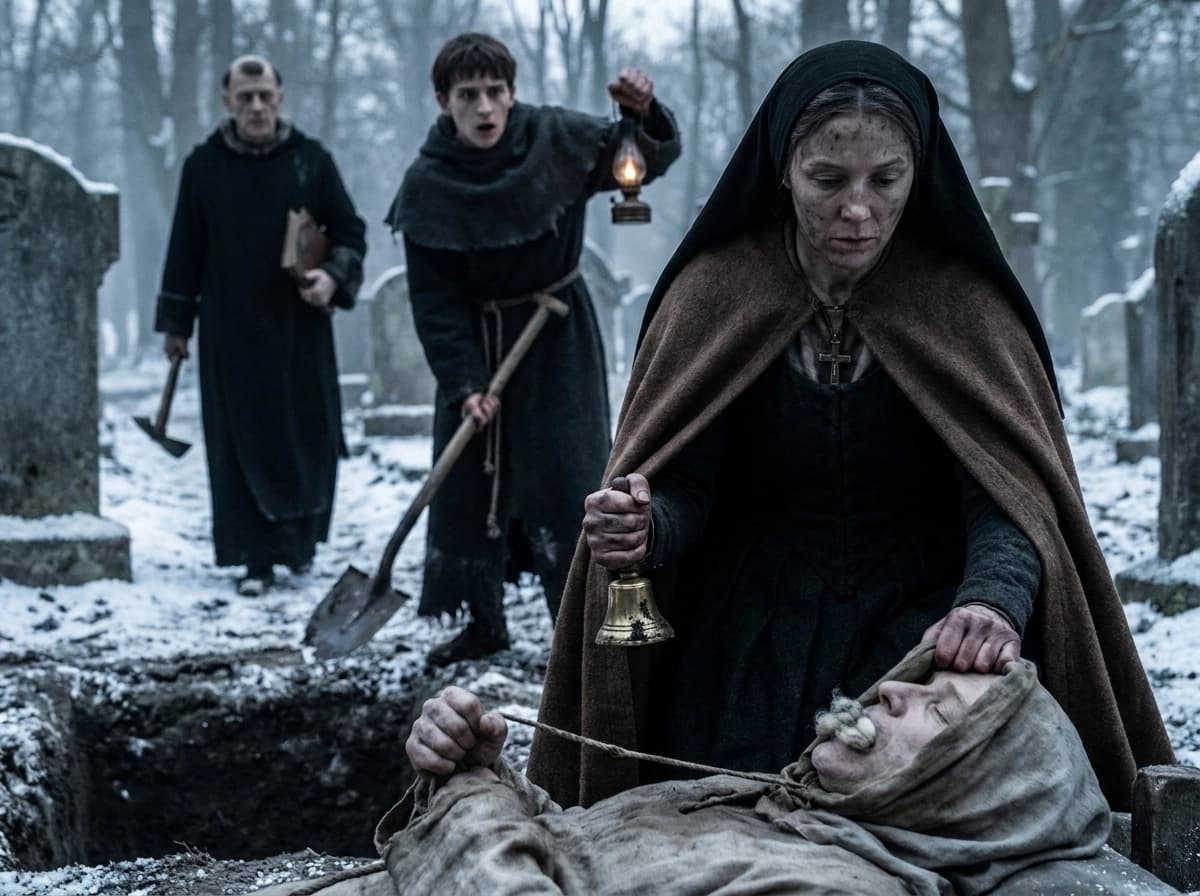
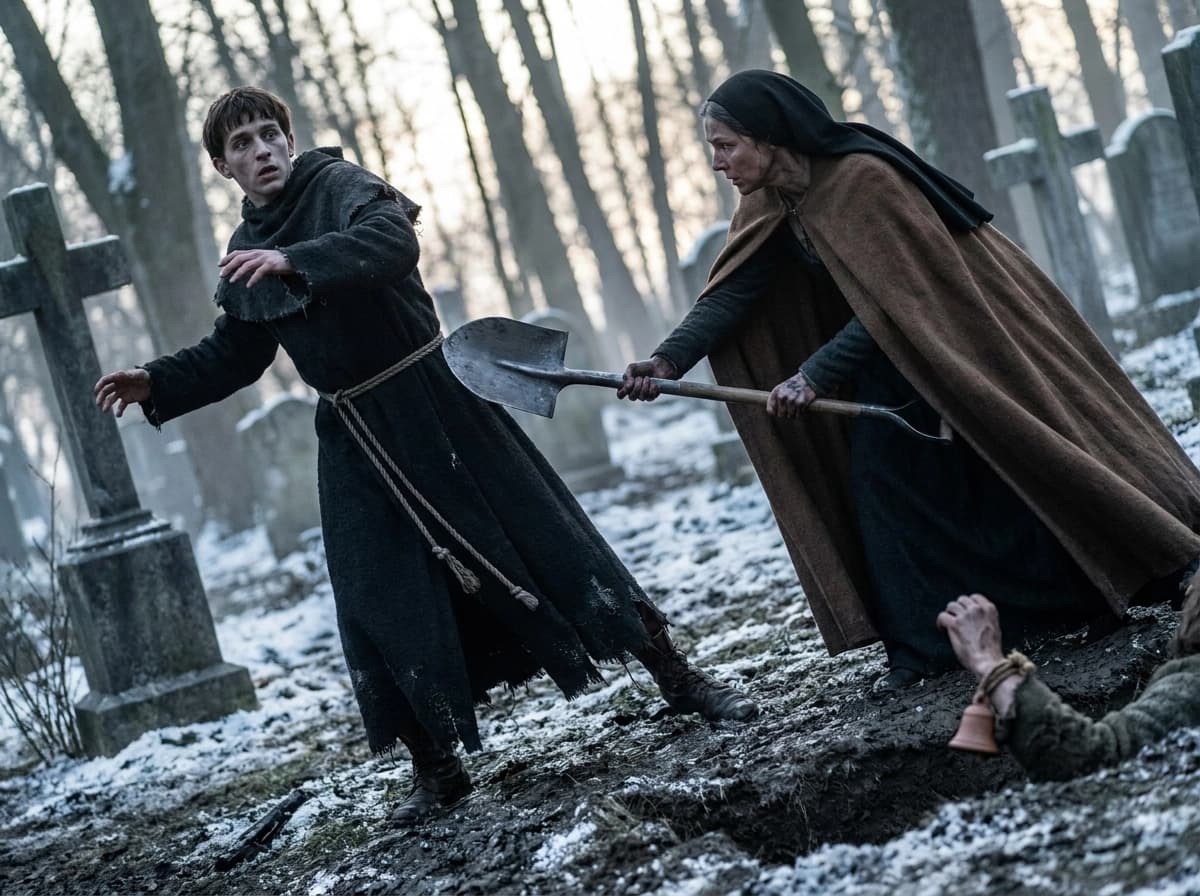
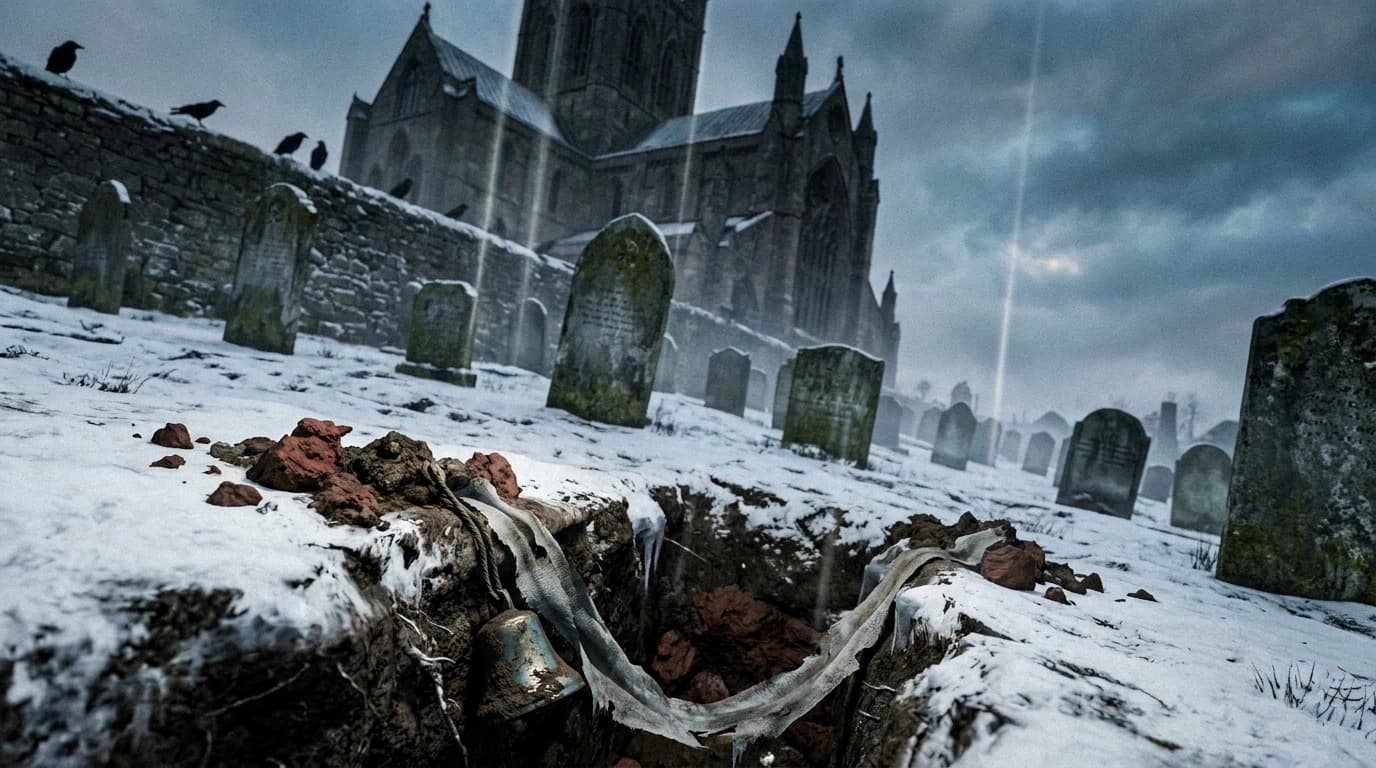
The graveyard falls away behind the abbey in a crooked white slope, its stones leaning at different angles as if the hill has been trying to shrug them off for years; near the low wall, one fresh burial has opened along a dark seam, crusted snow broken inward and a wedge of raw earth pushed up like meat under torn cloth.

Dawn gives everything the same thin pewter skin, but the split place shows its true colors—black soil, red-brown clay smears, wool shroud pulled tight over the face beneath—and from that open edge hangs the small wrist bell, dull with mud, heavy enough to drag the cord straight.

Crows bark from the wall and hop closer between shovel blows, never quite startled away, while each strike into the frozen ground answers with a hard iron crack that carries down the slope and back from the stone. A strip of burial linen has frozen into the lip of the grave and snaps in the wind like a little white tongue.

location 2 image

The Abbot's Warm Chamber

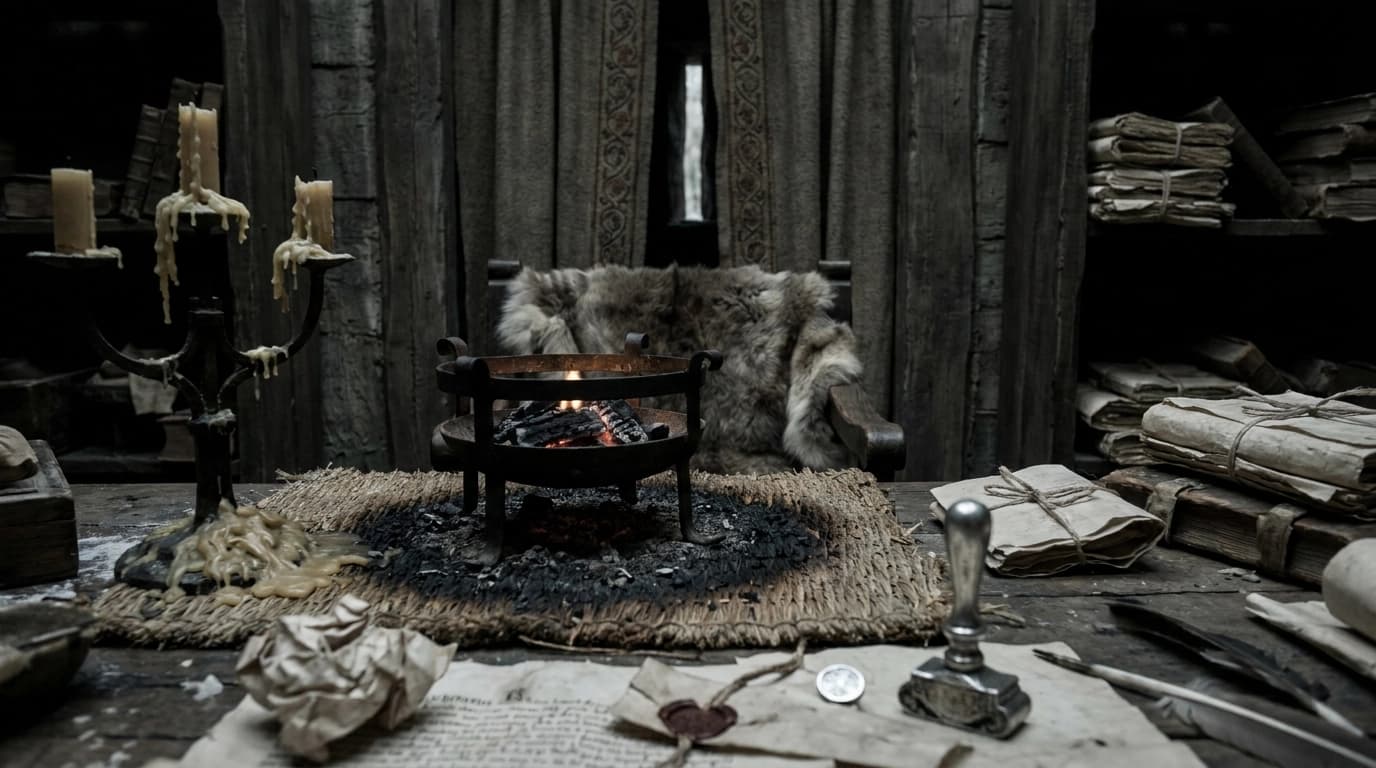
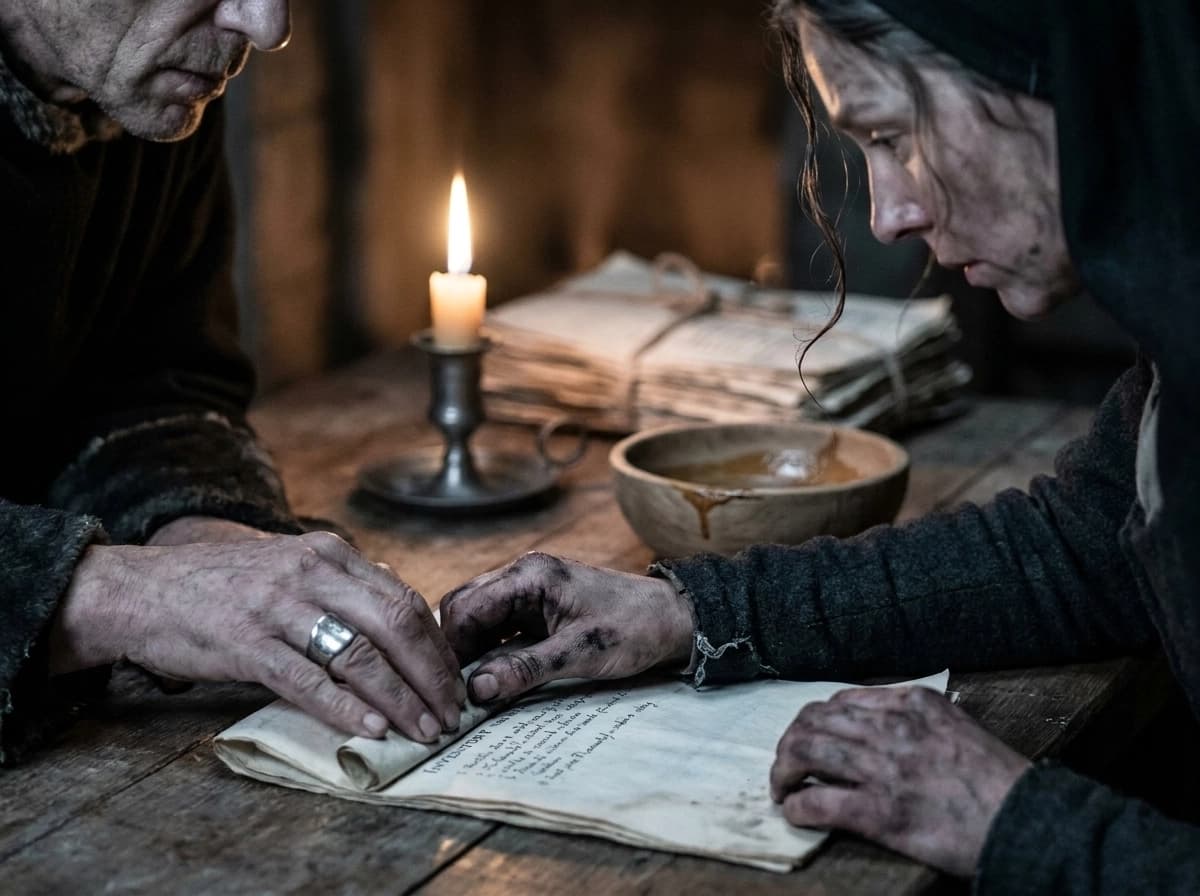
Amber candlelight gathers low in this cramped upper chamber and sticks to everything it touches: beeswax pooled thick on a three-branched stick, dry parchment stacked in tied bundles by the bed, a fur thrown over the abbot’s chair, and a brazier that has scorched the rush mat black in one careful circle.

The room sounds small enough to measure by ear—page edges rasping under cold-stiff fingers, a low voice close to the wall, and, between them, the soft repeated tap of a thumb against the table where charters, inventories, and a silver seal press lie within reach but never quite in order.

Wool hangings have been pinned over the narrow window to keep out the mountain draft, so the heat feels hoarded rather than generous, carrying the close smell of warm tallow, singed cloth, and old vellum while every shelf and chest makes plain why power sits here now that sight does not.

location 3 image

The Grain Storeroom

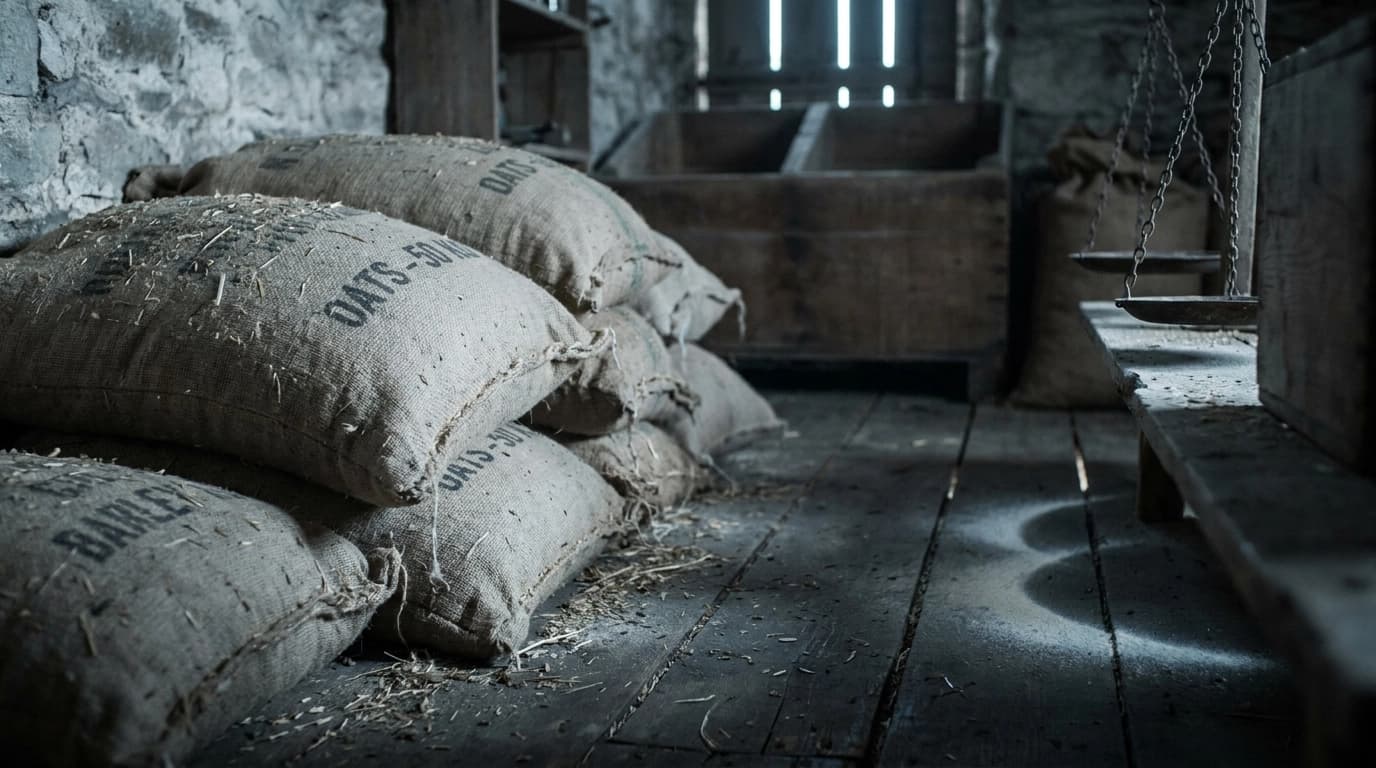
Sacks of oats and barley hump the walls in uneven tiers, their burlap skins rubbed shiny at the corners where hands have dragged them for years, and the narrow aisle between them is striped with weak lamplight that catches chaff drifting above worn boards.

Every movement speaks here in small hard sounds—the scrape of a sack heel, the dry spill of grain through a split seam into waiting bins, the fine clink of scale chains settling after a measure has been judged.

Dust has gathered in the cracks around the threshold and under the ledger shelf in pale crescent ridges, but the center planks are scoured bare by traffic, making the room feel less like storage than a place where hunger is counted, hidden, and argued over one weighed handful at a time.

location 4 image

Montvert Kiln Below the Pass

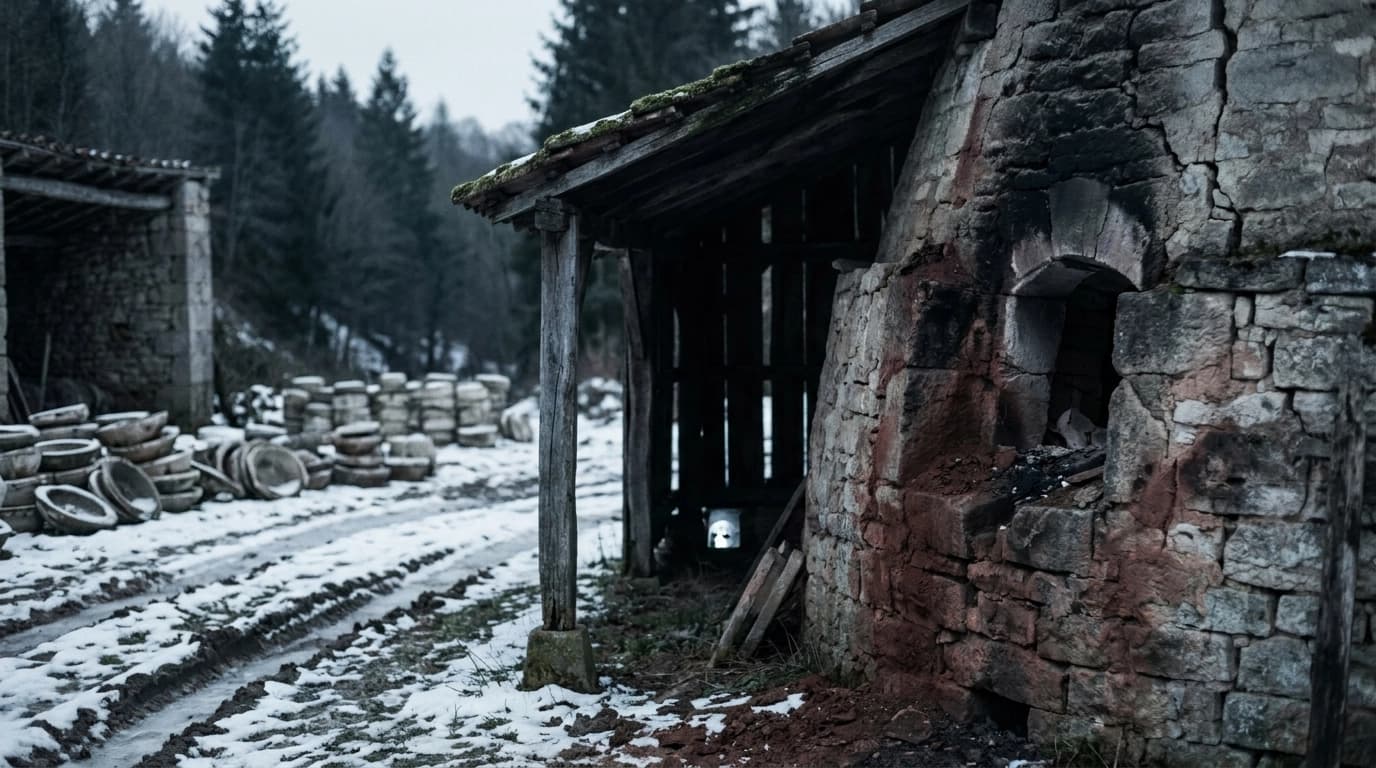
The kiln yard lies in a roadside hollow scooped out of white glare and dark fir shadow, its broken firing mouth split wide under a lean-to roof that has half-slid off its posts and left the clay floor striped with snow.

Red earth shows everywhere the winter cannot clean it—smeared up the kiln’s cracked flank, pressed into frozen mule ruts, baked into the rims of discarded molds stacked like bowls with their lips chipped through.

When the wind comes up the ravine, it brings the thin clack of old harness rings from the cart shed and runs through the shattered flues with a hollow note that sounds too small for a bell and too clear to ignore.

location 5 image

The Bell-Casting Room

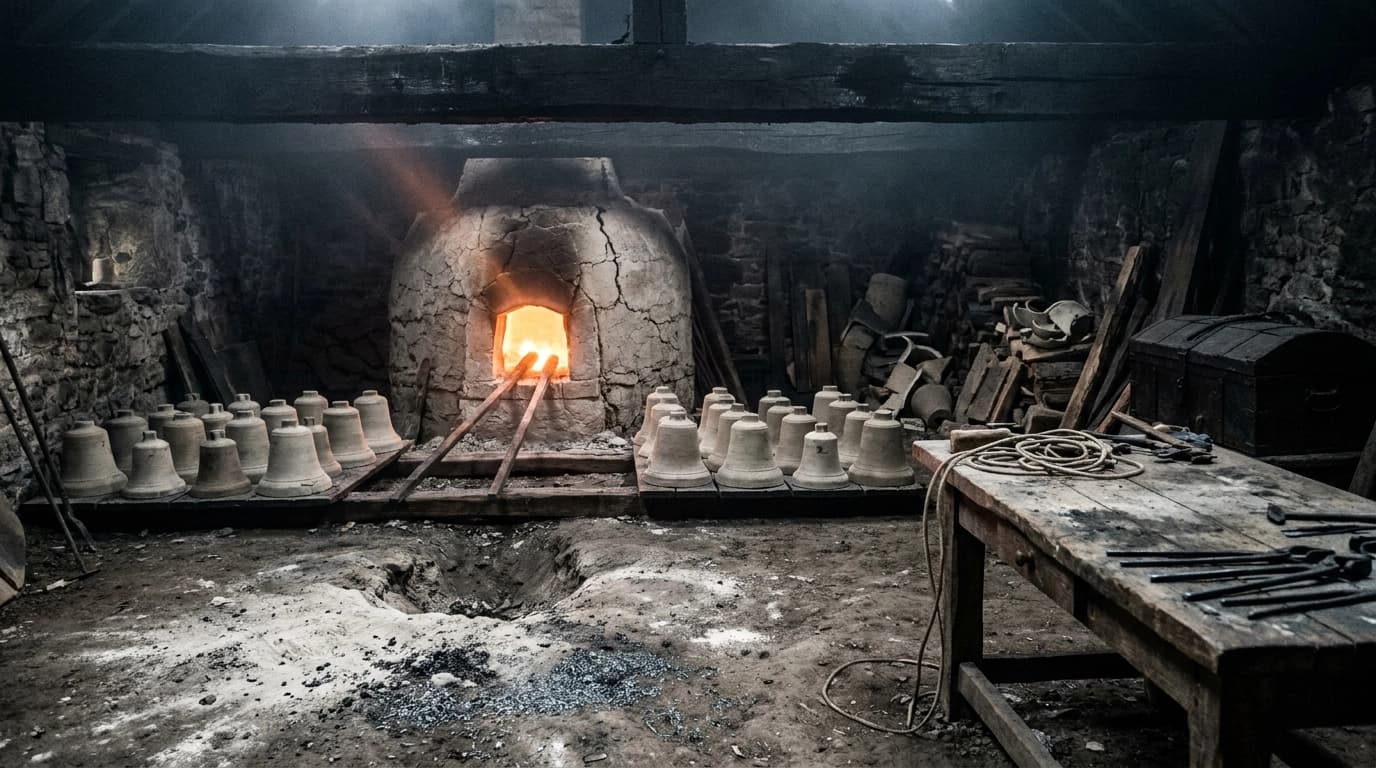
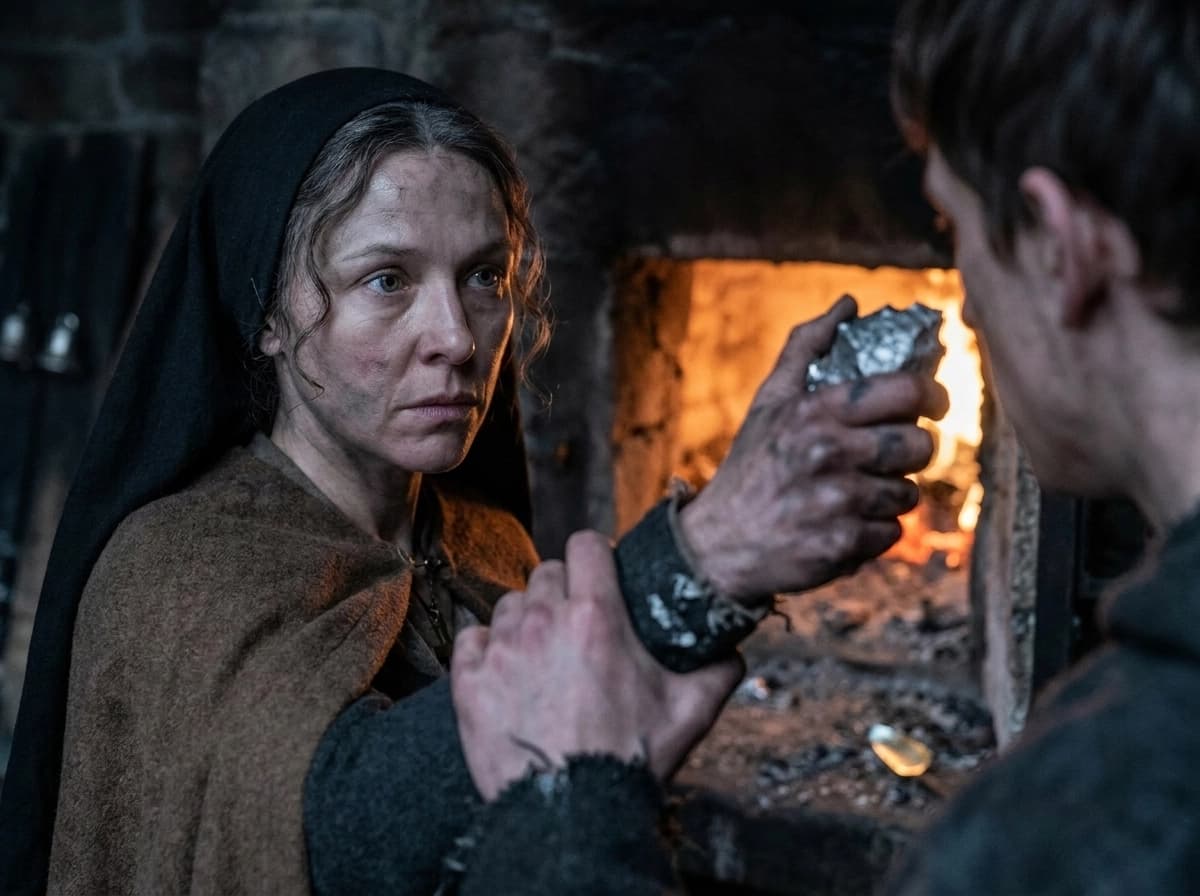
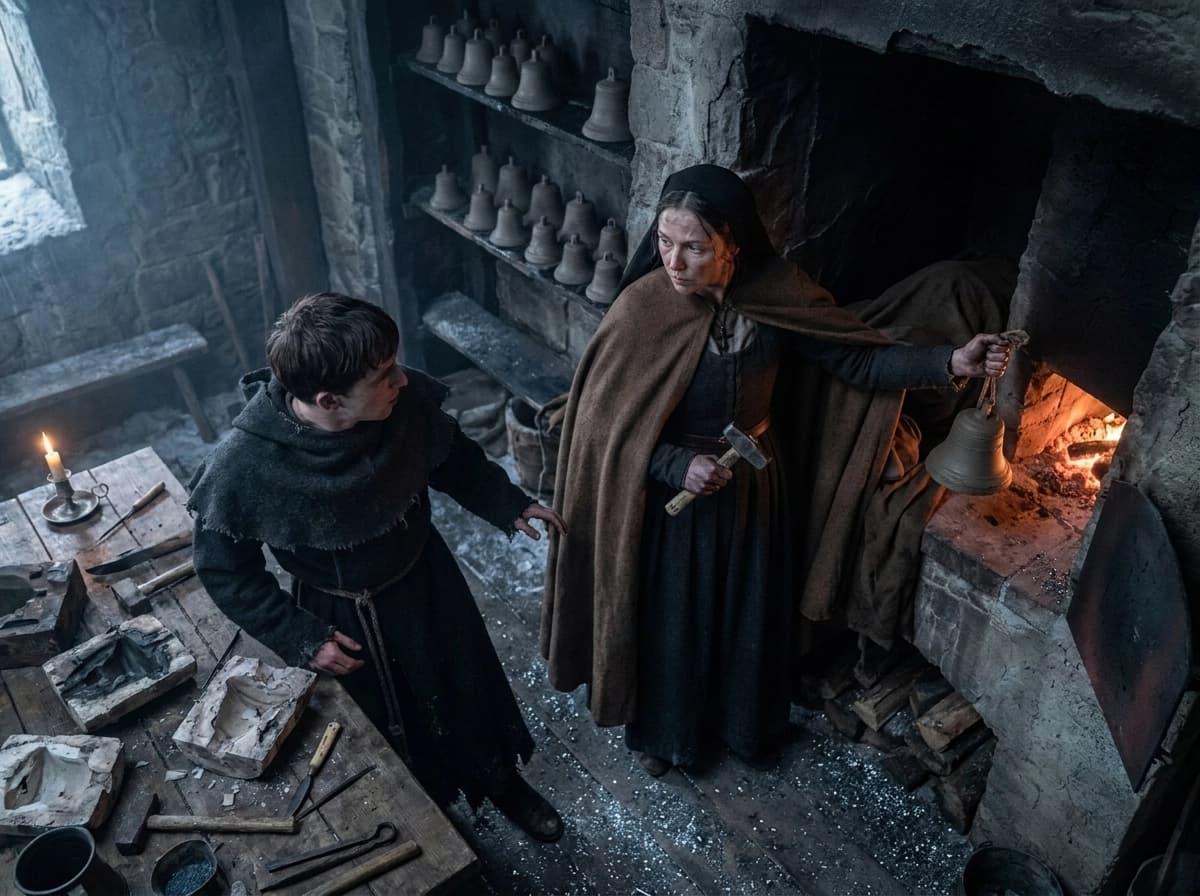
Fresh clay bells stand in rows on blackened boards, their damp red skins turning dull where furnace heat reaches them, while the cracked kiln throws a hard orange pulse across soot-slick walls and low beams smoked nearly to pitch. Every sound stays trapped and comes back wrong here: water ticking from the ceiling into a stone trough, the kiln shell clicking as it cools and swells, breath catching in smoke above a scatter of iron tongs, mold halves, and grit that shines underfoot like ground bone.

The floor is worn hollow before the furnace mouth and dusted with clay powder, ash, and bright filings too pale to be honest, and the worktable bears thumb-smears, cut cords, and a knife groove where someone has pared soft metal in haste. At the back, beyond the heat, the dark presses close around stacked fuel, broken mold rims, and a reliquary chest dragged where no chest meant for prayer should ever stand.

location 6 image

Aélis's Infirmary Alcove

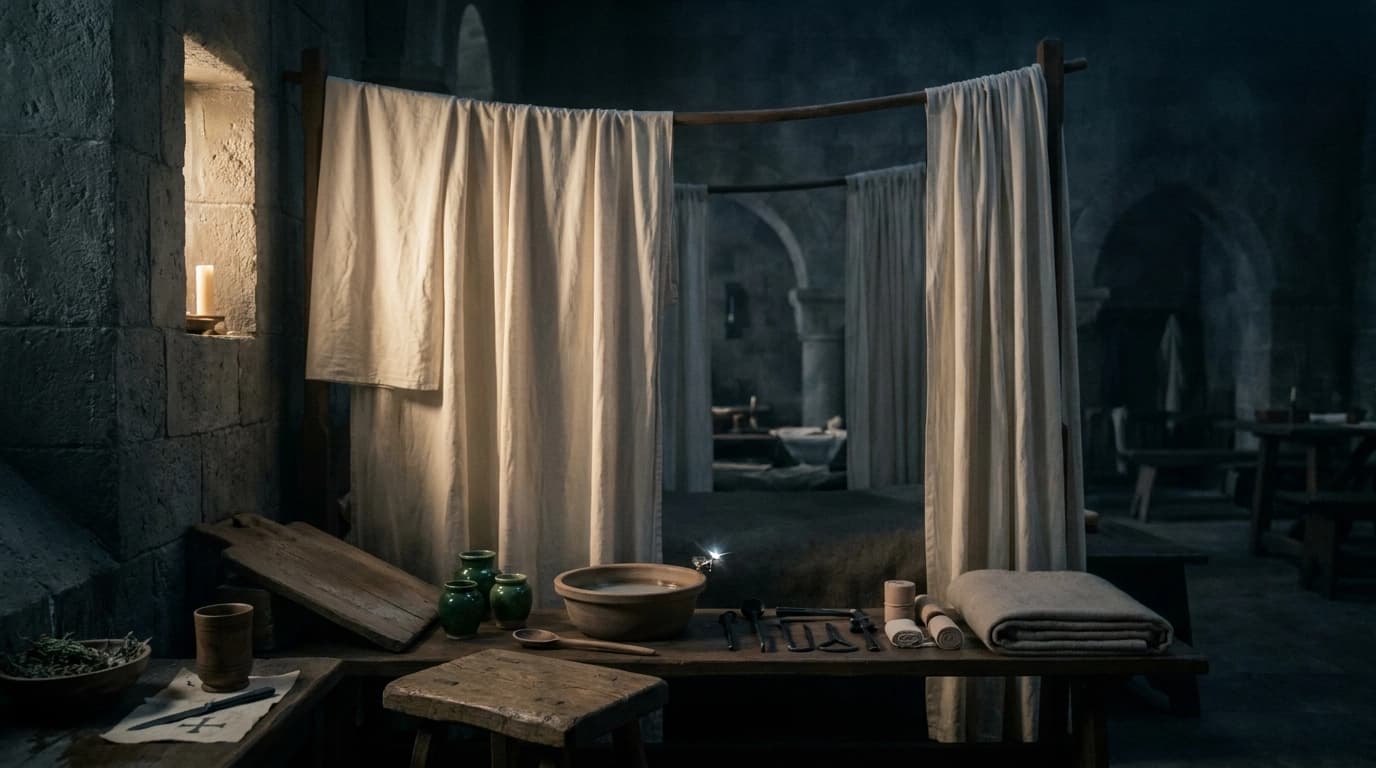
White linen hangs from a bent ash pole to make this narrow alcove inside the infirmary, and the cloth is so often boiled and rehung that it falls stiff in some places and soft in others, breathing faintly each time someone passes or coughs behind it. A low lamp set in a wall niche turns the linen cream at the folds and lays a gentle shine across the smooth oak stool, the scrubbed bedboard, the glazed green jars of comfrey and rosemary, and the shallow basin where water clouds pink, then clears, then clouds again under a rinsed cloth.

Everything here has been arranged by a hand that cannot afford waste: bandages rolled tight as coins, folded blankets stacked with their edges matched, a spoon, a salve knife, a prayer strip pinned flat beneath a wooden cup so it will not curl in the damp warmth of steeped herbs. The place holds care and scrutiny in the same small measure; from the bed one can hear every muffled cough in the room beyond, every dip of cloth into basin water, and the dry whisper of linen drawn closed when pain, grief, or a private bargain needs a wall no thicker than fabric.

location 7 image

The Shaved Altar Steps

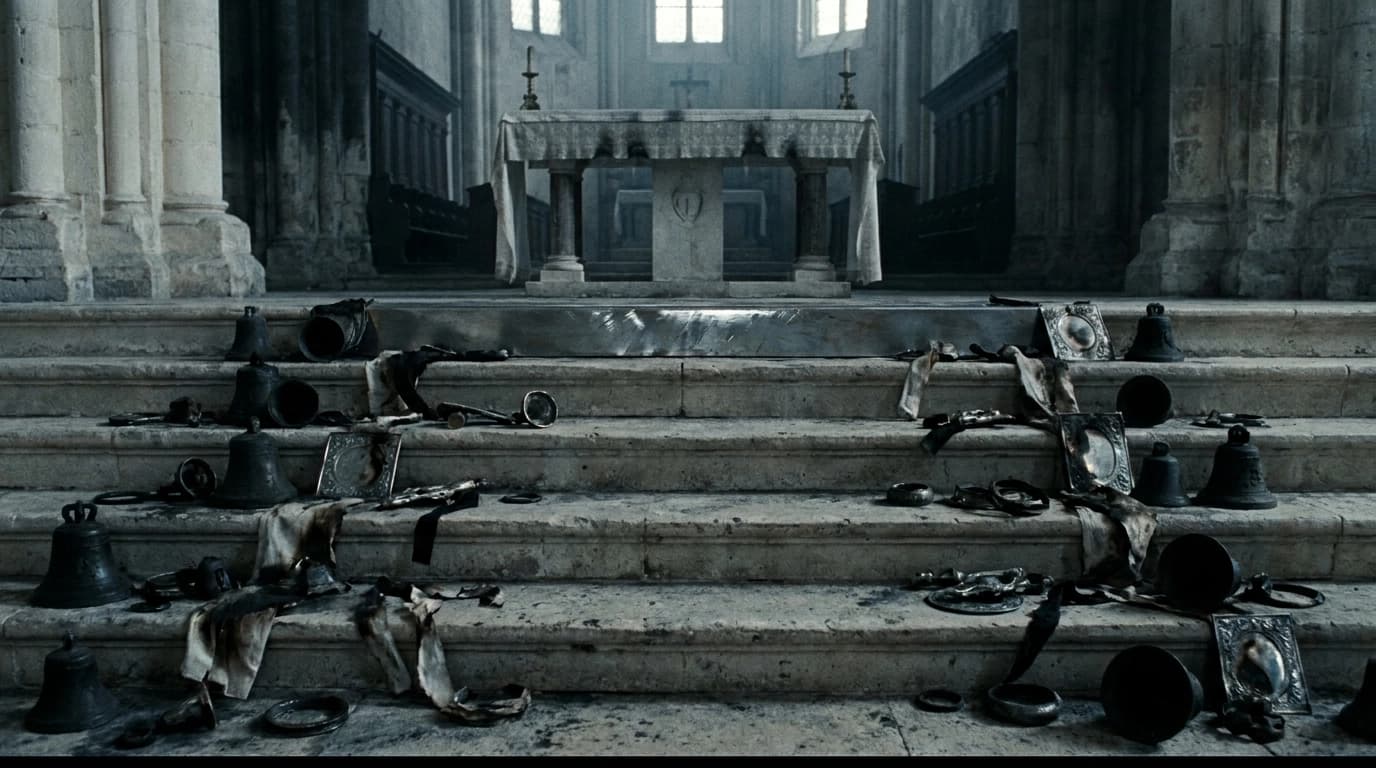
Broad stone steps lift the altar just above the nave, their front edges worn hollow by generations of knees and feet, and this morning every tread is crowded with what should never have lain there together: blackened clay bells, warped reliquary fittings, rings filmed with soot, and strips of singed altar cloth stuck to dull silver that catches the smoke-gray daylight like a bruise.

The cloth over the altar hangs straight, but beneath it the metal lip shows tiny patient bites where it has been pared away, each score bright enough to answer the objects below.

Sound carries strangely here—distant bells from the tower, the packed breathing of brothers in the cold church, and one human voice speaking names into the open space while the stone throws each name back flat and public.


場面 · Scenes

場面ごとの物語

チャプター 01

シーン 01· Dawn, immediately after Ysabeau’s arrival at the abbey

The Grave Split at Dawn

The Grave Split at Dawn
場所The Split Grave
時間Dawn, immediately after Ysabeau’s arrival at the abbey
出来事Lucien Varet hacks at the frozen edge of a fresh grave while holding his lamp too close to the open seam, and Ysabeau de Falaise, not yet warmed from the journey, drops to her knees beside him and pulls back the shroud from the dead man’s mouth. She finds the teeth packed with burial wool and, when the body shifts in the broken earth, catches sight of the clay bell tied at the wrist and sees how its weight drags the cord straight. Anselm of Mirepoix tries to force the work into order, ordering Lucien to get the body covered and the grave closed before the abbey gathers, but Ysabeau stops his hand long enough to look. In that brief struggle over the corpse, she establishes herself as someone who will treat the dead as proof, not only as pious burden.
影響The scene gives Ysabeau her first direct contact with the abbey’s burial fear and shows her the practical rule that every body must be bound, packed, and belled. It also places Lucien and Anselm in active opposition around her at once: Lucien frightened and half-frozen into obedience, Anselm exact and impatient with disorder. Most importantly, Ysabeau sees one material wrong thing before she knows any of the abbey’s politics—the bell looks and hangs too heavy for clay—which plants the chapter’s central suspicion inside a physical object she can later test.

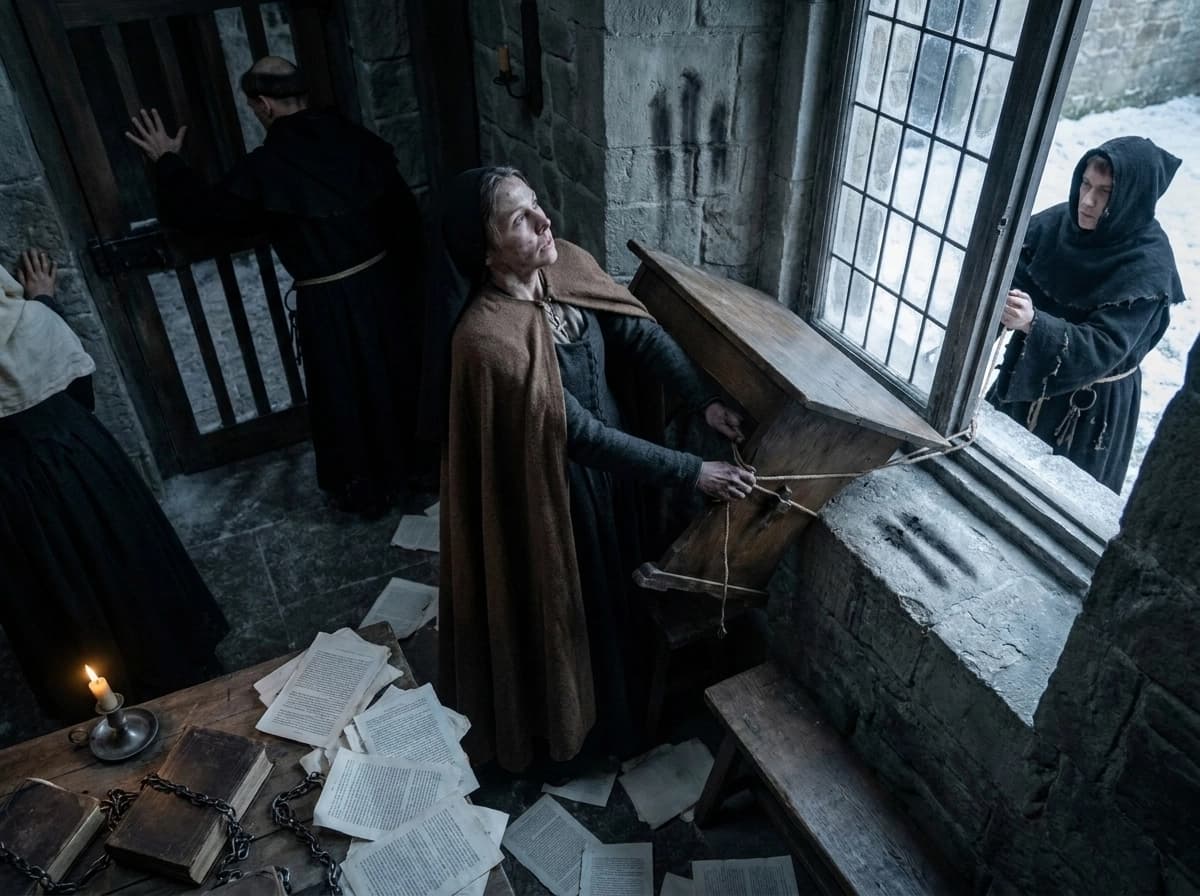
Lucien Varet drove his shovel into the black seam of the grave and the crusted snow broke inward with a hard crack, opening the fresh earth another hand’s width while his lamp shook above it. Ysabeau de Falaise came down the slope in the same travel mantle she had worn through the pass, stumbled once on a tilted stone, and went straight to her knees beside the split place before anyone could stop her. The grave had opened along one side as if the hill had bitten and spat it back; wool shroud was dragged tight across the dead man’s face, and a strip of burial linen snapped from the lip of the pit in the wind. “Don’t touch him,” Lucien said too quickly, but he did not reach to stop her. His free hand held a little bell by its cord and then let it fall again against the corpse’s wrist, as if even lifting it had frightened him.

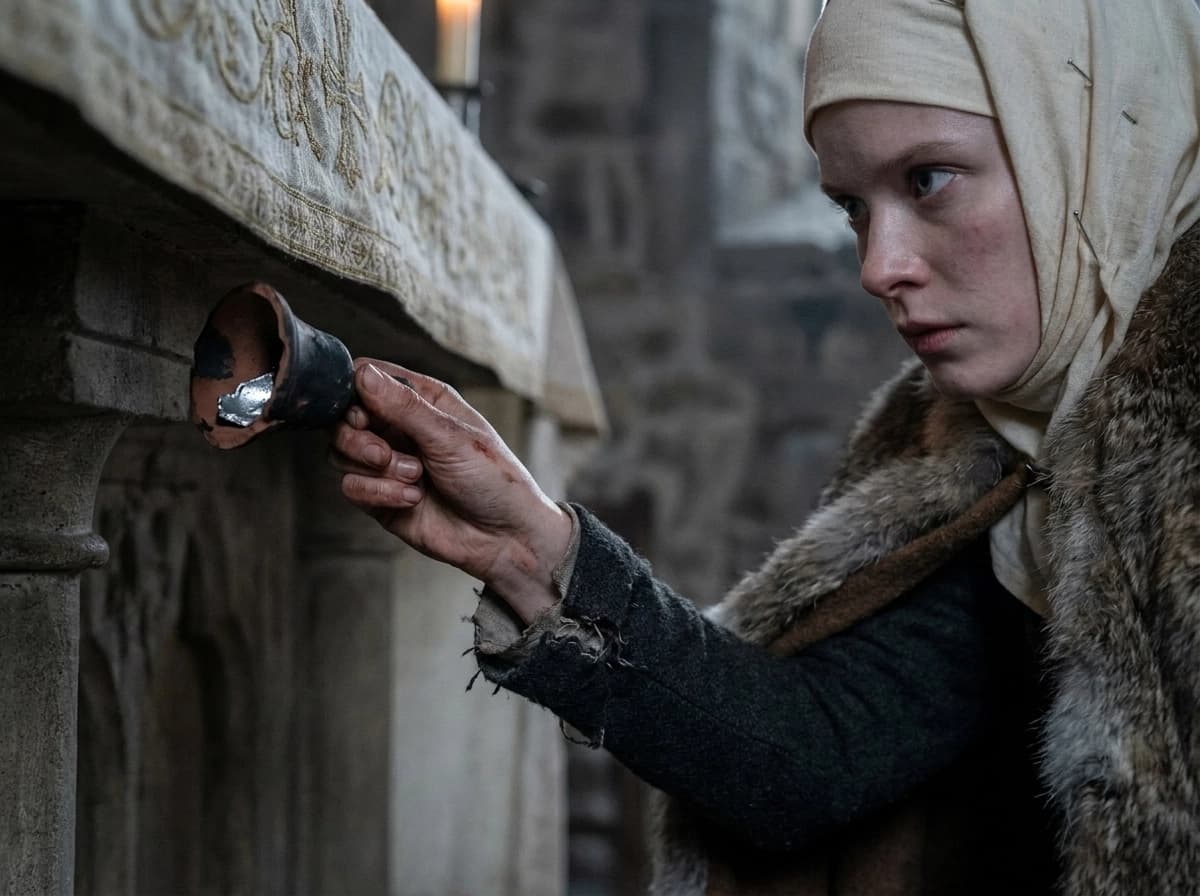
Ysabeau slid two ink-stained fingers under the cloth at the jaw and pulled it down enough to bare the mouth. The teeth were packed with wool, jammed in rough and deep, and when she pressed the lower lip with her thumb the head gave a small, wet tilt in the loosened earth that made Lucien jerk backward so hard the lamp flame guttered. Anselm of Mirepoix came down the path at that moment with a mattock in one hand and his ledger tucked under the other arm, took in the open grave, and said, “Cover him. Now.” Ysabeau did not move. She caught the bell instead, mud-caked and red-brown, and its pull surprised her; the little thing dropped with a weight no fired clay should have had, straightening the cord against the dead wrist. Anselm reached for it. Ysabeau closed her fist first.

For one beat the three of them held there over the opened burial: Lucien white-faced with the lamp, Anselm rigid above them, Ysabeau kneeling in the raw earth with the bell hidden in her palm. Then a crow hopped down onto the wall and barked once into the silence, and Lucien crossed himself with dirty fingers before setting his shovel back into the grave.

シーン 02· Dawn, before Prime

The Office Over Open Earth

The Office Over Open Earth
場所The Split Grave
時間Dawn, before Prime
出来事Abbot Matthieu d'Aubrac is led into the graveyard and orders the corpse put back into the earth at once. He places a folded burial office into Ysabeau de Falaise’s hands and makes her read aloud over the open grave while Brother Lucien Varet and Prior Anselm of Mirepoix force the frozen ground back over the body. As Ysabeau obeys, Matthieu comes close enough to steady the page with his hand, and she feels the shaved, uneven edge of his silver ring drag against the parchment. When Lucien bends to free the bell cord from the dead man’s wrist before retying it lower, the mud-caked bell drops and pulls hard in his hand, showing a weight that does not match common clay.
影響The scene binds Ysabeau to the abbey’s authority in public: she becomes useful to Matthieu before she has chosen him, and the brothers see her serving his need. It also sharpens two material suspicions that will drive the chapter forward. Matthieu’s ring bears the same patient reduction as worked silver, and the bell’s drag against Lucien’s wrist turns graveyard fear into a question of craft and concealed substance. By the end of the office, the reburial is complete, but Ysabeau has been drawn one step closer to the abbot and one step deeper into the wrongness under the ritual.

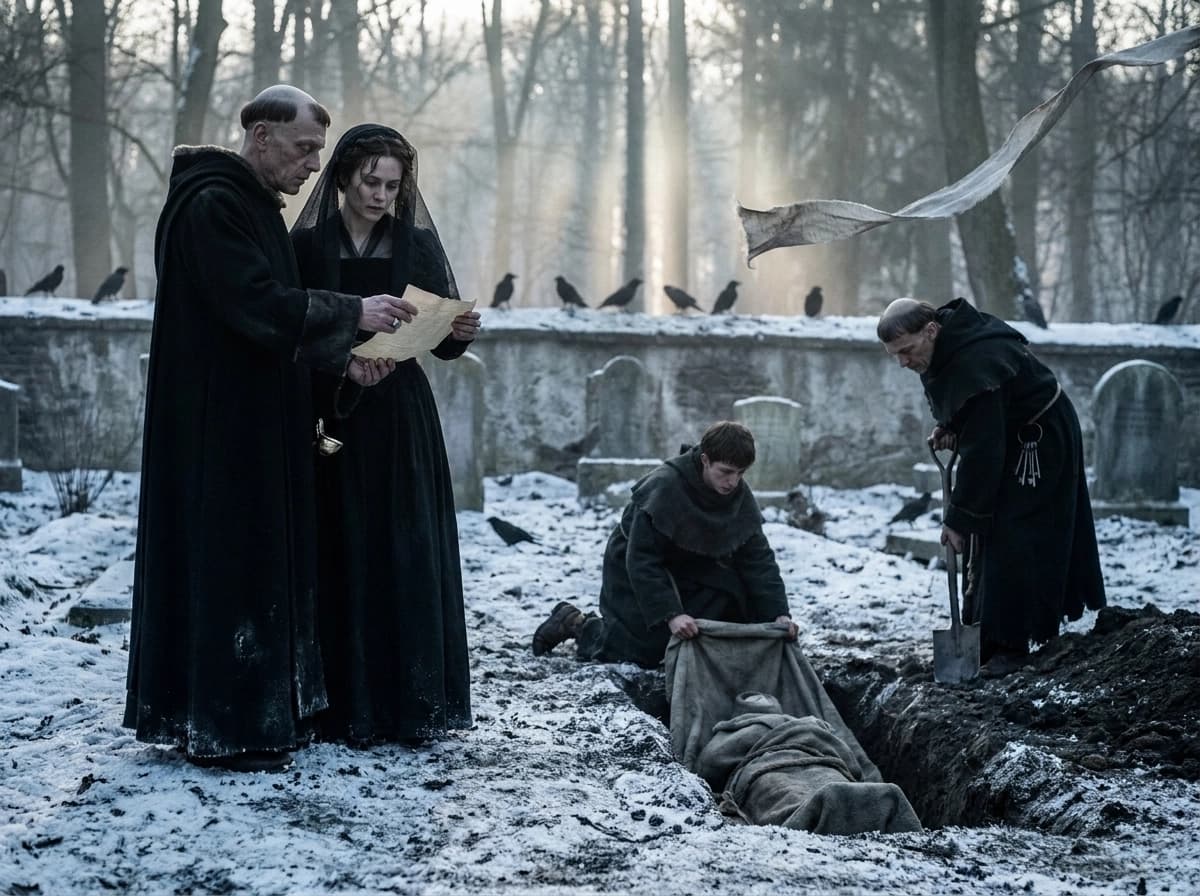
Matthieu d'Aubrac lifted his hand toward the split grave before anyone had finished crossing themselves, and Anselm of Mirepoix caught his sleeve and guided him over the crusted snow until his boots stopped at the raw black seam in the hill. “Back into the ground before Prime,” Matthieu said, his blind face turned a finger’s width past the opened earth, while Lucien Varet flinched and tightened both hands on the shovel shaft. The graveyard wall was striped with crows, and the torn strip of burial linen snapped above the body’s wool-bound mouth like a pale tongue in the wind. Matthieu held out a folded page. “Read.” Ysabeau de Falaise took it because the only roof in sight stood behind him.

She opened the office with stiff fingers and began, her voice carrying flat over the hard iron cracks of Lucien’s shovel and the heavier chop of Anselm’s spade biting frozen spoil back into the pit. When the wind tried to turn the page, Matthieu stepped close and laid two fingers on the parchment to pin it, and the edge of his silver ring rasped over her knuckle—one side worn thin and uneven, as if pared little by little with a patient tool. Below them Lucien knelt in the grave, dragged the shroud straighter over the dead man’s face, and fumbled at the cord sunk in mud around the wrist. “Not there,” Anselm said sharply. “Tie it clean.” Lucien loosened it with shaking fingers; the little bell slipped, dropped against the corpse’s arm, and tugged his hand down with a blunt, heavy pull that made him stare at it as if it had moved by itself.

Ysabeau did not stop reading. Lucien retied the cord lower and climbed out, his lamp knocking once against the grave edge while Anselm cast the first full spade of earth over the bell and hand together. Clods struck wool, then vanished under darker soil. Matthieu kept his fingertips on the page until the last of the face was gone. When Ysabeau reached the final response, the grave was level enough to pass at a glance, and Lucien stood above it with mud to his cuffs and the empty cord-burn red across his palm.

シーン 03· Moments after the reburial, early dawn before Prime

Warmth at a Price

Warmth at a Price
場所The Abbot's Warm Chamber
時間Moments after the reburial, early dawn before Prime
出来事Matthieu d'Aubrac draws Ysabeau de Falaise straight from the graveyard into his hoarded chamber heat, seats her at his table, and has Brother Lucien Varet set broth and a stack of charters within her reach while Prior Anselm of Mirepoix stands by the door with the burial accounts under his arm. Matthieu questions Ysabeau about her hand, her reading, and what she saw at the grave, then turns the exchange into employment before refusal can settle: he orders her to read inventories and old grants aloud into his ear while he listens and counts against the table. Anselm objects to drawing an outsider into the house records so quickly, but Matthieu overrules him softly and makes the objection itself sound like delay. The concrete turn is that Ysabeau takes the page, begins reading for warmth and food, and in doing so enters the abbey's chain of obedience in full view of the men who keep it.
影響The scene changes Ysabeau from a cold witness in the graveyard into a necessary instrument inside Matthieu's private power, which gives her shelter but also binds her to him before she understands the cost. It sharpens the chapter's central pressure by making every practical kindness conditional: broth, fire, and a chair are paid for line by line. It also puts Anselm and Lucien into relation around her—Anselm wary of access, Lucien serving under strain—so the chamber becomes the first enclosed field where authority, fear, and recordkeeping collide. By the end of the scene, Ysabeau is close enough to the papers and to Matthieu's hand to begin seeing that this abbey's wrongness lives not only in graves but in what is written, weighed, and withheld.

Matthieu d'Aubrac catches Ysabeau de Falaise by the sleeve before the graveyard cold has left her hands and steers her into his warm chamber, where candlelight sticks low to tied parchment bundles, a brazier's black ring on the rush mat, and the fur thrown over his chair. Brother Lucien Varet comes in behind them with a wooden bowl of broth slopping at the rim and nearly strikes the table when the door shuts too fast at his back. Prior Anselm of Mirepoix follows last, ledger tucked under one arm, and plants himself by the threshold as if he means to count every word that leaves the room. Matthieu lowers himself into the chair, turns his blind face a finger's width past Ysabeau, and says, "Sit. Eat while it is hot, then read." Ysabeau sets the bowl down untouched when he pushes a tied packet of charters toward her instead, and Lucien's hand lingers on the string before he lets go.

Anselm says, "She has just come off the road," but Matthieu lifts one palm and the room stills around it. "Then she knows the value of a roof," he says, and taps the table with his thumb until Ysabeau breaks the cord and opens the first sheet. She reads names, rents, strips of boundary land, her voice rough from the graveyard air; Matthieu listens with his head bent, asking for a date repeated, a donor's widow named again, one line more each time she reaches the bottom. When she pauses to swallow broth at last, he turns the pause into a question. "And at the grave?" he asks. "What did your hand make of the bell?" Lucien's knuckles whiten on the empty bowl. Anselm's keys give one hard click against his hip. Ysabeau answers, "Clay hangs lighter than that," and no one in the room corrects her.

Matthieu reaches across the table then, not for her wrist but for the page, and his ring grazes the parchment with a soft metal rasp before he folds her hand back onto the text. "Good," he says. "Read the inventories now." Anselm's mouth tightens, but he lays a second bundle down because the order has already been heard and cannot be unspoken. Ysabeau pulls the bowl closer with one hand, the accounts with the other, and begins again while Lucien stands at her shoulder holding nothing at all. By the time the broth skins over in the heat, the first column of abbey property lies open under her ink-stained fingers.

シーン 04· Late morning, just after Ysabeau has finished reading for Matthieu

The Boy with Mud on His Hem

The Boy with Mud on His Hem
場所The Abbot's Warm Chamber to the cloister passage outside the chapter house
時間Late morning, just after Ysabeau has finished reading for Matthieu
出来事Ysabeau leaves Matthieu’s chamber carrying a stack of tied papers back toward the scriptorium and nearly collides with Lucien Varet in the cloister passage. Lucien is coming up from below the chapter house with fresh mud dark on his hem and a splintered hammer haft clenched in his hand. Ysabeau catches his sleeve before he can slip past, and when he tries to wrench free the papers spill across the flags, drawing Anselm of Mirepoix out of the adjoining passage. Pressed between Ysabeau’s grip, Anselm’s stare, and the abbey’s rule of silence, Lucien blurts that the dead do not stay quiet under there, then bites the words off as if they have struck him. He drops his gaze, closes his hand harder around the hammer, and retreats the instant Ysabeau lets him go.
影響The scene gives Ysabeau her first living proof that the crypt’s wrongness is not confined to the graveyard and that Lucien has been made to serve it directly. His mud, the damaged hammer, and his involuntary outburst turn fear into a concrete lead tied to the chapter house below. Anselm’s presence sharpens the danger: he hears enough to register disorder but not enough to act, which leaves Ysabeau with a question no one intends to answer openly. The scene pushes the mystery inward from grave to building and fixes Lucien as both witness and obstacle.

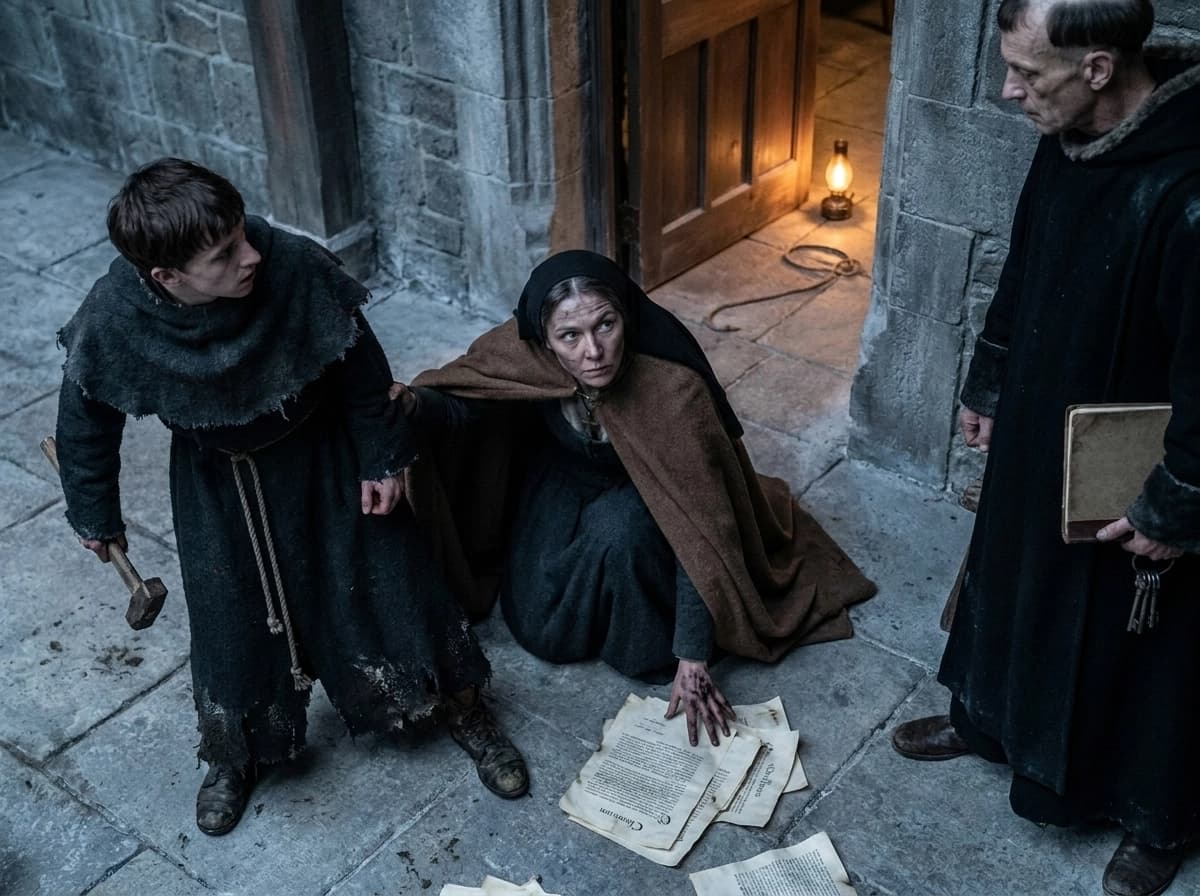
Ysabeau caught Lucien Varet by the sleeve just as he came around the turn from the chapter-house stair, and the tied bundle of charters in her other arm struck his wrist hard enough to knock the hammer haft against the wall. Mud had dried in a dark fan up the back of his hem and flaked onto the scoured stones between them; one end of the haft was split white where iron had torn away from it. Behind Ysabeau, the abbot’s chamber door still stood ajar on its hoarded amber light. “Where have you been?” she said, keeping hold when he tried to slip past with his shoulder turned. Lucien’s eyes went first to her face, then over her shoulder, as if the warmth behind her could accuse him more sharply than she could.

He jerked once to free himself. The charters slid from Ysabeau’s arm and slapped across the passage, their cords loosening, and Anselm of Mirepoix stepped in at once from the storeroom side with his ledger under one arm and his keys hidden in his fist. “Boy.” That was all he said, but Lucien went still except for the hammer shaking in his hand. Ysabeau bent first for the fallen pages and looked up from one knee. “What is under there?” Lucien swallowed, stared at the split wood in his own grip, and answered too fast, “Nothing fit for daylight.” Anselm took one step nearer. Lucien’s mouth worked; then the rest came out in a burst he seemed unable to stop. “The dead do not stay quiet there.”

No one moved for a beat after that except a strip of loose parchment lifting in the draught along the floor. Lucien recoiled from his own voice, snatched his sleeve out of Ysabeau’s fingers, and backed away so quickly his heel smeared a crescent of wet earth on the flagstones. Anselm’s gaze dropped to the mud, then to the broken haft, exact as a scale settling. Lucien turned and went down the cloister at a half run, the hammer bumping against his thigh, while Ysabeau gathered the scattered pages and one clot of black soil sat on top of the clean parchment like a seal.

シーン 05· Later that morning, before Prime gives way to work

What the Ledger Says

What the Ledger Says
場所The Abbot's Warm Chamber
時間Later that morning, before Prime gives way to work
出来事Ysabeau seizes a gap in Matthieu d'Aubrac’s attention and pulls an older inventory bundle from the tied stacks on his table, then spreads it open beside the newer burial accounts before he can stop her. As she reads aloud, Anselm of Mirepoix arrives at the chamber door with a measure of grain and is drawn into the reckoning when Ysabeau forces the numbers into the room: too much burial cloth issued, too much lamp oil gone, and altar silver once recorded at a weight the abbey can no longer possess. Matthieu first tries to turn the reading back into obedience, but when Ysabeau names the missing ounces and Anselm asks for the older account in his hand, the discrepancy becomes public between them. The scene’s decisive action is Ysabeau opening and comparing the ledgers in front of both men, making private unease into shared evidence.
影響The opened grave stops being an isolated horror and becomes the first visible seam in a larger system of concealment. Ysabeau wins what she came for in practical terms—heat, work, and continued access to Matthieu’s papers—but the price is sharper now, because Matthieu hears exactly how dangerous her usefulness has become. Anselm leaves with the numbers lodged in him, not yet an ally but no longer willing to let the accounts blur into piety. The chapter ends with two material wrongnesses fixed together in Ysabeau’s hands: the bell is too heavy for clay, and the books claim silver the abbey does not seem to have.

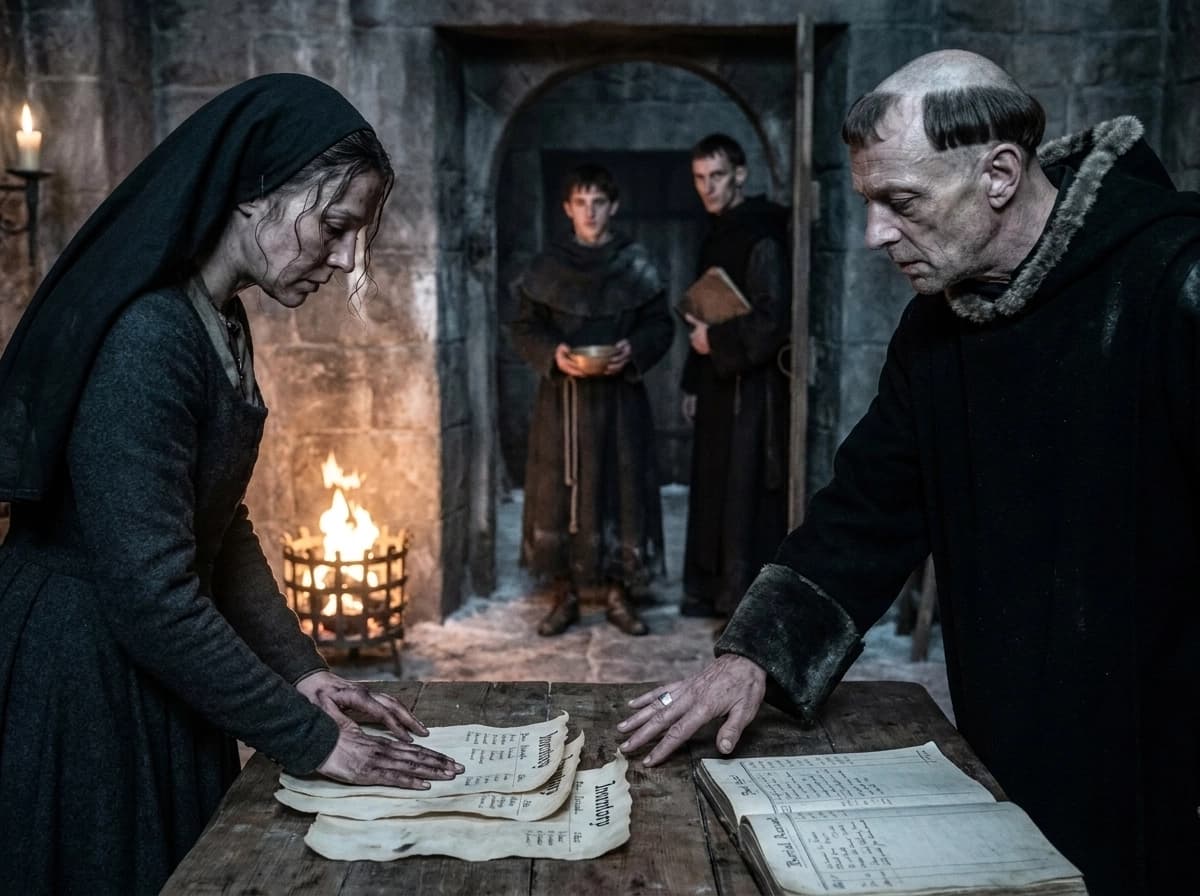
Ysabeau untied the nearest parchment bundle and dragged three older inventories across Matthieu d'Aubrac’s table before his hand found the edge of them, the wax-stiff cords snapping back against the wood while the brazier threw one hard circle of heat across the chamber floor. “That is not the one I gave you,” Matthieu said, his thumb already counting at the tabletop. Ysabeau flattened the curling skins with her ink-stained palm and set the fresh burial account beside them. At the door, Lucien Varet halted with an empty broth bowl and mud still drying at his hem, and behind him Anselm of Mirepoix shouldered in with a grain tally tucked under his arm, stopped by the sound of pages being turned too fast.

Ysabeau read the figures out plain. Burial linen for six bodies, then for eight, though half that number lay in the week’s office; lamp oil drawn after Compline in amounts fit for processions, not prayers; altar plate entered in an older hand at a heavier weight than the vessels she had seen on the cloth below. Matthieu reached across the table to gather the parchments back by touch, but Ysabeau caught one sheet and held it while Anselm stepped forward and took the other end. “Read that line again,” Anselm said. She did. His face tightened without moving much at all. Lucien set the bowl down too quickly; it struck the chest by the wall with a small crack and rolled in place.

No one spoke for a beat except Matthieu, who said, very softly, “Winter changes what a house can keep.” Anselm did not answer him. He took the oldest inventory from Ysabeau’s hand, laid his finger under the silver weight, and then looked past the page to the abbot’s ring where its edge sat shaved thin against the candlelight. Ysabeau let the newer account remain open on the table between them, burial cloth on one side, altar ounces on the other, while Lucien stood in the doorway with the spilled broth darkening the rushes at his feet.

チャプター 02

シーン 06· Later that same day, before Vespers

Bell Under the Sleeve

Bell Under the Sleeve
場所The Grain Storeroom
時間Later that same day, before Vespers
出来事Ysabeau slips the mud-caked grave bell under her sleeve and takes it into the grain storeroom, where Anselm is measuring out stores beneath weak lamplight. She presses the warmed bell to the edge of his scale table and scrapes its base with her bone-handled penknife before he can stop her, cutting through the red-brown clay to raise a bright silver line underneath. Anselm catches her wrist, then the bell, and instead of calling for the abbot he shuts the storeroom door with his back and sets the object on his scales. Their confrontation turns into a shared test: craft against ledger, suspicion against proof.
影響The bell stops being only a thing that felt wrong in the graveyard and becomes material evidence of concealed silver. Ysabeau and Anselm cross an important threshold here, because each sees the other is willing to risk scandal for exact truth, even if neither fully trusts the other. The scene begins the alliance that will carry the chapter, while making the danger sharper: if burial bells hide altar metal, then the abbey’s theft is bound directly to its dead.

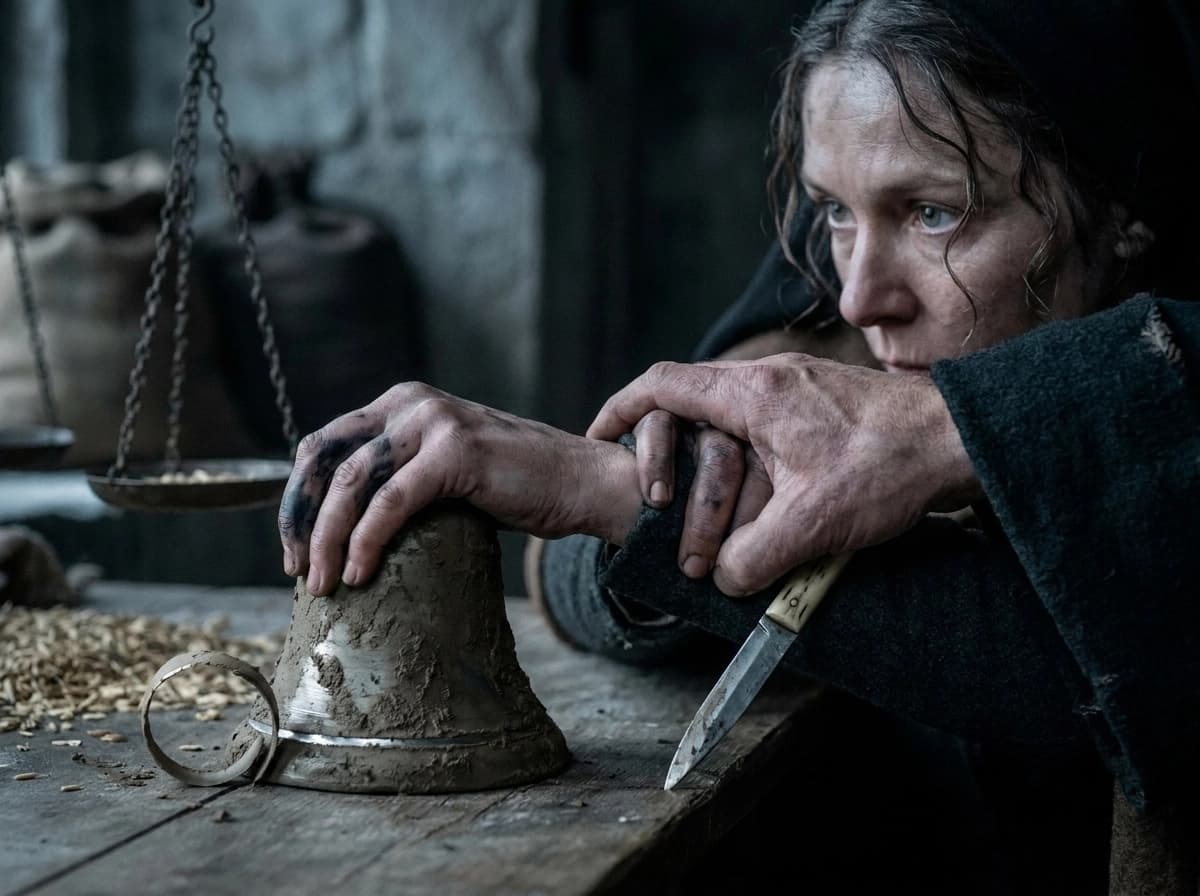
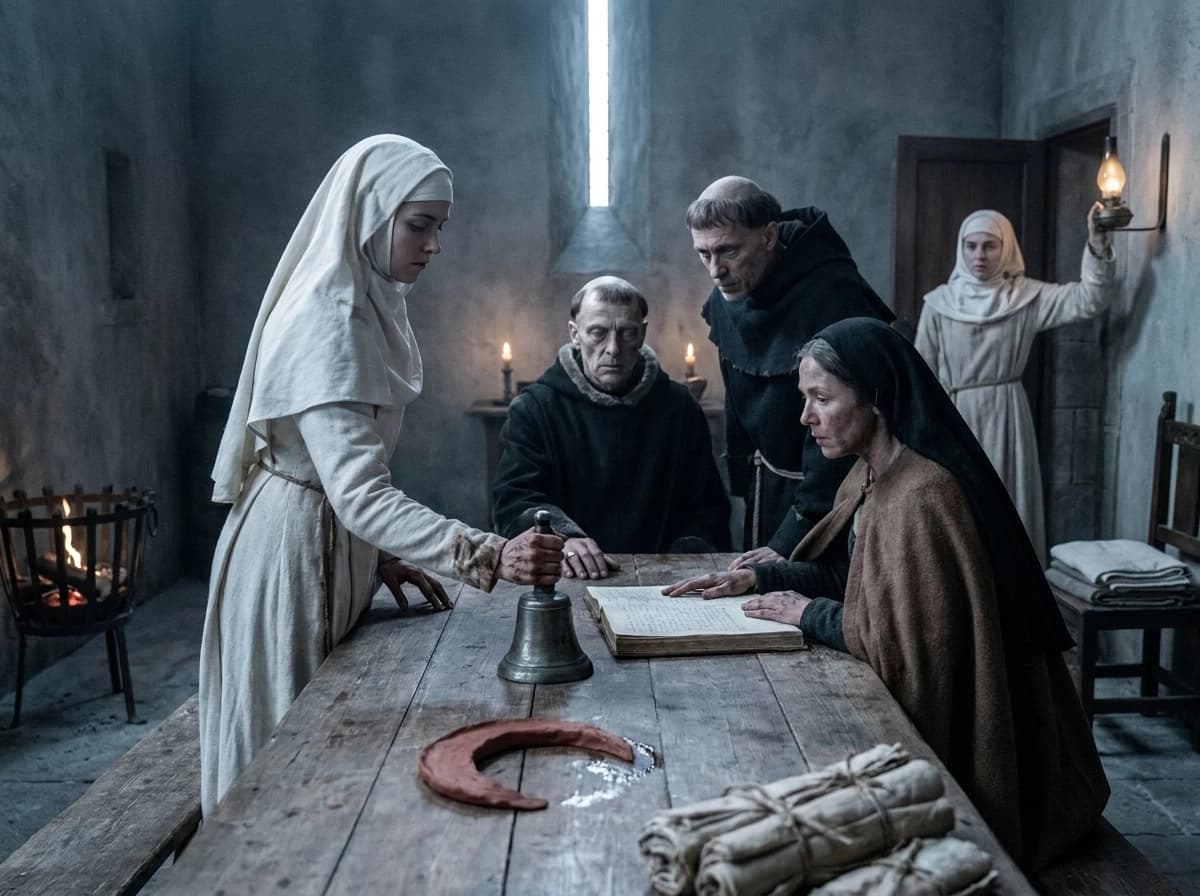
Ysabeau pulled the grave bell from under her sleeve and struck it down on Anselm of Mirepoix’s scale table hard enough to make the hanging chains chime, scattering a drift of chaff across the bare planks between oat sacks. He turned at once from the bins, ledger under one arm, keys tight under his scapular, and reached for it, but she had already braced the bell in her palm and drawn her penknife across its base. Red-brown clay shaved up in a thin curl. Under it, a bright line flashed like wet metal in the weak lamp. “Do not tell me this is piety,” Ysabeau said. Anselm caught her wrist on the second scrape, not gently, and the knife stopped with its point buried in the table edge.

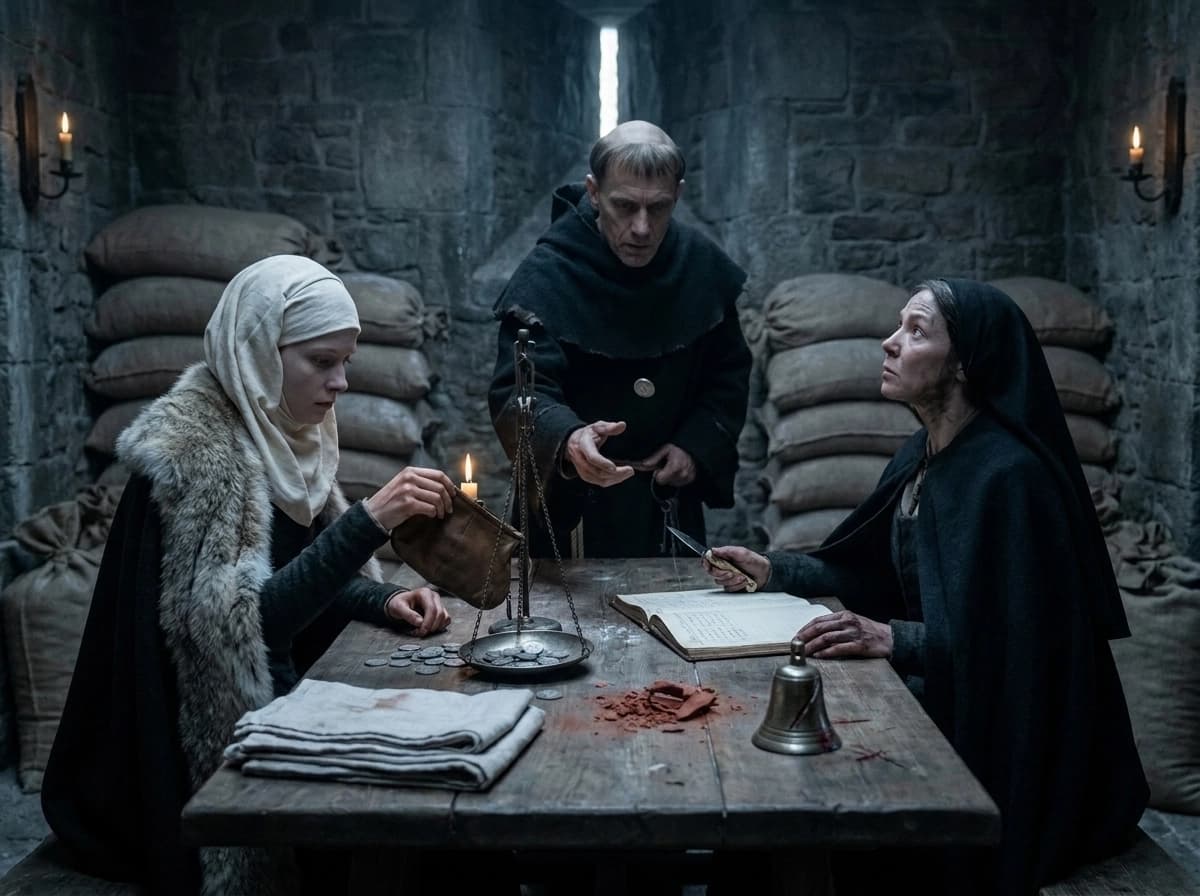
For a beat they stood close enough that the bell hung between them like a weight on a cord, his hand locked on her sleeve, hers still around the mud-stiff object. Then Aélis de Montvert stepped into the threshold with a folded length of burial linen over one arm and saw the silver line before either of them spoke. Anselm’s face changed by fractions only; he shoved the door shut with his back, set the bar into place, and held out his other hand. “Give it here.” Ysabeau did. He laid the bell into one brass pan and grain weights into the other, adding them one by one while Aélis watched without moving, the linen whitening under her fingers. When the beam settled, Anselm touched the scraped cut with his thumb and looked from the hidden silver to Ysabeau, then to Aélis, as if each of them had brought a different kind of accusation into the room.

No one called for Matthieu. The scale chains gave one last fine clink and went still. On the tabletop, beside the penknife and the red dust of scraped clay, the bell sat with its wound showing bright through the earth-colored skin.

シーン 07· Late morning, just after the bell is scraped open

The Prior Shuts the Door

The Prior Shuts the Door
場所The Grain Storeroom
時間Late morning, just after the bell is scraped open
出来事Anselm of Mirepoix swings the storeroom door shut with his heel and plants his back against it instead of calling for witnesses. Ysabeau de Falaise keeps the scored burial bell in her palm while Anselm clears a patch of table between the grain scales and his ledger, then makes her surrender the bell so he can weigh it against measured scoops of barley and a pair of small iron weights. Matthieu d'Aubrac arrives outside before they are finished and speaks through the wood, asking what account keeps his cellarer so long; Anselm answers him without opening, buying a few more breaths. When the balance settles too low for solid silver and too high for clay, Ysabeau takes the bell back, cracks more red crust from its lip with her penknife, and lays the bright metal crescent bare on Anselm’s ledger board.
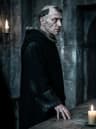
影響The scene turns Ysabeau and Anselm from wary observers into co-keepers of a dangerous fact. By choosing concealment over immediate accusation, Anselm shows he needs proof more than obedience, and Ysabeau sees that his caution can be used rather than merely endured. Matthieu’s voice outside the shut door tightens the risk around them: if burial bells contain silver, then the theft touches the altar, the graveyard, and the abbot’s authority at once. The abbey’s horror is no longer rumor or frightened burial custom but an object that can be weighed, scraped, and hidden again.

Anselm of Mirepoix kicked the storeroom door closed and dropped the bar into place before Ysabeau de Falaise could decide whether to hide the bell or run with it. Burlap sacks humped the walls on either side of them, and the narrow aisle caught one stripe of weak lamplight across the scales, the ledger shelf, and the red-brown dust on Ysabeau’s fingers. “Give it here,” Anselm said. She did not. He held out his hand and added, quieter, “If I meant to denounce you, I would have left the door open.” Ysabeau set the scored little bell into his palm at last, and he flinched almost invisibly at its pull before carrying it to the weighing board.
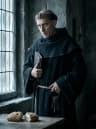

He worked without haste, though the chain links clicked faster each time he changed a weight. Barley from an open sack hissed into the pan by small measures while Ysabeau watched the other side sink and rise, sink and rise again. “Clay should not answer like that,” she said. Anselm did not look up. “Clay answers for itself. Men answer for what they hide inside it.” A knock sounded once, then Matthieu d'Aubrac’s voice came through the planks from the passage: “Prior?” Anselm flattened one hand over the bell as if blessing it and called back, “A split oat sack, my lord. I’ll come.” The silence beyond the door held for a beat too long before the abbot’s steps moved away.

As soon as the passage emptied, Ysabeau took the bell back, set its rim against the board, and drove her penknife under the loosened clay skin. A larger flake snapped free and skittered across Anselm’s open ledger, leaving a clean bright crescent exposed beneath, duller than coin and far too living a color to mistake. Anselm touched the silver with one finger, then turned that same finger to the weight column he had been keeping in the margin. When he looked up at Ysabeau, the room had changed sides around them; the barred door stayed shut, and the bell lay between the grain scales and the ledger like a small buried thing dug up wrong.

シーン 08· After Vespers, the same evening

Bites in the Altar

Bites in the Altar
場所The cold church before the altar
時間After Vespers, the same evening
出来事Anselm takes the scraped bell from the grain storeroom and leads Ysabeau into the empty church instead of bringing the evidence to Matthieu. At the altar steps, he lifts the hanging cloth and forces the comparison into her hands by pressing her fingers to the silver lip beneath. Aélis follows and witnesses the test. When Ysabeau feels the tiny shaved cuts along the edge and matches them to the bell’s hidden weight, the theft stops being suspicion and becomes proof shared by three people.
影響The scene binds altar silver directly to the burial bells, turning graveyard fear into deliberate craft and sacrilege. Anselm crosses a line by showing Ysabeau the altar itself, which makes her more than a servant reading accounts; she becomes a necessary witness. Aélis’s silent arrival tightens the faction forming against Matthieu and sets up her next demand with greater force, because now the dead, the metal, and the abbey’s authority are visibly part of the same crime.

Anselm snatched the scraped bell off the storeroom table, wrapped it in a fold of sacking, and strode Ysabeau out of the grain room before the lamp there had stopped swinging. She followed him through the cloister and into the church where the last of Vespers had emptied away, the nave all weak gray light and cold stone, while Aélis de Montvert came after them with her burial linen still over one arm. At the broad altar steps Anselm set the bundled bell down among the shadows, glanced once toward the choir stalls, and then thrust both hands under the hanging cloth. “Come here,” he said. “Not your eyes. Your hand.” When Ysabeau stepped up, he caught her wrist and pressed her fingertips to the silver edge hidden beneath the linen.

The metal bit cold through her skin. It was not smooth. The rim ran in tiny patient losses, one shallow nick after another, as if someone had pared it with a small tool and then polished the wound flat for distance. Ysabeau pulled free, seized the wrapped bell, and scraped its exposed silver line against the altar lip with a short hard drag. The two surfaces answered each other with the same dull rasp. Aélis climbed the last step at once. “Again,” she said. Ysabeau did it again, slower, and Anselm lifted the cloth higher so the bright little bites showed plain in the failing light.

For a moment no one spoke. Then Aélis set her folded linen on the altar step and laid two fingers against the shaved place as if testing a cut on living flesh. Anselm unwrapped the bell fully and held it in his palm beside the wounded edge; the clay skin was red-brown, the silver beneath gone gray where Ysabeau’s knife had opened it. Behind them the church gave back one small sound—the fine clink of the bell touching the altar where he set it down.

シーン 09· Just after Vespers, the same evening

Coins on the Table

Coins on the Table
場所The Grain Storeroom
時間Just after Vespers, the same evening
出来事Aélis de Montvert comes into the grain storeroom and empties silver coins onto Anselm of Mirepoix’s scale table beside the scraped burial bell. She pays outright for burial linen, lamp oil, and physic, making herself too useful to dismiss, then uses that leverage to demand that her brother’s grave be opened before dawn. Anselm refuses without the abbot’s leave and tries to turn the matter back into account and procedure. Ysabeau de Falaise, caught between them, watches Aélis make grief into pressure and sees that the fight is no longer only about a hidden bell but about which dead may be touched and who is allowed to name why.
影響The scene pulls Aélis fully into the chapter’s conflict as an active force rather than a watcher at the edge of it. Her money changes the room by binding need to accusation: once she has paid for the abbey’s shortages, refusal looks less like prudence and more like concealment. Anselm’s resistance shows the limit of his alliance with Ysabeau; he wants proof, but not a rupture he cannot control. Ysabeau leaves the exchange aligned more openly with those seeking to force the truth into daylight, and Aélis’s brother’s grave becomes the next contested ground.

Aélis de Montvert tipped her purse over Anselm of Mirepoix’s scale table, and silver coins struck the wood among the red clay scrapings with a hard bright clatter that made Ysabeau look up at once. The grain storeroom narrowed around the sound: oat sacks humped the walls, weak lamplight striped the aisle, and the scored burial bell still lay beside Anselm’s open ledger with its wound of silver showing through. Aélis set folded burial linen down beside the money as neatly as if she were laying a cloth for supper. “For linen, oil, and whatever the infirmary lacks,” she said. “Now open my brother’s grave before dawn.” Anselm put his hand over the nearest coin, not to take it but to stop its spin, and the scale chains gave a small answering clink.

He did not look at Aélis first. He looked at the bell, then at Ysabeau, then back to the coins as if trying to decide which weight would ruin him more exactly. “You may give alms,” he said, “but you do not purchase exhumation.” Aélis began counting the silver out one by one with a still face, setting each piece in a short line toward him across the scarred boards. “I saw him stop breathing on the mule track,” she said. “If this house means to call him back by morning rumor, I will have him seen first.” Ysabeau kept one hand over her penknife where it lay by the scraped clay, and when Anselm reached to push the coins back, Aélis caught his wrist in bare fingers stained faintly red at one knuckle. “Refuse me if you dare,” she said quietly. “But refuse the linen too. Refuse the oil. Refuse the salves you have already taken from my purse.”

Anselm pulled free and swept the coins into a tight stack instead of returning them, his jaw set hard enough to sharpen his whole face. “I refuse disorder,” he said. “And I refuse to let grief break the ground by night because fear wants a witness.” Aélis did not answer that. She slid the last coin forward until it touched the weighted bell. For a beat all three of them looked at the two silver things meeting on the table—the clean coin above, the hidden metal under clay below—before Anselm snapped his ledger shut over both their shadows.

シーン 10· At dawn, directly after the storeroom confrontation

Clay from Below the Pass

Clay from Below the Pass
場所The Split Grave
時間At dawn, directly after the storeroom confrontation
出来事Aélis de Montvert leads Ysabeau de Falaise and Anselm of Mirepoix out to the reopened grave and kneels in the snow to set the disturbed shroud straight with her bare hands. When Anselm tries to turn the matter back toward permission and order, Aélis scrapes red-brown clay from the frozen grave edge and shows Ysabeau the same color ground into her own fingernail, then names her father’s abandoned kiln below the pass as the source of the bells’ clay. Matthieu d'Aubrac arrives before the exchange can stay private and forbids any opening of her brother’s grave, but the knowledge has already changed hands in front of witnesses.
影響The mystery gains a physical origin: the bells are no longer merely altered objects but products of a specific abandoned work below the pass, tying the theft to a hidden place that can be reached later. Aélis stops being only a patron pressing with money and becomes a keeper of withheld craft knowledge, which pulls Ysabeau closer to her side against Matthieu’s authority. Anselm is forced to hear both the accusation and the source in the same breath, narrowing his room for caution and setting the next movement of the story toward the crypt and the old kiln’s network.

Aélis de Montvert dropped to her knees at the split grave before either Ysabeau de Falaise or Anselm of Mirepoix could stop her, and her bare hand went straight to the wool shroud where it had frozen in a hard fold across the buried face. The graveyard sloped white and crooked around them, crows shifting along the wall while the little bell at the wrist hung dull with mud from the dark seam in the earth. “Do not touch that again,” Anselm said, coming after her through the crusted snow with his ledger tucked under one arm, but Aélis only pulled the cloth smooth and pressed the edge down as if neatness could still keep a body from being used twice. Ysabeau came close enough to see the red-brown smear on Aélis’s thumb before the woman closed her hand over it.

Aélis drove that same thumb into the broken lip of the grave and came up with a clot of wet clay streaking her skin. She held it out between them. “Not from this hill,” she said. Anselm’s mouth tightened. Ysabeau took Aélis’s wrist, turned her hand palm-up, and saw the same color packed under the nail in an older stain that had not come from this morning. “Below the pass,” Aélis said, looking at Ysabeau and not at the prior. “My father’s kiln. Shut these six years. Someone has opened it again.” Anselm reached for her hand as if he meant to test the clay himself, but she pulled back and rose in one movement, skirts dark at the knees. “Open my brother’s grave,” she said. “Before whoever uses your dead goes to him again.”

Matthieu d'Aubrac’s staff struck the path stones behind them, and all three turned as he came into the graveyard with his blind face lifted toward their voices. “Stand away from it,” he said. Aélis did not move. Ysabeau still had the smear of clay on her fingers; when she looked down, one red mark had transferred onto the strip of white burial linen frozen at the grave lip, bright as sealing wax against the snow.

チャプター 03

シーン 11· Before Prime, at first light after a night freeze

Dawn at the Heaved Grave

Dawn at the Heaved Grave
場所Abbey Graveyard
時間Before Prime, at first light after a night freeze
出来事Lucien Varet hacks his shovel into the seam of a fresh grave as Ysabeau de Falaise reaches the wall and sees the earth lifted again, this time not split open cleanly but swollen from beneath as if something has shoved once and failed. When the crust breaks, a muffled sound comes up through the packed soil and Lucien staggers back, dropping to one knee and swearing that the dead man inside spoke his name. Ysabeau forces him to help pull the upper boards and frozen clods aside before the other brothers can smooth the grave over. Abbot Matthieu d'Aubrac arrives led by his stick and the wall, hears enough to understand disorder has outrun concealment for another dawn, and orders the body covered at once. Ysabeau does not challenge him openly yet, but she watches Lucien refuse for one beat too long before obeying.
影響The scene makes the graveyard disturbance immediate and recurrent, proving the first opened burial was not an isolated accident the abbey can explain away. Lucien’s terror becomes specific and active: he claims a voice from the grave, and his fear now presses him toward Ysabeau instead of away from her. Matthieu’s quick command to close the ground sharpens the sense that he is managing appearances under mounting strain. By the end of the scene, Ysabeau has a frightened witness who is near breaking, and the pressure to go below the chapter house has become urgent rather than merely curious.

Lucien Varet drove the shovel point into the heaved grave before Ysabeau de Falaise reached him, and the frozen crust gave with a black crack along the downhill edge. Dawn lay thin and pewter over the tilted stones; snow clung in the grass between graves, and one clay bell already showed at the loosened wrist beneath the soil. Lucien stabbed again, too fast, then jerked backward so hard the shovel tore free from his hands. “It said my name,” he said, not loudly, as if afraid the earth would answer. Ysabeau caught the shaft before it slid into the pit, thrust it back at his chest, and said, “Then dig while it still has a mouth full of dirt.”

He stared at her a beat, white-faced, then bent because her hand was firmer than his fear for that instant. Together they dragged away two boards laid over the settling ground, and a shoulder under wool showed dark with thawed mud where the grave had pushed upward from below. The bell tied at the corpse’s wrist knocked once against a stone with a dead little clink. Lucien made the sign of the cross with dirty fingers and whispered, “I buried him deep.” Ysabeau knelt, seized the bell cord, and lifted just enough to see the knot had been retied, fresh clay smearing her thumb. Footsteps scraped on the path above them; Abbot Matthieu d'Aubrac came along the wall with one hand out and the other closed on his staff, his blind face turned a finger’s breadth past the grave. “Cover it,” he said at once. “Before the choir comes through.”

Lucien did not move. Matthieu’s head shifted toward the stillness as precisely as if sight had not left him. “Brother.” The word landed like a grip. Lucien flinched, bent, and began shoving earth back with both hands instead of the shovel. Ysabeau rose with the damp red smear on her thumb and the image of the retied knot fixed in front of her, while Matthieu stood listening to the soil fall over the bell until its shape disappeared again.

シーン 12· Night, just after Compline

The Bargain at Compline

The Bargain at Compline
場所Passage outside the crypt stair, beneath the chapter house
時間Night, just after Compline
出来事Lucien Varet intercepts Ysabeau de Falaise in the dark passage after prayers and physically stops her from going back to the dormitory stairs. With his lamp shaking in one hand and the splintered hammer haft in the other, he demands that she answer whether a dead man can truly speak, then offers to take her below the chapter house if she will tell him what she believes. Ysabeau refuses to comfort him with piety and instead forces him to trade facts for facts. When Matthieu d'Aubrac's staff sounds faintly above them, Lucien makes his choice, catches Ysabeau by the sleeve, and pulls her toward the hidden stair.
影響The scene turns Lucien from a frightened obstacle into an active accomplice who chooses to break the abbey's rule of silence. Ysabeau gains the access she has been trying to force, but only by taking on Lucien's fear and the moral weight of what he has already done below. The bargain also sharpens Matthieu's pressure without requiring him to appear fully in the passage; his nearness is enough to make secrecy feel like pursuit. By the end of the scene, the descent is no longer a possibility but an act already underway.

Lucien Varet caught Ysabeau de Falaise by the sleeve and dragged her into the narrow dark beside the crypt stair before the last scrape of sandals from Compline had died overhead. His lamp swung hard enough to throw the passage walls in and out, showing wet stone, a barred side door, and the splintered hammer haft tucked under his arm like a crutch he hated. “Say it plain,” he whispered, too close, his breath breaking on the words. “If a dead man speaks your name from under earth, is it him?” Ysabeau pulled her sleeve free, set her back to the wall, and looked straight at the hand that was shaking instead of at his face. “Tell me what you heard. Tell me what you touched. Then I’ll tell you whether it was the dead.”

He swallowed, glanced once up toward the chapter house, and thrust the lamp at her so suddenly she had to take it or let it fall. In the same motion he opened his fist to show a black thread of burial wool caught around two fingers and a smear of red clay ground into his palm. “Not from a grave above,” he said. “From below. He sends me after Compline with this and that.” He knocked the hammer haft once against the step edge. “Open. Lift. Nail shut again.” Ysabeau put the lamp low between them, took his wrist, and turned his hand until the wool showed in the light. “Living hands did that,” she said. “Not a saint. Not a corpse.” For one beat he shut his eyes as if the answer hurt more than the fear.

Then Abbot Matthieu d'Aubrac's staff struck stone somewhere beyond the turn above them, one measured tap, then another, and Lucien flinched like a horse under whip crack. “If I take you,” he said, already moving, “you do not leave me to answer alone.” Ysabeau gave him back the hammer instead of a blessing. Lucien stared at it, then gripped it hard, turned, and lifted the bar from the side door with both hands. The wood came free with a dry jerk, and black air opened under the chapter house while the lamp flame bent into it.

シーン 13· Just after Compline, deep night

Through the Cistern Passage

Through the Cistern Passage
場所The Roman cistern passage beneath the chapter house
時間Just after Compline, deep night
出来事Lucien Varet lifts the lamp and leads Ysabeau de Falaise past the Roman cistern into the low passage, breaking the abbey’s rule with every step. When Ysabeau stops him at a fork and makes him show her the hammer he brought, he finally admits Abbot Matthieu d'Aubrac has sent him below night after night to open stone, move weight, and keep silent in exchange for grain promised to his sisters. Their whispered bargain turns into an active alliance when Lucien, shaking, knocks a loose brick from the wall to reveal a hidden niche marker cut into the passage stone, proving this route has been used as part of a burial system rather than a single theft.
影響The scene moves the mystery from suspicion into the abbey’s hidden physical network: there is a route, a method, and a coerced witness. Lucien stops being only a terrified boy with grave dirt on him and becomes a compromised guide whose obedience has helped the dead circulate below the house. Ysabeau gains not just access to the bell-casting room ahead, but the first broken confession tying Matthieu directly to the work under the crypt.

Lucien Varet catches Ysabeau de Falaise by the sleeve and pulls her sideways through a low arch before the last chapel footsteps above them have faded, his lamp throwing a yellow shake across the Roman cistern and the wet run of mineral on its rim. The passage beyond narrows at once, older stone giving back their movement in cramped little echoes, and Lucien nearly loses the lamp when his splintered hammer haft bangs the wall. Ysabeau snatches the tool out of his hand before it can fall. “If you mean to lead me, do not clatter like a thief,” she says. He reaches for the hammer, then stops when she does not give it back.

They go on with Ysabeau carrying the hammer and Lucien the lamp until the floor tilts and splits around a black side cut in the rock. There she plants herself broad in the way and makes him choose with his body instead of his mouth. Lucien stares into the dark, then lifts the lamp toward the left branch where fresh scrapes score the stone at knee height. “He said I was strong enough,” he whispers. “For opening mortar. For lifting what should not stay where it was left.” Ysabeau holds out the hammer between them. “Who said it?” Lucien’s fingers close on the haft hard enough to reopen the cracked skin at his thumb. “Matthieu. He said grain would go down to my sisters if I did as I was told.”

A drip falls somewhere ahead. Lucien turns suddenly, jams the hammer claw into a seam in the wall, and wrenches loose a chalky brick no bigger than a loaf. Behind it, cut into the hidden face of the stone, is a small bell mark and beside it two straight knife-lines, old and blackened with damp. “We were to count by these,” he says, holding the lamp so close the soot jumps on the mark. “One bell for a fresh grave. Two for one opened before.” Ysabeau takes the brick from his other hand and sees red clay ground into its edge like dried blood under a nail. When Lucien puts the brick back, he does it carefully, as if closing a mouth he has finally made speak.

シーン 14· Night, moments after Lucien unbars the side door after Compline

The Bell-Casting Room

The Bell-Casting Room
場所The Bell-Casting Room beneath the abbey crypt
時間Night, moments after Lucien unbars the side door after Compline
出来事Lucien leads Ysabeau into the abandoned casting room and tries to hurry her past what he already knows how to fear, but she stops at the worktable, seizes a half-finished bell, and breaks its damp clay skin open against the edge of the furnace stones. The split shell exposes soft gray silver packed inside, while bright filings and pared scraps on the table answer the shaved altar and the weighted grave bells above. As Ysabeau forces Lucien to show her the rest, he drags the reliquary chest out from the soot-dark back wall and opens it, revealing wrapped silver shavings, old fittings, and cords ready for more bells. Before they can retreat, Matthieu’s staff sounds faintly in the passage beyond, driving Lucien to smother the lamp and press them both into the room’s black margin until the steps pass.
影響The mystery hardens into proof: altar silver is being recast here into burial bells by living hands under the abbey itself. Lucien is no longer only a frightened witness from the graveyard but a compromised participant who has carried, opened, and hidden what Matthieu ordered. The scene also shifts the danger upward, because the theft is no single desperate act; the tools, molds, and stored metal show an organized practice built to continue. By the time the steps recede, Ysabeau has seen enough to know the dead are being used as cover for craft, inventory, and movement below the church.

Ysabeau caught a damp red bell off the drying board and smashed it hard against the furnace mouth before Lucien Varet could stop her. Clay burst in her hand and scattered across the hollowed floor, and a misshapen core of gray silver dropped out among ash and pale filings that shone too bright to be honest. The Bell-Casting Room jumped alive in the kiln’s hard orange pulse: rows of fresh bells on blackened boards, mold halves stacked by the wall, iron tongs underfoot, and a worktable scored with a knife groove where soft metal had been pared in haste. Lucien snatched at her wrist. “Do you want him to hear?” he hissed. Ysabeau shoved the broken silver under his nose and said, “He meant me to hear the bells above. I mean to hear this.”

She kicked aside a broken mold rim and drove him backward with the next question until his shoulders struck the soot-slick table. “What else?” Lucien looked once toward the passage, then seized the reliquary chest from the dark rear corner and dragged it into the kiln light with a scrape loud enough to make them both freeze. When he threw the lid back, wrapped bundles lay inside among old cords and red clay dust: altar shavings tied in linen, reliquary fittings bent flat, two patron rings gone black with soot, and a row of little clappers waiting to be hung. “We fill them here,” he said, his thumb split open again around the chest edge. “He weighs them by hand and tells us which go up.”

Then a staff tapped stone somewhere beyond the room, one measured strike and then another, and Lucien moved faster than fear. He clapped his palm over the lamp mouth, pinched the flame down, and shoved Ysabeau behind the stacked fuel where the dark pressed close and the cracked kiln clicked as it cooled. Matthieu d'Aubrac’s steps paused outside the threshold; neither spoke while smoke hung low over the table and the open chest gaped in the dark. When the staff moved on at last, the room held its shape again in thin returning lamplight: the broken clay shell at Ysabeau’s feet, the silver lump naked in ash, and the reliquary chest standing open like a grave left unfinished.

シーン 15· Just after Compline, deep below the chapter house

The Older Body

The Older Body
場所The Bell-Casting Room
時間Just after Compline, deep below the chapter house
出来事Ysabeau forces Lucien to show her which niches the bell marks count, and he leads her past the furnace boards to the back wall where mismatched mortar seals old burials. When she tears loose a loosened stone from one reopened niche, an old wool-wrapped arm slides forward with a bell already tied at the wrist, caked in ancient clay. Pressed by the sight of it, Lucien confesses that Matthieu has been sending novices down to open long-buried patron graves, strip out hidden offerings and shaved altar silver, and recast the metal here into new burial bells. He admits they used the bells’ weights as markers so silver could be moved from emptied niches onto fresh corpses without any account naming the theft.
影響The scene breaks Ysabeau’s simpler theory that the abbey is only tampering with recent plague burials. The dead below are part of an older, organized traffic through the crypt, and Matthieu’s crime expands from sacrilege and concealment into a system built on disturbed memory, coerced labor, and hidden inventory. Lucien’s confession also binds him more tightly to Ysabeau, because he has now named both his own part in the work and the abbot’s method aloud. What should have made the hauntings easier to explain instead makes them more dangerous, because the graveyard disturbances can no longer be blamed on panic alone.

Ysabeau drove the hammer claw into a seam of fresh mortar and ripped a stone out of the back niche wall before Lucien Varet could stop her. The block broke free with a chalky snap, and cold dark opened behind it in the Bell-Casting Room beyond the kiln’s orange pulse, where rows of damp clay bells dulled on blackened boards and bright filings still glittered in the ash underfoot. Lucien lunged for her wrist. She shook him off, struck again, and the gap widened enough for old wool to bulge through. Then an arm slid forward to the elbow and dropped against the niche lip with a dead, heavy thud, the shroud rotted brown-black and a clay bell still knotted at the wrist.

Lucien made a sound low in his throat and backed into the worktable hard enough to rattle the mold halves. “We opened this one three nights ago,” he said. Ysabeau caught the ancient bell before it could roll, thumbed the cord, and lifted the wrist into the kiln light; the knot was old, the clay crusted into the fibers, and the bell beneath her hand dragged with the same hidden weight as the others above. “Not plague dead,” she said. Lucien wiped his split thumb across his mouth and nodded once, like a blow taken standing. “Patrons. Priors. Whoever was sealed with metal when the road failed before. He had us count the marks and open by weight. Fresh graves for carrying, old graves for taking.”

Ysabeau turned on him, the old bell in one hand and the hammer in the other. Lucien did not run. He pointed past her to the reliquary chest dragged into soot by the wall, then to the drying boards, then to the half-pared silver curls on the knife-grooved table. “We brought it from the dead to there,” he said, voice shaking now that it had started. “Rings, altar shavings, fittings, whatever was hidden with them. He melted it, skinned it with clay, tied it to the new burials, and moved the emptied bodies where no one would look twice.” The kiln shell clicked behind them. Ysabeau set the old bell beside the fresh row, and in the furnace light the two looked near twins except for the centuries of dirt ground into one cord.

チャプター 04

シーン 16· Morning, just after Ysabeau and Lucien come up from the crypt

Bread Against Silver

Bread Against Silver
場所The Abbot's Warm Chamber
時間Morning, just after Ysabeau and Lucien come up from the crypt
出来事Anselm of Mirepoix brings a weighted burial bell and his ledger into Abbot Matthieu d'Aubrac’s chamber and forces a reckoning in front of Ysabeau de Falaise. Ysabeau reads the older altar weights aloud while Anselm sets the bell on the table and presses Matthieu to answer the missing silver. Matthieu does not deny the theft. He says he shaved the altar and opened graves to keep broth in the bowls and grain in the bins through winter. Aélis de Montvert arrives in the doorway before the argument is done, hears enough to understand her brother’s burial may be part of the same traffic, and turns the chamber from a private accusation into a divided front.
影響The scene hardens suspicion into open conflict without yet producing action strong enough to stop Matthieu. By admitting what he has done and defending it as necessity, Matthieu becomes more dangerous, not less, because his logic lands on real hunger in the house. Anselm is pushed from secret proof toward public opposition, but his need to proceed exactly still leaves room for delay. Aélis is drawn fully into the confrontation with personal stakes sharpened, and Ysabeau sees that truth alone will not move this abbey unless someone breaks obedience before Matthieu can use winter and office to bury the evidence again.

Anselm of Mirepoix struck the weighted bell down on Abbot Matthieu d'Aubrac’s table hard enough to tip the silver seal press, and Ysabeau de Falaise saw the red clay leave a damp crescent beside the tied inventory bundles. The chamber’s hoarded heat made the mud on her hem begin to dry, but Lucien Varet still stood just inside the door with his lamp untrimmed and his splintered hammer haft tucked under his sleeve as if he had forgotten to let it go. Matthieu did not reach for the bell. He turned his blind face a finger’s width past the sound and kept his thumb beating once against the table edge. “Read the older weight,” Anselm said, pushing his ledger toward Ysabeau with two fingers. She opened to the altar accounts and gave the number aloud. Then Anselm rolled the bell under Matthieu’s hand until the abbot’s fingertips met the scrape Ysabeau had cut through the clay. “Bread,” Matthieu said before either of them could speak again. “That is what the missing silver bought.”

Anselm caught the bell before it could roll off the table and held it up like proof at judgment. “It bought silence,” he said. “It bought boys in the crypt with hammers.” Lucien flinched as if the words had struck him, and Ysabeau set her palm on the ledger to keep the page flat when Matthieu’s next answer landed. He did not lower his head or ask pardon. He said dead patrons need no rings, no fittings, no plate under stone; living men need broth, lamp oil, wool, and spring seed if any of them mean to see thaw. The latch lifted behind them. Aélis de Montvert came in carrying folded burial linen, stopped at the sight of the bell in Anselm’s hand, and set the linen down with exact care on the chair by the brazier. “Whose grave?” she said. No one answered quickly enough. Matthieu’s thumb had stopped.

Ysabeau took the bell from Anselm and placed it directly into Aélis’s hands before caution could close over the room again. Clay stained Aélis’s fingers red-brown where she gripped it; then her gaze moved from the bell to Lucien’s mud-dark hem and finally to Matthieu’s still face. The brazier gave a small spit. Anselm’s keys knocked once against the table as he leaned in, but he still did not call for witnesses or open the door wide. Matthieu sat upright in his chair with the fur at his shoulders and said, very evenly, “If I had left silver on the altar and grain bins empty, you would all have named that holiness too.” Aélis did not blink. She set the bell down on top of the ledger, squarely over the written weights, and the table creaked under it.

シーン 17· Before dawn, after the confrontation in the abbot’s chamber

The Grave Opened Twice

The Grave Opened Twice
場所The Split Grave
時間Before dawn, after the confrontation in the abbot’s chamber
出来事Anselm of Mirepoix brings spades to the split grave at Aélis de Montvert’s demand, and Ysabeau de Falaise goes with them while Lucien Varet holds the lamp and watches the path in terror. They open Aélis’s brother’s grave in the hard, half-frozen ground and uncover the body in front of witnesses instead of in secret. Ysabeau examines the corpse where it lies and finds the wrist skinned by a bell tied and retied, the shroud changed, and the mouth packed with fresh carded wool from abbey stores rather than the coarse burial wool Aélis used herself. Aélis climbs down into the grave and gathers her brother to her in the slush, making the abbey’s tampering undeniable and public among them.
影響The graveyard horror becomes proof of human handling, not rumor or pious fear. Aélis’s grief turns from accusation into witnessed fact, and Anselm loses more of the ground on which he could delay for cleaner evidence later. Lucien is forced to stand beside what Matthieu’s orders have done to a body he knew by name, which pushes him closer to choosing against the abbot. The scene sets the terms for open defiance: once the grave has been opened twice and seen by four pairs of eyes, silence can no longer pass as prudence.

Anselm of Mirepoix drove the spade into Aélis de Montvert’s brother’s grave while Ysabeau de Falaise knelt at the split edge and Lucien Varet held the lamp so high his arm shook. The snowy slope behind the abbey fell away in crooked white bands, crows hopping along the low wall as iron struck frozen earth with a hard crack. Aélis did not wait for permission or prayer; she seized the loosened boards with both hands and dragged them aside, then dropped to her knees in the dark seam of the grave before Anselm could stop her. “Witness,” she said, not looking up. “All of you.” Ysabeau slid down beside her into the raw earth and pulled back the shroud from the dead man’s wrist.

The skin there was rubbed open in a red-brown ring where a cord had bitten, loosed, and bitten again. Ysabeau put two fingers under the cloth at the shoulder and held up the edge for Anselm to see the cleaner linen beneath the mud, newer than the outer wrap. Lucien made a sound in his throat and backed one step uphill, but Aélis caught his sleeve without turning and held him fast. “Look,” she said. Ysabeau took her bone-handled penknife, cut the binding at the jaw, and drew a plug of soft white wool from between the dead man’s teeth; it came away in one damp tuft, finer and cleaner than burial wool had any right to be. “Store carding,” Anselm said, the words flat as ledger marks.

Aélis climbed fully into the grave then, her skirts sinking black at the hem, and gathered her brother’s shoulders into her lap as if she could keep the body from being moved a second time by the force of her arms alone. The lamp shook harder in Lucien’s hand, throwing the open mouth, the fresh wool, and the abraded wrist in and out of yellow light while Anselm stood above them with the spade planted like a post. No one covered the grave again.

シーン 18· Before Prime, in the gray after the exhumation

No One Obeys

No One Obeys
場所The Split Grave
時間Before Prime, in the gray after the exhumation
出来事Abbot Matthieu comes down into the graveyard and orders Aélis’s brother covered again at once. No one moves. He tries to take back control by laying hands on the nearest body he can command—first Lucien, then Ysabeau—and the struggle turns the open grave into a public test of whether office still rules when four witnesses have seen too much. Ysabeau answers his touch with an open threat: if another corpse is moved in darkness, she will read the altered burial accounts aloud at Mass. Anselm does not support her fast enough, and Aélis’s refusal makes Matthieu’s authority look suddenly dependent on force rather than obedience.
影響The scene breaks the old habit of immediate submission. Matthieu is exposed as physically frail even while still dangerous, and Ysabeau crosses from private investigator into open accuser before witnesses who matter. Lucien is forced to feel the abbot’s grip and to choose, if only for a moment, not to bend at once. Anselm’s hesitation becomes costly; his need for exact procedure leaves a gap Matthieu can still use, setting up Ysabeau’s confinement and the night move below.

Matthieu d'Aubrac struck his staff into the frozen path above the split grave and came down toward them with one hand out, while Aélis de Montvert still knelt in the slush below the lip holding her brother’s shoulders through the soaked shroud. The graveyard wall, the tilted stones, the raw black cut in the earth all held still around that movement; only the crows hopped nearer. “Stand away,” Matthieu said, his blind face turned just past the open pit. Lucien Varet had the shovel in both hands, mud to his wrists, and did not step back. Anselm of Mirepoix opened his mouth, ledger tucked under one arm like a board, but said nothing before Matthieu reached the grave.

The abbot’s hand closed around Lucien’s wrist first, hard and practiced, the same grip that had sent boys below after Compline. Lucien jerked as if burned and stumbled against a leaning stone, the shovel blade ringing once on rock. Aélis looked up from the grave with wet clay on her sleeves and said, “Touch him again and I will have the whole house watch what you buried twice.” Matthieu turned toward her voice, missed, and caught Ysabeau by the shoulder instead when she stepped between them. His fingers bit through wool; she felt how light he was under the habit, bone and anger and the force of everyone else’s habit of yielding. “You forget where you stand,” he said. Ysabeau seized his wrist with both ink-stained hands and answered, “In your graveyard, over your false accounts. Move one more body in darkness and I will read every altered burial before the altar at Mass.”

For a beat only the wind snapped the frozen strip of linen at the grave edge. Anselm came one step forward, keys knocking softly under his scapular, but he stopped there, exact even now. Matthieu let go of Ysabeau’s shoulder and lifted his chin as if the words had struck him across the face. “Lock her to her pages,” Aélis said to Anselm without taking her hands from her brother. No one obeyed that either. Then Lucien bent, not to cover the body, but to pick the shovel back up and plant it upright between the open grave and the abbot like a post driven into frozen ground.

シーン 19· Night, just after Ysabeau is shut away from the graveyard

Locked Among Pages

Locked Among Pages
場所The abbey scriptorium
時間Night, just after Ysabeau is shut away from the graveyard
出来事Anselm of Mirepoix escorts Ysabeau de Falaise from the open grave to the scriptorium and bars her in at Abbot Matthieu d'Aubrac’s order, while Aélis de Montvert follows as far as the threshold and Lucien Varet hangs back in the passage, unable to meet Ysabeau’s eyes. Once alone, Ysabeau tears a strip from a spoiled parchment wrapper, blackens it in a lamp stub, and begins leaving her hidden witness marks through the room: a soot line under the desk lip, a nick in the shutter latch, a cut in pooled wax on the windowsill. Outside the door, voices pass and stop. Anselm argues too low to make out; Aélis strikes the wood once with her palm; then boots and dragged weight move toward the chapter-house stair. Lucien slips back to the shuttered window and passes Ysabeau a bundle of binding cords through the leaded gap after she forces one pane loose with her penknife. In the exchange he tells her, plain at last, that Matthieu has sent men below to open Aélis’s brother’s sealed niche before dawn.
影響The scene turns Anselm’s hesitation into visible failure: by obeying the order to confine Ysabeau, he gives Matthieu the time and clear corridor he needs. Ysabeau, stripped of movement, changes tactics and turns the scriptorium itself into a record, extending her hidden system of marks into the one room meant to contain her. Lucien crosses his line here. Instead of carrying orders downward, he brings Ysabeau the means to escape and names the immediate target of Matthieu’s next move, which drives the chapter directly into the rescue and descent that follow. Aélis’s brief, frustrated presence at the door keeps her grief active in the scene and sharpens the urgency around her brother’s body.

Anselm of Mirepoix shoved Ysabeau de Falaise through the scriptorium door and dropped the bar into place while loose pages skidded off the nearest desk and fanned across the stone. The room was all cold angles and hoarded labor: scraped benches, chained books, horn windows filmed white at the edges, and one lamp left burning low enough to make the inkpots shine like black water. Aélis de Montvert came fast behind them and caught the door before it shut, her bare hand flat to the plank. “If he moves my brother again, I will open every grave on this hill,” she said. Anselm did not look at her. He pulled the door from her fingers one by one, and on the other side of the wood Lucien Varet’s hammer struck once against the wall, then went still.

Ysabeau crossed the room at once, snapped the crusted nib off a dead pen, and used the sharper reed to score a mark beneath the window ledge before the lamp could gutter lower. She smeared soot from the wick base under the reading desk, cut a notch into spilled wax with her bone-handled penknife, and pried at one leaded pane until it bent enough to breathe night through the gap. Voices moved in the passage beyond: Aélis sharp and low, Anselm answering with the flat patience he used when fear made him more exact, then the heavier scrape of something carried or dragged away from the stairs below. Ysabeau pressed her eye to the slit. Lucien’s face rose there out of the dark yard side, pale under his ragged tonsure, binding cords looped over one shoulder. “He’s sent them down,” he whispered, pushing the cords through the opening. “To your niche?” Ysabeau said. “To hers,” Lucien answered. “The sealed one. Before Lauds.”

She wrapped the cords around the desk leg, hauled until the oak groaned, and then shoved the desk under the window while Lucien braced the other end outside with both hands. In the corridor beyond the barred door, Aélis struck the plank again, once, hard enough to shake dust from the lintel, and Anselm’s keys rang as he turned away too late. Ysabeau knotted the first loop, set her foot on the sill, and left three soot-black finger marks on the stone where the page-light failed.

シーン 20· Deep night, not long after Ysabeau is locked away

Binding-Cord Rope

Binding-Cord Rope
場所The abbey scriptorium, then Aélis’s infirmary alcove and Anselm’s door off the cloister
時間Deep night, not long after Ysabeau is locked away
出来事Lucien Varet returns in the dark and lowers a rope twisted from knotted binding cords through the scriptorium window, choosing open betrayal over one more errand for Abbot Matthieu d'Aubrac. Ysabeau climbs down, bruising her hands on the knots, and lands in the cloister snow while Lucien thrusts her own bone-handled penknife back into her palm and tells her Matthieu has sent men below for Aélis de Montvert’s brother’s sealed niche. Together they run to Aélis’s infirmary alcove, pull her from beside her brother’s disturbed body, and force her grief into movement. Then the three of them pound on Anselm of Mirepoix’s door until he opens with keys in one hand and refusal already on his mouth; Aélis shoves him backward with both palms, Ysabeau names the niche, and Lucien puts the splintered hammer haft across the threshold like proof. Anselm finally snatches up his lamp and comes with them.
影響The scene turns Lucien’s fear into irreversible action: he stops serving as Matthieu’s instrument and becomes the one who breaks Ysabeau out. It also gathers the four people who can witness the truth together in one moving body, ending the pattern of private knowledge, delayed caution, and isolated grief. Anselm is forced out of procedure and into pursuit, while Aélis is dragged from mourning into direct confrontation. By the end of the scene, secrecy has lost its advantage; they are no longer waiting for proof to come to them but carrying tools, keys, and accusation toward the crypt.

Lucien Varet heaved the rope of knotted binding cords through the scriptorium window and hissed up into the dark, “Now,” while Ysabeau de Falaise swung one leg over the stone sill. Frost filmed the inside of the leaded panes; below, the cloister walk lay striped with snow and black arch-shadow. Ysabeau wrapped the cords around her wrists and slid, knots burning through her palms, while Lucien braced his boots against the wall and took her weight with both hands. She dropped the last arm’s length, struck the frozen ground on one knee, and looked up in time to see the loose end of the rope twitch like a cut vein against the sill. Lucien shoved her penknife into her hand and bent close enough that his breath smoked between them. “He sent them below,” he said. “For the sealed niche. For her brother.”

They ran bent under the cloister arches to the infirmary, where Aélis de Montvert was already on her feet inside the linen alcove before Ysabeau tore the hanging aside. The low lamp turned the cloth cream and the basin water beside the bed showed a cloud of pink where some rinsed rag had been left to steep. “Up,” Ysabeau said, catching Aélis by the forearm. “If you kneel here, he takes him again.” Aélis did not ask who; she snatched the salve knife off the stool, then threw it down for a heavier pry bar leaning by the bedboard and came through the curtain with her mantle half-fastened. They crossed the cloister at a run and hammered Anselm of Mirepoix’s door with fists, wood, and iron until it jerked inward and he stood there in his habit, hair crushed on one side, key ring already clenched under his scapular. “This is madness,” he began. Aélis hit him square in the chest with both hands and drove him back a step. “This is delay,” she said.

Ysabeau caught the door before he could push it shut, and Lucien laid the splintered hammer haft across the threshold between them all. “Matthieu sent them to open Montvert’s niche,” he said, voice shaking but loud now. Anselm stared at the haft, then at the red clay ground into Lucien’s thumb and the rope fibers still hanging from Ysabeau’s scraped hands. He turned, seized his lamp from the peg, and dragged his keys free so hard they rang against the jamb. When the four of them moved off together through the cloister, the rope of binding cords trailed from Ysabeau’s belt and tapped the stone behind her like a second, hurried bell.

チャプター 05

シーン 21· Deep night, moments after the descent below the cistern

Kilnfall

Kilnfall
場所The Bell-Casting Room beneath the abbey crypt
時間Deep night, moments after the descent below the cistern
出来事Ysabeau de Falaise climbs into the broken niche beside Aélis de Montvert’s brother just as the hidden hoard is exposed and the cracked kiln begins to fail under heat and strain. When fire from a spilled lamp runs across the boards and Matthieu d'Aubrac is pinned by falling stone at the casting-room threshold, Aélis lunges toward her brother, Lucien Varet freezes over the silver, and the room splits between rescue and possession. Ysabeau ends the paralysis by hurling the wrapped silver bundle into the open passage where no one can hide it and ordering the others to drag Matthieu free first. Lucien obeys, then Aélis and Matthieu are forced into the same struggle, with the abbot saved not out of mercy alone but to keep the truth from being buried under his body.
影響The scene turns the crypt discovery into public evidence that can no longer be quietly resealed below ground. Ysabeau takes command in action rather than argument, breaking the pattern by making survival serve exposure instead of concealment. Lucien chooses people over hunger, and Aélis is forced to divide her grief between guarding her brother and helping save the man who used him. Matthieu survives, but maimed and stripped of control over the room; the hoard lies out in the passage where it must be carried upward before witnesses.

Ysabeau de Falaise snatched the wrapped silver bundle from beneath Aélis de Montvert’s brother’s shoulders and hurled it out of the niche into the passage, where it burst against stone and spilled blackened rings, reliquary scraps, and dull plate across the wet floor. The Bell-Casting Room jumped orange around them: one lamp had gone over, oil crawling fire along the blackened boards under the rows of damp clay bells, while the kiln clicked and shed grit from a crack running wider through its side. Aélis dropped to her knees in the half-open burial and caught her brother’s shroud to keep him from sliding deeper as Matthieu d'Aubrac, blind and coughing, groped toward her sleeve with one hand and the wall with the other. Then the kilnface gave with a hard stone snap. A slab of hot masonry crashed across the threshold and took Matthieu’s legs under it, knocking him flat with his hammer clattering away into ash.

Lucien Varet stared once at the spilled silver, his mouth open, then at Matthieu pinned and cursing through smoke. “Leave him,” Aélis said, already sawing at the false wrist binding on her brother with Ysabeau’s penknife. Ysabeau dropped into the niche with one boot against the dead man’s ribs and seized Aélis by the forearm hard enough to wrench her around. “No,” she said. “If he dies on it, they bury him with it.” Matthieu tried to order them even then, voice breaking into coughs—“Take the hoard. Put out the fire. Obey”—but Lucien had already thrown himself to the fallen stone, both hands searching for purchase where the heat had not yet reddened it.

Ysabeau scrambled back out of the niche and braced beside Lucien, clay powder and ash whitening her skirt, while Aélis stood one beat too long with the cut binding in her fist before she flung it aside and knelt at Matthieu’s other side. Together they heaved. The stone lifted just enough for Lucien to drag the abbot by the shoulders into the passage, his crushed legs trailing under torn wool, while the flame bit higher through the stacked boards and a line of fresh bells toppled and burst one by one. When Matthieu cleared the threshold, the silver lay scattered beside him in the same smoke-gray light, too exposed now to belong to any grave but the abbey’s own.

シーン 22· Moments after the kilnfall, before Lauds

What Each Hand Refuses

What Each Hand Refuses
場所The Bell-Casting Room beneath the crypt
時間Moments after the kilnfall, before Lauds
出来事Aélis de Montvert cuts her brother’s body free from the false cords inside the broken niche while Ysabeau de Falaise forces the exposed silver hoard into the open passage where it cannot be hidden again. Lucien Varet, standing over soot-filmed rings and reliquary scraps, leaves them untouched despite the chance to take what might feed his sisters, and instead helps Anselm drag the crushed Abbot Matthieu d'Aubrac clear of the fallen stone. Matthieu, coughing on the floor with his legs trapped and then freed, still defends what he did aloud, making his logic part of the evidence as much as the metal itself. The scene ends when the four witnesses and the maimed abbot are all physically committed to carrying both body and proof upward together.
影響The scene turns private motives into visible refusals. Aélis chooses her brother’s dignity over immediate vengeance, Lucien chooses not to steal, and Ysabeau refuses to let Matthieu die inside the crime he built. Matthieu’s argument survives the collapse with him, which prevents the abbey from dismissing him as a mad grave-robber and raises the harder burden of answering necessity without hiding behind it. By forcing rescue, grief, and evidence into the same cramped room, the scene makes separation impossible and drives the story toward a public reckoning in the church.

Aélis de Montvert slashed Ysabeau de Falaise’s penknife through the cord at her brother’s wrist and yanked the false bell free, sending it skidding over the clay-dusted floor into the spill of blackened silver. The Bell-Casting Room had gone low and red after the kilnfall; broken stone lay across the threshold, smoke dragged under the beams, and the cracked furnace clicked behind them like teeth. Ysabeau braced one boot against the niche lip and heaved the wrapped hoard farther into the cistern passage where lamplight could strike it—rings, reliquary fittings, altar scraps, all of it out of shadow at last. On the floor by the fallen wall, Matthieu d'Aubrac coughed and clawed at a slab pinning his habit. “Leave me,” he said, then, before any of them could obey, “Take the silver if you mean to keep them fed.” Lucien Varet dropped to one knee beside a soot-filmed ring no bigger than a thumbnail, stared at it one beat too long, and then shoved it away with the back of his hand as if it burned.

Aélis climbed backward out of the niche with her brother’s shoulder in both arms, dragging him clear inch by inch over the stone lip while cloth tore at the seam. “He does not go back under you,” she said, not looking at Matthieu. Ysabeau caught Lucien by the sleeve and thrust him toward the fallen slab. “Hands here.” He obeyed at once. Together he and Ysabeau got their fingers under the rock edge while Matthieu, half blind with pain and smoke, still turned his face toward command rather than mercy. “Dead patrons fed no one,” he rasped. “I made metal serve breath.” Aélis’s head snapped toward him, clay streaked to the elbow, but she did not strike him; she bent instead and cut the second binding from her brother’s jaw, pulling the fresh carded wool from his mouth and dropping it onto the ash where all of them could see it.

When the stone shifted, Matthieu cried out once, a raw animal sound that filled the room more completely than any prayer had. Lucien dragged him by the shoulders clear of the collapse while Ysabeau seized the silver bundle again and shoved it against the passage wall beside the open niche, setting crime, corpse, and abbot in one line. Aélis laid her brother flat on the boards meant for drying bells and covered his face with the torn edge of his own shroud. Then Lucien stood over the scattered rings with empty hands, Matthieu gasping at his feet, and the hoard blackening in plain sight beside them.

シーン 23· Before Lauds, in the smoke-gray hour before dawn

Up from the Cistern

Up from the Cistern
場所The Roman cistern passage rising toward the church
時間Before Lauds, in the smoke-gray hour before dawn
出来事Ysabeau forces the truth into motion by making the others carry it upward together instead of letting grief, fear, or authority split them apart below. In the cistern passage, Lucien and Aélis haul the crushed Matthieu between them while Ysabeau drives Anselm to take the exposed silver bundle in both arms, turning the hoard into a burden that cannot be hidden again. Matthieu tries to halt the climb with orders and argument, but each stop costs them breath and risks giving the abbey time to reseal the story. By the time they reach the church stair, evidence, victim, and perpetrator have become one ragged procession moving toward public witness.
影響The scene converts discovery into irreversible exposure. Matthieu loses the last chance to keep his crime contained below ground, because his own body and the hoard now travel together under hostile eyes. Anselm is forced out of ledgers and into physical testimony, carrying what he would once have preferred to inventory in private. Lucien and Aélis, each pulled by private need, are made to spend their strength on the same ascent, binding them to the coming reckoning before the altar.

Ysabeau kicked the fallen lamp aside and shoved the silver bundle into Anselm of Mirepoix’s chest while Lucien Varet ducked under Abbot Matthieu d'Aubrac’s arm and Aélis de Montvert seized the other, dragging the wounded abbot out of the Bell-Casting Room and into the Roman cistern passage before the smoke could fold back over them. The low tunnel took the orange kiln glow and broke it into dull flashes on wet stone, on Matthieu’s white eyes, on the blackened clay bells still tied in cords at Anselm’s wrist where the bundle had snagged. Matthieu’s crushed legs trailed uselessly over the slick floor; once he struck the threshold hard enough to grunt, and Aélis’s mouth tightened but her grip did not loosen. “Higher,” Ysabeau said, catching the pry bar before it slid from Aélis’s belt and thrusting it into Lucien’s free hand. “If he dies below, he dies inside his lie.”

At the first rise by the cistern lip, Matthieu twisted against them and planted his palm bloody against the wall. “Leave the silver,” he said through smoke-rough breath. “Leave it, and the house stands.” Anselm stopped one step above him, arms bowed under the wrapped weight, soot streaking the front of his habit where singed altar cloth had come away on him. For a beat he looked as if he might set it down. Then Ysabeau came up behind and struck the bundle once with her flat hand so the wrapped rings and fittings clinked inside for all of them to hear. “Carry it,” she said. Lucien answered first, not with words but by heaving Matthieu up another step until the abbot’s staff, caught under his robe, skittered backward down the passage and vanished into the dark with a hollow knock.

They came out from the crypt stair in a knot of mud, wool, and smoke, the church cold enough to show their breath, and no one looked like office anymore. Aélis’s sleeve hung half torn where Matthieu had caught it below. Lucien’s hands were black to the wrist. Anselm climbed the last steps to the nave and, instead of hugging the hoard to himself, turned and laid the whole blackened bundle across the broad stone before the altar so hard that soot jumped over the worn front edge. Behind him, Ysabeau and Lucien lowered Matthieu onto the church floor at the foot of the shaved silver steps, where he had to hear the bells in the tower answer the little dead weight scattered at his side.

シーン 24· Smoke-gray dawn, just before Lauds

Names Before the Altar

Names Before the Altar
場所The Shaved Altar Steps
時間Smoke-gray dawn, just before Lauds
出来事Ysabeau forces the procession out of the crypt and up into the church with the hoard exposed, Matthieu on a makeshift drag of torn boards, and Aélis and Lucien on either side refusing to let any part of it disappear again. On the broad stone steps before the altar, she orders the blackened bells, rings, reliquary scraps, and singed cloth laid out where every eye in the nave can see them beneath the shaved silver edge. When Matthieu tries to claim necessity once more, Ysabeau cuts across him by speaking the names of the dead whose graves were opened and the plain acts done to them, making the others hold their places as witnesses instead of slipping back into obedience and silence.
影響The truth stops being a secret shared by a few frightened people below ground and becomes public fact anchored to objects, bodies, and spoken names in the cold church. Matthieu is not allowed the shelter of dying inside the crime or of being reduced to madness; he survives to hear the sequence spoken aloud. Aélis gets her brother named before the altar rather than hidden in another false burial, and Lucien stands through the naming without fleeing or stealing. The abbey cannot reseal what has been carried into view.

Ysabeau de Falaise swept the singed altar cloth off the lower step with her forearm and slapped the first blackened bell down on bare stone, then another, while Lucien Varet stumbled up beside her with both arms full of soot-filmed rings and warped reliquary scraps spilling through his fingers. The church was all weak pewter light and breath hanging pale between the pillars; beneath the clean-hanging altar cloth, the silver lip showed its tiny bites bright as teeth above the mess they made below. Aélis de Montvert came straight from the nave carrying the wrapped body of her brother’s severed false bindings and flung them down among the bells as if returning evidence to its owner. Behind them Matthieu d'Aubrac was dragged to the foot of the steps on a scorched board, wool habit dark at the legs, one hand still clawing for command against the stone.

Ysabeau knelt, seized a bell by its cord, and lifted it high enough for its cracked clay skin to show the bright metal under the break. “Look well,” she said, not loudly, and the words went flat through the cold church. Matthieu turned his blind face toward her voice and forced out, “It fed you.” Lucien flinched as if struck, but he did not lower what he carried; he climbed one step and let a handful of blackened fittings clatter down at Ysabeau’s knees. Aélis stood above Matthieu with mud dried to her hem and said, “Name him first.” So Ysabeau did: Aélis’s brother, then the older dead from the opened niches, and with each name she set down an act beside it—grave opened, bell tied, silver taken, shroud changed, mouth packed again.

When Matthieu tried to speak over her, Aélis put her foot on the dragging board to hold him where he was, and Lucien laid the splintered hammer haft across the lowest step like a bar. Ysabeau kept reading into the open nave until names, objects, and the shaved altar edge answered one another in plain sight. She finished by placing the last bell on the highest tread directly under the bright-pared lip of silver, where clay dust marked the stone red-brown and no cloth covered either wound.

シーン 25· Moments after Lauds, in smoke-gray dawn

After Lauds

After Lauds
場所The Shaved Altar Steps
時間Moments after Lauds, in smoke-gray dawn
出来事Ysabeau folds the fresh mortuary roll shut on the altar step and hands it to Anselm instead of to Matthieu, making the transfer of memory as public as the hoard laid out below the shaved silver edge. Matthieu, feverish on his litter with both legs splinted under torn blankets, answers her reading by saying before the gathered house that he would do it again, and the words stop any easy murmur of repentance. Aélis steps down from her brother’s bier, takes one blackened clay bell from the altar step, and smashes it against the stone so its silver core shows in front of everyone. Lucien kneels at once and begins gathering the broken shards into his sleeves while Ysabeau orders the rest of the bells broken as well, here, before they can be tied to another wrist.
影響The abbey is denied the comfort of treating Matthieu as either a confessed penitent or a madman beyond judgment; his logic remains in the room, ugly and human, and must be answered in practice rather than prayer. Anselm is forced to accept custody not only of stores but of a new burial rule enacted in public sight. Aélis turns grief into an irreversible act by breaking the first bell herself, and Lucien’s obedience shifts from the abbot’s hidden orders to visible repair. Ysabeau’s spoken record becomes the ground under everyone’s feet, and the scene closes with the house beginning, in small bodily actions, to rebuild its handling of the dead.

Aélis de Montvert snatches a blackened clay bell from the broad stone step and brings it down hard against the altar edge, cracking it open beneath the hanging cloth where the shaved silver lip still shows in tiny bright bites. The sound jumps through the cold church. Half the brothers flinch; Lucien Varet drops to both knees among the soot-filmed rings and catches the larger shard before it can skid away, its broken belly flashing dull metal through the red clay. On the litter to one side, Matthieu d'Aubrac hauls himself up on one elbow despite the bindings on his crushed legs and says, not loudly but into the full hearing of the nave, “I would do it again.” Anselm of Mirepoix, standing one step below Ysabeau de Falaise with the wet-creased mortuary roll in both hands, turns toward him as if to answer, but Ysabeau cuts across it. “Then hear what follows,” she says, and points at the bells.

Lucien looks from Matthieu to Ysabeau, then raises the splintered hammer haft and strikes the broken bell again until clay and silver separate cleanly on the stone. Aélis strips the singed cord from the shard and throws it at Matthieu’s litter; it lands across the blanket near his ringless hand. Anselm stoops, gathers another bell from among the warped reliquary fittings, and sets it down in front of Lucien instead of hiding it under his scapular or in a ledger yet unwritten. One by one the little bells come apart on the altar steps under hammer, stone, and bare hands while Ysabeau stands above them with the names still in her mouth, and by the time the tower begins its next distant ringing the broad tread before the altar is covered not in whole tokens for graves, but in separate heaps of honest clay and exposed silver.

'Break the Bells'ストーリーチャット

このストーリーの登場人物と話したいなら?

'Break the Bells'ストーリーチャット

このストーリーの登場人物と話したいなら?

story image
story image
story image
story image
story image

情報 · Story details

制作情報

モデル

  • GPT-5.4テキスト
  • Claude Sonnet 5テキスト
  • Stable Diffusionイメージ
  • Gemini Proイメージ

コメント · Comments

コメント · 0

のテーマ音楽