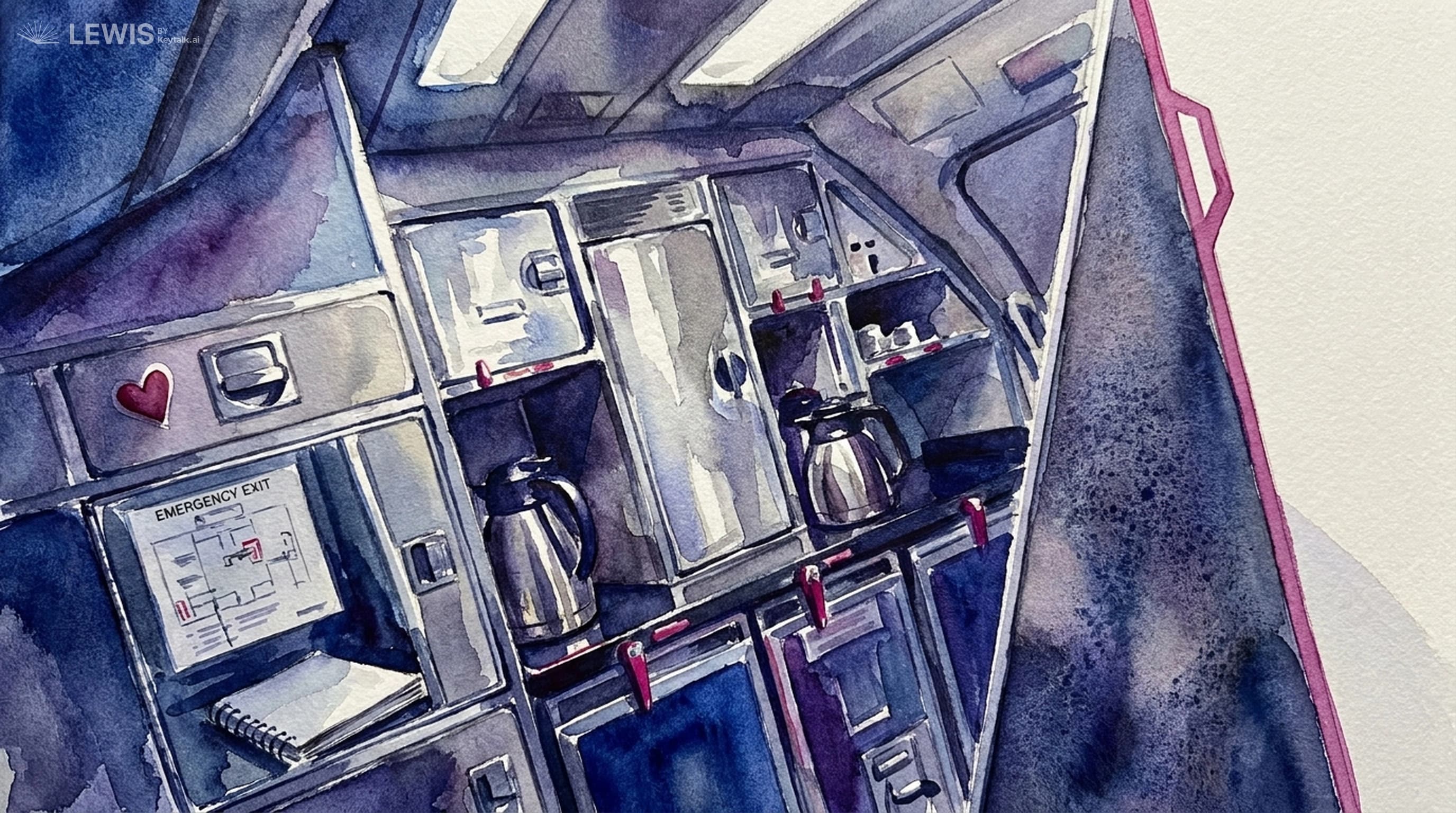
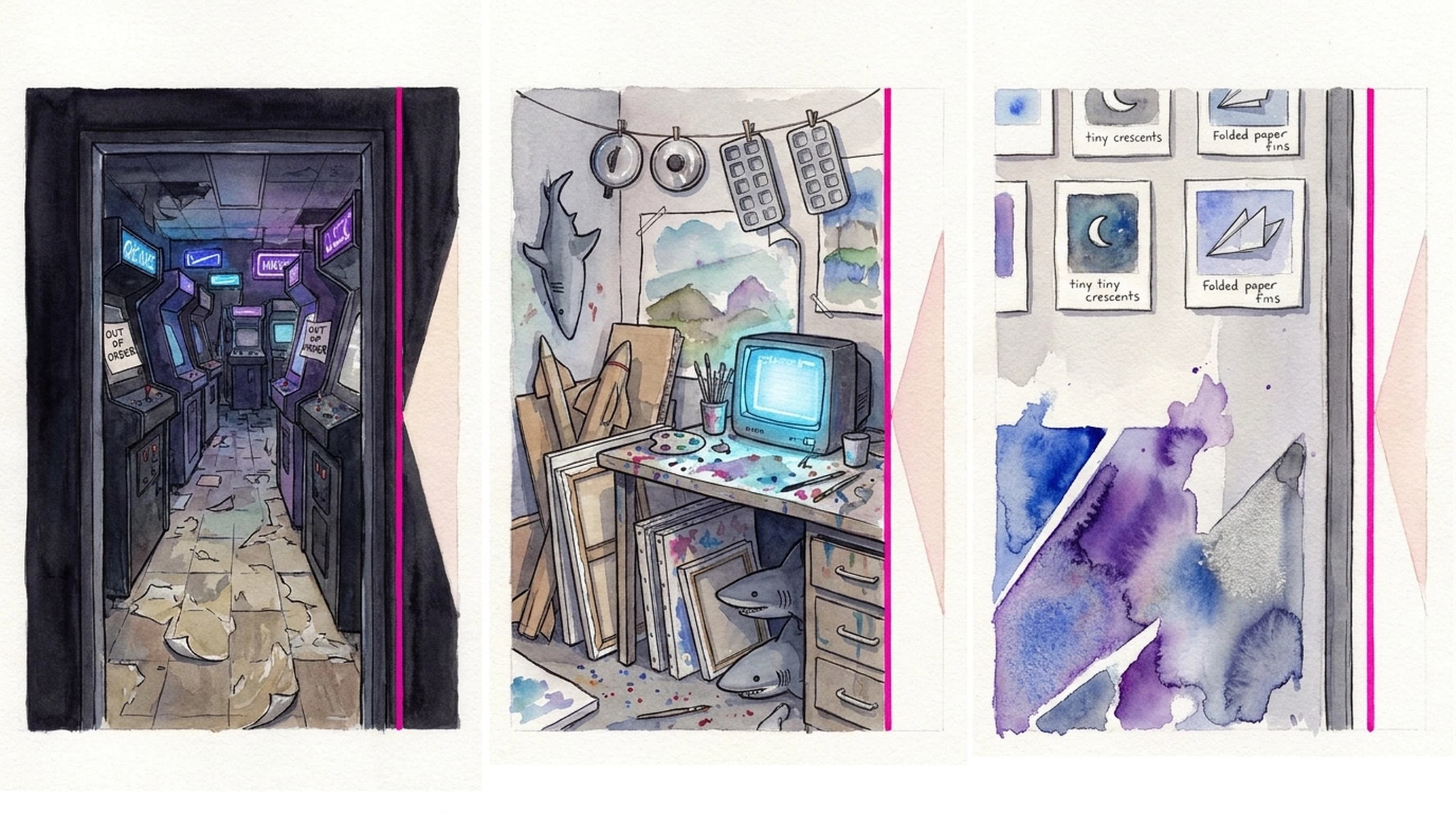
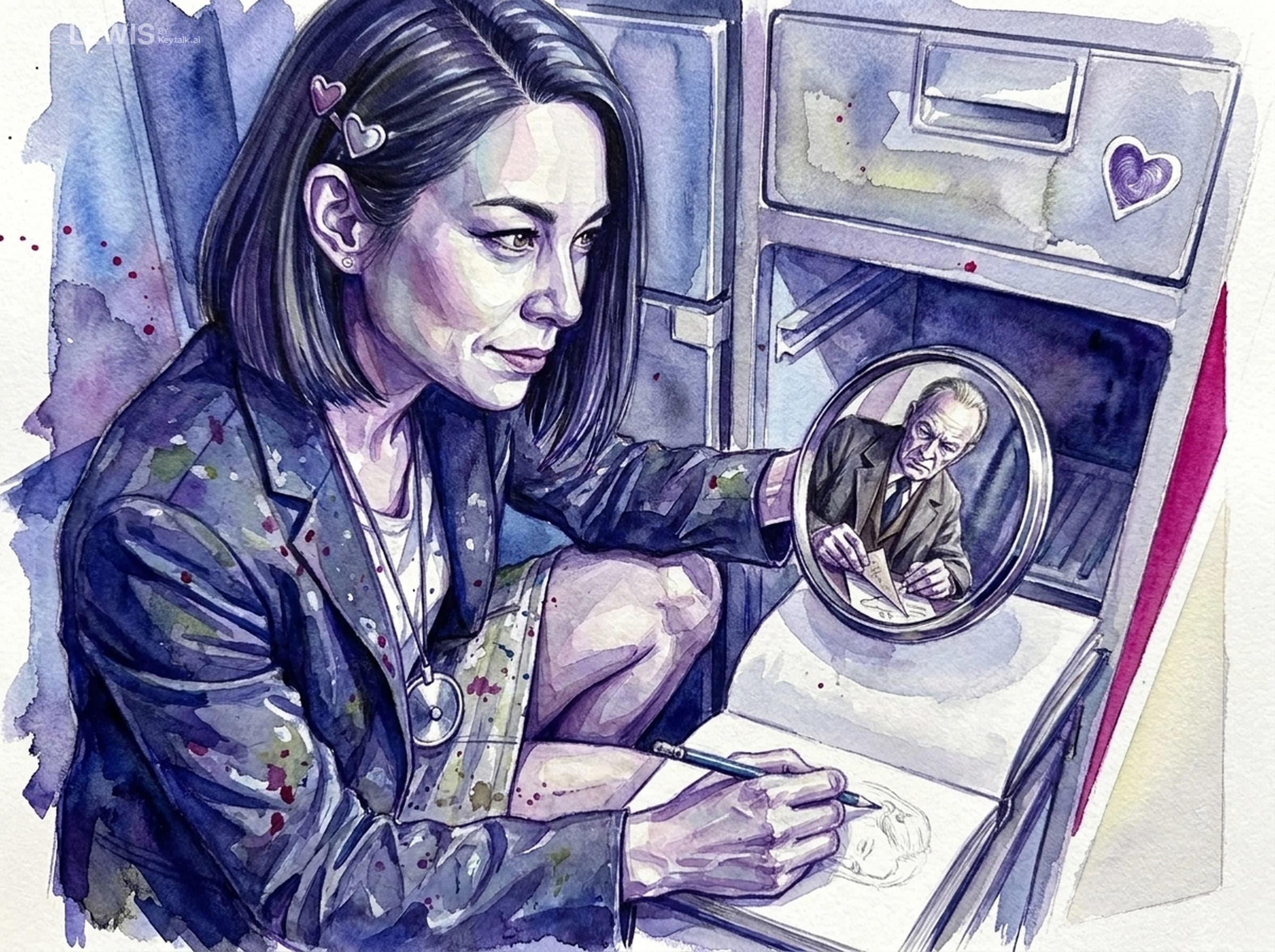
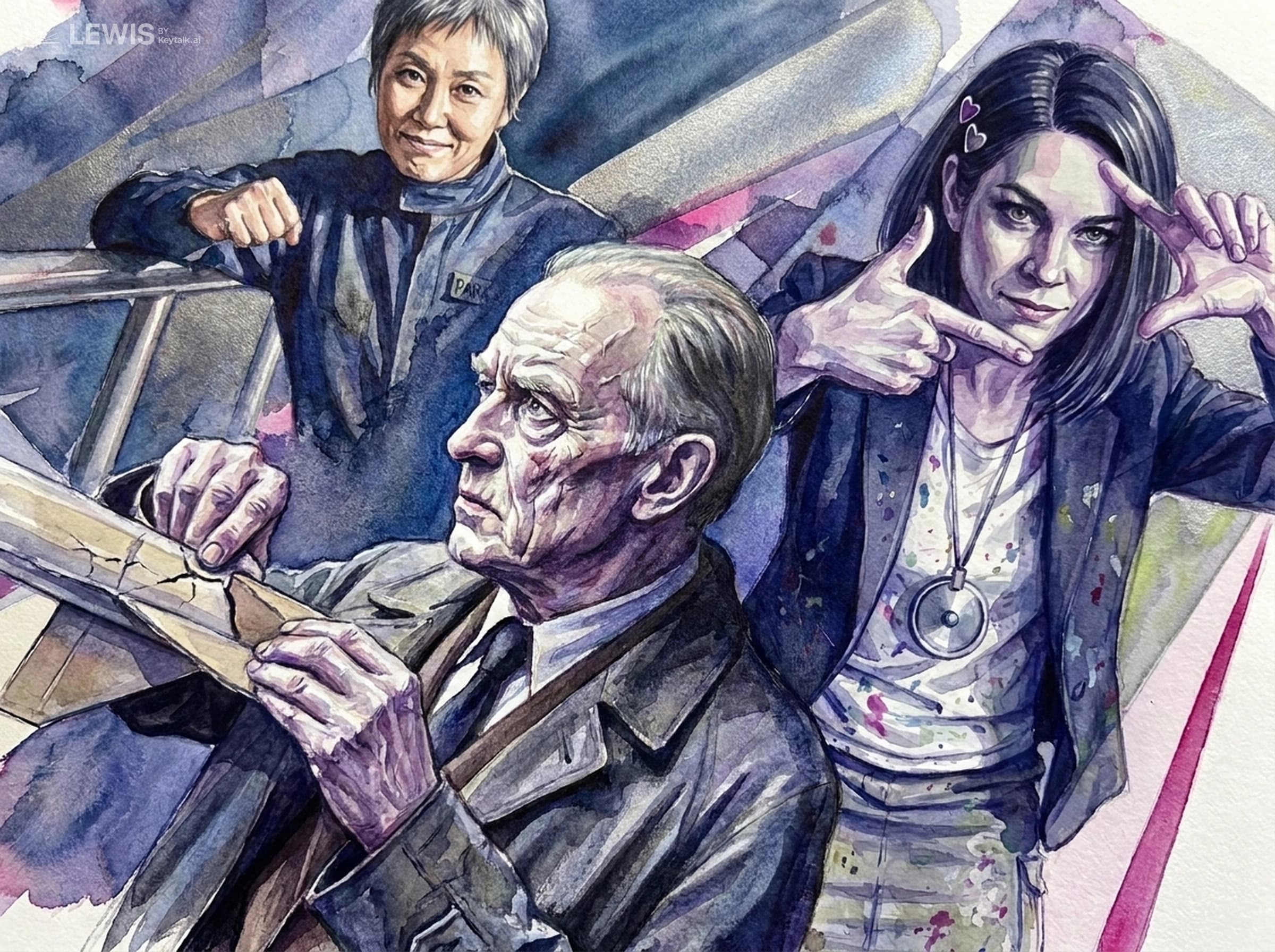
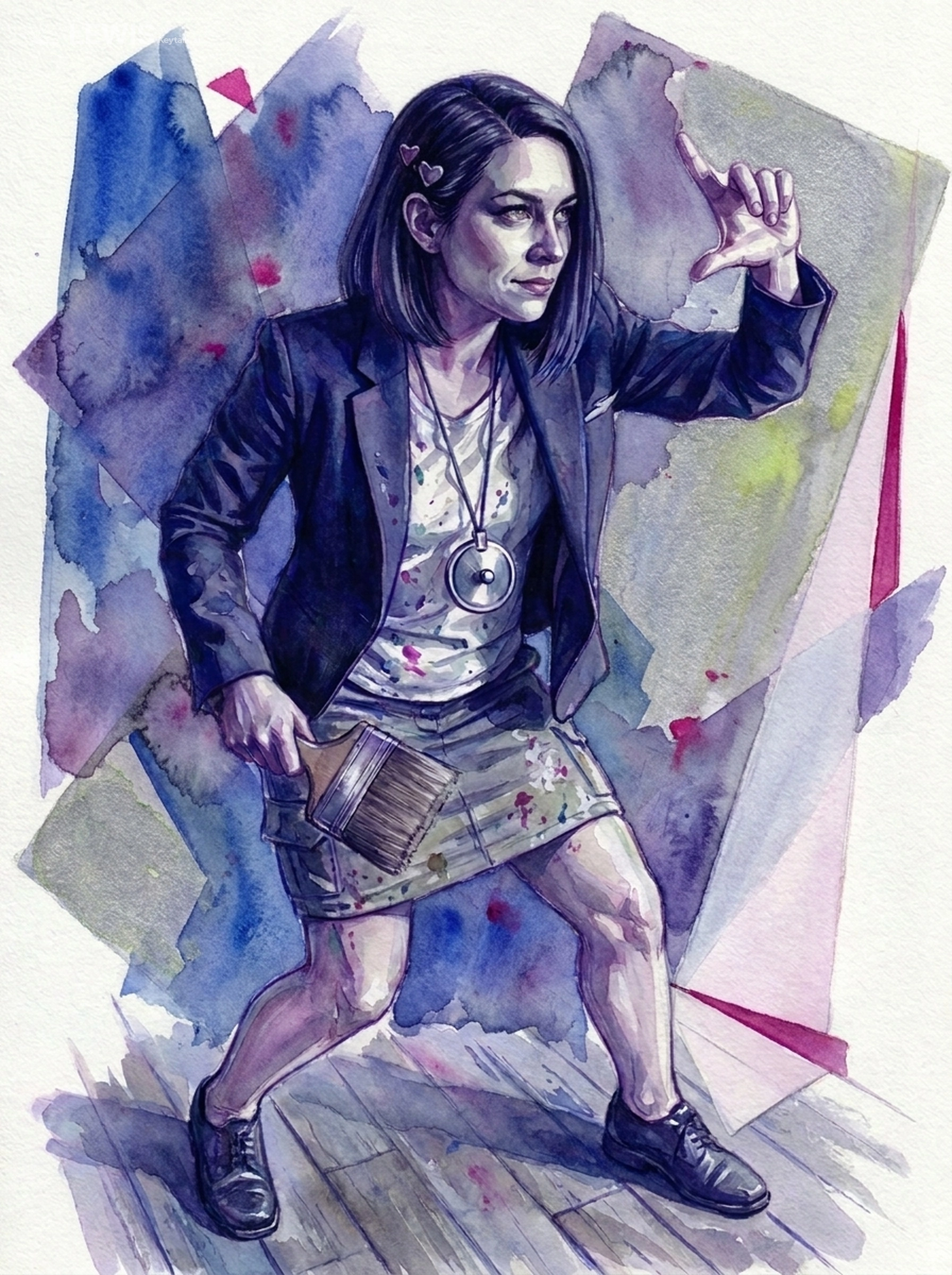
At twenty-three, Sandra Han has already learned to turn trespass into charm. During her years as a Korean-German flight attendant, she sketched passengers without permission, catching them in coffee-pot lids, ice trays, and dark cabin windows. After settling in Seoul, she enlarges those stolen angles into gaudy espionage paintings populated by cardboard missiles, rubber sharks, and villains in bad wigs. Critics call her a prodigy. Sandra accepts the praise alone, while Park Jae-hyun builds her props, Choi Eun-ho writes her deliberately clumsy broadcasts, and Oh Mi-sook performs the dangerous falls hidden inside her live tableaux.
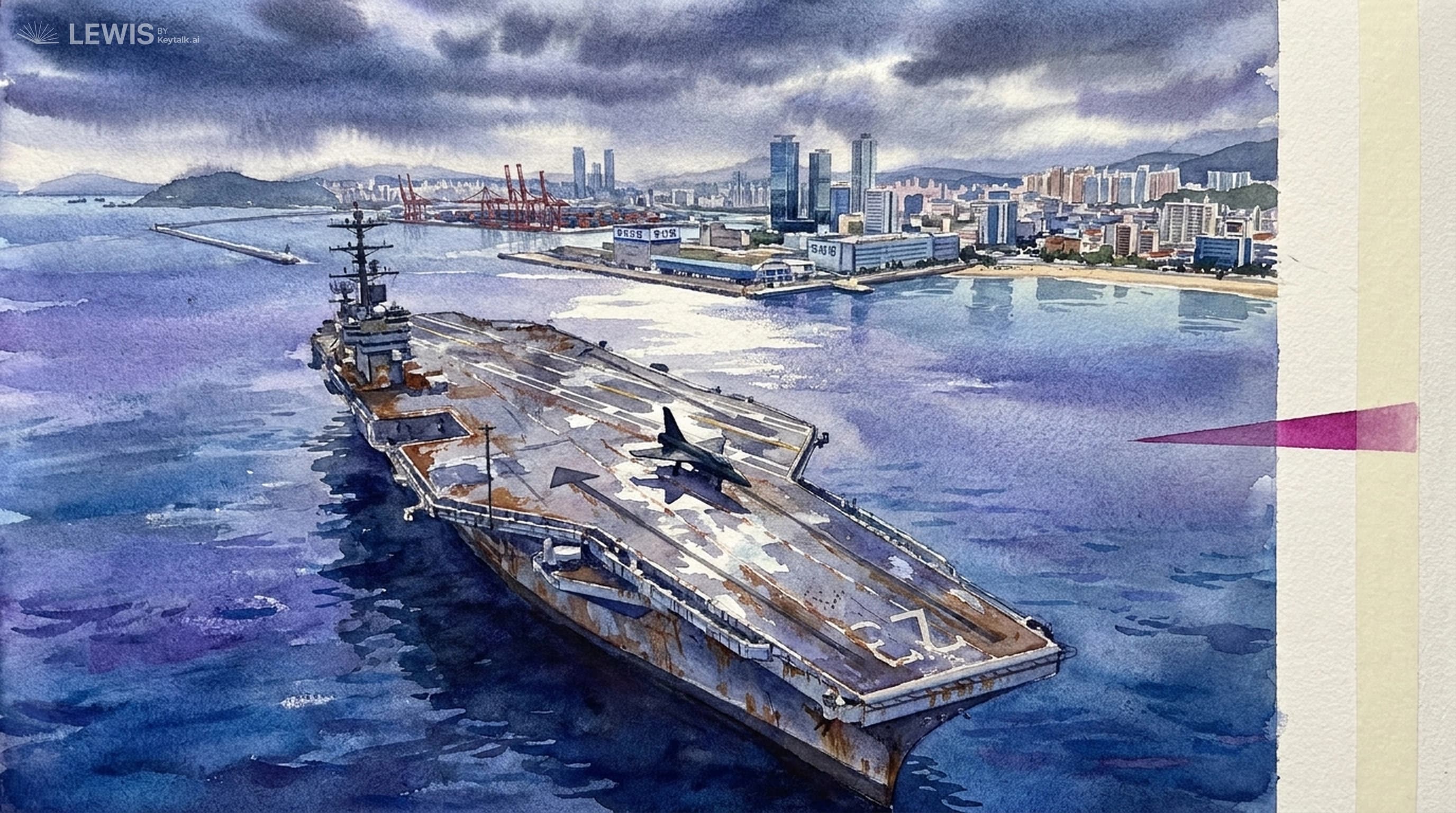
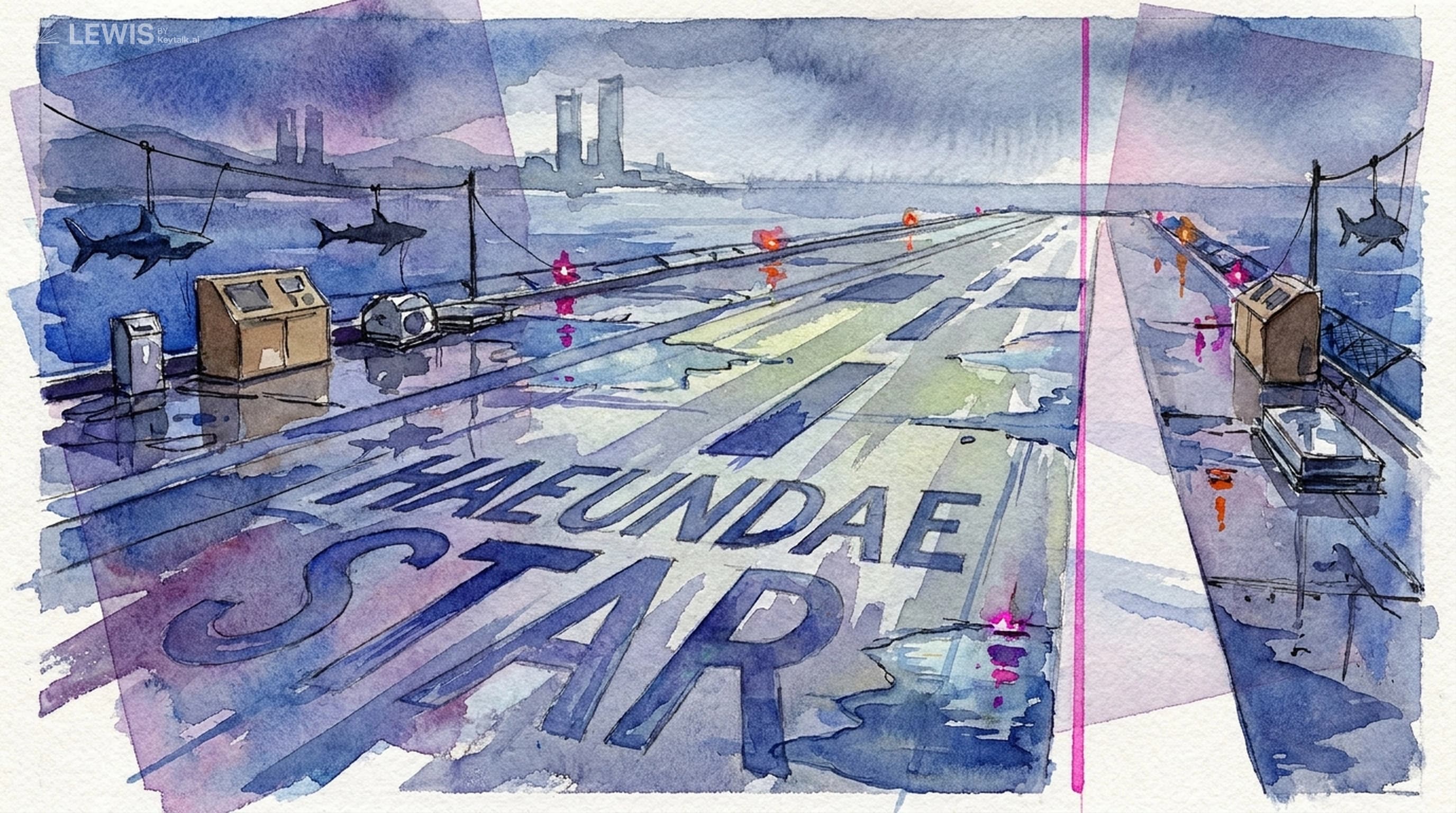
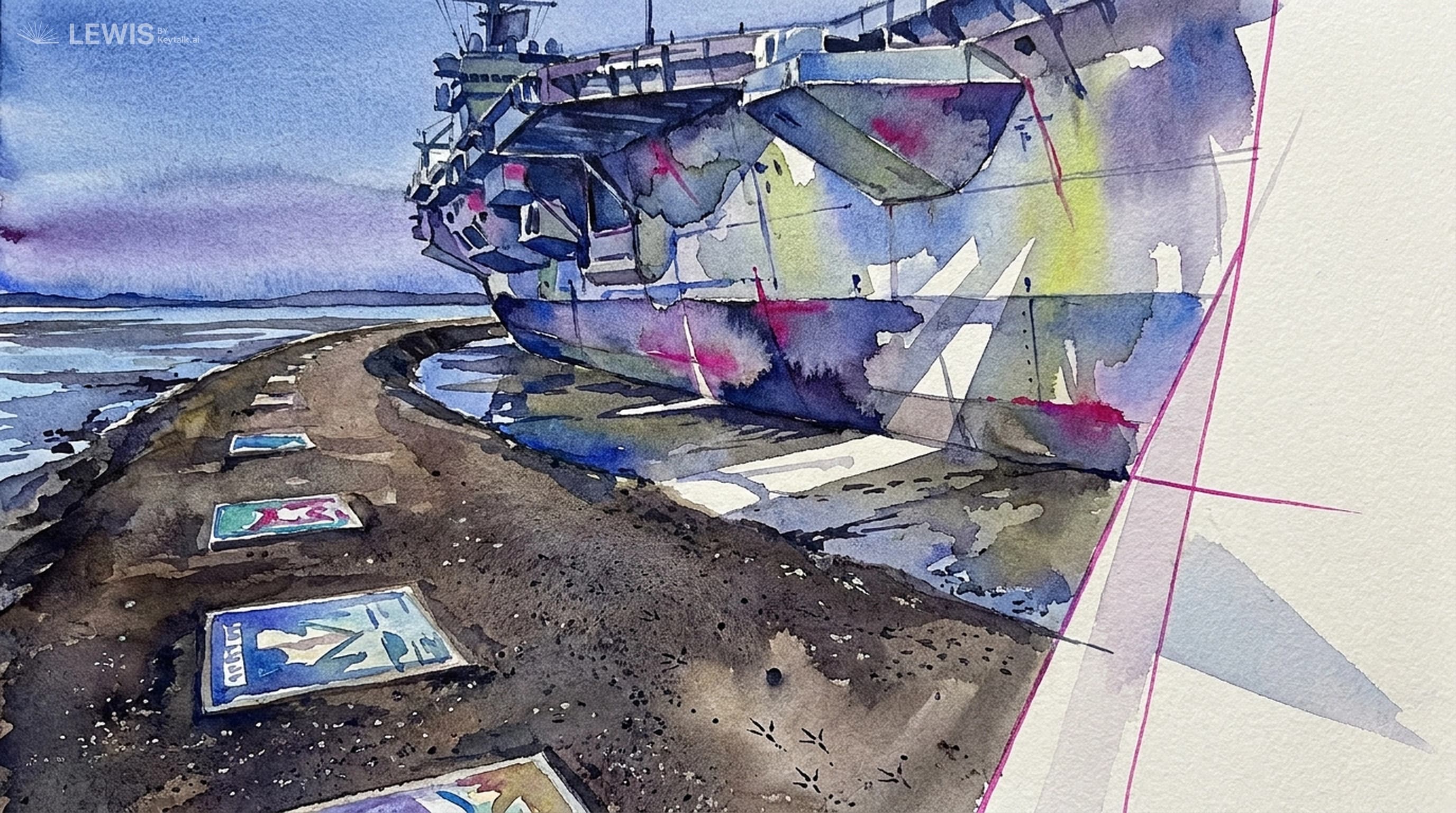
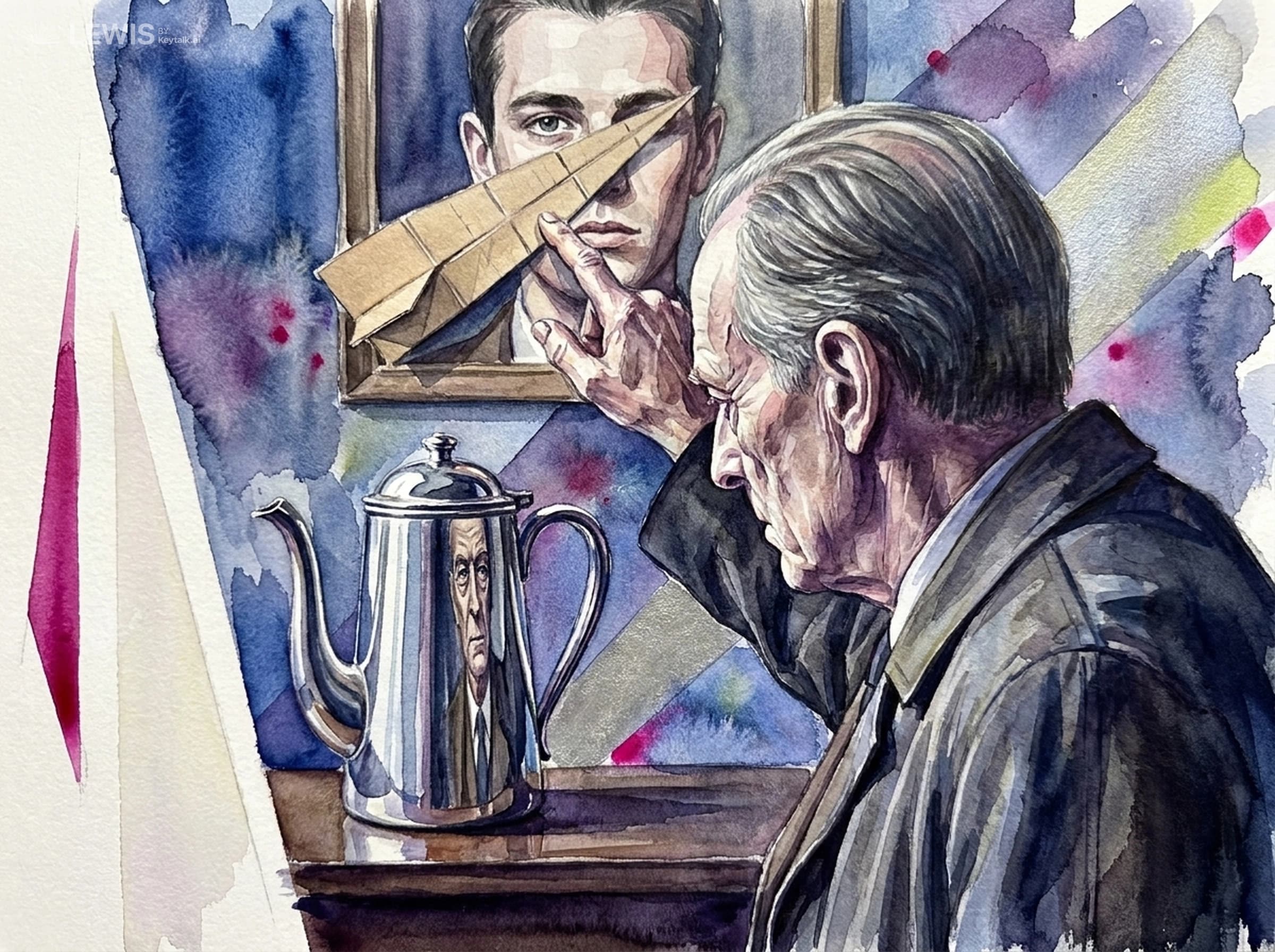
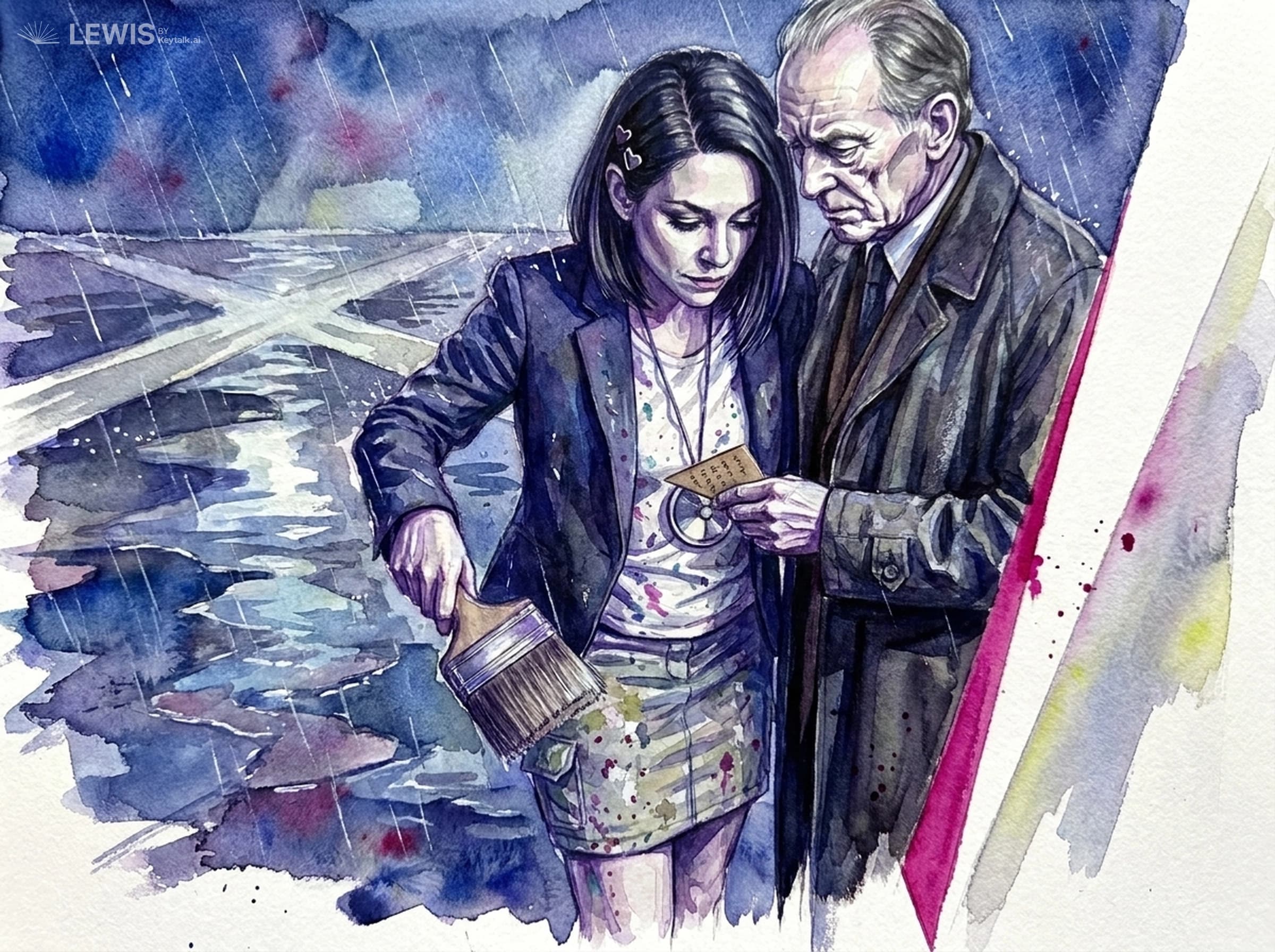
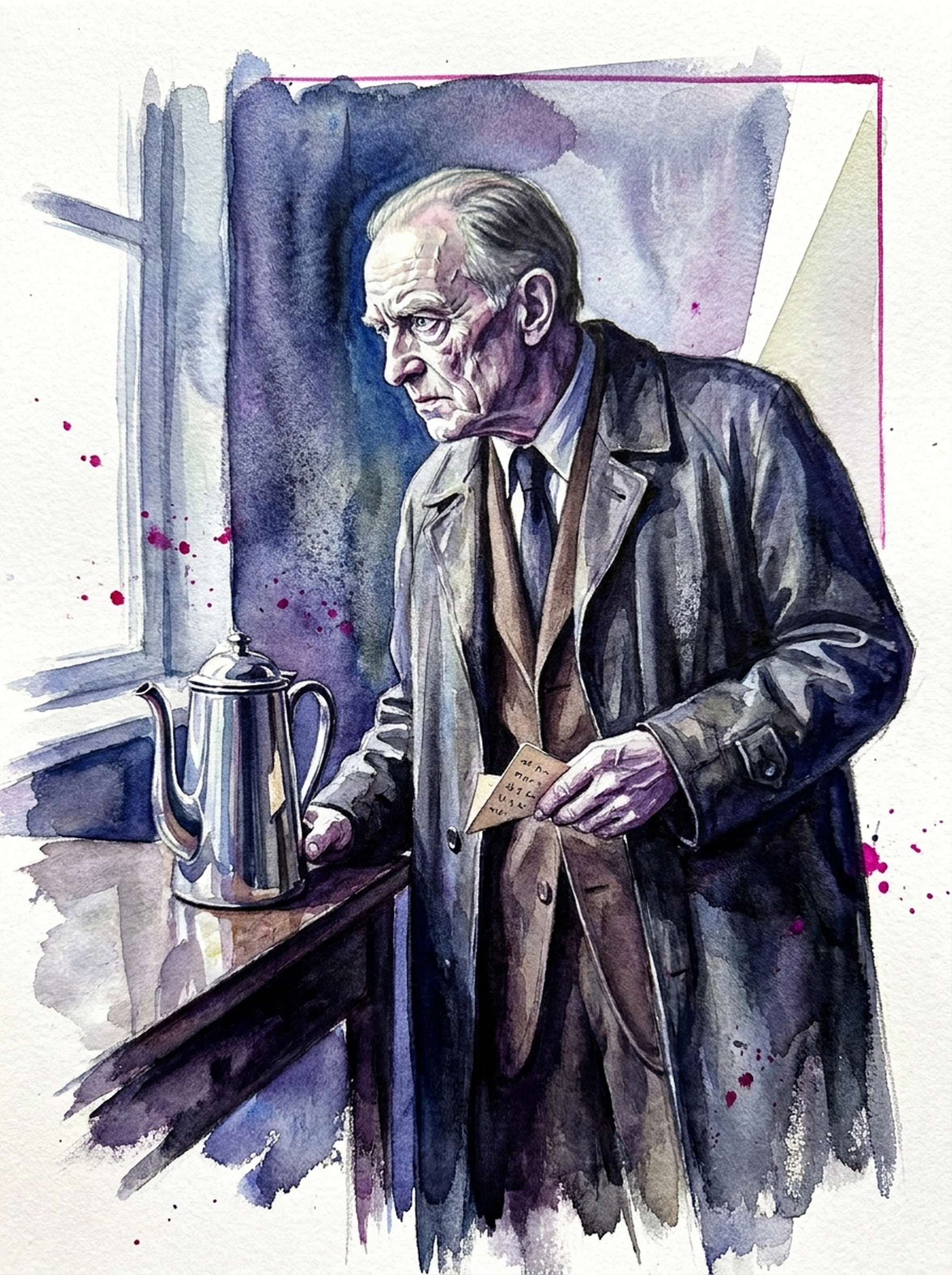
Sandra’s first international retrospective opens aboard the Haeundae Star, a decommissioned aircraft carrier moored off Busan. Its centerpiece is the flight deck itself, painted as a false runway that appears to plunge through the ship when seen from above. Dieter Voss, hired to pose as a trench-coated villain, recognizes his younger reflection in Sandra’s earliest celebrated portrait. He folds one of her cardboard missiles into a precise old intelligence cipher and asks where she obtained the image. Sandra claims she invented it. Their argument ends when the carrier lurches hard enough to send a rubber shark swinging through a wall.
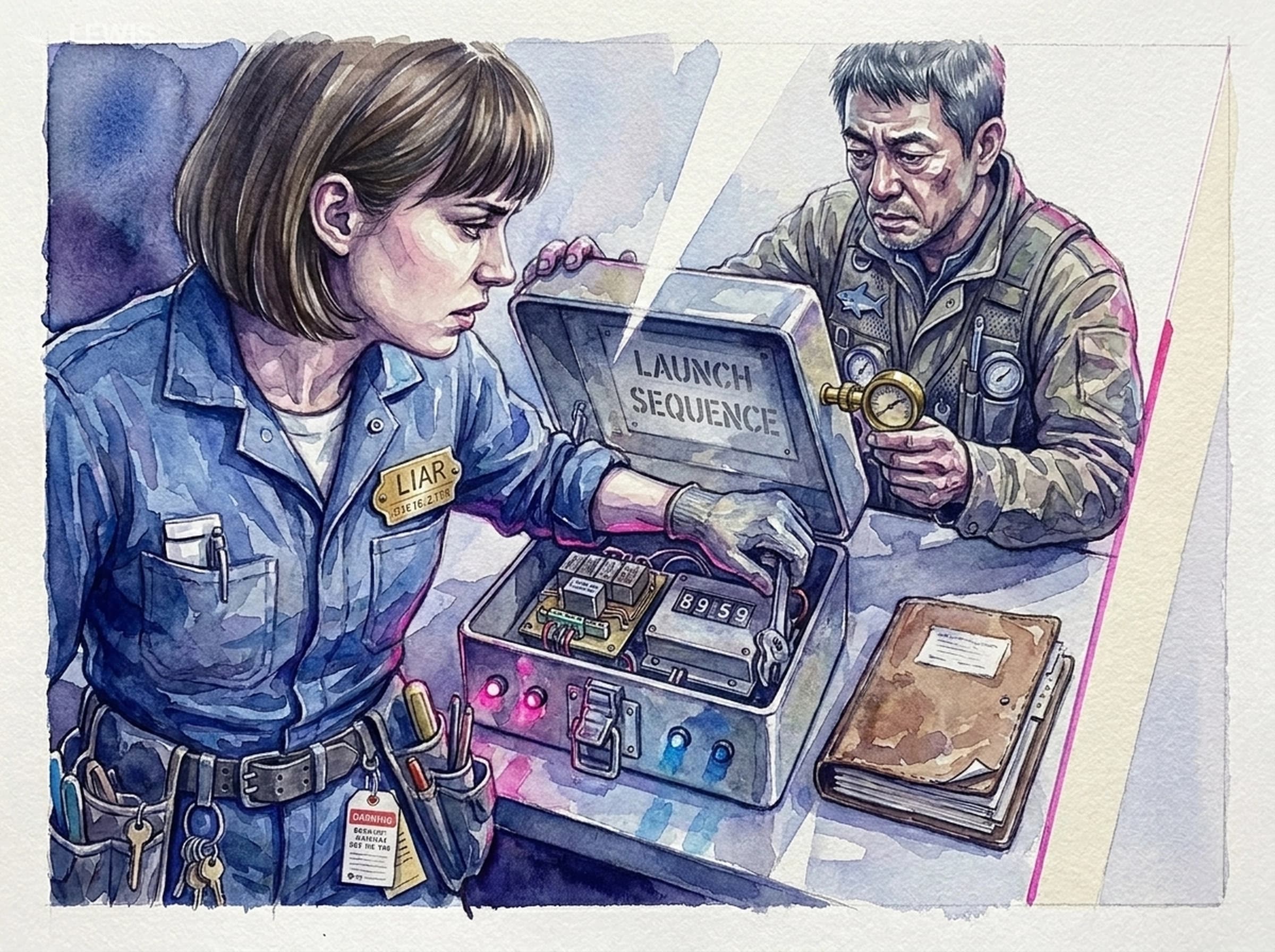
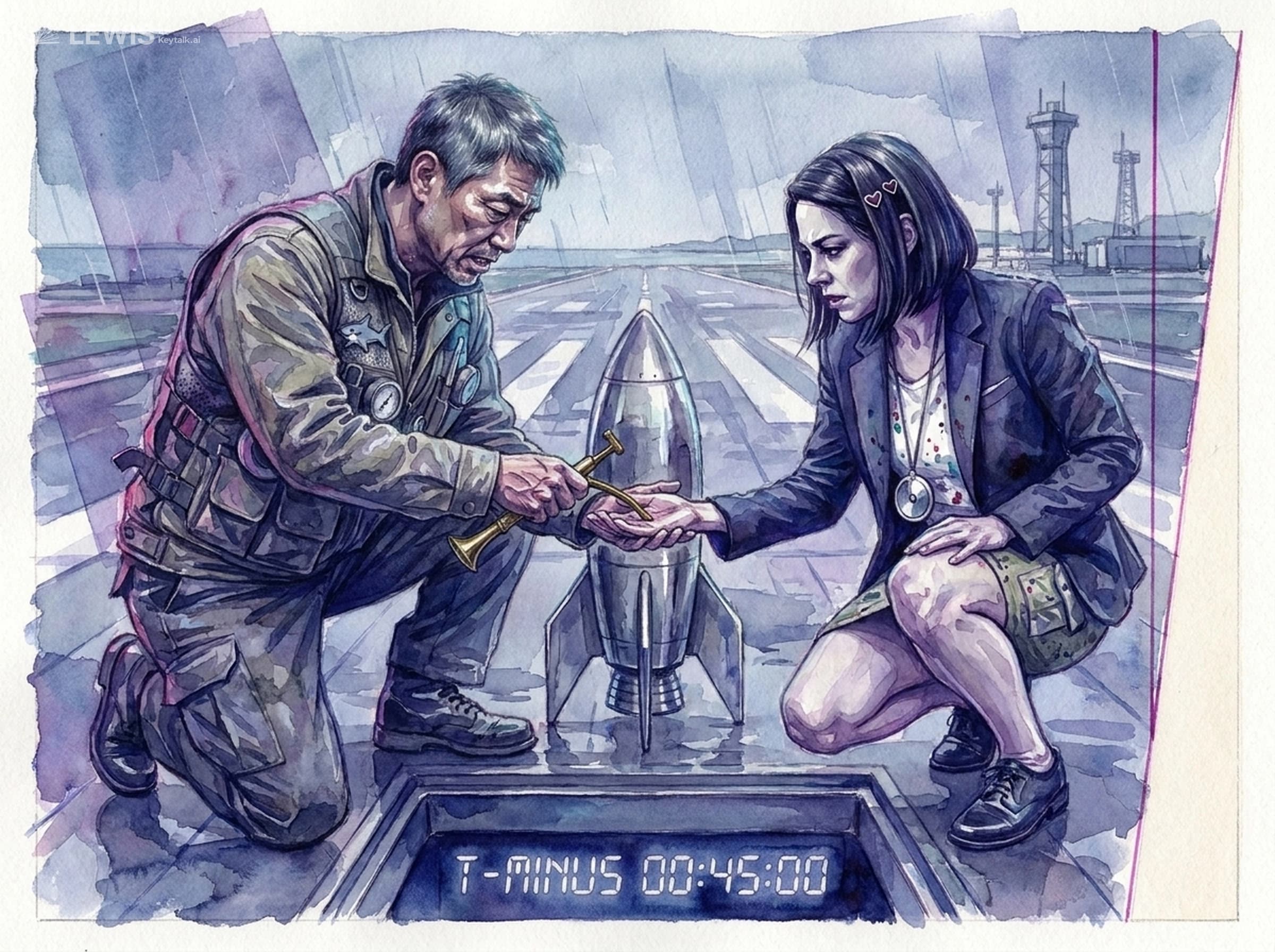
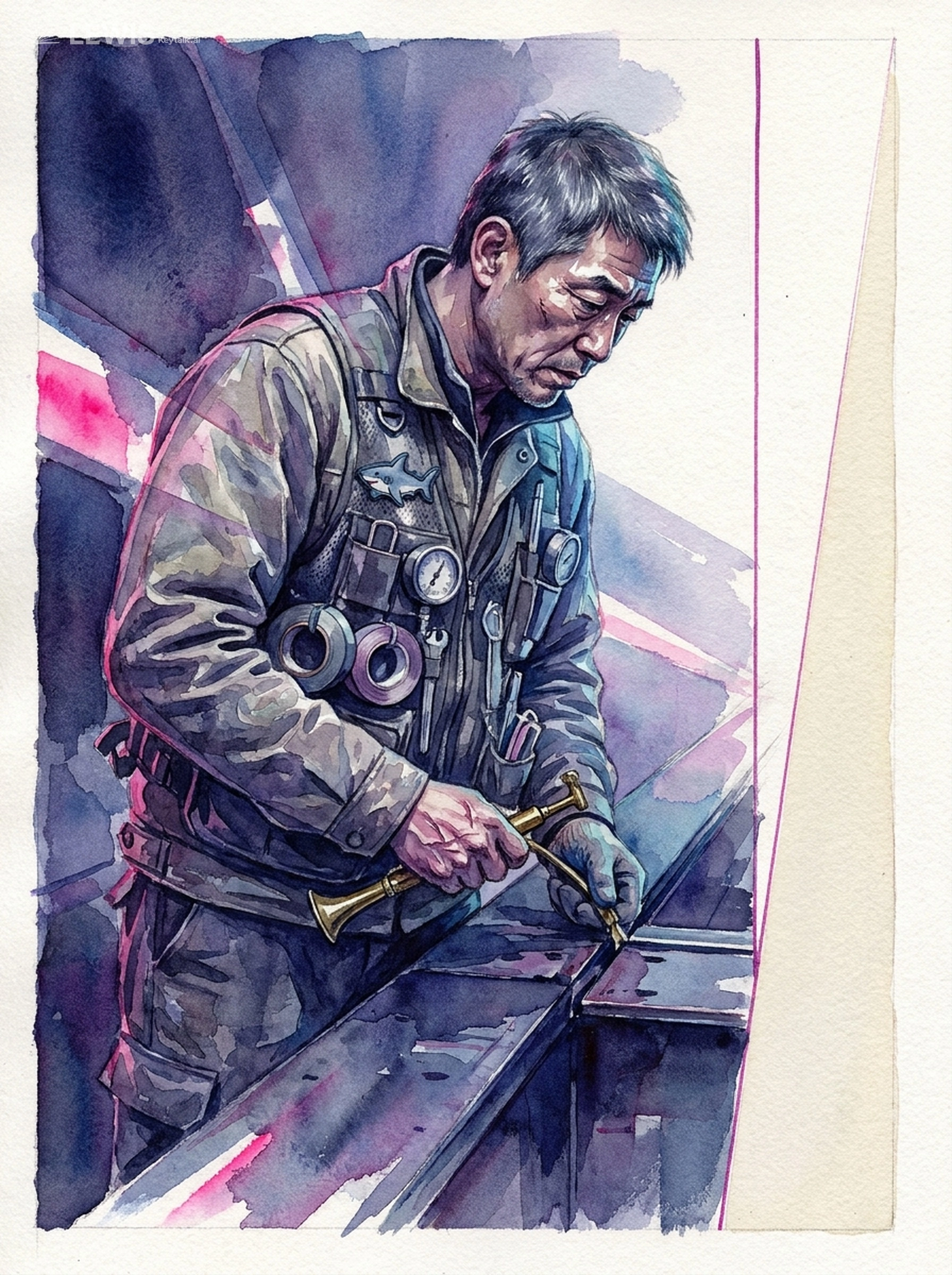
Kang Bo-ra discovers that the moorings have been severed and the engines restarted through machinery she secretly maintained for unauthorized demonstrations. The carrier is drifting toward Busan, and a museum alarm reports ninety minutes until a launch sequence completes. Government liaison Ryu Gyeong-tae calmly locks the visitors inside the hangar “for evacuation control,” then sends technicians below. Park taps the exhibition’s silver missile with his brass gauge. Instead of the hollow ring of his sculpture, it answers with a dense metallic thud.
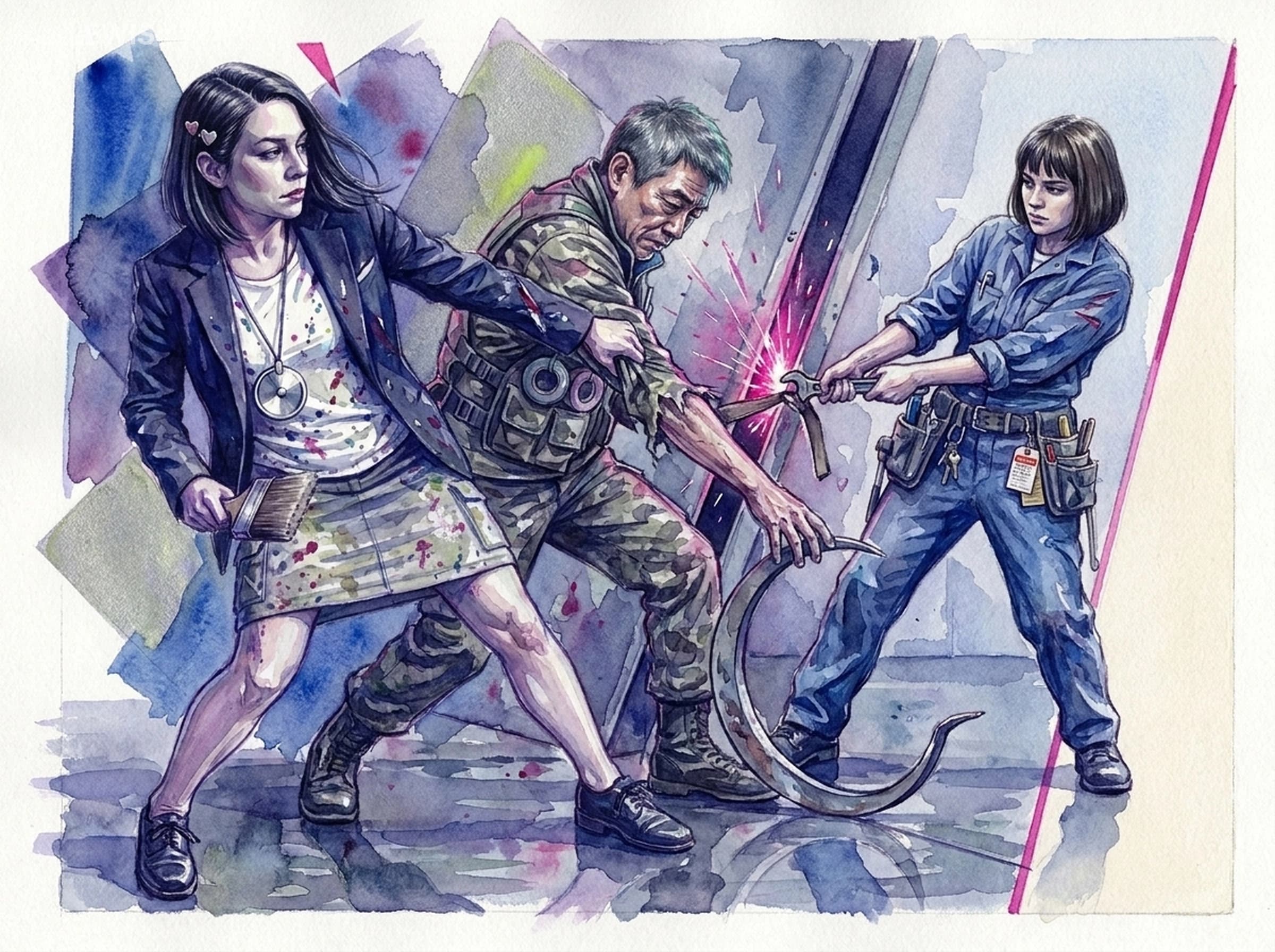
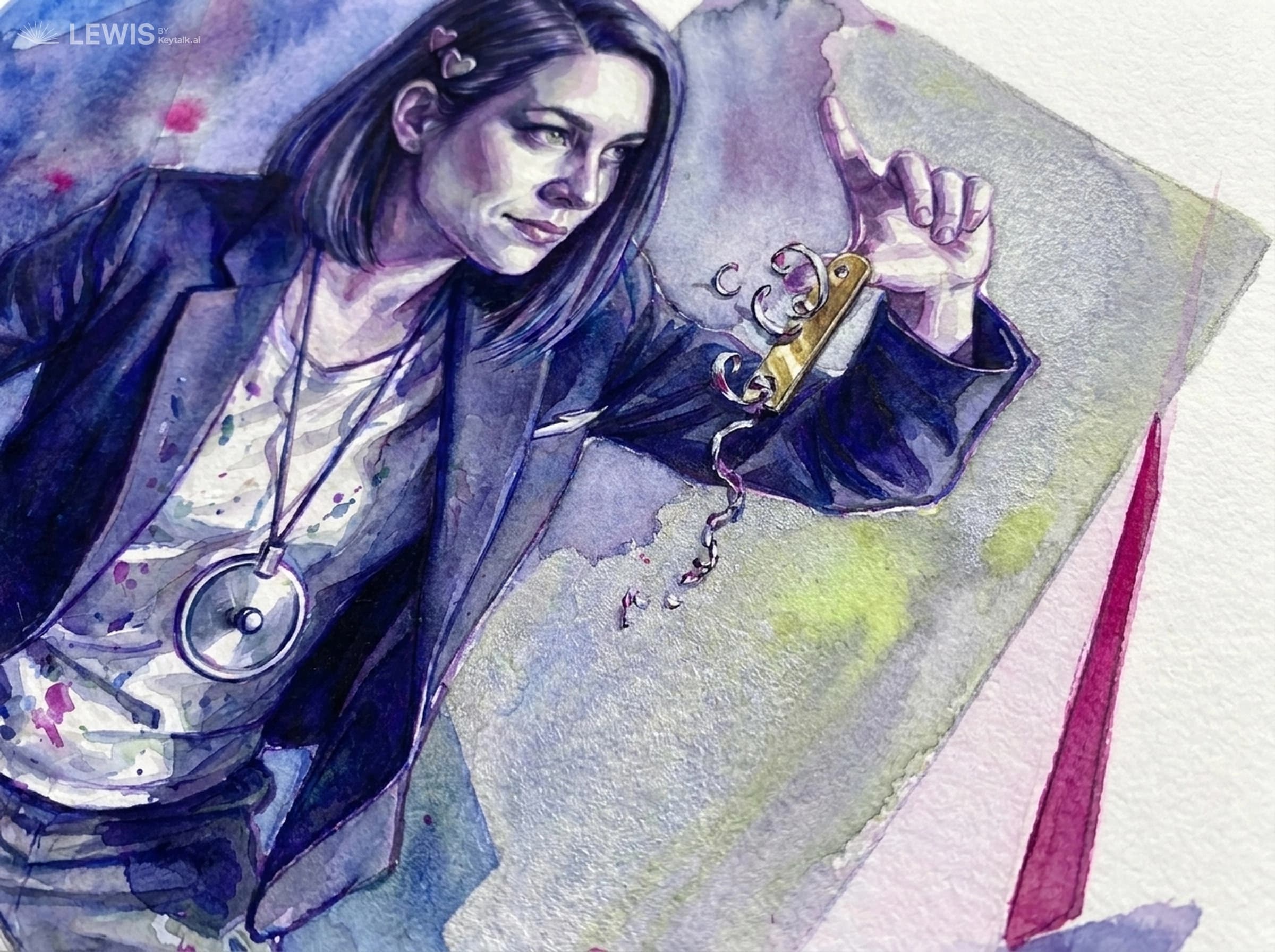
Because moving or opening the object would destroy evidence and violate Kang’s conservation authority, Park and Sandra inspect it in place while the deck pitches beneath them. Park finds his usual blue crescent on its casing, but Sandra notices that the mark bends incorrectly in a puddle’s reflection. Someone copied his signature onto a working weapon. When Park tries to block her view and remeasure it himself, a panel shifts under his hand and traps his sleeve beside a live relay. Sandra cuts apart her fitted exhibition jacket to pull him free, leaving the cameras to broadcast her crouched beside the weapon she had advertised as harmless art.
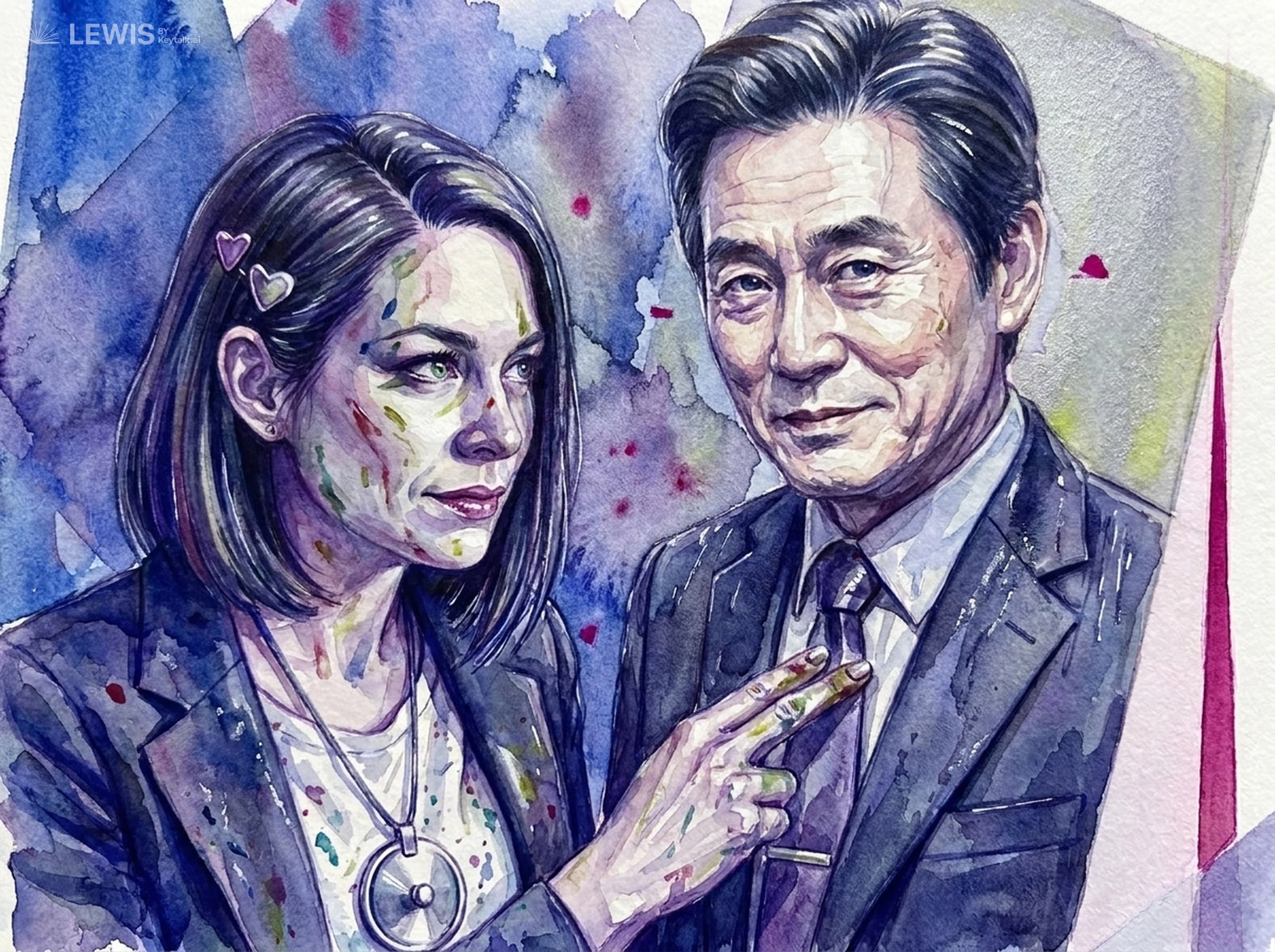
Ryu enters the gallery and frames Sandra between his thumbs. He admits that his dismissed propaganda unit replaced the sculpture and restarted the carrier. The missile will detonate harmlessly at sea after passing over Busan, producing a magnificent emergency without casualties. The spectacle will restore his unit’s funding, while Sandra’s work will become the image through which the world remembers it. He offers her sole credit for the “intervention.” Sandra appears to accept, then smears silver paint across his immaculate tie clip and uses its warped reflection to glimpse the armed technicians behind her. Oh Mi-sook crashes a breakaway console onto them, giving the crew time to escape into the service passages.
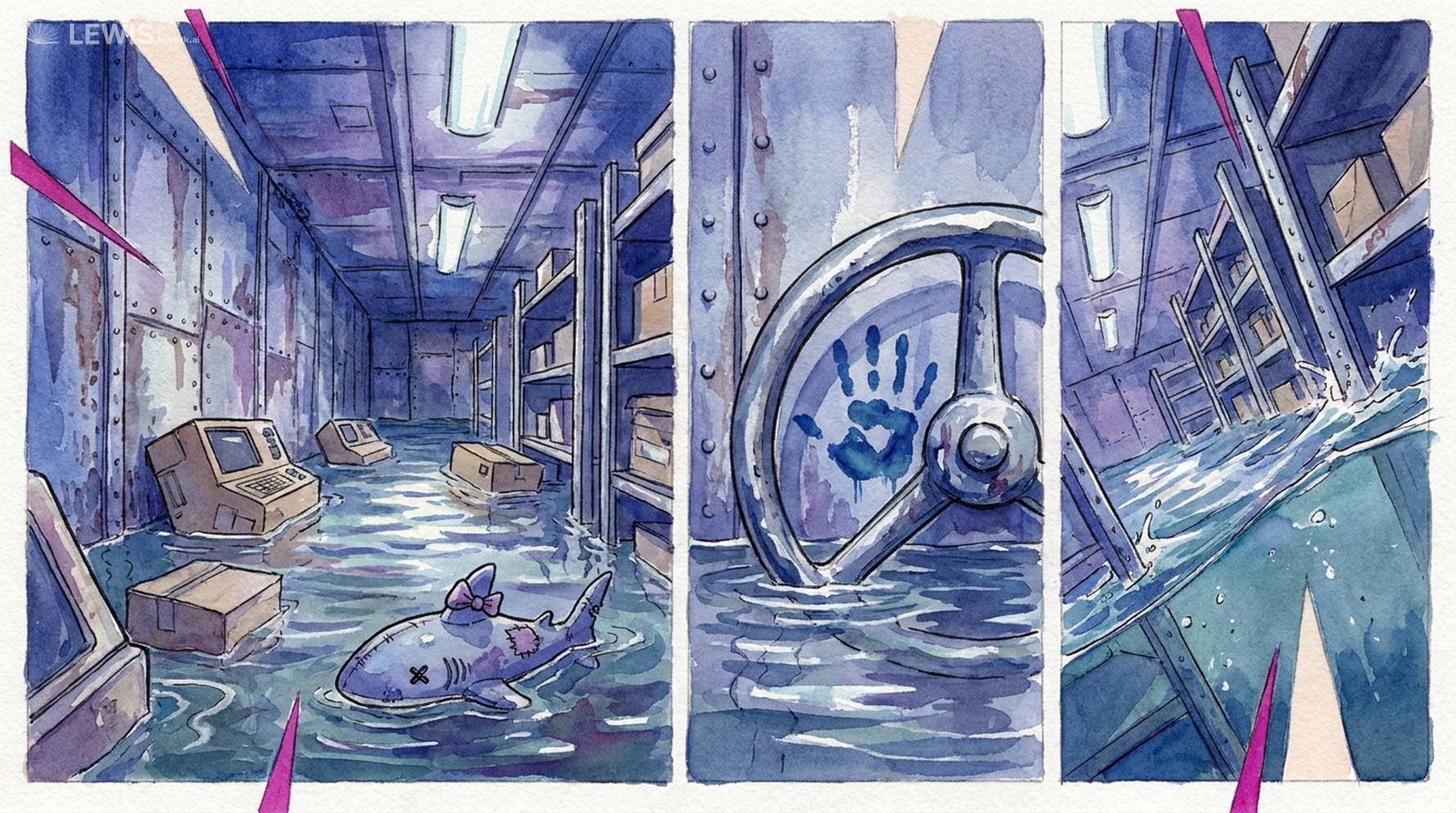
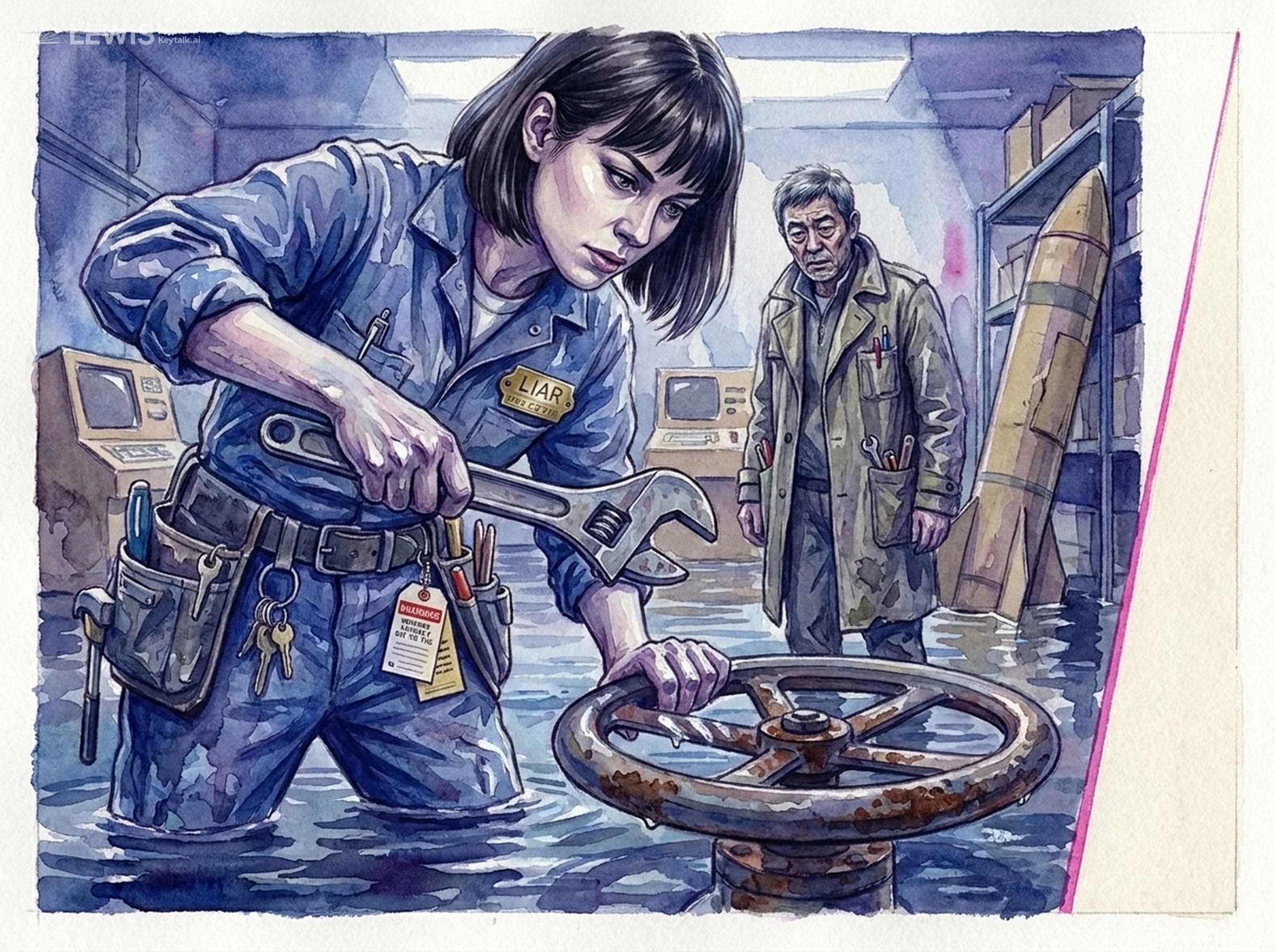
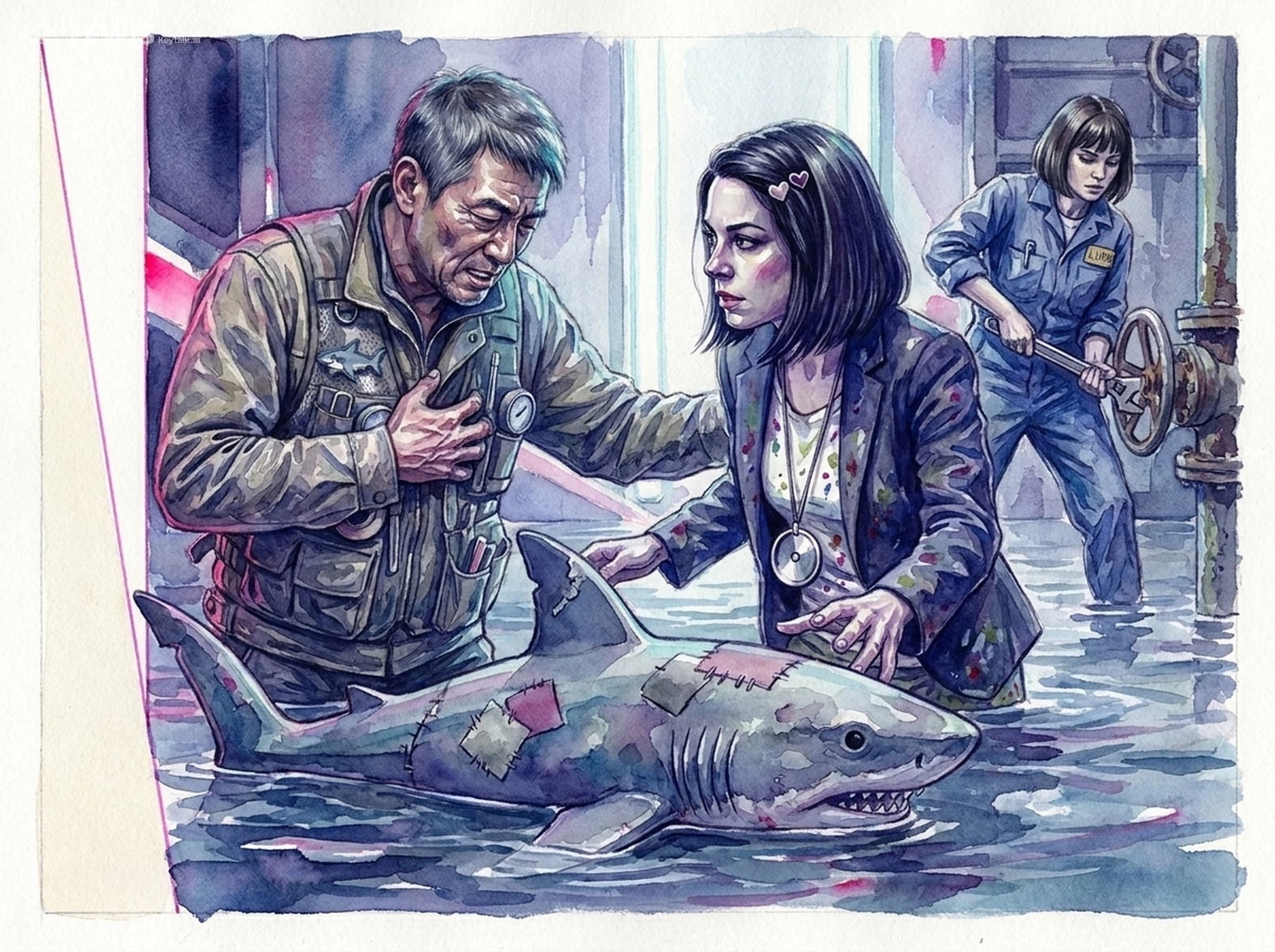
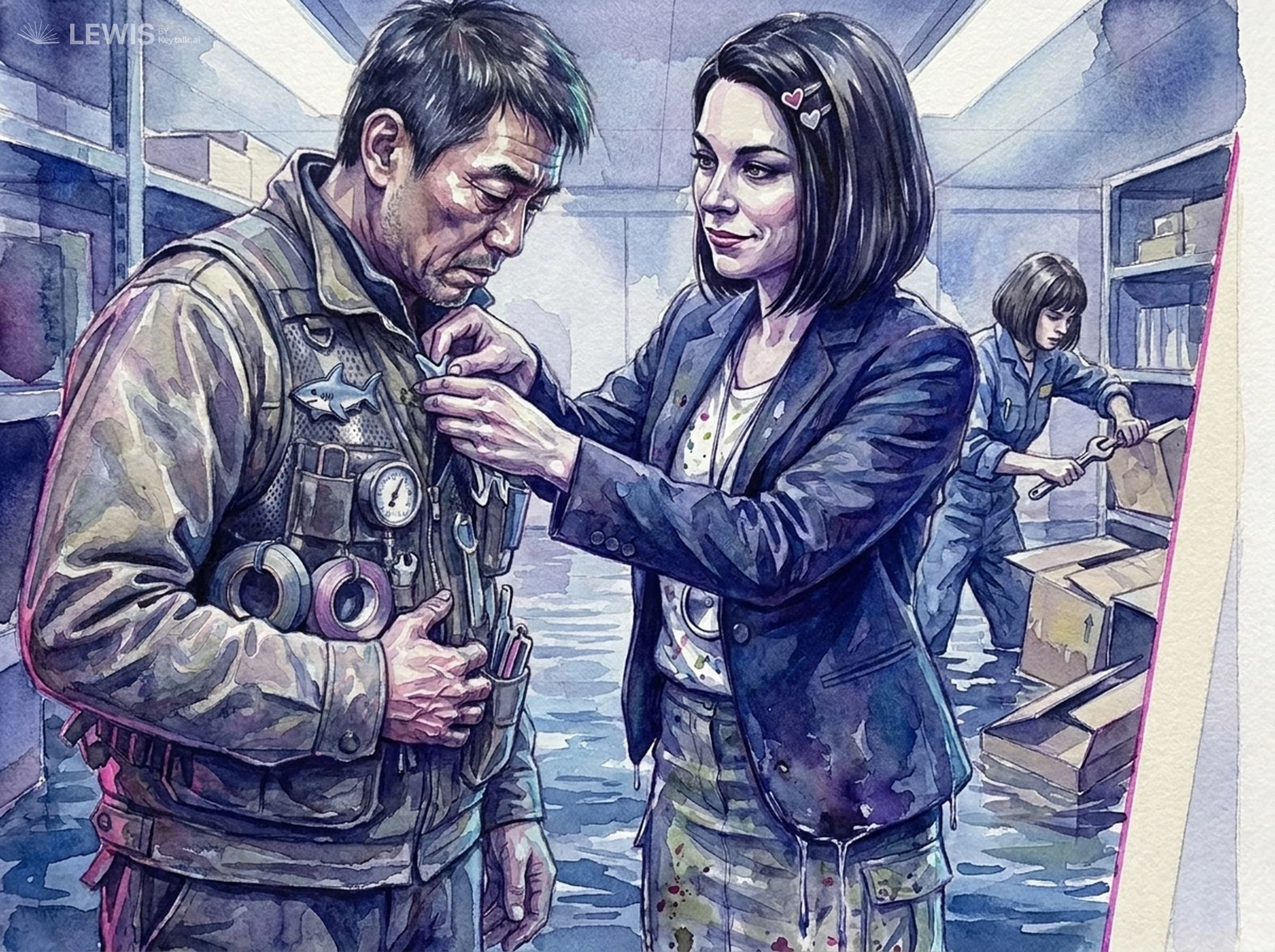
Kang leads Sandra, Park, Dieter, Choi, and Oh Mi-sook toward the launch compartments while tearing prohibited pages from her maintenance binder to mark their route. Salt water floods the lower prop hold. Park uses Sandra’s oldest rubber shark, patched years earlier with aircraft sealant, as a float and discovers that the rising water is entering through a valve opened from inside. He wedges his body against the wheel while Kang closes it, but the effort ruins the hand he uses for fine model work. When Sandra calls him “foreground” and orders him onward, he drops the shark at her feet and refuses to move until she says his name. She does, quietly, then clips the ridiculous shark back onto his harness herself.
Dieter recognizes the launch system as a hybrid of Korean naval hardware and a West German cipher he once carried between intelligence services. Sandra’s cardboard missile designs reproduce that cipher because her first sketch caught its folds in Dieter’s hands. He confesses that the coffee-pot reflection she built her career on showed him during an operation he later erased from official history. Sandra strikes the bulkhead with her brush, furious that even her theft was not wholly hers. When she redraws his cipher incorrectly to prove him mistaken, a relay activates and seals Oh Mi-sook on the far side of a watertight door. Sandra must scrape away her own marks and follow Dieter’s folds precisely to release her.
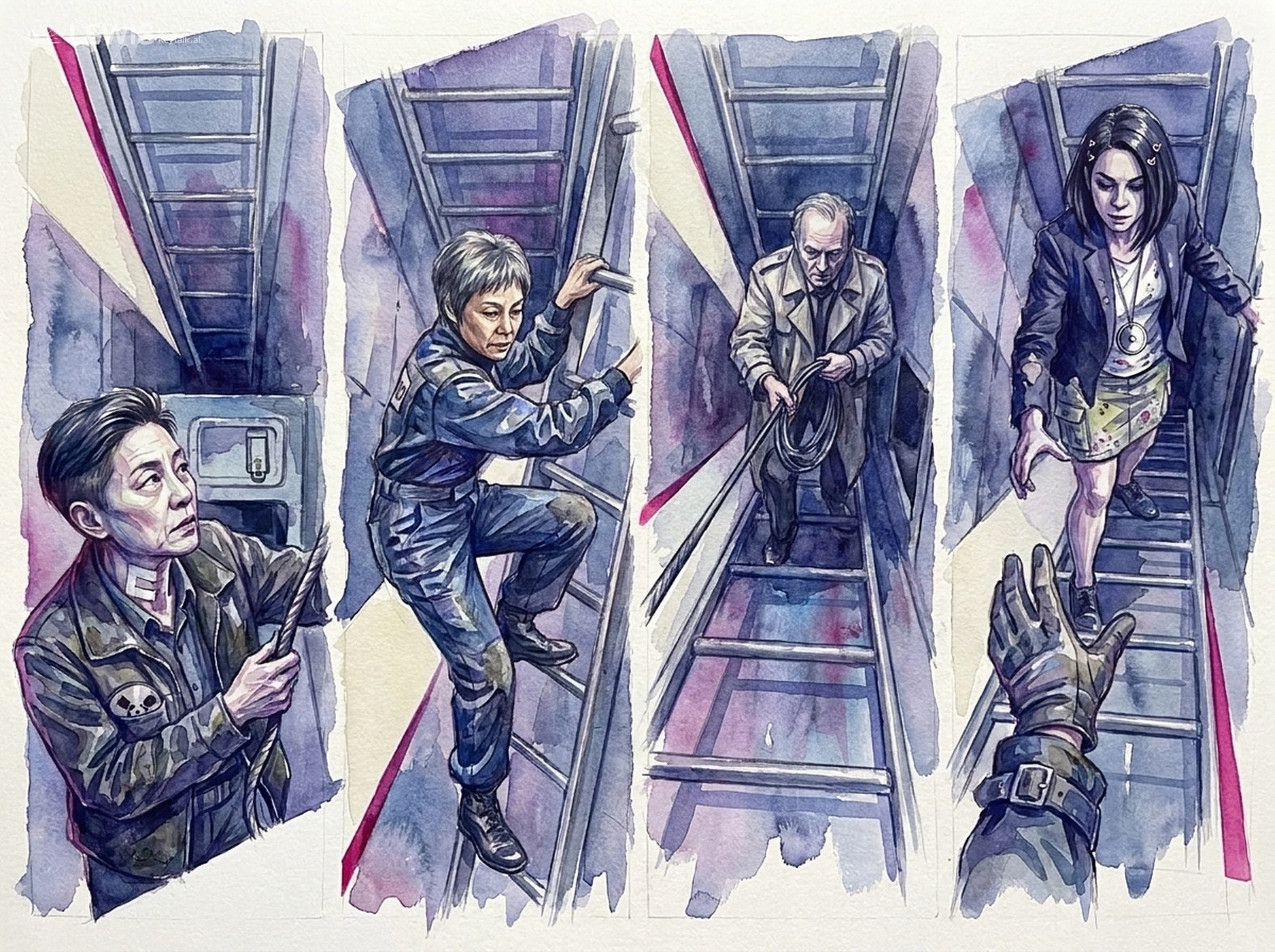
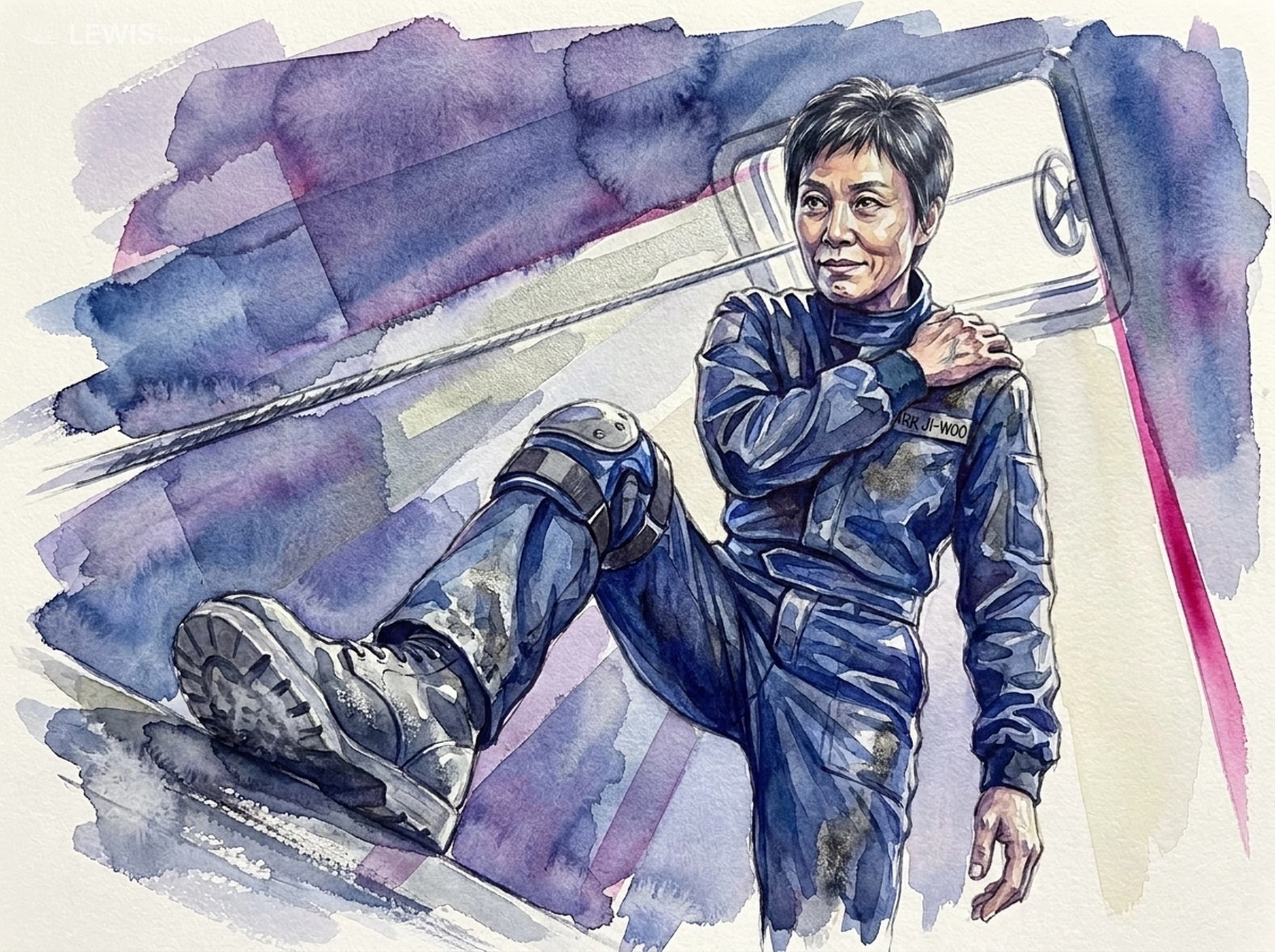
The cipher delays the launch but cannot cancel the voice authorization. Choi must reach the broadcast mast and imitate the commander whose testimony destroyed their career. Ryu’s technicians pursue the group up a ladder shaft as the carrier rolls. Oh Mi-sook’s knee gives way halfway up, and Dieter fastens her concealed brace while she hangs from one arm. She refuses to be carried. Instead, she loops a stunt cable around herself, kicks away from the ladder, and swings through an open hatch to knock the pursuing technician off balance. The fall tears her shoulder, but she lands upright and demands that Sandra remember who performed it.
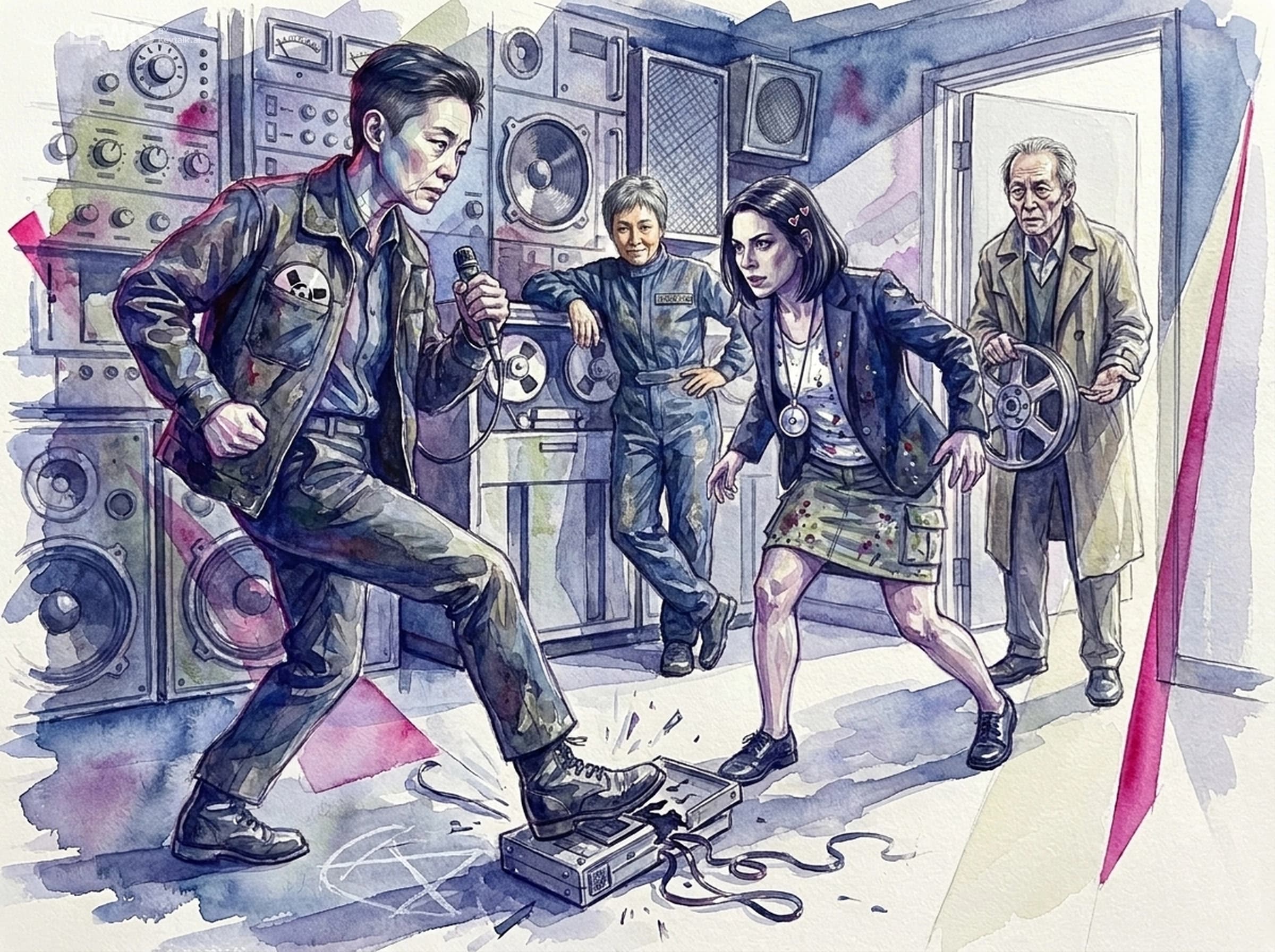
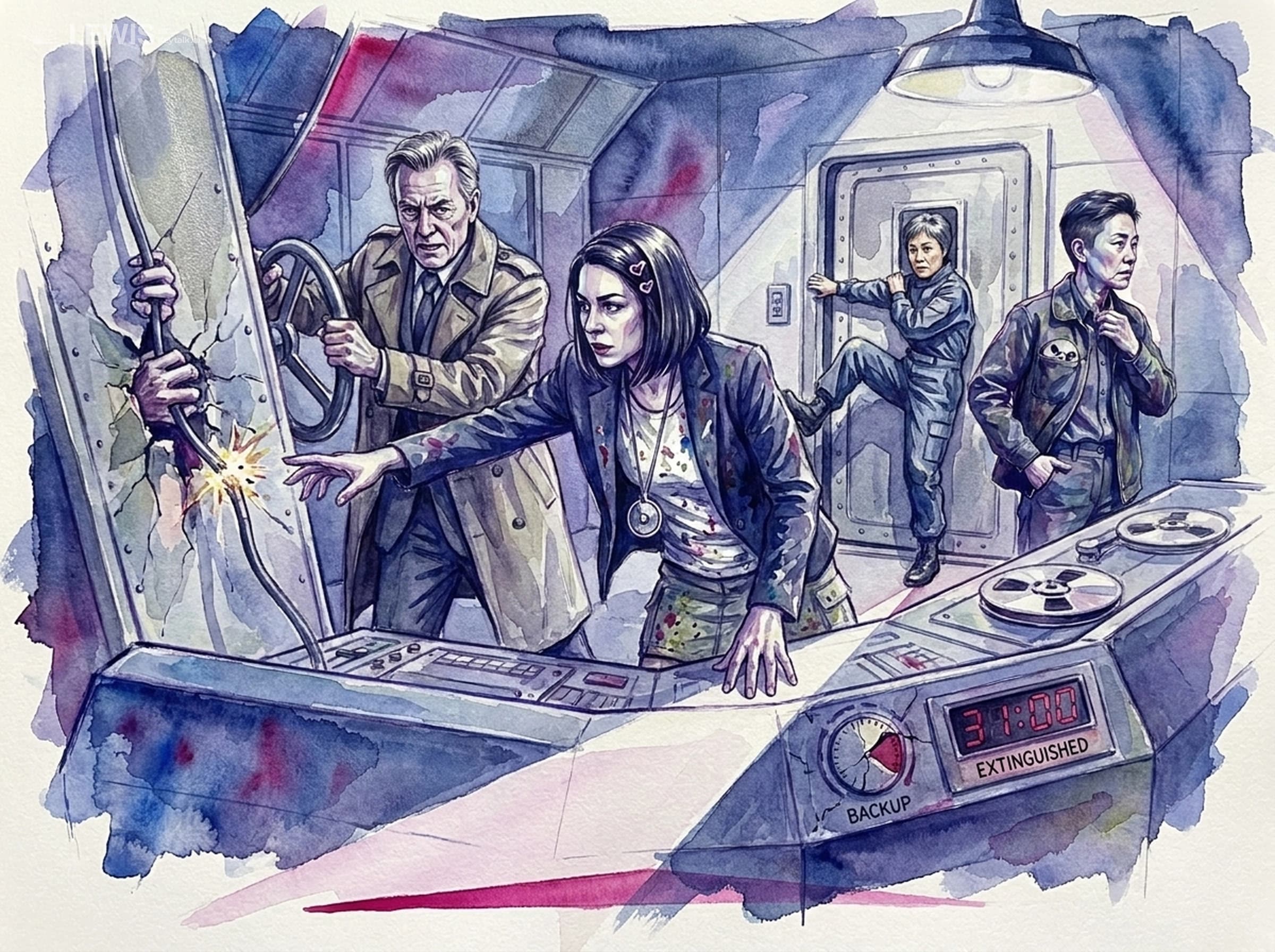
At the mast room, Choi tests the throat microphone by whispering Sandra’s name. The speaker returns Choi’s own voice, and they nearly abandon the attempt. Sandra raises her recorder, promising she will keep the performance private. Choi sees her thumb already resting on the record switch and crushes the device beneath their heel. They will perform only in the presence of witnesses. With Sandra, Dieter, and Oh Mi-sook bracing the buckled door against Ryu’s technicians, Choi assumes the dead commander’s posture and voice. The launch system accepts the counterfeit order, but Ryu cuts power to the mast by wrenching a cable from the wall with his own hands. The countdown resumes at thirty-one minutes.
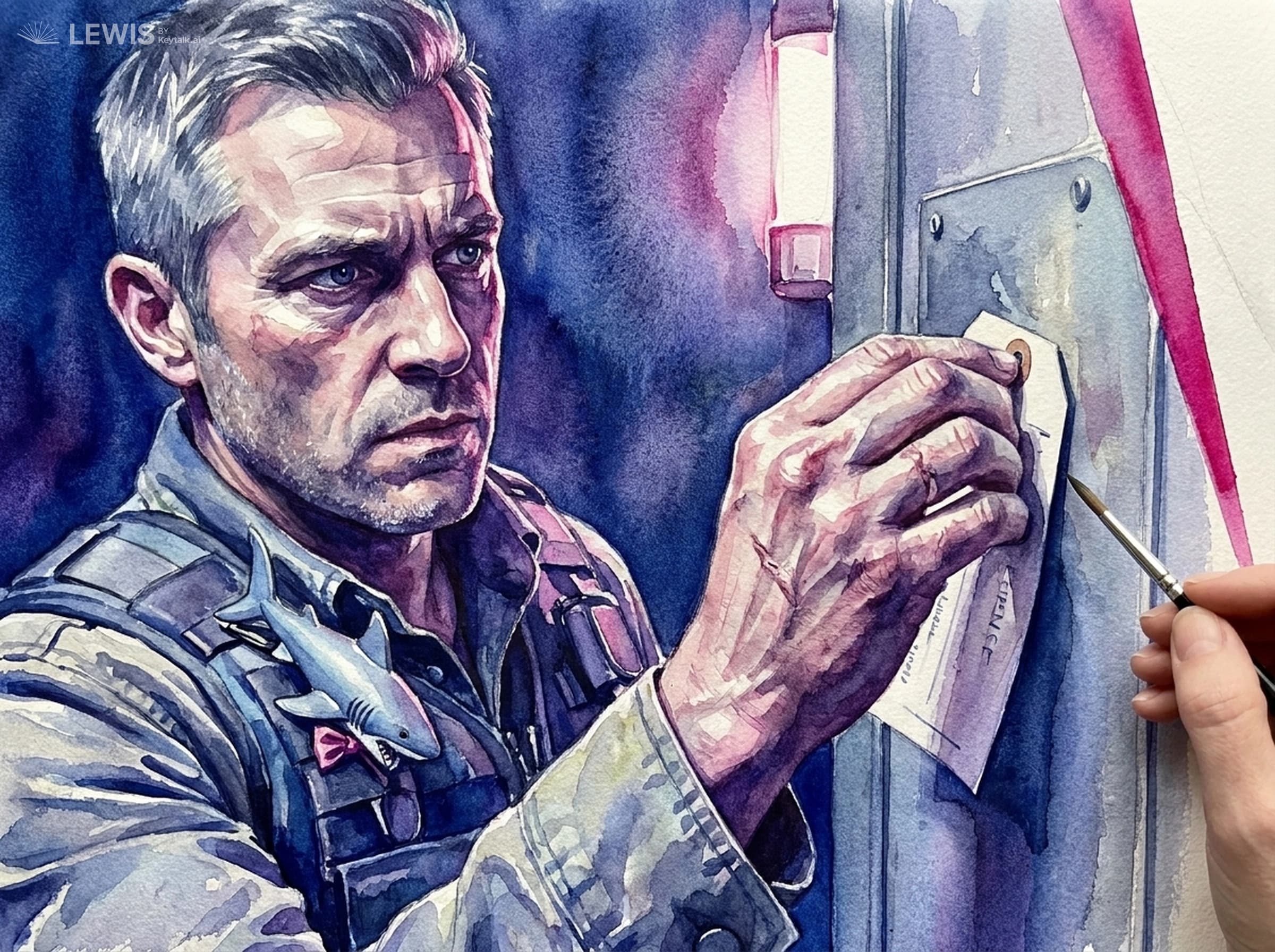
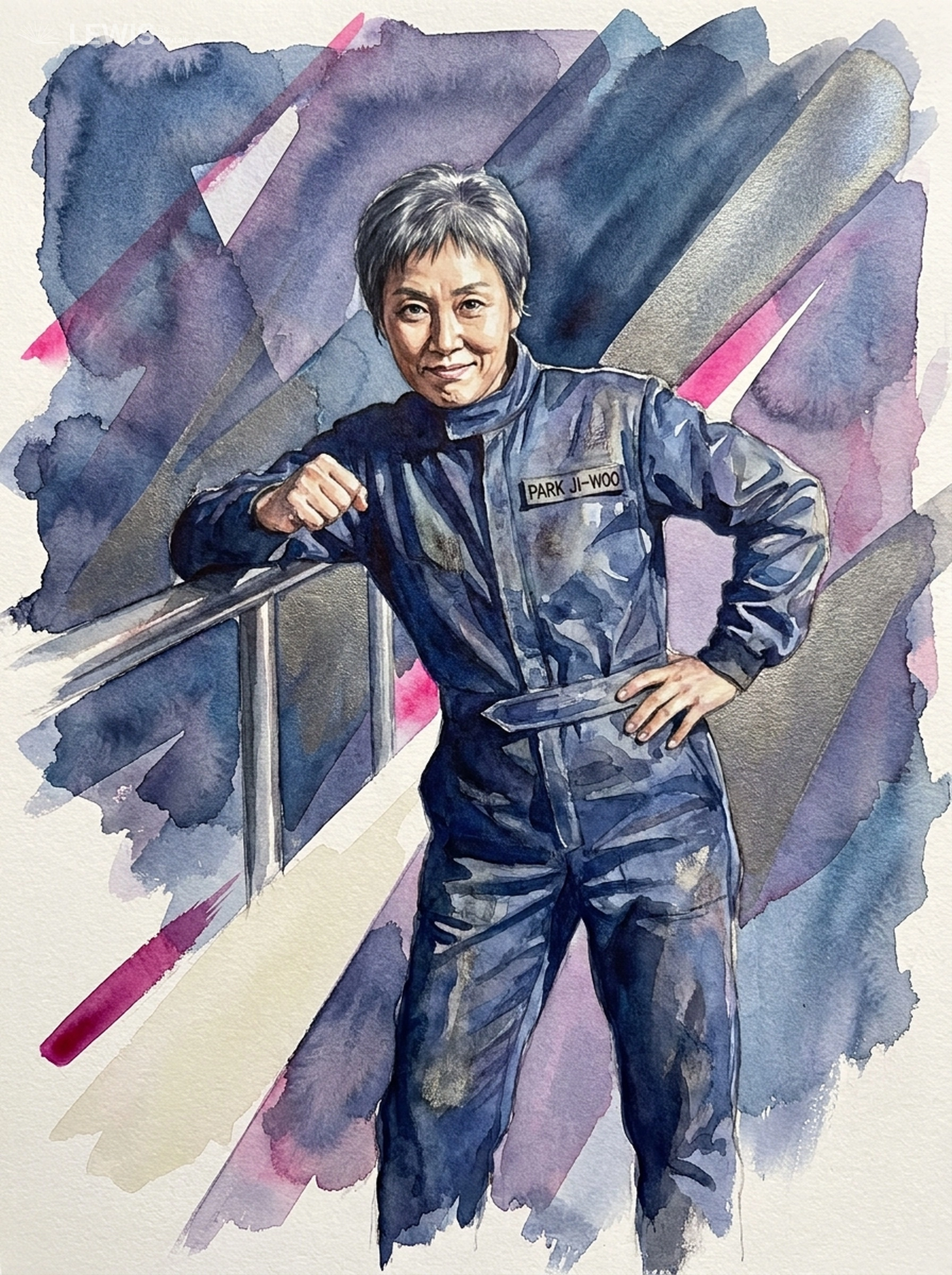
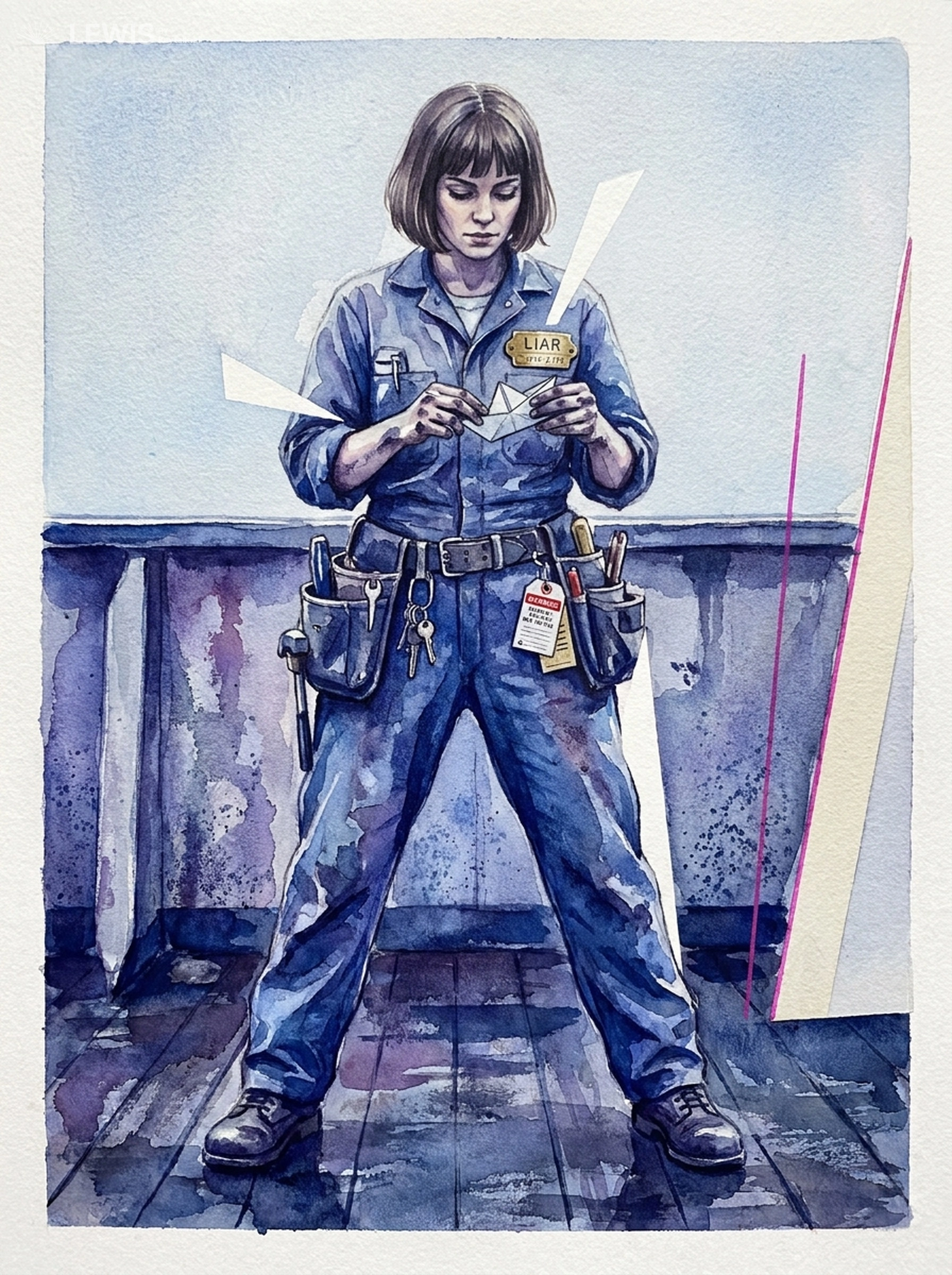
Kang reaches the bridge and finds the steering linkage jammed. She can ground the carrier on a tidal mudbank before the exclusion line, but only by engaging machinery her logs falsely list as disabled. Ryu confronts her there and offers to preserve the ship if she holds course. Kang folds the warning tag from the steering lever into a tiny boat, places it in his palm, and then strikes the seized handle with her wrench. The linkage moves, but the carrier’s turn exposes its broadside to coastal weapons. Authorities fire a warning round across the bow. Kang keeps turning, sacrificing the hull she has protected to buy Sandra twelve minutes.
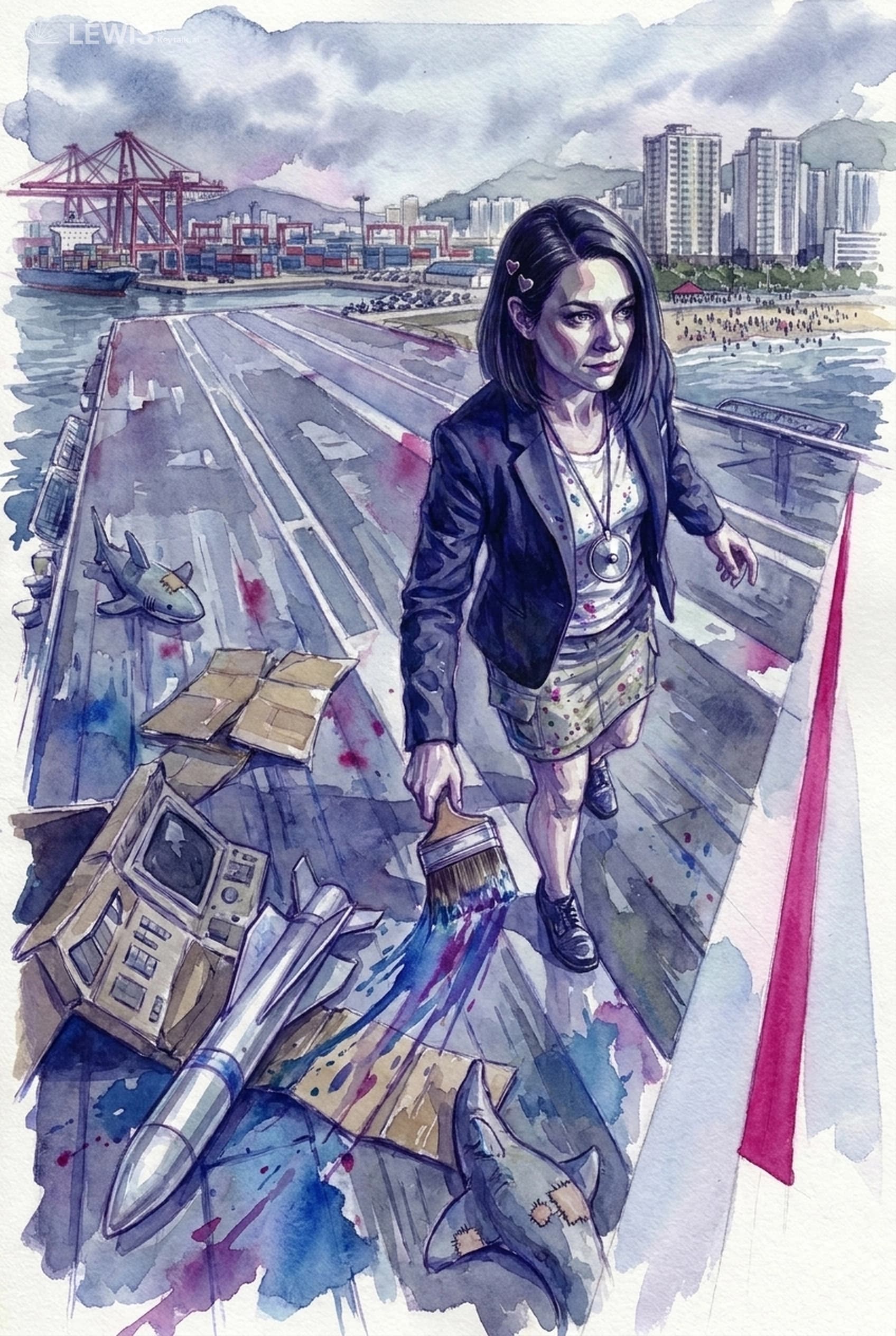
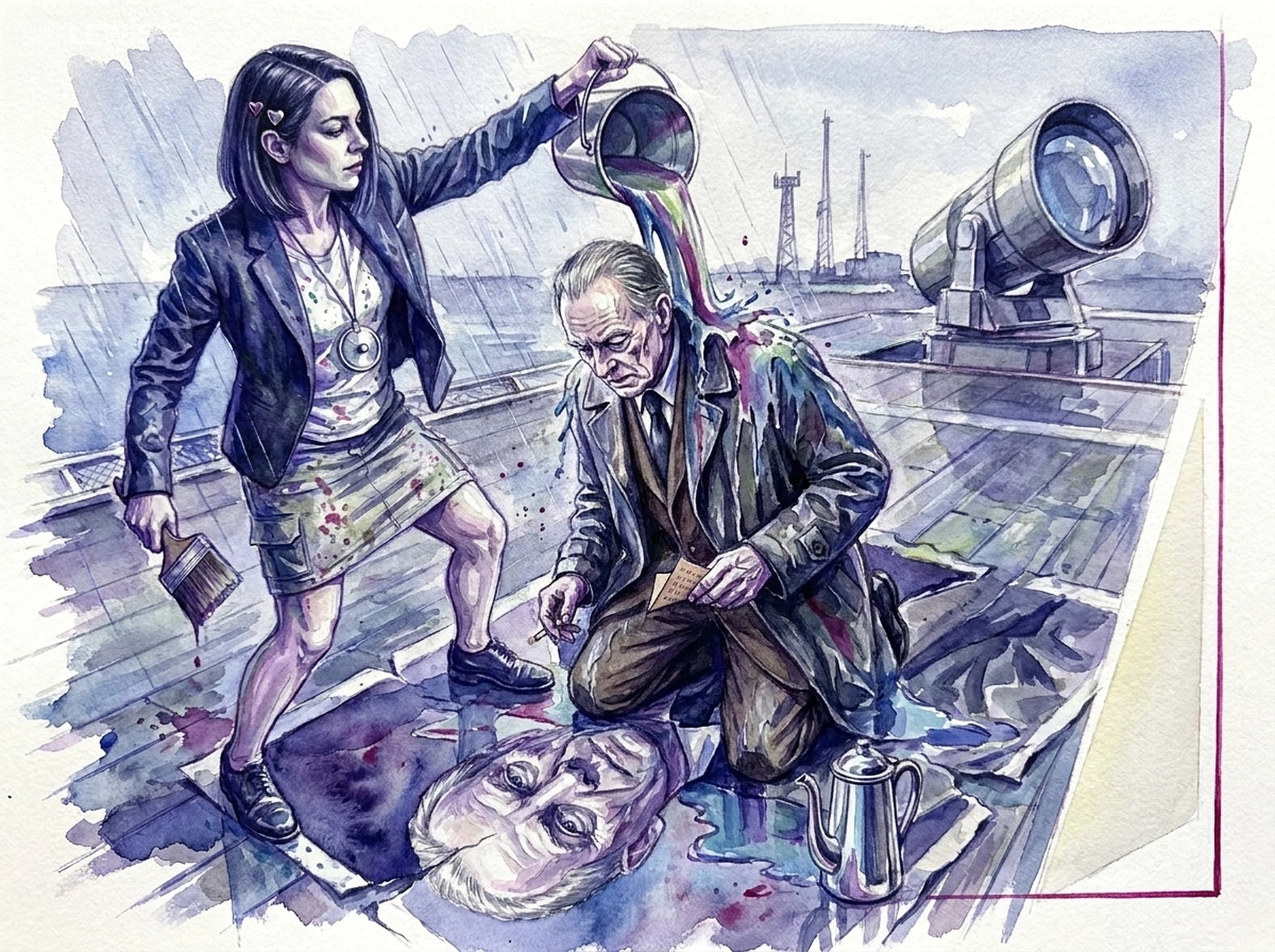
Dieter calculates that the missile’s optical guidance is using Sandra’s painted flight deck as its calibration image. Redirecting it requires repainting the entire geometry from the weapon’s viewpoint. Sandra races onto the rain-swept deck with Park’s marking tape and buckets of red, cobalt, and acidic yellow. She first tries to preserve the recognizable heart of her masterpiece, bending new lines around it. Dieter warns that her need to keep her signature intact will send the missile directly over the crowded beach. Sandra accuses him of trying to steal her work back. He answers by standing on the painted face she made from his reflection and tearing it open along the cipher lines.
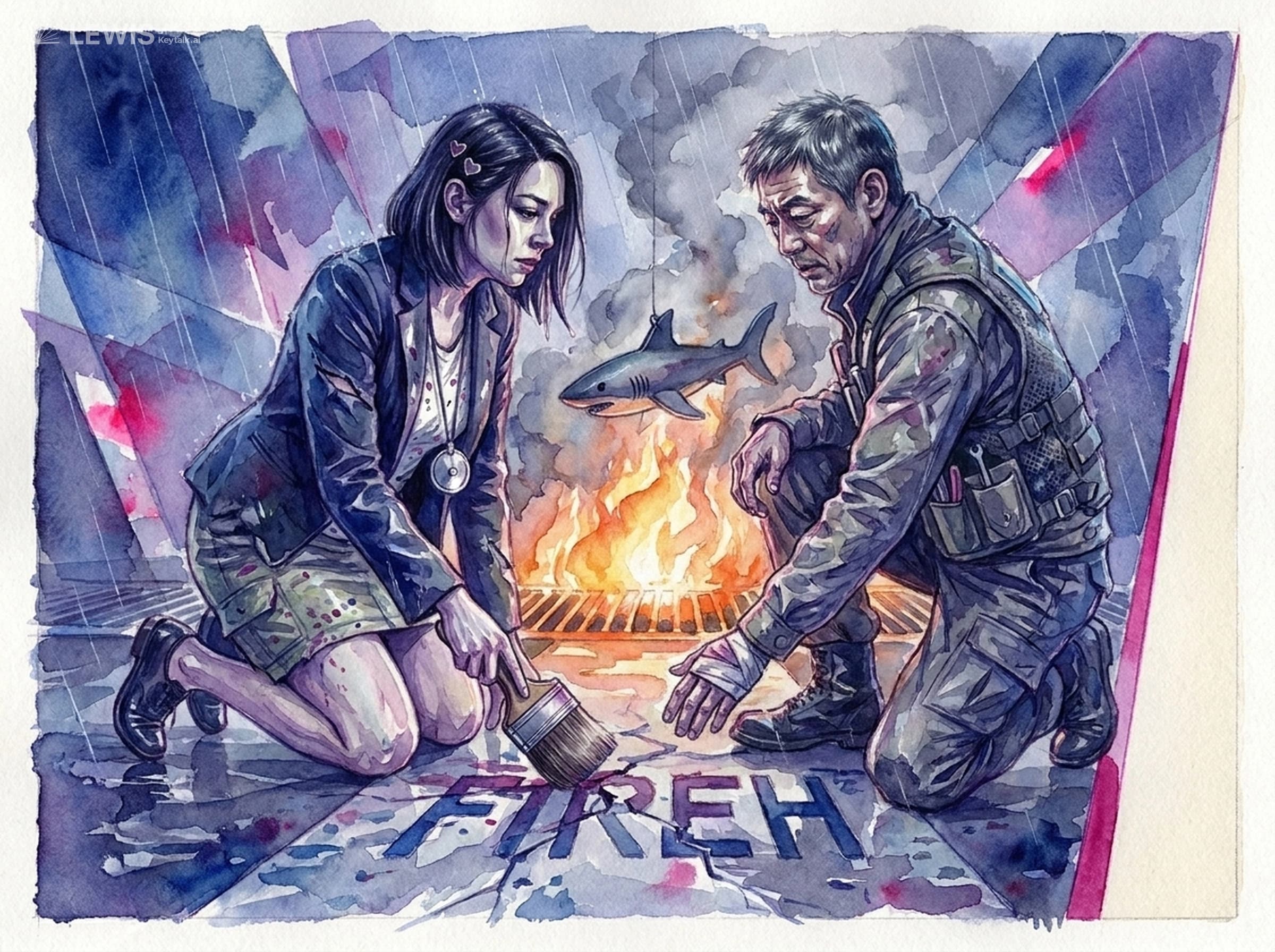
Sandra follows. She pours black paint across the face that made her famous, then orders the others into position as human sight lines. Under pressure she again calls Oh Mi-sook “red shape.” Oh Mi-sook knocks the brush from her hand and demands to be seen whole. Sandra retrieves it, paints OH MI-SOOK in runway-sized letters across the deck, and adds PARK JAE-HYUN, KANG BO-RA, CHOI EUN-HO, and DIETER VOSS along the false vanishing lines. Each name alters the guidance geometry while publicly exposing the collaborators Sandra had hidden.
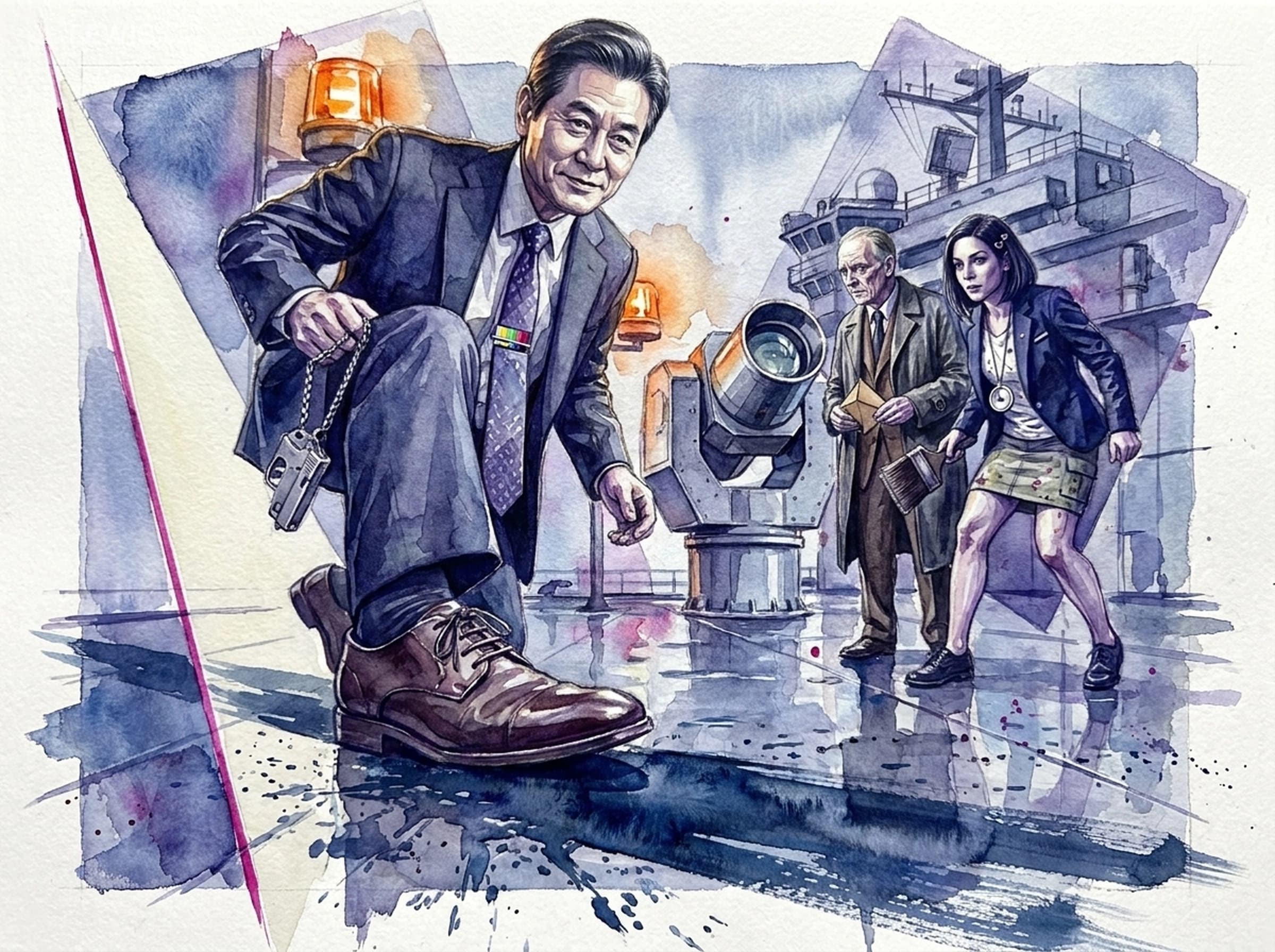
Ryu arrives with the physical trigger case chained to his wrist. Rather than shoot Sandra, he watches her paint and lowers the trigger to study the changing composition. He understands before she does that the names form a new target: an empty patch of horizon. Then he notices that one letter is too narrow. The error will curve the missile back toward the carrier, creating the tragic image his campaign needs. He steps into the wet paint and uses his shoe to drag the line farther inward.
Sandra tackles him before he can complete it. They slide across the deck, each gripping one end of her broad brush while rain turns the painted names into colored wakes. Ryu insists that no one will die if she lets the spectacle proceed. Behind them, a warning round strikes the sea close enough to throw both flat. Sandra sees Busan’s towers broken into pieces across the polished coffee-pot pendant at her throat. For the first time, she stops choosing the angle alone. She calls to Dieter.
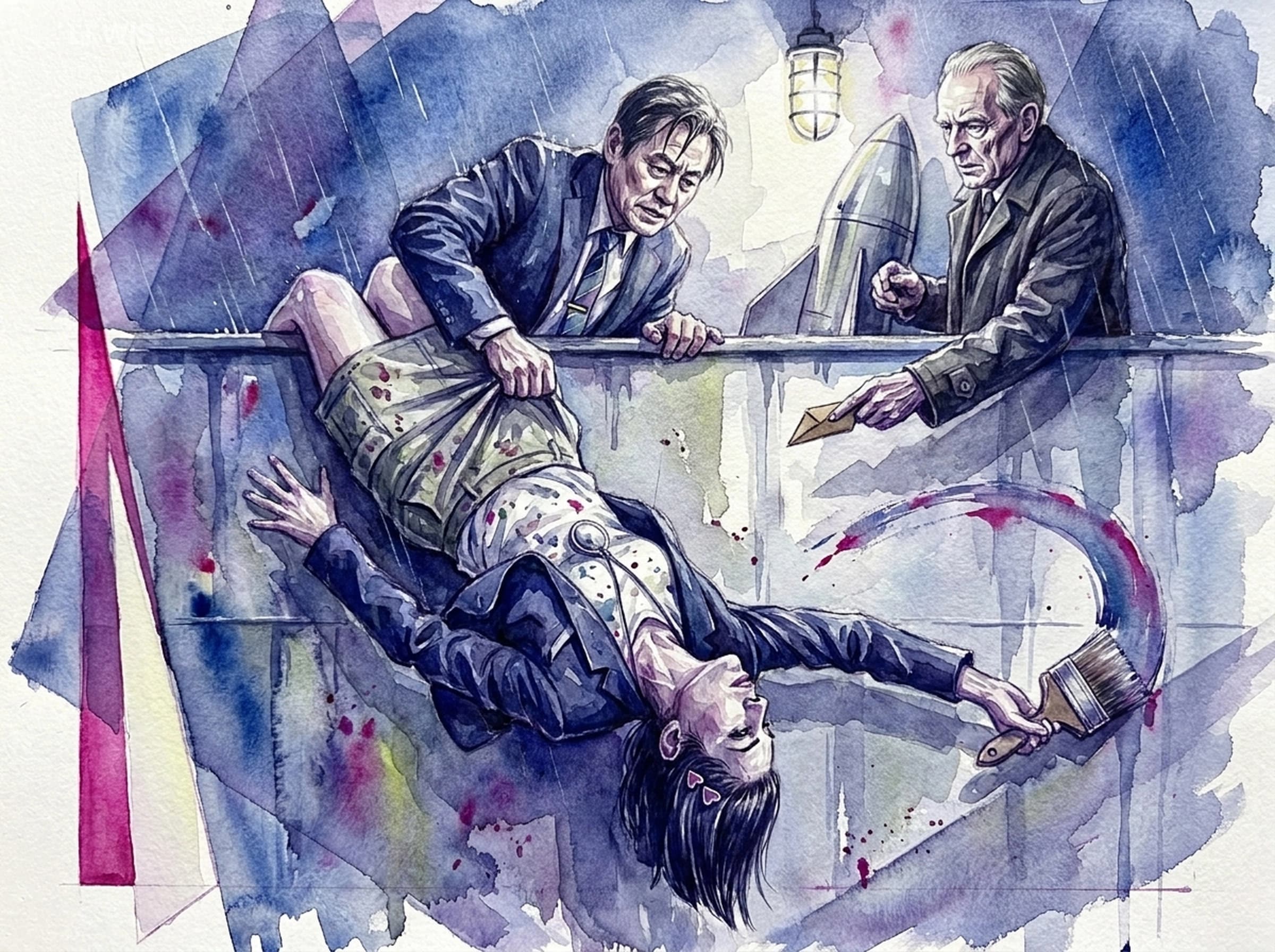
Dieter directs her from the missile’s obsolete point of view. Park anchors a cable around Sandra’s waist. Oh Mi-sook, one arm useless, runs the line through a stunt pulley. Choi and Kang hold Ryu back as he reaches for the trigger. Sandra leans over the deck edge and paints the final curve upside down, trusting instructions she cannot verify with her own eyes. Ryu tears free, but instead of pressing the trigger, he seizes Sandra’s belt when the wind lifts her from the deck. Saving her costs him the last seconds in which he could restore his intended image.
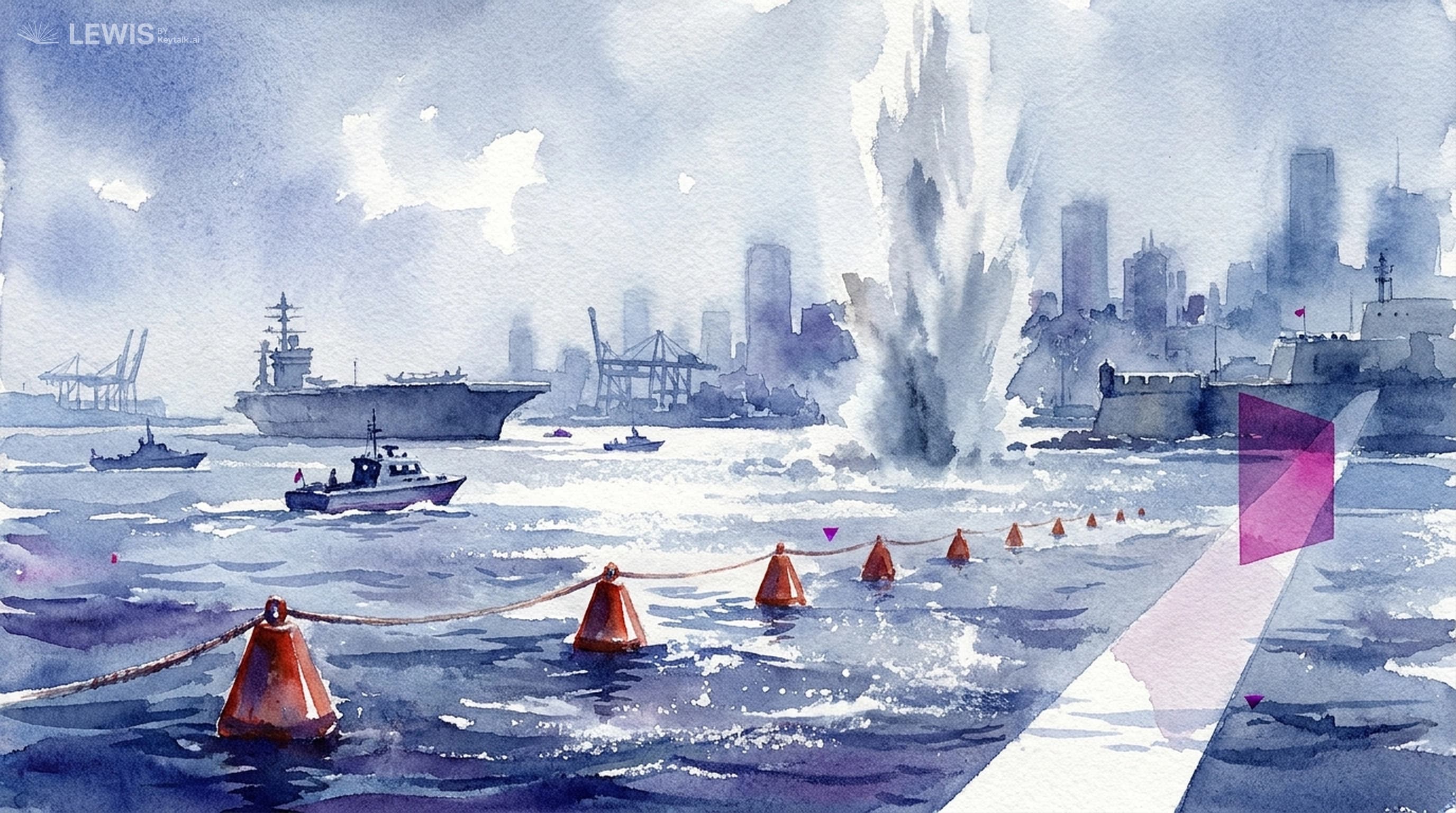
The missile launches from the silver casing with a blast that shreds the cardboard control room and scatters rubber sharks across the deck. It rises over the carrier, reads the names and altered lines, and turns toward open water. No triumphant explosion follows. The weapon vanishes into low cloud and detonates beyond the horizon, leaving only a dull flash that most cameras fail to capture. Ryu’s perfect crisis ends as an image of people staring at empty sky.
Kang drives the Haeundae Star onto the mudbank seconds before the exclusion line. The hull tears open below the waterline, and the old carrier settles crookedly but does not sink. She hands her falsified maintenance pages to the arriving authorities, then returns to the engine room to stop a fire before accepting arrest. Park loses the museum commission but preserves the copied blue crescent from the missile as proof that his craft was forged. Choi gives their voiceprint testimony in their own voice. Dieter publicly identifies the cipher and the erased operation behind Sandra’s first painting. Oh Mi-sook refuses a stretcher until a news camera records her name on the deck beneath her boots.
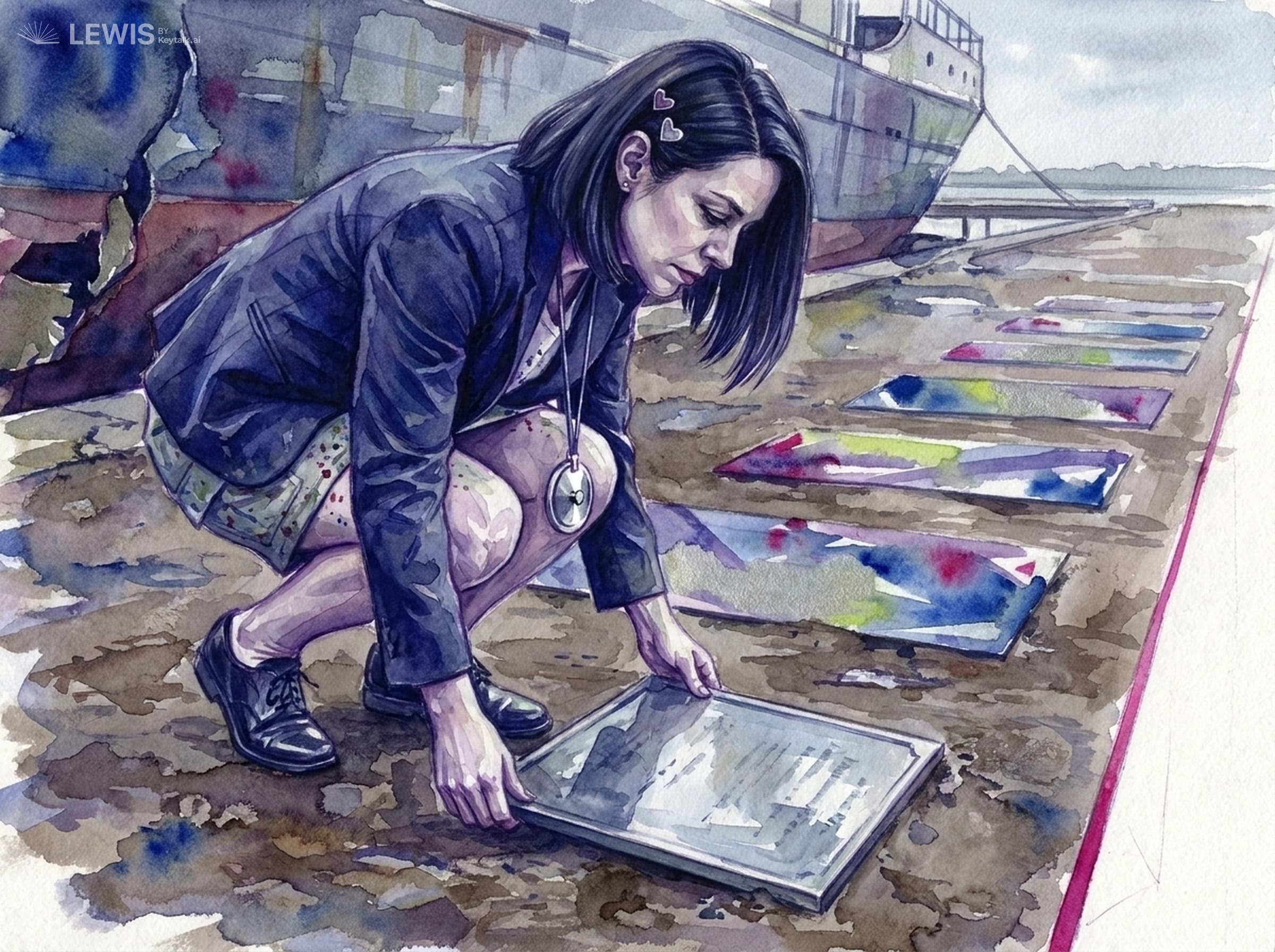
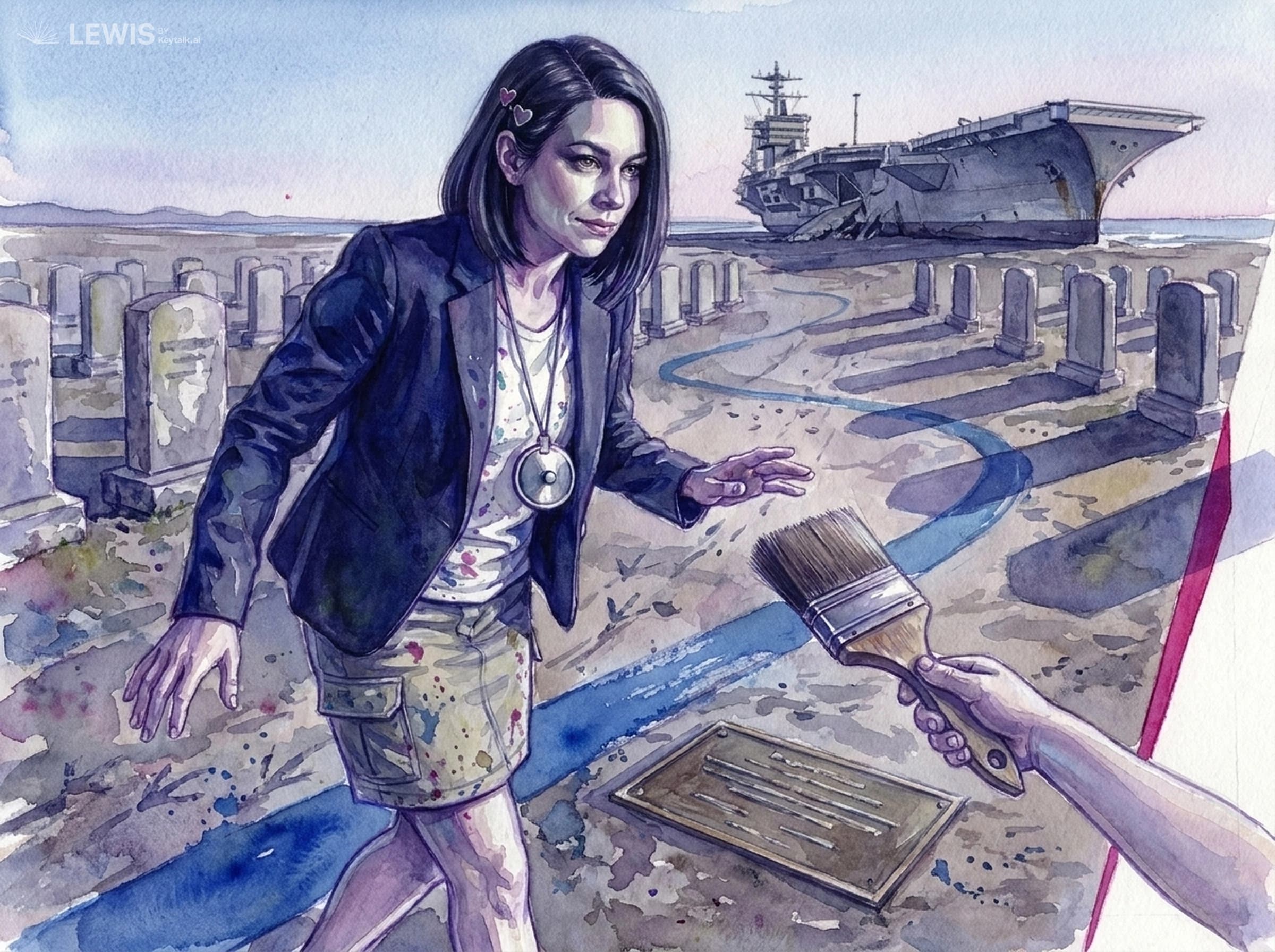
Sandra’s galleries cancel the retrospective, and critics strip her singular origin story apart. Months later, the grounded Haeundae Star reopens only in sections, its torn hull fixed permanently in the mud. Sandra returns without her bright jacket or polished pendant. She does not restore the ruined illusion. Instead, she paints small plaques beside every surviving mark, naming who built, folded, performed, maintained, forged, or remembered it. Her own name appears last.
At the reopening, a child asks Sandra which part is the real artwork. Sandra gives the child her broad brush and steps sideways until the carrier, the city, and the people repairing both align in a puddle. She does not correct the child’s first stroke.














댓글 · Comments
댓글 · 0