本文へスキップ

Keytalk オリジナル · 場面 15 · チャプター 5

Delayed with Passengers

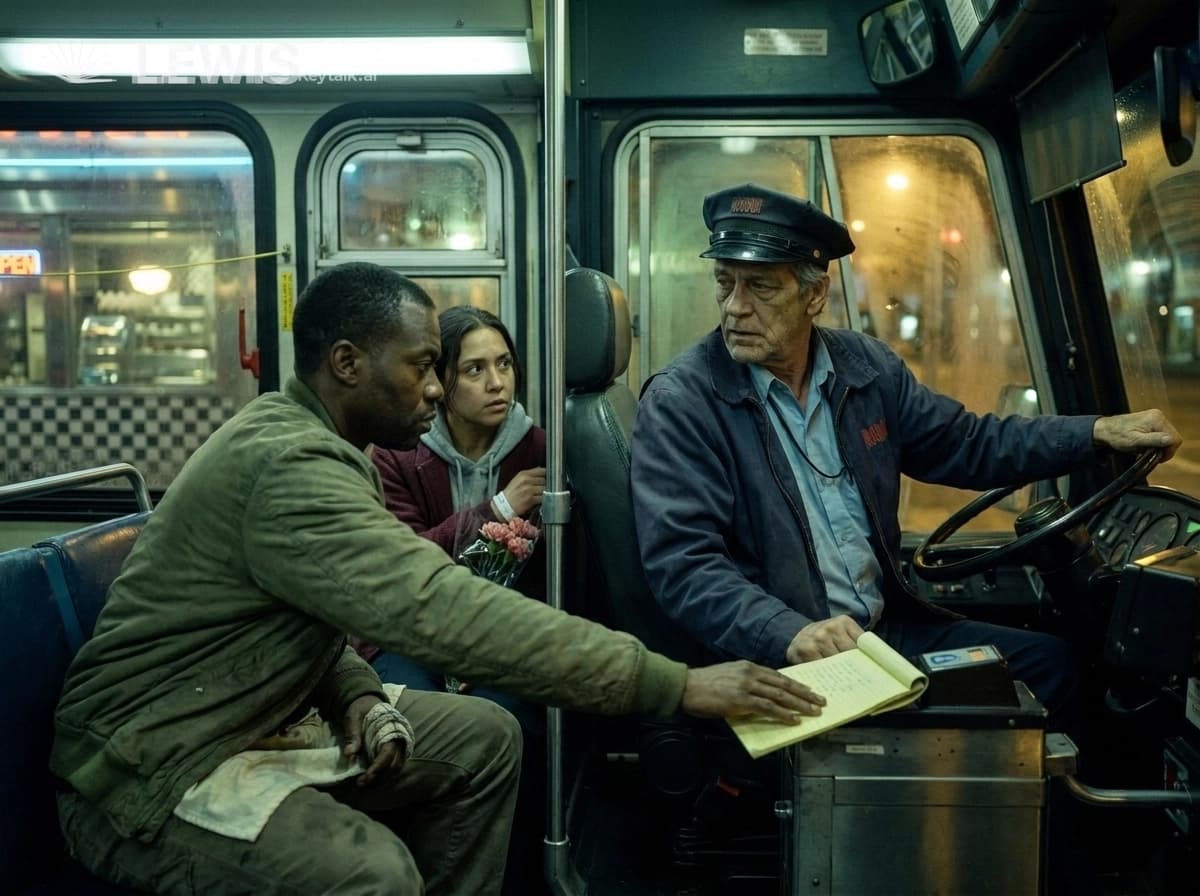
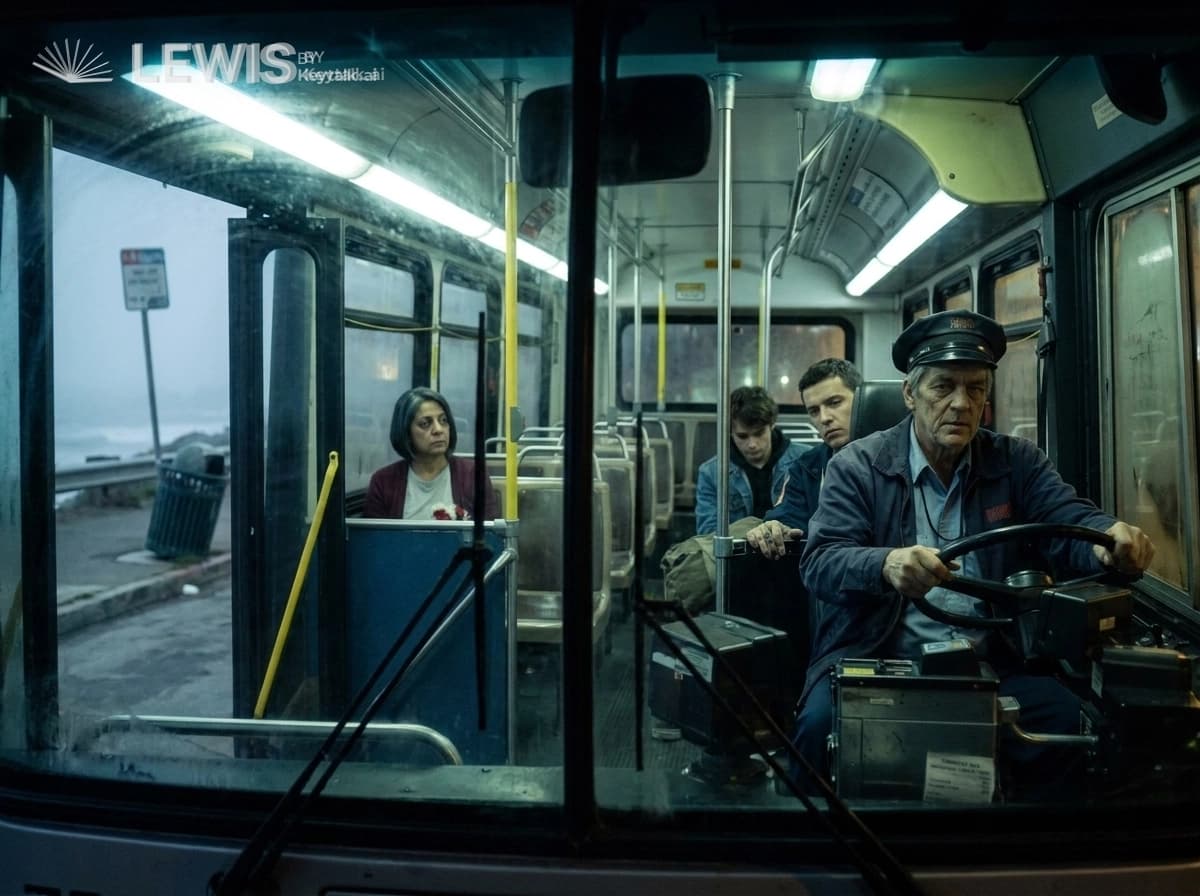
On her first graveyard shift, a nervous trainee climbs aboard the 3:33 a. m. Geary coach with a yellow legal pad in her lap and finds the seat behind the veteran driver already occupied by the only rider he has dodged for years: a middle-aged woman in a hospital wristband, holding a damp bouquet wrapped in corner-store plastic.

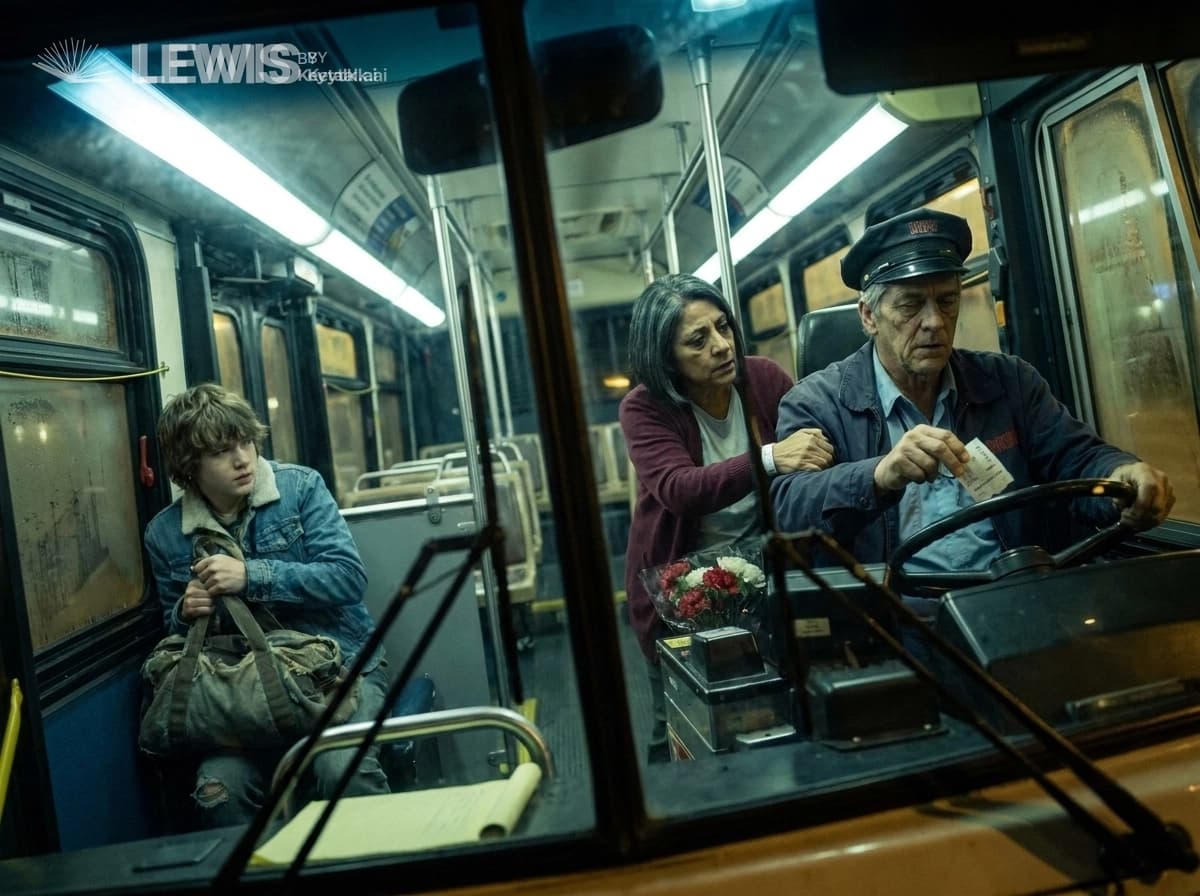
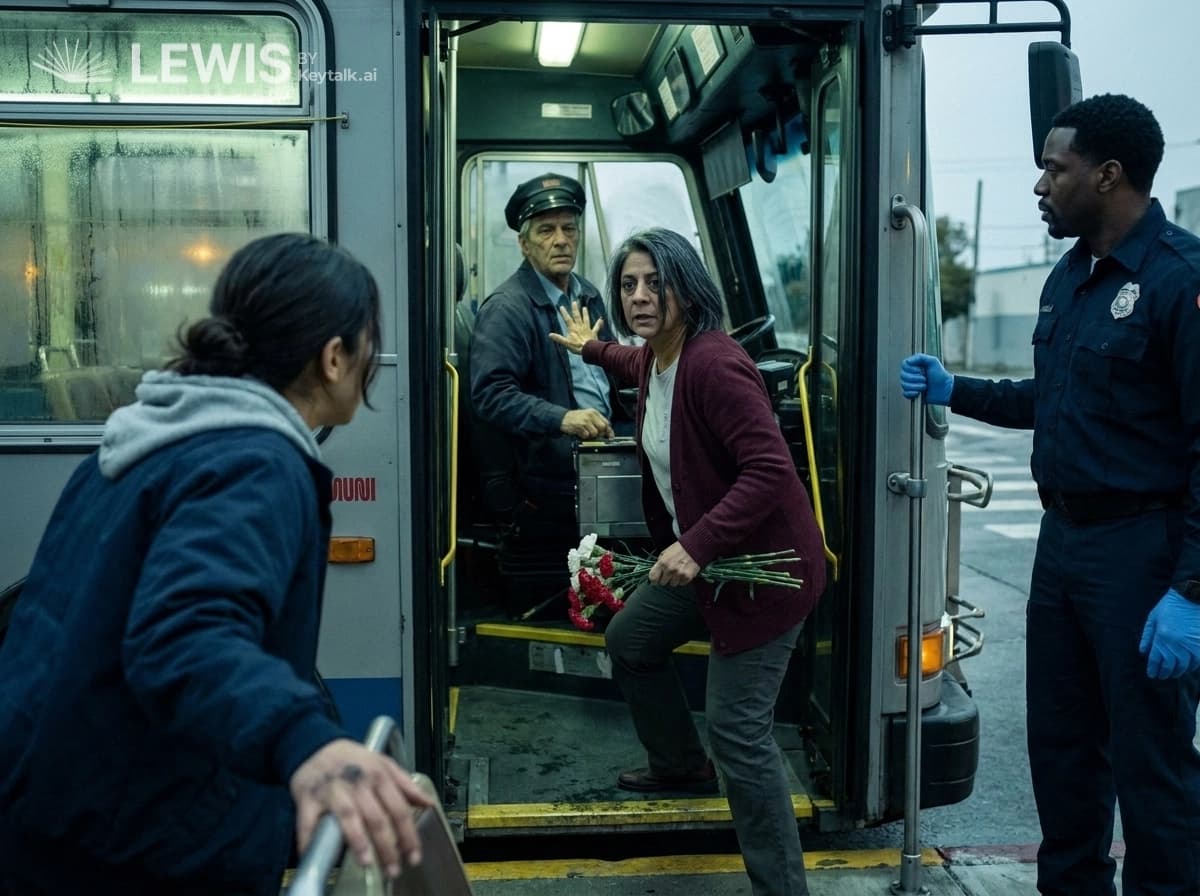
At each stop, the bus kneels for other would-be last riders—a line cook with a split knuckle, a teenage skateboarder with a duffel bag, an exhausted paramedic still in blue gloves—and the driver has to keep them talking while steering through fogged windows and a rattling heater that keeps cutting out on the hills.

The trainee slowly understands the rule when she watches him

  • 人物 6
  • 場所 5
  • 場面 15
  • あらすじ 14,519字

週間ランキング

rank icon image
#14 Genre
Delayed with Passengers cover image

人物 · Characters

登場人物たち

Inez Villareal

女性

newly certified Muni operator on her first overnight training run, carrying a legal pad because she still trusts written procedures more than instinct

プロフィール

Inez Villareal wants to get through the route without stalling at the curb, saying the wrong thing, or giving her supervisor proof that she cannot handle the dead hours, but every rider who steps aboard forces her to touch the kind of grief she has spent years stepping around at home. Hollis Vale keeps pulling her closer to the work instead of shielding her from it, and when he places the wheel in her hands for one blind block while he keeps Marisol Quintero talking, finishing the shift starts to look like agreeing to the rule that has been eating him alive. If Inez Villareal learns how this bus really runs, dawn may ask her for more than competence.

She writes down every stop, every phrase Hollis uses, every time a passenger's shoulders drop, then presses the pen so hard the paper tears when someone starts telling the truth too plainly. In conversation, Inez Villareal buys herself seconds by adjusting mirrors, flattening transfer slips, and repeating the last two words she heard as if checking the sound system. Put her near open hurt and she goes visibly still; put someone else in danger and she moves before she has decided to be brave.

背景

At nineteen, Inez Villareal left a house where bad news traveled by silence: her father slept in his work boots on the couch, her mother folded hospital bills into recipe books, and nobody said her older brother's name after he disappeared for three days and came back thinner.

She chose transit because routes had posted rules, clean lines, and a union exam with right answers, then spent years on daylight assignments where lost tourists, schoolkids, and office commuters never asked her to stand inside the worst minute of their lives.

A supervisor finally bumped her to nights after calling her "polite to the point of useless," and Inez Villareal boarded the 3:33 expecting drunks, not a hidden apprenticeship in talking strangers back toward morning.

描写

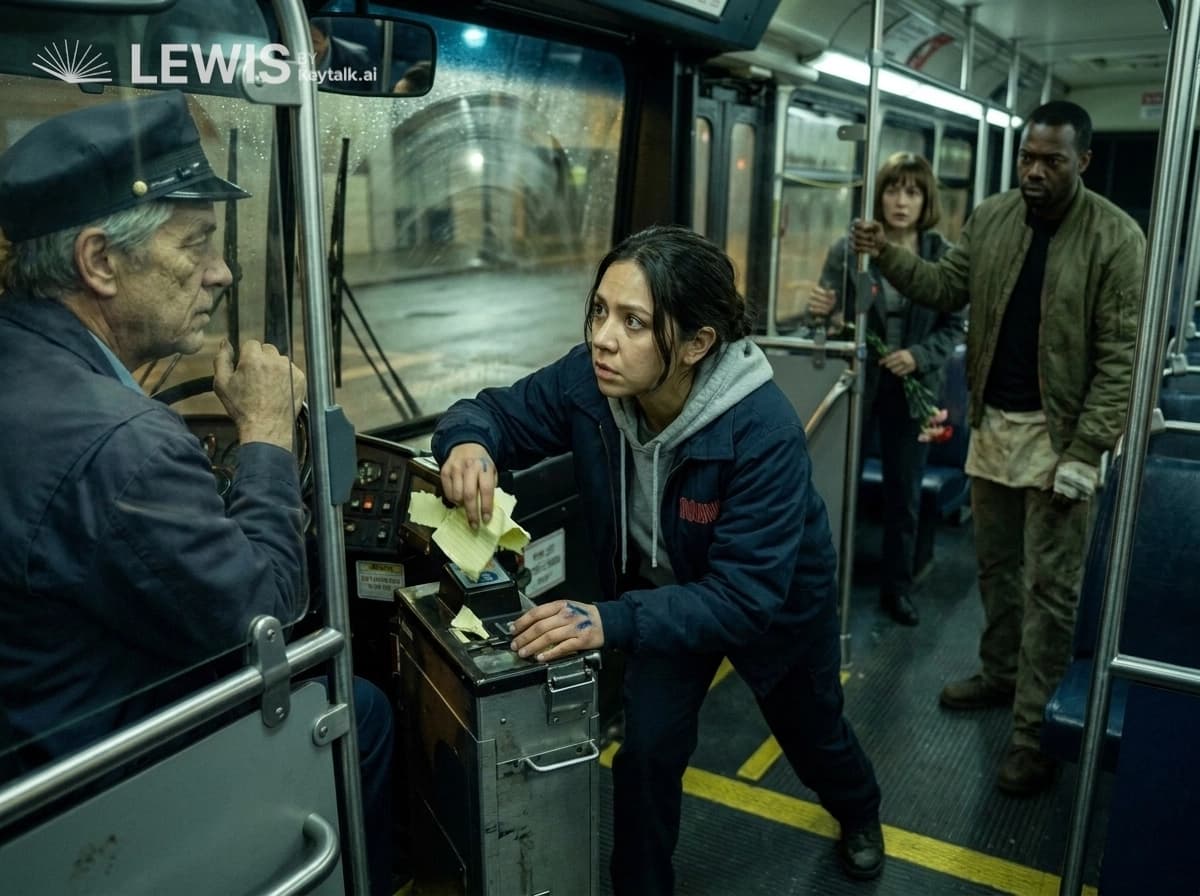
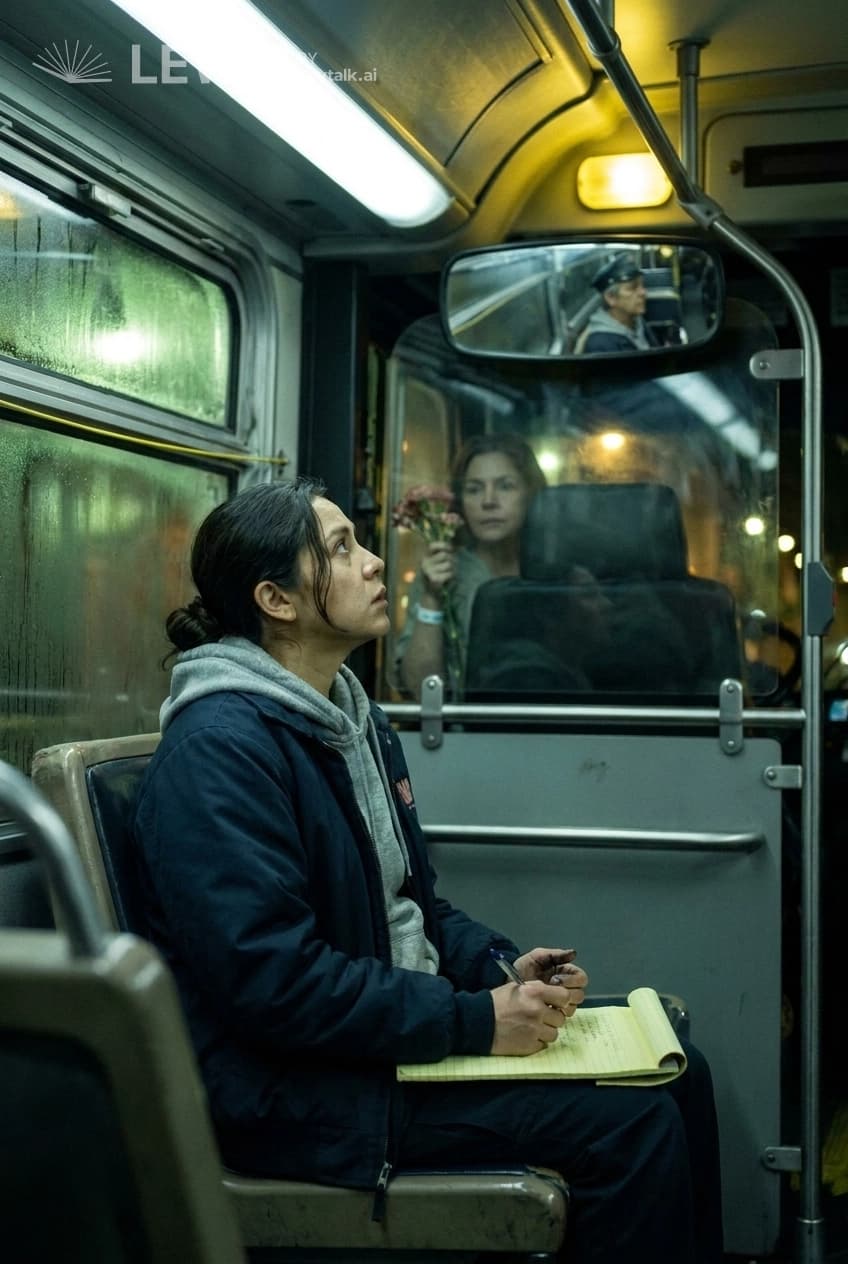
Inez Villareal is a 27-year-old Latina woman with a compact build that looks braced against cold and scrutiny alike; she wears a navy Muni trainee jacket over a gray hoodie, dark work pants, and sensible black shoes damp at the edges from the fog tracked onto the bus floor.

Her dark hair is pulled into a practical low bun already loosening at the temples, and she holds herself with the rigid care of someone trying not to take up trouble—shoulders tight, chin tucked, one hand flattening a yellow legal pad against her thigh while the other worries a pen hard enough to leave ink on her fingers.

The detail that fixes her in memory is the way she keeps glancing at the mirrors instead of people's faces, as if reflection gives her just enough distance to stay standing when the truth in the aisle gets too close.

Hollis Vale

男性

the long-haul night driver who has spent thirteen years taking the unscheduled 3:33 run no one bids on twice

プロフィール

Hollis Vale wants to get every rider on his bus to morning still willing to step off into it, even if it means prying open his own worst memories for strangers between red lights and fogged glass. The work has already cost him his marriage, his sleep, and any belief that he will be allowed to retire before one rider slips past his voice. On Inez Villareal's first shift, Hollis Vale can no longer dodge Marisol Quintero, the woman he has refused to pick up since her daughter died on his route, and the rule he has lived by starts closing around his own seat.

He drives with one hand loose on the wheel and the other drumming twice against the farebox whenever a passenger goes quiet, as if he can knock them back into the room before the bus reaches the next corner. Asked a direct question, Hollis Vale buys time by adjusting mirrors that do not need adjusting, then answers with a joke dry enough to sound rude until the rider laughs in spite of himself. He keeps his eyes on the road when people cry, but at every stop he lowers the bus so gently it looks like an apology.

背景

Years ago, Hollis Vale was just a night driver with a clean uniform and a wife who waited up with the kitchen light on; then one impossible shift taught him what the 3:33 route was really for, and he said yes because nobody else on the line would.

Since then he has learned the city's private map by its emergency-room bracelets, bar aprons, work boots, and missed calls glowing in dark windows.

The spring Marisol Quintero's daughter died after riding his route, Hollis Vale broke his own pattern for the first time and kept rolling past one waiting figure after another, turning avoidance into ritual until Inez Villareal climbed aboard to watch him run out of road.

描写

Hollis Vale looks like a man who has spent too many years under fluorescent light and too many nights refusing to blink first.

At 58, he wears a faded navy Muni driver’s jacket over a short-sleeved uniform shirt gone soft at the collar, his silver-shot dark hair clipped close and flattened by long hours under a cap, his face lined hard around the mouth but gentled by tired, watchful eyes that never quite leave the windshield; one hand rests loose on the wheel while the other hovers near the farebox, two fingers poised to tap it twice whenever the silence on the bus turns dangerous.

His wedding ring still hangs on a black cord tucked beneath his shirt, and even standing still he holds himself like a man braced for the next stop to ask more of him than he has left.

Marisol Quintero

女性

hospital billing clerk on unpaid leave, fresh from an oncology floor discharge with a plastic wristband still cinched to her arm

プロフィール

Marisol Quintero boards the 3:33 with fog-wet supermarket carnations because she wants one ride in which nobody asks her to endure another morning, and because going home would mean unlocking an apartment she has stripped of Alma's clothes, posters, and toothbrush. She takes the seat behind Hollis Vale to force him to say, stop by stop, what he saw on the night Alma stepped off his bus and vanished into traffic, even if hearing him answer leaves Marisol Quintero with nowhere clean to put her blame. If Hollis Vale talks her back toward dawn, he also has to survive being made useful to the woman he has spent years refusing to pick up.

She keeps the bouquet upright between both knees as if it were breakable glass, but her questions come flat and exact, each one timed to the hiss of the doors so nobody can interrupt with comfort. When another rider starts to cry, Marisol Quintero turns her face to the window and worries the edge of her hospital wristband until it curls, furious at any grief in the bus that is not hers and ashamed of that fury a second later. She does not raise her voice at Hollis Vale; she makes him repeat details instead, which lands harder.

背景

For years, Marisol Quintero rode Muni home from late shifts with Alma asleep against the window, waking only when the bus lurched uphill near their block.

The last time Hollis Vale saw Alma, he watched the girl step down alone into wet headlights while Marisol Quintero was across town mopping a clinic floor and missing calls she would later play until the voicemail timestamp wore into her memory.

Since then she has learned the routes Hollis Vale drives, missed them on purpose, and finally boarded only after emptying the apartment of everything that still expected her daughter to come back.

描写

Marisol Quintero looks like a woman who came straight from discharge and never meant to go home: a faded burgundy cardigan pulled over a hospital-issue T-shirt, dark slacks gone shiny at the knees, sensible black shoes still dusted with city grit, and a plastic wristband biting into the arm that steadies a bunch of supermarket carnations beaded with fog.

She sits rigidly in the seat behind the driver, shoulders narrow but unyielding, keeping the flowers upright between both knees while one thumb worries the curling edge of the wristband; her face is tired in the hard, sleepless way that makes every question feel sharpened in advance.

The memorable thing is not grief but control—her mouth held flat, her gaze fixed past the glass or into the driver's mirror, as if she has boarded to collect an answer and will not spend a single extra movement on falling apart.

Darnell Pike

男性

fry cook closing a Richmond District diner, with a dish towel around his split knuckle and tomorrow's prep list still in his apron pocket

プロフィール

Darnell Pike boards the 3:33 bus because dawn means going back to the apartment where his younger brother is asleep on the couch after another relapse, and once Darnell unlocks that door he becomes the only person left to enforce the promise that this time will be different. He recognizes Marisol Quintero from the hospital cafeteria, where he has been slipping her extra pie through the service window for weeks, and he wants her to admit she came here for the same reason he did without making him play grateful recipient of rescue. His flat, unsentimental answers force Inez Villareal to work harder than she does with open despair, because Darnell Pike will accept coffee, warmth, and another mile of road, but not the comforting lie that wanting to leave and wanting to stay can be neatly sorted before sunrise.

At work, Darnell Pike scrapes burnt cheese off the flat-top with quick, angry strokes, then sets a slice of pie down in front of the right person without looking up, as if generosity only counts when nobody can thank him for it. On the bus he keeps his split knuckle tucked under his opposite arm, answers direct questions with exact facts, and stares out the fogged window whenever Inez Villareal sounds too kind. If someone reaches for him softly, he goes still; if they push, he pushes back harder.

背景

For months Darnell Pike has worked the hospital night shift and learned the rhythms of grief by tray count: which waiting rooms go silent at two, which families start bargaining at three, which patients come downstairs alone because they cannot stand one more fluorescent room.

His younger brother's relapses have turned Darnell Pike's apartment into a revolving clinic of paper cups, apology texts, and promises made on linoleum, and each return home has trained him to dread the hour when buses stop running.

Marisol Quintero became familiar to him long before this ride because she always asked for black coffee and never touched the pie unless he slid it over without a word.

描写

Darnell Pike looks like a man who came straight from a closing shift and refused to go anywhere softer first: grease-dark work pants, a faded diner T-shirt under an open nylon jacket, apron strings still hanging at his waist, and tomorrow's prep list making a hard rectangle against his pocket.

He sits angled away from the aisle with his split knuckle wrapped in a dish towel and tucked under his opposite arm, jaw set, shoulders braced, as if every kind word is something he has to physically endure; the one thing you remember is the white towel gone gray at the edges, wound around his hand like a flag he does not want anyone to salute.

Tavi Mercer

男性

high school senior sleeping between a friend's garage and late-night skate spots, with a duffel bag packed before his mother woke up

プロフィール

Tavi Mercer boards the 3:33 bus convinced that if he can keep his phone dark until the final stop, one vicious kitchen fight can harden into a disappearance no one can undo before dawn. The price is concrete: his little sister will scan the auditorium for him at her school concert in eight hours, and missing that seat means teaching her he leaves the way their mother did. When Tavi Mercer spots Inez Villareal's yellow legal pad, he starts performing a cleaner, tougher version of himself for her notes, but Hollis Vale catches the bus-transfer doodles in Tavi Mercer's margin and realizes he is looking at a boy tied to a rider Hollis once drove home pregnant.

Tavi Mercer answers direct questions with polished half-smiles and ready-made details, then ruins the act by tapping transfer-slip patterns against the fogged window with one bitten thumbnail. If someone offers him kindness too quickly, he laughs first, shifts in his seat, and turns the story meaner than it needs to be. Around children and anything that belongs to them, though, his whole body gives him away: he straightens dropped crayons, checks forgotten backpack tags, and goes quiet in a way that makes his lies look borrowed.

背景

Earlier that night, Tavi Mercer stood in a narrow kitchen while a pan hissed in the sink and his stepfather said the kind of sentence that makes a packed duffel feel like proof instead of drama.

His mother had once ridden this same overnight route while pregnant with him, filling old transfers with looping doodles to stay awake after late shifts, and Tavi Mercer learned that habit at the edge of her ashtray years before she left for good.

He knows the 38 line by muscle memory, knows where cameras do and do not point, and knows exactly how long he can stay missing before his sister starts calling everyone.

描写

Tavi Mercer looks like a boy trying to pass for someone already gone: lean to the point of sharpness, half-folded into a bus seat in a thrifted black hoodie under a weather-beaten denim jacket, one scuffed skate shoe planted on his duffel bag as if he expects someone to grab it.

His mouth keeps a practiced, almost amused half-smile that never reaches his watchful hazel eyes, and one bitten thumbnail taps transfer-slip patterns into the fogged window beside him.

The giveaway is the care he cannot hide—his free hand has automatically straightened a child's loose backpack tag looped over the seat ahead before he remembers to look hard again.

Celia Nwosu

女性

paramedic at the end of a double shift, still wearing one blue glove because she never found the second after a failed apartment resuscitation

プロフィール

Celia Nwosu wants ten unbroken minutes on the 3:33 bus in which nobody asks whether she missed a sign, pushed too hard, or should have called someone sooner after a patient died hours after she got him home. The price of that silence is that she has boarded the one route where silence is dangerous, and the dead man's daughter's stare keeps dragging answers out of her mouth. Years ago Celia Nwosu taught Hollis Vale CPR in a transit first-aid class and kissed him once beside a humming vending machine, so when Inez Villareal realizes what the last stop demands, Celia Nwosu is the rider who can tell her exactly what Hollis Vale would lose by surviving one more night.

On crowded buses, Celia Nwosu folds herself small, pins the damp bouquet upright between her knees, and answers direct questions with the fewest words possible, as if each extra syllable might count against someone. If another rider starts to spiral, her hands move before her face does — two fingers to a wrist, a coat shoved under a head, a paper bag opened and held steady — and then she goes visibly rigid when anyone thanks her. Ask whether she did the right thing and she will look past your shoulder, jaw working once, like she is bracing for a second impact.

背景

For years, Celia Nwosu ran after-hours first-aid trainings for city workers who saw too much and were expected to keep moving; Hollis Vale was the driver who stayed late, asked the practical questions, and made her laugh hard enough once that she kissed him in the fluorescent dead zone beside a vending machine.

She stopped taking his route after her husband died and after too many strangers began treating her calm voice like a promise she could keep them alive.

Tonight she is wearing a hospital wristband because she walked a confused cardiac patient through discharge paperwork, rode the elevator down with him, and learned before dawn that he collapsed in his own kitchen anyway.

描写

Celia Nwosu looks like a woman who has been useful for too many hours in a row and has no room left for anyone else's reassurance.

Her dark EMT uniform is creased and salt-marked from fog and sweat, the radio clipped at her chest gone silent, one blue nitrile glove still stretched over her right hand while the bare left steadies a damp bouquet wrapped in cloudy corner-store plastic; the white hospital wristband at her wrist catches the bus light like something she forgot to remove because forgetting was easier.

She sits folded inward to take up less space, shoulders locked, jaw set against a question she can already hear coming, and her signature detail is that single gloved hand held unnaturally still in her lap, as if any movement might start another rescue she cannot bear to fail.


あらすじ · Synopsis

あらすじ

Inez Villareal boards the coach at 3:28 a.m. with a yellow legal pad, a cheap pen, and the kind of posture people mistake for calm. Hollis Vale is already in the driver’s seat, rubbing two fingers over the black cord at his throat where his wedding ring hangs under his shirt. He gives her the practical instructions first—mirror checks, brake lag on wet grades, the heater that cuts out on hills—and leaves out everything that matters. When the bus pulls from the yard and joins the empty Geary corridor, Inez notices the route placard is blank and the radio stays low, as if dispatch has agreed not to hear them. At the first unscheduled stop, the bus kneels without anyone pulling the cord. A woman in a hospital wristband steps aboard holding damp carnations in corner-store plastic and sits directly behind Hollis. Hollis goes white before he says her name. Marisol Quintero answers by asking for a transfer she does not need. Inez writes that down, then tears the paper pressing too hard when Hollis does not collect fare.

At the next pool of streetlight, Darnell Pike climbs on with a dish towel around his split knuckle and fryer grease still in the seams of his hands. He takes a sideways seat and keeps one arm folded tight over himself. A few blocks later Tavi Mercer hops aboard with a duffel bag and a half-smile too polished for the hour; he clocks Inez’s legal pad at once and starts acting like a boy who wants to be recorded as tougher than he is. Then, outside an ambulance bay, Celia Nwosu boards in her creased paramedic uniform, one blue glove still on, carrying her own wet bouquet like evidence she has no use for. The bus feels less like transit than a waiting room nobody chose, every rider holding the object the night has assigned them. Hollis steers west through fogged glass and keeps them talking by inches. He gets Darnell to admit he left his brother asleep on the couch after flushing pills and then standing over the sink long enough to want to follow them. He needles Tavi until the boy snaps and reveals he packed before his mother woke up, because leaving while she slept felt cleaner than hearing her call him selfish again. He turns one red light into a joke dry enough to make even Marisol’s mouth twitch. Each honest detail seems to buy the bus another block.

Inez tries to reduce the work to procedure. She notes which questions loosen shoulders, which silences make Hollis drum twice on the farebox, which corners he takes slowly when someone is close to bolting. But the rule breaks through in a physical way she cannot explain away. When Darnell, stung by Marisol’s flat stare, stands and yanks the stop cord to get off near a shuttered liquor store, the bus lowers only halfway. The doors wheeze open six inches and stick. Hollis does not look surprised. He tells Darnell to take the towel with him. Darnell throws it on the seat and tries to step down anyway, catching his shin hard on the half-lowered step. He swears, snatches up the blood-stiff dish towel, and only then do the hydraulics sigh the rest of the way. Inez stares at the door, then at Hollis. He tells her to write this part down if she wants, but says it without humor.

The route grows meaner as the city thins. The heater coughs warm dust, dies on a hill, and everyone’s breath starts to film the windows. Marisol uses each stop to pin Hollis down with another exact question about the night her daughter Alma died: where Alma sat, whether she was crying, whether Hollis saw her cross in front of the bus or behind it, whether he called after her. He answers with details he has spent years refusing to say aloud. Alma had transfer slips folded into stars. Alma got off two stops early after a fight on the phone. Alma turned once in the mirror as if she had forgotten something and then kept walking into fog and headlights. Each answer costs Hollis visibly; his hands tighten on the wheel, and the bus drifts near the curb before he corrects. Marisol does not shout. She makes him repeat what color jacket Alma wore, and that lands harder.

Inez begins to understand that honest speech is not a metaphor here but fuel. When riders retreat into scripts, the bus seems to drag; when they say one ugly, specific thing, it moves easier. She tests it by speaking up to Tavi instead of writing him down. She asks why the duffel is packed with rolled socks around something breakable. He smirks, says she must think she’s a cop, then jerks when the bag tips and a little girl’s glitter-glued poster tube slides partly out. Caught, he admits he stole his sister’s concert sign because she made him promise to hold it from the audience. He thought if he took it, he could pretend missing the concert was an accident. The admission empties the swagger from him. Hollis gives Inez one sideways look in the mirror that is as close to approval as he gets.

At a long red light near a closed elementary school, Celia finally speaks when Marisol notices the hospital wristband on her bare hand and asks which floor. Celia says the oncology floor, then the apartment on Turk where she lost a man after getting him home, then the part she has not said to anyone: she paused on the landing outside his door because she did not want to climb one more flight of stairs. It was only seconds. She says that like it should convict her. Her gloved hand has already moved to Tavi’s wrist because his breathing has gone thin and fast, two fingers finding his pulse before her face changes. She shoves a paper bag into his hand, orders him to breathe into it, and goes rigid when he mutters thanks. Hollis asks, too casually, whether she still teaches compressions harder than she kisses. The old familiarity between them flashes across the aisle and dies. Later, when Inez corners Celia by the rear door while Hollis helps Darnell rewrap his knuckle, Celia tells her what Hollis never did: if one rider reaches the end still set on disappearing, the driver does not just fail. The seat takes him. Another driver shows up someday because the city always finds one, but the person who drove that last run is gone from ordinary life. Hollis has lasted thirteen years by talking people back, and every year has taken a piece.

That knowledge curdles Inez’s goal. Getting through training now means helping Hollis spend himself for strangers while the company pretends none of it exists. Her inherited habit—to survive by staying useful and not asking what work costs the worker—starts to feel like cowardice. When the bus pauses outside a diner with bleached floors, Darnell recognizes Marisol from the hospital cafeteria and says he knows she never ate the pie he slipped her; he watched her wrap it and carry it upstairs untouched. Marisol answers that he always overbrowned the crust on purpose so nobody else would ask for the free slices. The two of them, strangers linked only by night labor and fluorescent rooms, begin to speak to each other without Hollis mediating. Darnell admits he is tired of being the last wall between his brother and a grave. Marisol admits she came aboard because going home would mean unlocking a stripped apartment and proving she can survive after erasing Alma’s toothbrush. Their honesty pulls others in. Tavi, unable to bear being the youngest person there and still the least truthful, blurts out that his mother did not hit him tonight; she begged him to stay, and he left anyway because being needed felt like a trap. He has spent the ride making her sound cruel so he would not have to feel cruel himself.

The middle stretch of the route becomes a chamber piece of collisions and small rescues. Tavi tries to get off twice and is physically blocked once by Darnell planting his body in the aisle and once by Marisol pinning the duffel with her sensible shoe until he stops pulling. Celia opens a packet of stale crackers from her pocket and makes Inez eat when her hands start to shake. Hollis misses a turn for the first time in years because Marisol asks whether Alma looked scared of dying or scared of going home. He brakes hard, everyone lurches, carnations hit the floor, and the bouquet plastic crackles underfoot like fire. Inez grabs the wheel instinctively while Hollis hauls the bus straight. For one blind block he orders her to hold lane and speed while he kneels in the aisle gathering Marisol’s flowers with both hands. It is the first time he trusts her with motion while he tends to the living work inside the bus. The block is short, but when he takes the seat again, she has crossed from observer into accomplice.

Near Ocean Beach, where the route grows emptier and the windows turn black with their own reflections, the farebox begins spitting transfer slips without being touched. They flutter into the aisle and stick damply to shoes and seat legs. Most are blank. One bears Alma’s old stop number. Hollis nearly pulls over. Marisol picks it up before he can and asks whether this is how he has been haunted into mercy all these years. He says no. Worse: this is how he has been excused from speaking plainly. He has told himself the city, the bus, the rule, Alma’s ghost—anything but his own choice—kept him driving. Marisol forces the real confession out of him. On the night Alma died, he saw she was in trouble and let her off anyway because he had a bus full of other people and a schedule in his bones. He called after her, but he did not leave his seat. For years he has refused to pick up Marisol because her face made that failure present in the mirror. The admission lands like a physical blow. Marisol slaps the transfer slip against the farebox so hard it sticks there with condensation. Then she starts to cry for the first time, silent and furious, bouquet crushed crooked in her lap.

The final approach begins when the bus should by all logic be almost done and instead keeps finding one more block. Dawn has started to thin the fog, but the coach feels sealed against it. Hollis grows slower, his jokes gone. The riders have all yielded something except Marisol. She says she still does not want morning. Not because she wants death in some grand sense, but because morning means forms, keys, dishes in the rack, and a body memory of calling Alma’s name into rooms that stay empty. The bus shudders. The heater dies for good. Hollis pulls to the curb outside the dark, wind-wet overlook above the beach that serves as the route’s last stop, though no sign marks it. The doors open onto gray air. Nobody moves. Hollis takes his hands off the wheel. He says, almost gently, that this is where the route settles its debt.

Inez finally refuses the role of note-taker. She tears the legal pad in half, drops it on the dash, and physically steps between Hollis and the open door when he rises. He tells her to move. She says no, because the whole night he has been teaching her to keep people on the bus long enough to choose again, and she is not letting him make one noble disappearance look like procedure. Hollis tries to shoulder past her. Darnell stands and blocks the aisle from the other side. Celia grabs the stanchion and braces herself, not letting Hollis force through without dragging all of them. Tavi, shaking, picks up the fallen carnations and jams them back into Marisol’s hands because the object has to leave with its owner. The bus becomes a literal barricade of bodies around one exhausted man trying to pay a debt the old way.

Marisol ends it. She stands, steps into Hollis’s path, and makes him look at her instead of the open door. Then she says the thing she came for and did not know until now: Alma was not on that corner only because Hollis failed her. Alma had been disappearing by degrees for months, and Marisol had answered her daughter’s fear with neat bills, packed lunches, and the hard brightness of a mother who could not bear one more emergency. She stripped the apartment tonight not because she was ready to die, but because she wanted to erase the evidence that she had once had a daughter she could not keep. Saying it buckles her. The bouquet trembles; one carnation head drops to the floor. Hollis reaches for her elbow, not to rescue but to steady. She does not pull away. She says she still hates him for staying in the seat. She also says she is not willing to make another person vanish to prove her grief is larger than his. It is the first clean thing she has chosen all night.

The bus reacts at once. The kneeling suspension, which had sunk under Hollis’s weight toward the open doors, lifts level. Morning finally floods the windshield in a thin municipal gray. The route is finished because the last certainty has broken—not into hope, exactly, but into willingness. One by one the riders get off carrying what they brought. Darnell steps onto the curb with his towel and, before leaving, asks Inez for her pen; he writes his brother’s rehab intake address on the torn back page of her notes so he cannot pretend later he forgot where to go. Tavi shoulders his duffel and the poster tube together, then asks what time the first eastbound bus will get him to the school auditorium. Celia pauses on the step, touches Hollis’s shoulder with her gloved hand, and tells him to sleep before he mistakes endurance for service again. Marisol is last. She takes the crushed carnations, the transfer slip stuck wet to the farebox, and Hollis’s full gaze. She does not forgive him. She says, “Tell the next one sooner,” and walks into dawn.

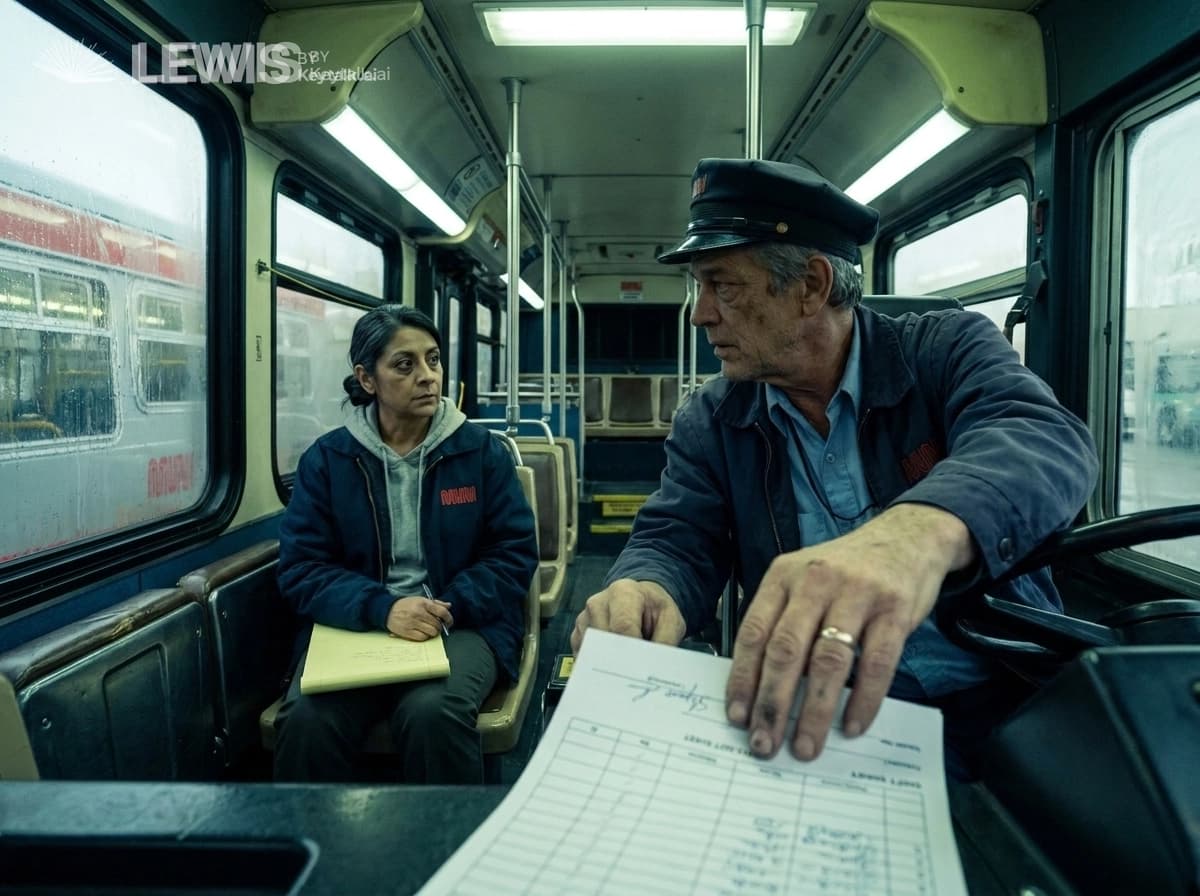
Back at the yard, the coach looks like any other dirty overnight bus except for the torn legal pad on the dash and the coffee rings no report will mention. Hollis offers Inez the easy lie—that she can tell supervision the run was uneventful and ask off graves forever. Instead she hands him the half of the pad she kept. On it she has written no magic rule, no names, nothing the company could use to kill the route. She has written only the stops, the silences, and one line underlined hard enough to dent the paper: Ask before the door opens. Hollis understands that she is not exposing him and not absolving the system either. She is choosing the work with her eyes open, which is more frightening than ignorance and cleaner than martyrdom. When dispatch finally crackles over the radio asking why Coach 721 is late clearing, Inez reaches past him, lifts the handset, and answers in a steady voice that they were delayed with passengers. Then she signs her name to the shift sheet and takes the seat behind him, not yet at the wheel, but no longer a bystander.

世界観 · World

世界

representative image

設定

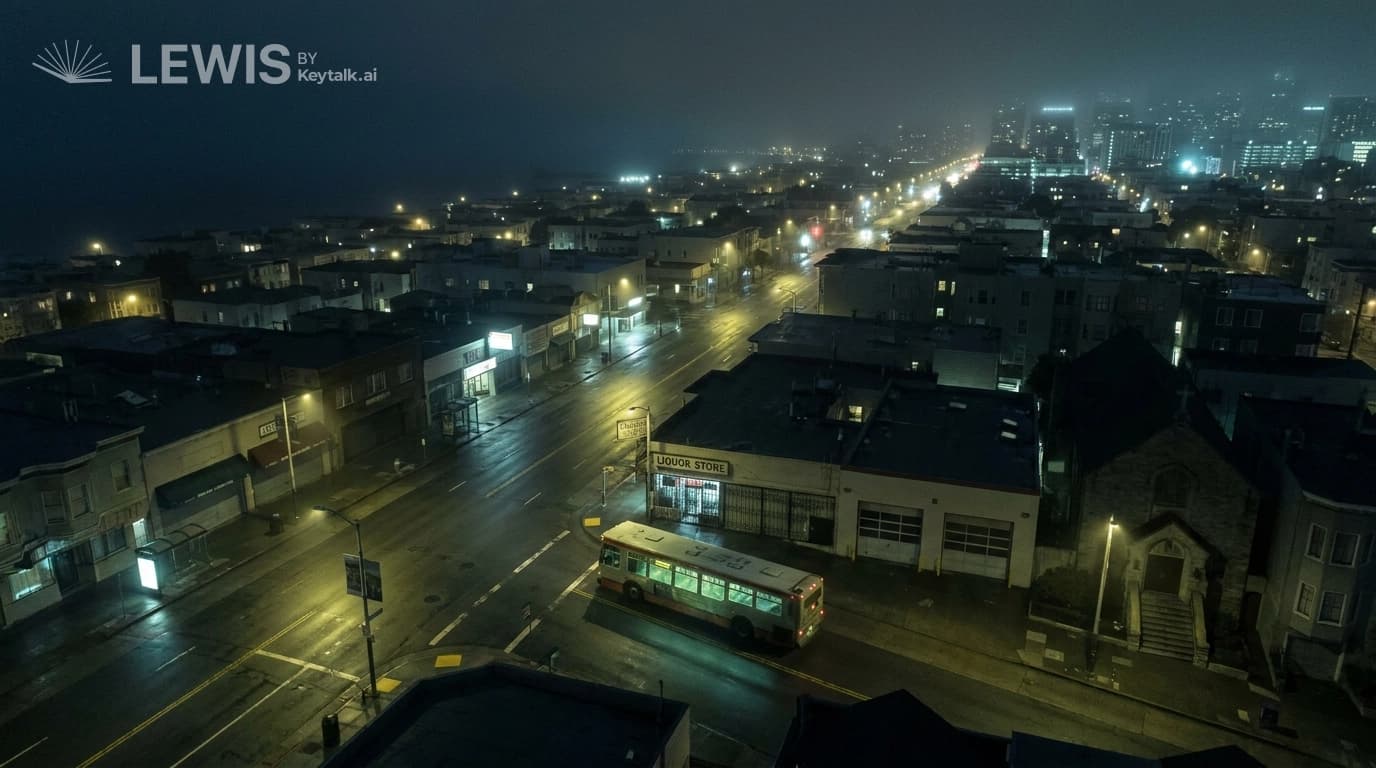
Present-day San Francisco after midnight, centered on the westbound Geary corridor and the interior of a single aging Muni coach that runs a route no public schedule admits exists. The city aboveground is ordinary in the blunt, sleepless way only San Francisco can be: liquor-store security gates half-down, taquerias bleaching their tile floors, emergency room doors sighing open, fog pressing low enough to erase the tops of streetlights. But between 3:33 and dawn, the bus becomes a moving threshold for people who have privately decided not to make it to morning.

This world is small on purpose. It lives in bus shelters filmed with condensation, in hospital discharge bracelets that have not been cut off yet, in transfer slips softened by damp hands, in the long pull from downtown brightness into the darker western neighborhoods where houses sit shut and black-windowed. The route passes places built for transit and places built for waiting: curb cuts slick with mist, empty stop benches, all-night diners, ambulance bays, shuttered schools, laundromats with one machine still spinning, the ocean wind beginning to push inland before sunrise. Every block matters because no rider has much farther than a few miles in either direction between secrecy and daylight.

時代

Now, in the years after public systems have been thinned by burnout, staffing shortages, and institutional euphemism. Late autumn edging into winter, when the city goes dark early, the fog stays wet, and the first blue of morning arrives too slowly to trust. The story unfolds over one graveyard shift, in the narrow civic dead zone when bars are closed, trains have thinned, hospitals discharge people into the cold, and anyone still awake has usually run out of easy lies.

In the hidden history of this world, the 3:33 run has existed for decades as an unwritten obligation passed from one night driver to the next. Transit supervisors do not name it. Dispatchers route around it. Mechanics know which coach comes back with too many coffee rings and no incident reports. The city survives partly because some of its workers have agreed to carry what the official system refuses to record.

ルール

The 3:33 bus only stops for people who have silently chosen this night as a last exit, and they can board without signaling because the bus recognizes decision before gesture. This makes the route a magnet for concealed crisis; riders do not need to confess to be admitted, which means Inez and Hollis must read truth through posture, objects, and silence before it hardens.

No rider may reach the final stop still certain they want to disappear. If even one passenger arrives unchanged, the driver must surrender the seat and take that rider's place in the bargain, turning every conversation into a literal life-for-life negotiation and making Hollis's exhaustion a visible countdown.

The bus can only be moved toward morning by honest speech freely given inside it; rehearsed answers, polite deflections, and institutional scripts buy distance but not release. This pressures every rider differently: Inez's dependence on procedure fails her, Hollis must reopen old wounds instead of managing people cleanly, and passengers who survive by withholding have to choose whether being known is bearable.

Anyone who boards carries the night's unfinished weight in a physical object that cannot be discarded until they step off willing to live. Bouquets, gloves, duffel bags, towels, wristbands, and scraps of paper become emotional evidence on screen; if a rider tries to leave the object behind, the bus will not lower fully at the curb, forcing them to claim what they meant to abandon.

技術と哲学

The world runs on ordinary civic machinery bent around an unofficial moral function. Fareboxes, radios, route placards, transfer printers, hydraulic kneeling systems, dispatch chatter, hospital wristbands, and late-night surveillance all exist exactly as they would in a real city, which is why the hidden rule feels plausible instead of fantastical. Nothing flashy reveals the 3:33 for what it is; the supernatural hides inside public infrastructure and worker routine.

The governing philosophy is not redemption but custodianship. The city does not heal people; it keeps them in motion long enough to hand them back to themselves. That burden falls not on clergy or family first, but on underpaid night workers who are already trained to manage strangers in crisis without naming crisis directly. Transit, emergency medicine, food service, and custodial labor form a shadow care network beneath official mental-health language. Their opportunity is intimacy with people at the hour masks slip. Their oppression is that institutions exploit this intimacy while denying it exists.

Speech in this world has practical weight. Not inspirational speeches, not cinematic monologues—specific remembered detail, grudging admissions, corrected lies, ugly small truths. A person saying, "I did not go home," matters more here than a declaration about hope. Procedure and paperwork can move bodies through the city, but they cannot complete the route's hidden work. That leaves rule-followers like Inez exposed, because competence is necessary but insufficient.

The transit company survives by cultivated deniability. Officially, the 3:33 is a gap in service, a deadhead movement, a scheduling artifact. Unofficially, certain drivers, medics, dispatchers, and night-shift workers know how to place a person near Geary when the hour turns dangerous. No one writes this down because naming the system would invite liability, policy, and removal. Silence protects the route and corrodes the people who keep it running.

視覚的描写

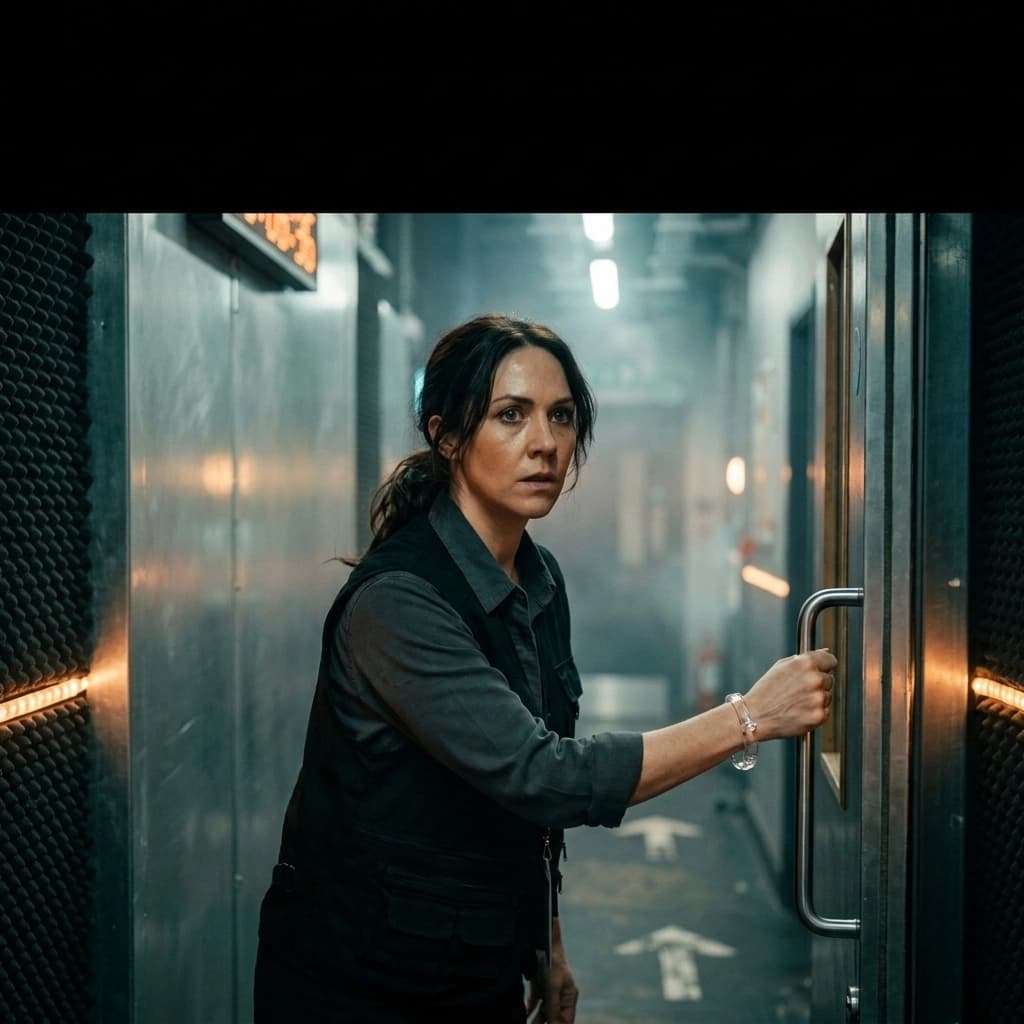
Cold fluorescent interiors against sodium streetlight exteriors. Muni navy, hospital blue, fog white, brake-light red, transfer-slip yellow. The bus is lit too flat for comfort, exposing every tired pore and damp cuff, while the city outside smears into watercolor through streaked windows and breath-clouded glass. Reflections matter: faces double over dark streets, riders appear layered with storefronts, and the rearview mirror becomes a second stage where Hollis watches truths arrive before words do.

The coach itself should look used, not haunted in a decorative way. Cracked vinyl seats gone shiny with age. Stainless poles dull from disinfectant and skin oil. A heater that clanks, coughs warm dust, then cuts out on hills. Kneeling suspension that sighs like tired lungs. The windshield catches beads of mist that wipers only smear. Each stop is a pool of artificial light surrounded by soft darkness, making boarding feel intimate and exposed at once.

San Francisco is photographed as a city of grades, edges, and withheld warmth: steep streets vanishing into milk-thick fog, corner markets glowing green-white, stucco apartment buildings with barred entryways, church steps slick with condensation, ambulance ramps lit like stages no one wants to enter. Dawn should not feel triumphant. It arrives gray, thin, and municipal.
その世界観のテーマ音楽
Lyria
トラック 01 (世界観のテーマ曲)

場所 · Locations

舞台となる場所

location 1 image

Coach 721, Front Half

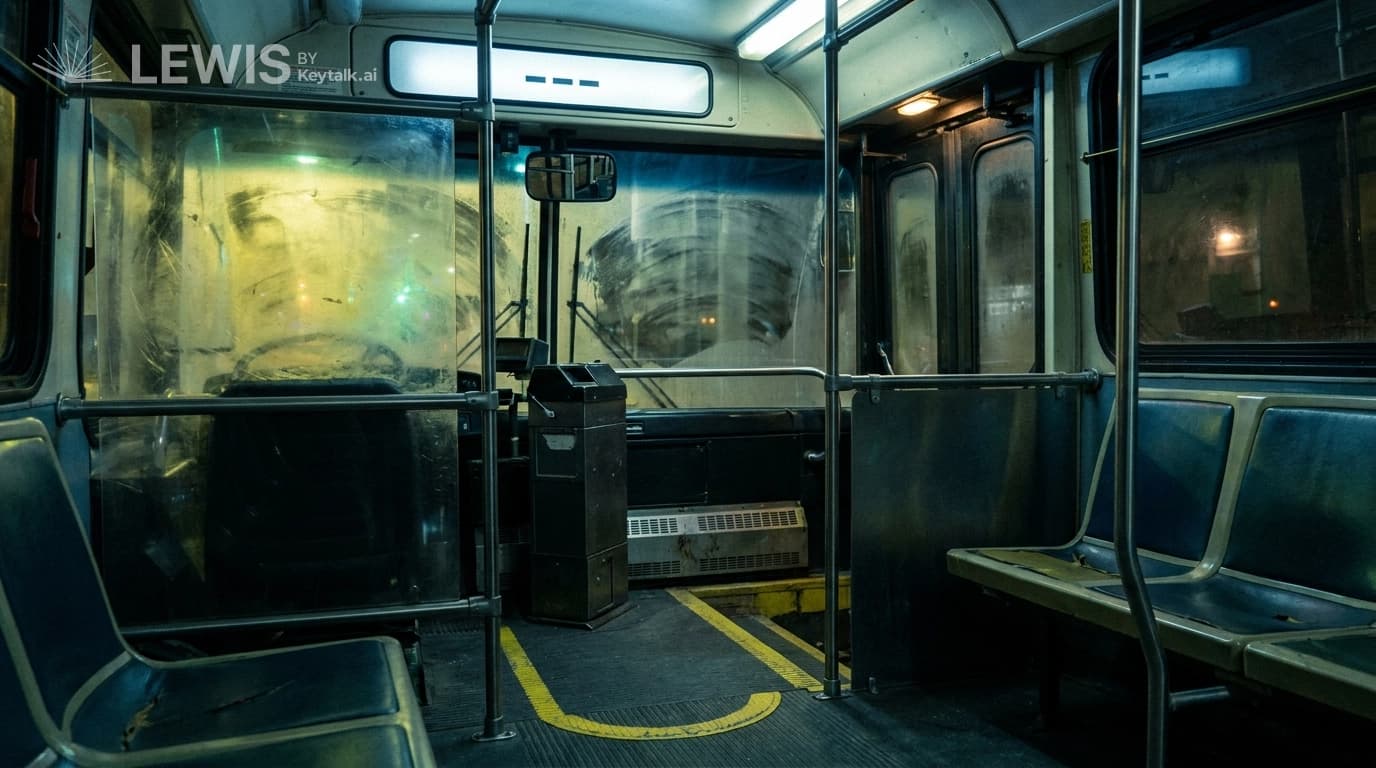
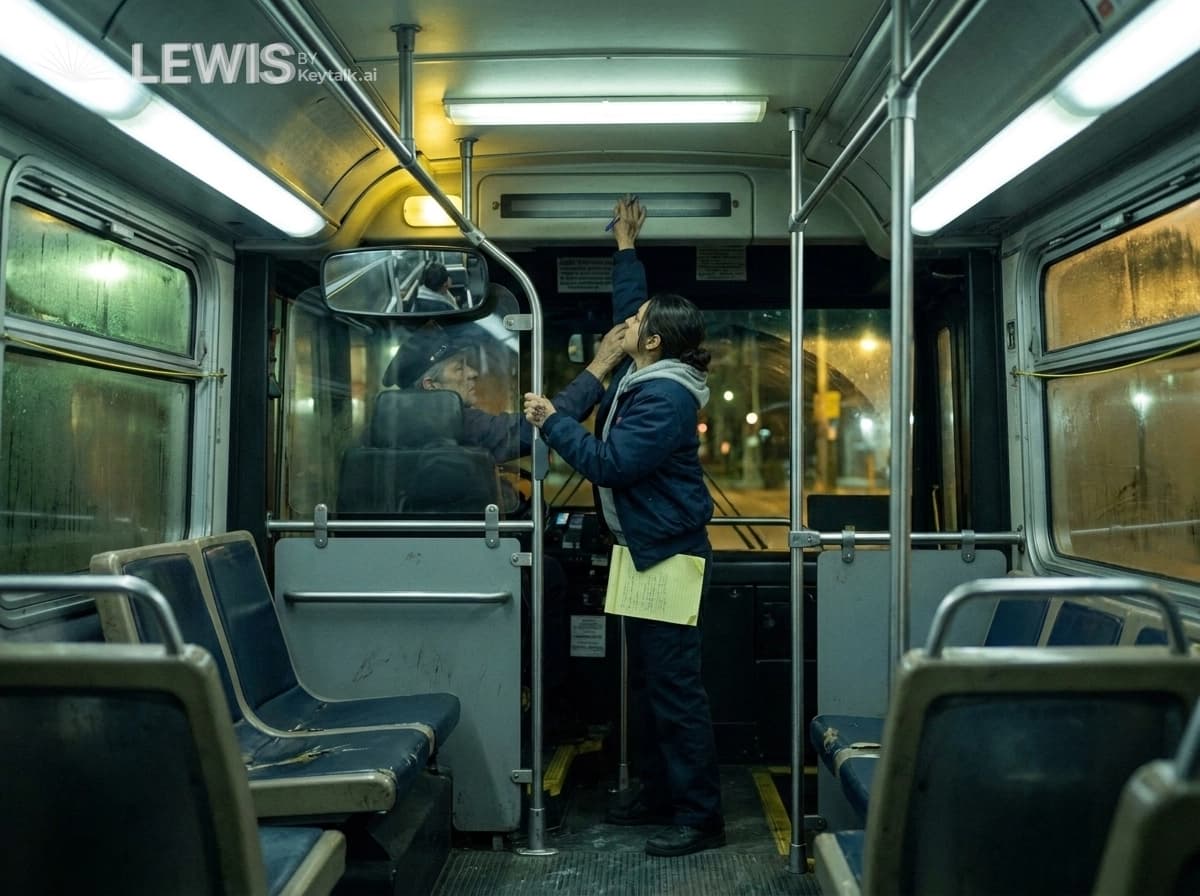
Coach 721’s front half traps everyone in the same flat blue-white glare: the driver’s plexiglass shield scratched to a haze, the farebox throat dark and waiting, the first rows of cracked vinyl seats shining at the seams where thousands of coats have polished them smooth.

The heater under the dash clanks, coughs out one breath of dusty warmth, then falls off again, leaving the low radio hiss and the hydraulic kneel to do the talking while every sound near the front—pen tapping a legal pad, a transfer printing, two fingers drumming the farebox—carries farther than it should.

Dull stainless poles cut the space into narrow lanes, forcing riders close to the mirror where faces double over the windshield’s smeared mist and the blank route placard glows like something withheld.

Its signature detail is the shallow groove worn into the yellow safety line beside the driver’s seat, a crescent scuff made by years of shoes hesitating there before stepping fully inside.

location 2 image

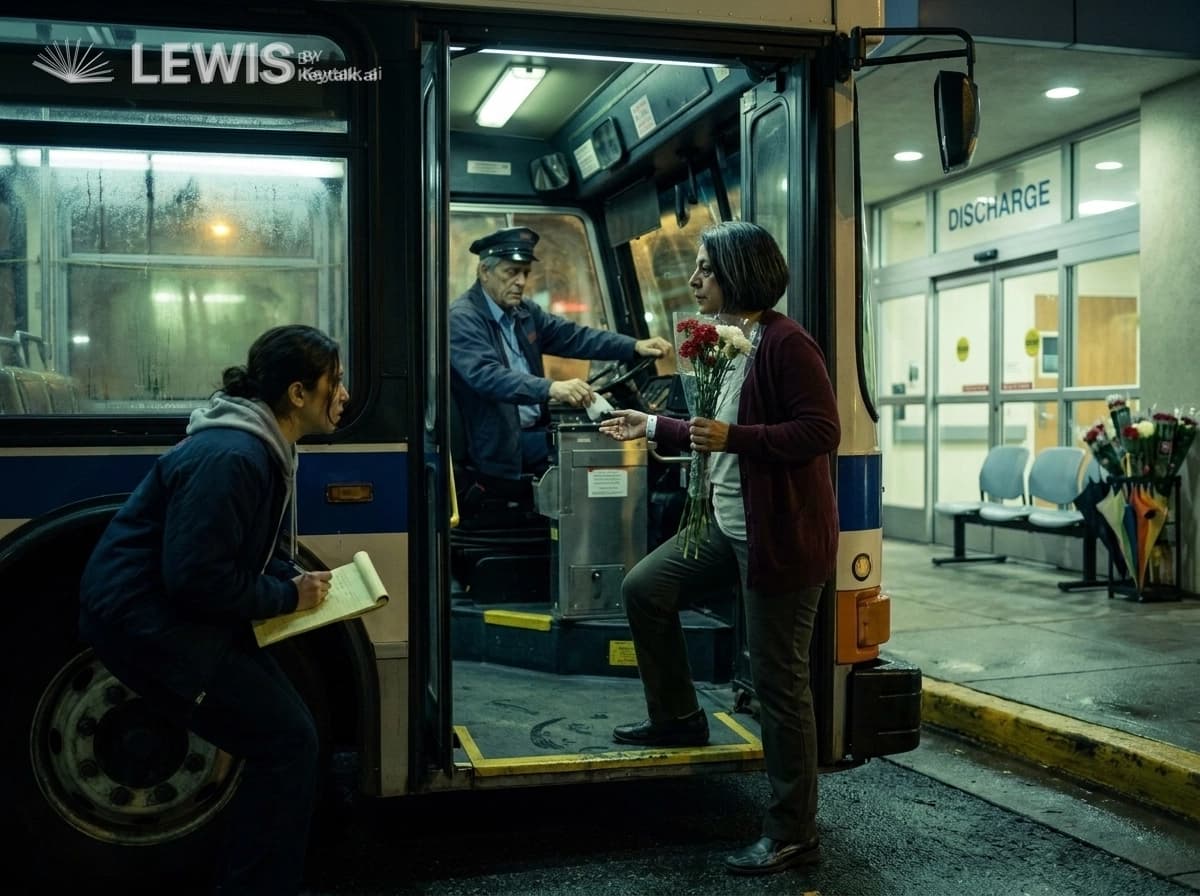
St. Brigid Oncology Discharge Doors

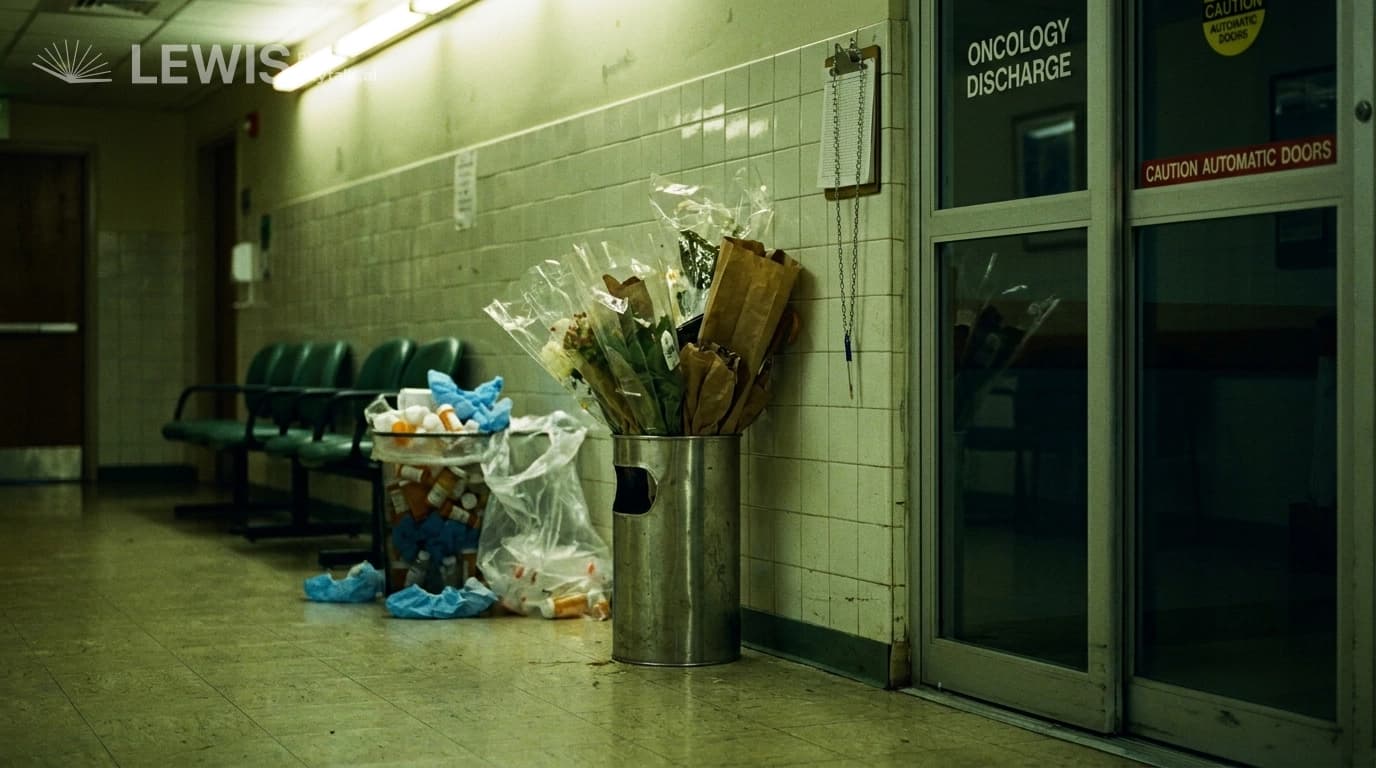
St. Brigid’s oncology discharge doors sit under green-white light that flattens every face and turns the waxed tile the color of old mint gum, with a row of molded plastic chairs bolted to the wall and a dented umbrella stand full of abandoned flower sleeves crackling softly whenever the automatic doors part.

The place never quite goes quiet: the doors exhale on their sensor, a gurney rattles somewhere deeper in the building, an intercom blurs a name no one here answers, and the thin hospital wristbands on patients’ arms catch the light like fresh labels on luggage.

A discharge clipboard hangs from a chain beside the exit, its pen missing, while the trash can below is stuffed with pill-bottle bags, paper booties, and the clear plastic caps torn from IV ports, all the small proof that people are sent back into the dark in stages rather than all at once.

location 3 image

Richmond Lantern Diner

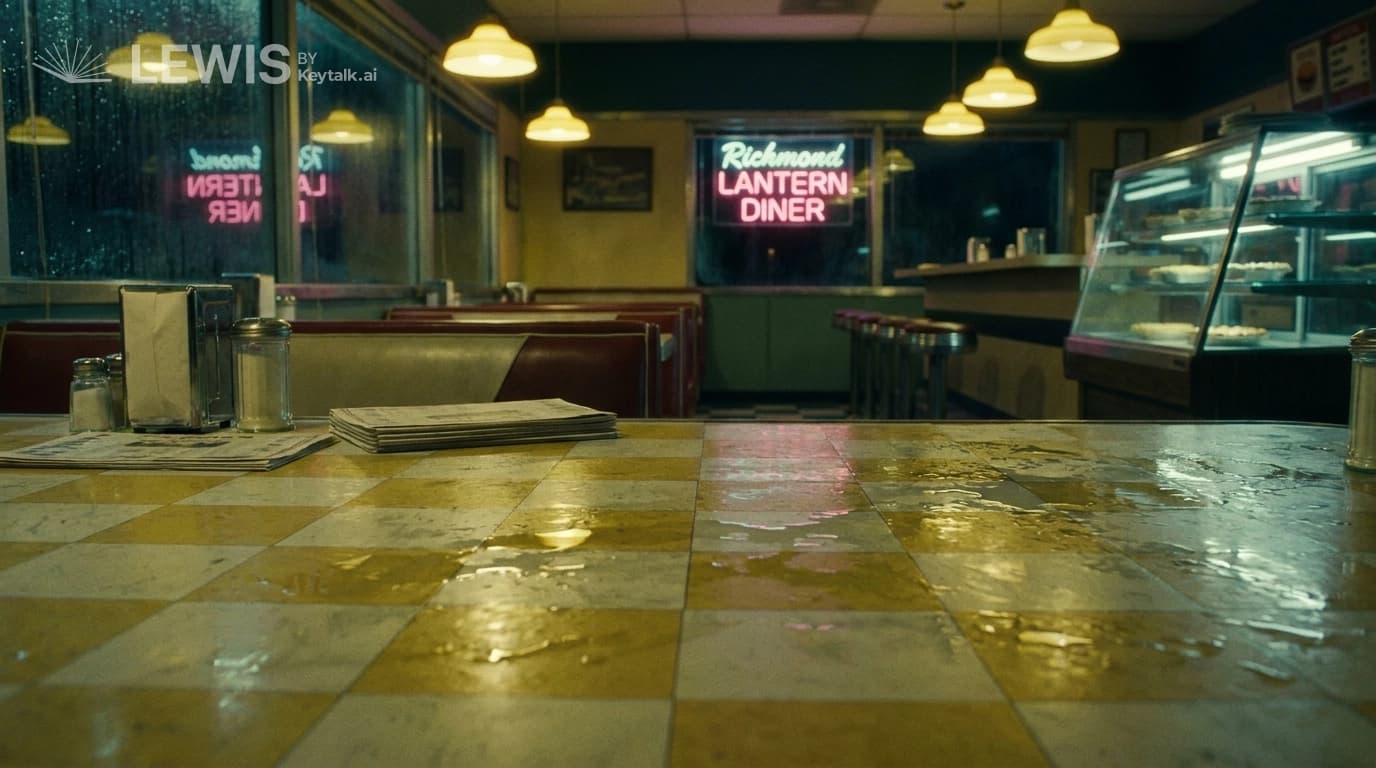
Butter-yellow pendants pool over bleached checker tile and red-edged laminate booths, warming the chrome napkin holders and the pie case by the register while a tired neon lantern in the front window blinks one weak corner of pink against the glass.

The place sounds busy even when it is nearly empty: fryer oil murmuring behind the pass, plates touching down with small hard clicks, and the slow swish of a mop pushing gray water toward a floor drain while the coffee machine gives off its patient hiss.

Every tabletop holds the same ringed sugar dispenser and a stack of paper placemats gone soft at the corners, and the counter stools shine with old use, making the room feel built for people who need somewhere bright enough to be seen without being asked too much at first.

location 4 image

Alma and Marisol’s Stripped Apartment

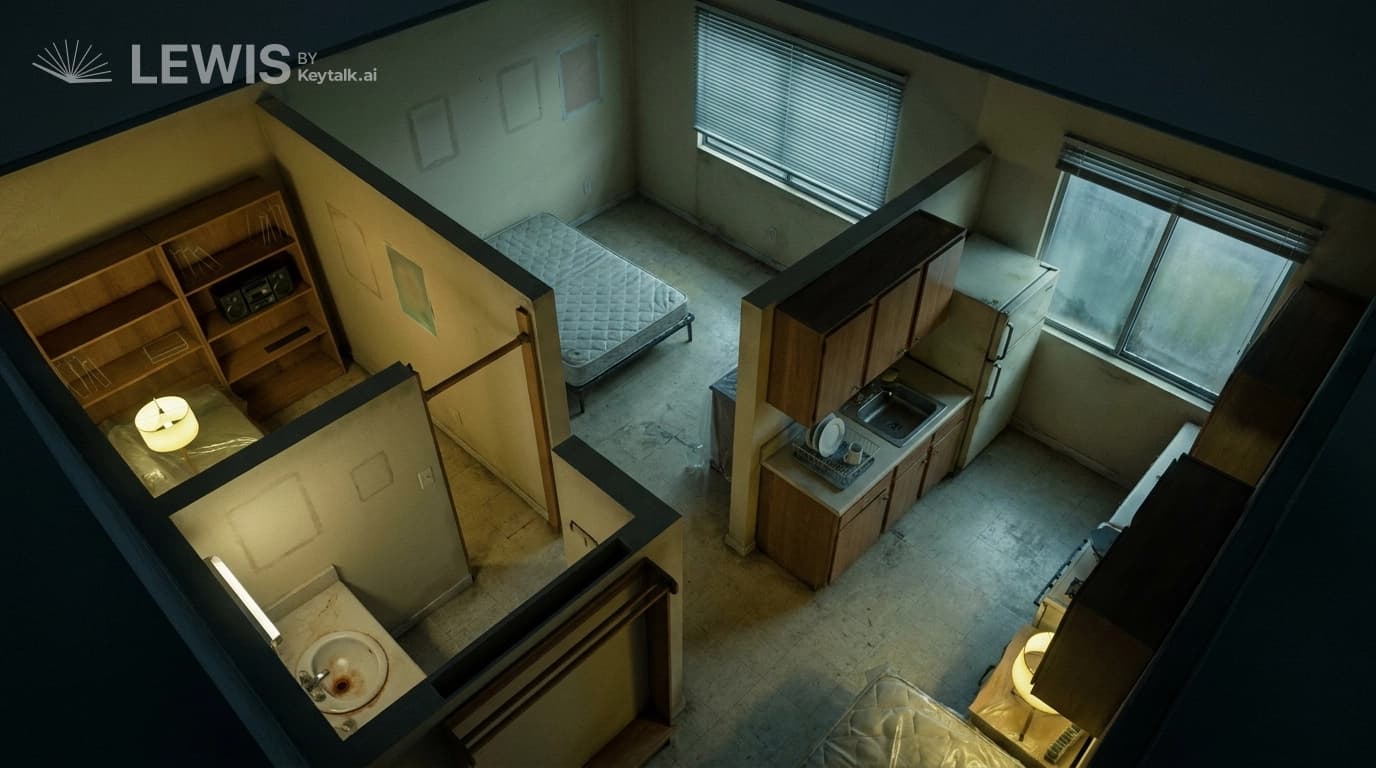
A dawn-colored apartment sits with the wrong kind of order: beige walls ghosted by cleaner rectangles where posters used to hang, a child-height toothbrush cup ring still visible on the bathroom sink, and bedroom shelves emptied so completely their dust outlines show the shape of books, a small stereo, and something once taped along the edge. The light comes in thin and gray through half-closed blinds and lands on scuffed linoleum, open closet rods, and a mattress without sheets, while the refrigerator gives off a flat electric buzz that fills the rooms between the pipe ticks and the hollow echo of a key turning in the lock.

Kitchen drawers stand shut but unlived-in, too neat beside a dish rack holding only two plates and one mug, and the air has the dry, stale stillness of a place packed in anger rather than abandoned over time. Every sound carries—cabinet hinge, shoe sole, breath—because there is nothing soft left to catch it, and that bareness makes the apartment feel like the one place morning would have to be admitted by hand.

location 5 image

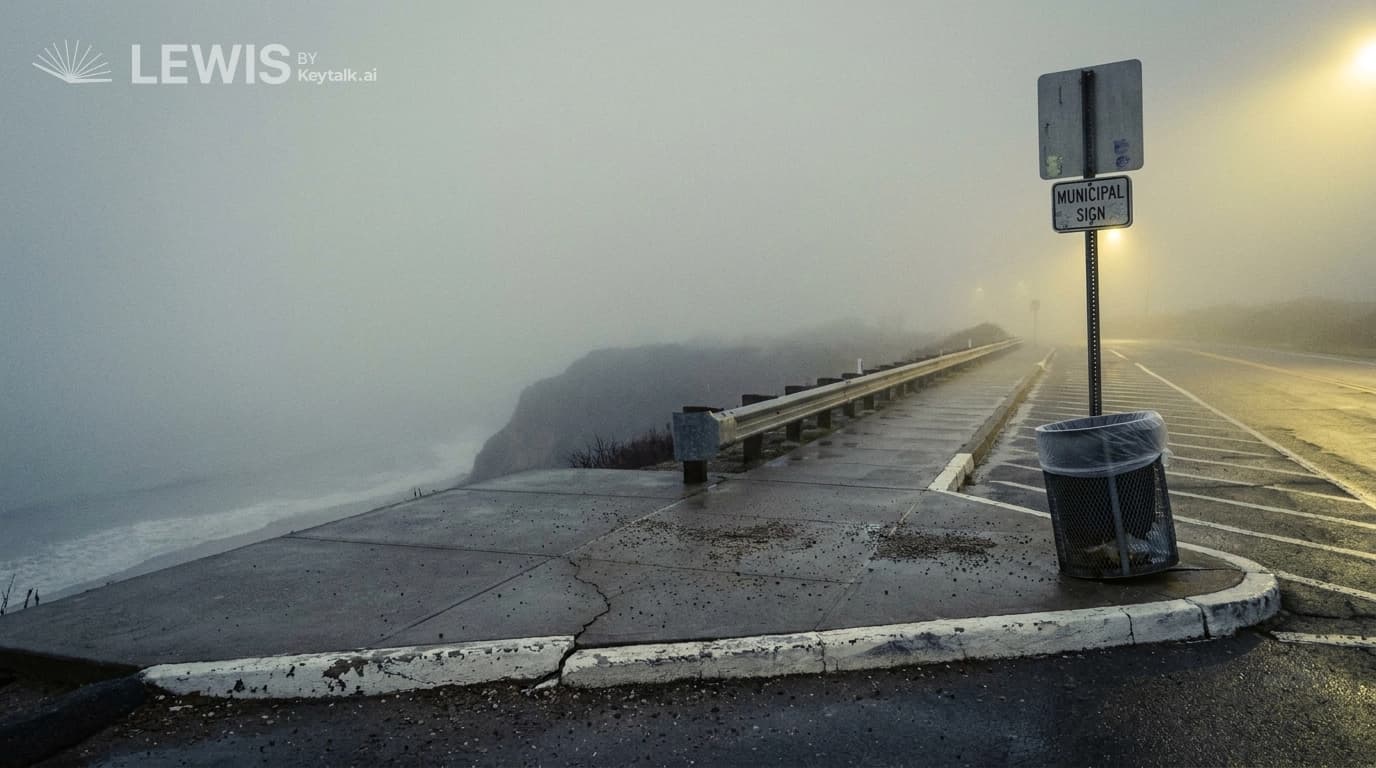
Ocean Beach Overlook Turnout

Wet concrete juts out above the beach in a blunt little turnout, edged by a low guardrail furred with salt and a city sign whose loose bolts make it chatter in the wind.

Pre-dawn light comes in thin and gray, flattening the overlook, the empty pull-in lane, and the black drop of water beyond into one washed municipal tone while surf keeps striking somewhere below the cliff, heard more than seen through the fog.

Grit skates underfoot, the paint on the curb is blistered white, and a public trash can leans slightly toward the road as if every night bus that pauses here leaves the place holding its breath for one more person to step back from the edge.


場面 · Scenes

場面ごとの物語

チャプター 01

シーン 01· 3:28 a.m., just before the route leaves the yard

Blank Placard

Blank Placard
場所Coach 721, Front Half
時間3:28 a.m., just before the route leaves the yard
出来事Inez Villareal climbs onto Coach 721 with her yellow legal pad already open and stops dead when she sees the route placard above the windshield left blank. Hollis Vale keeps the bus idling and talks her through ordinary overnight cautions—wet brake lag, a heater that quits on hills, mirrors that lie in fog—while pointedly skipping whatever the blank sign and low radio are for. When Inez reaches up to flip the placard herself, Hollis catches her wrist, takes the roll sign key from her fingers, and tells her, “Leave it.” She presses him anyway, asking what line they are running if they are not posting one, and Hollis answers by tearing a transfer from the printer and sliding it across the farebox as if paper could stand in for an explanation. The bus lurches out before she gets one.
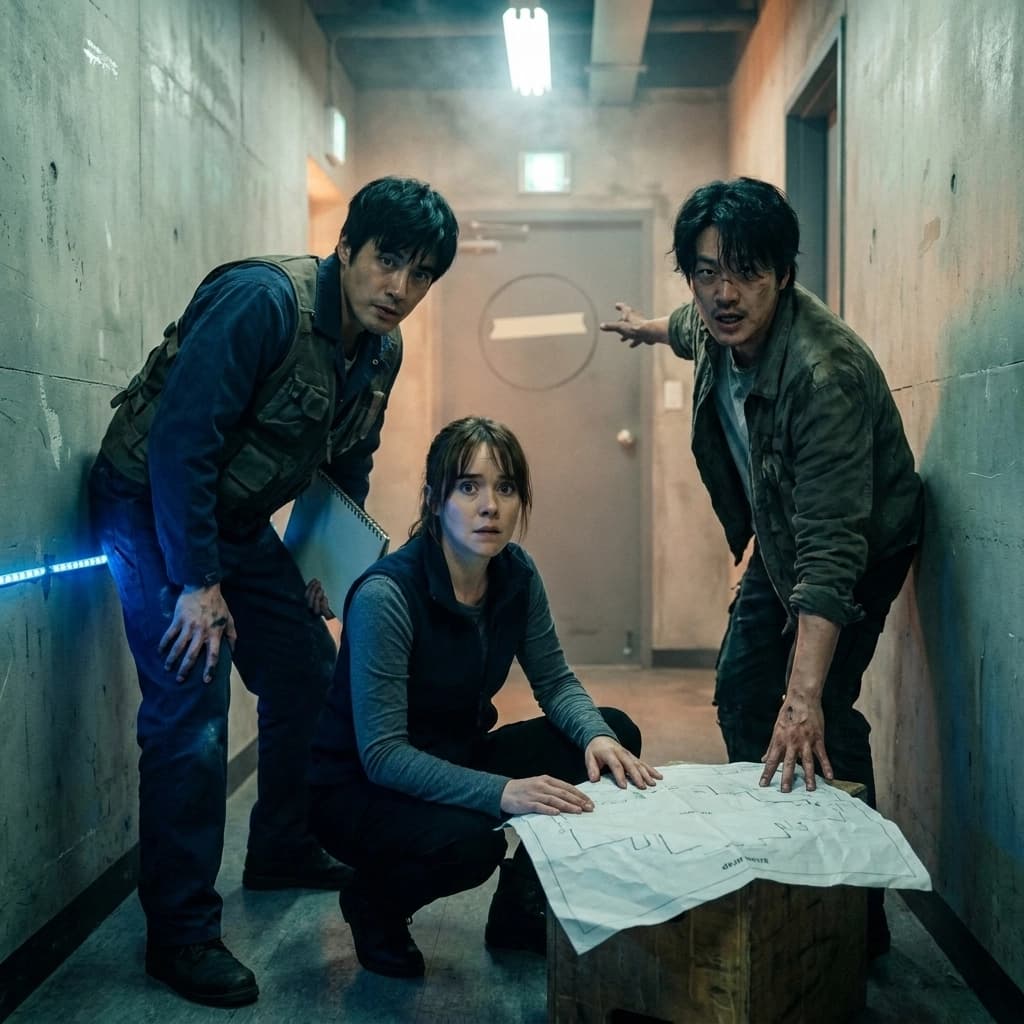
影響The scene turns a training shift into a withheld initiation. Inez loses the comfort of believing this run can be mastered by procedure alone, because Hollis physically stops her from making the bus legible and replaces a direct answer with transit routine. Their relationship sharpens at once: she is no longer just a trainee taking notes, and he is no longer just a tired mentor with dry jokes. By the time Coach 721 pulls into the sleeping city with its sign still blank, the front half of the bus has become a space organized around omission, and Inez has her first proof that Hollis is keeping a rule he does not intend to teach cleanly.

Inez Villareal hauls herself up the steps of Coach 721, yellow legal pad tucked against her ribs, and reaches for the route placard the moment she sees the space above the windshield glowing empty in the flat blue-white light. The front half of the bus is all scratched plexiglass, dull poles, and cracked vinyl polished shiny at the seams, with the dark farebox throat waiting beside the shallow crescent scuff worn into the safety line. Hollis Vale stays in the seat with one hand loose on the wheel and says, without looking at her, “Mind the brake lag on wet grades. Heater cuts out on hills. Mirrors smear when the fog sits low.” Inez keeps her fingers on the placard latch. “What line are we running?” she asks. Hollis reaches up, closes his hand around her wrist just long enough to stop the motion, and removes the sign key from her fingers. “Leave it.”

She pulls back, more startled than hurt, and drops into the fold-down trainee seat with the pad open on her knee while Hollis slots the key into his shirt pocket like it belongs there more than any answer does. The radio hisses low but no voice comes through. Inez writes blank placard, no line posted, then underlines it hard enough to dent the page. Hollis releases the brake, lets the coach roll a yard, and tears a transfer slip from the printer with a quick snap. He slides it across the farebox toward her. “Write down what matters,” he says. The heater under the dash clanks and coughs one dusty breath before dying again.

The bus noses out of the yard and into the wet dark with no route number in its forehead and no passengers yet to witness it. In the windshield, Inez sees Hollis watching the road and her at the same time through the mirror. She sets the transfer on top of her notes instead of pocketing it. Above them, the blank placard keeps glowing.

シーン 02· 3:33 a.m., moments after leaving the yard

The Woman Behind Him

The Woman Behind Him
場所Coach 721, Front Half / St. Brigid Oncology Discharge Doors
時間3:33 a.m., moments after leaving the yard
出来事Coach 721 kneels at an unscheduled curb outside St. Brigid without anyone signaling, and Marisol Quintero boards under the hospital’s green-white discharge light carrying wet carnations and wearing a plastic wristband. Hollis Vale goes visibly white when he sees her, misses the fare routine entirely, and lets her pass the dark farebox throat without collecting anything. Marisol stops in the worn groove beside the yellow safety line, asks for a transfer in a flat voice, and forces Hollis to hand her one while Inez Villareal watches him fumble the printer for the first time. Marisol then takes the seat directly behind Hollis, close enough to live in his mirror, and says his name like a summons he can no longer dodge.
影響The scene turns Hollis from a withholding mentor into a man under direct claim, and Inez sees that whatever rule governs this run is bound up with people Hollis has failed or refused before. Marisol’s request for a transfer she does not need becomes the first visible proof that ordinary transit procedure is being used as a weapon and a ledger at once. By the time the doors shut and the bus pulls away, Inez knows Hollis is not merely secretive; he is afraid of one specific passenger. The front half of Coach 721 stops feeling like a training space and becomes a narrow stage where every next boarding will happen under Marisol’s stare.

Coach 721 drops to its knees at the curb outside St. Brigid’s oncology discharge doors, and Marisol Quintero steps in through the folding doors with damp carnations upright in both hands, her hospital wristband flashing pale under the green-white light. Behind her, the automatic doors to the hospital part and close on a row of bolted plastic chairs and an umbrella stand stuffed with crackling flower sleeves. Hollis Vale’s hand comes off the wheel and misses the farebox entirely. Inez Villareal, already half-risen with her legal pad, sees his face in the scratched plexiglass go flat and bloodless before he can tuck it away.

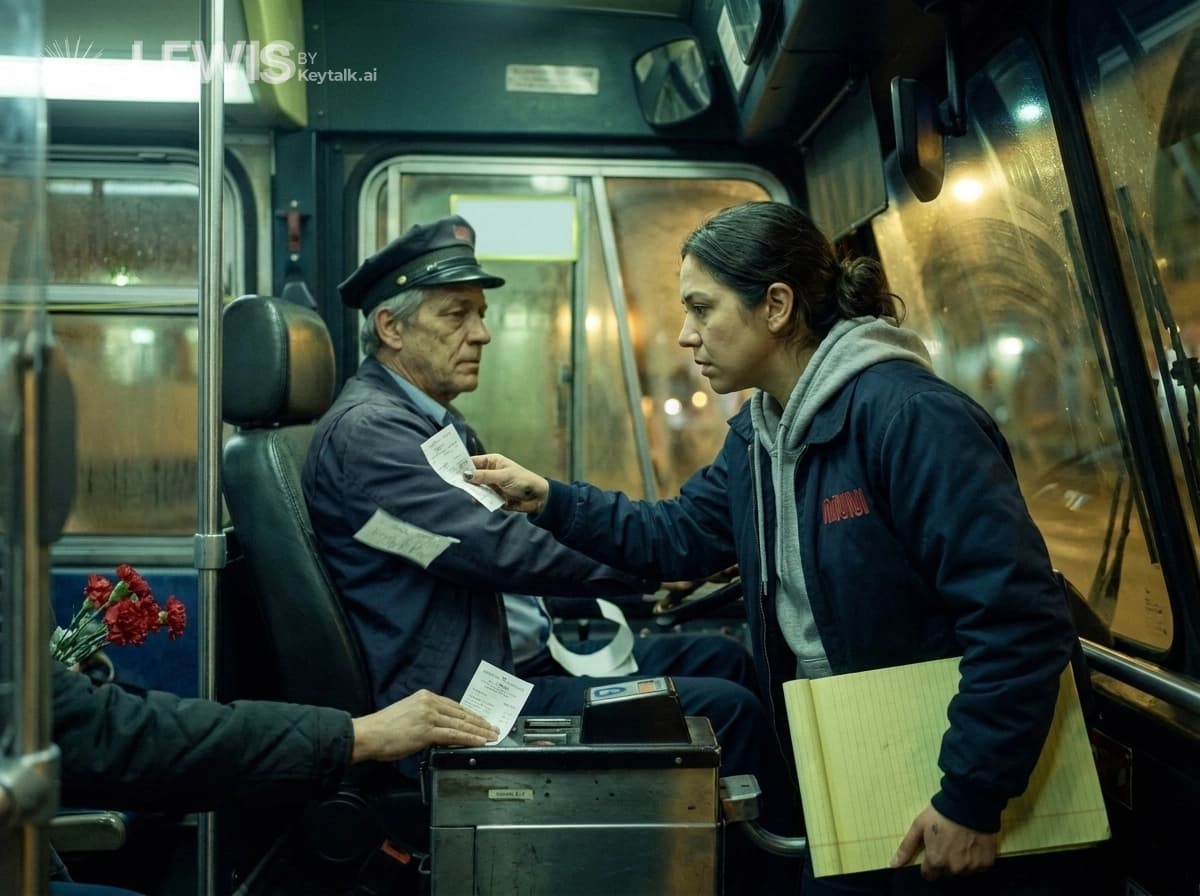
Marisol stops with one sensible shoe in the crescent scuff beside the yellow line and holds out her hand. “Transfer,” she says. Hollis stares at her for one beat too long, then reaches for the printer with fingers that catch on the housing and tear the slip crooked before it spits free. “You don’t need one,” he says, and it comes out strained, too careful. Marisol takes the paper without looking at it. “I asked for one.” Inez’s pen touches the pad, then presses hard enough to dent the top sheet as Marisol moves past the scratched shield and sits directly behind Hollis, bouquet braced between her knees, close enough that her face doubles with his in the rearview mirror.

The doors fold shut on the hospital light, and the bus lifts with a tired hydraulic sigh. Hollis pulls back into the wet street without checking fare, transfer, or destination, his eyes fixed ahead so hard they look pinned there. Marisol smooths the crooked transfer against her thigh, then says, not loudly, “Drive, Hollis.” Inez looks from the blank route placard to the mirror and writes nothing at all while Coach 721 noses west into fog with the woman behind him already in the bus’s line of sight.

シーン 03· 3:40 a.m., westbound on Geary after St. Brigid

First Westbound

First Westbound
場所Coach 721, Front Half
時間3:40 a.m., westbound on Geary after St. Brigid
出来事Darnell Pike climbs aboard as Coach 721 pulls farther west, bringing the first new body into the front half since Marisol Quintero took the seat behind Hollis Vale. Hollis fails to treat him like an ordinary passenger; instead of asking for fare, he watches Darnell’s wrapped knuckle in the mirror and lowers the bus’s usual roughness into a careful, almost apologetic crawl. Inez Villareal keeps writing down Hollis’s tells until Darnell catches her doing it and forces her to choose between hiding in procedure and speaking to the people on the bus. Marisol uses almost no words, but her silence and exact stare turn Darnell’s boarding into another entry in whatever account she has come to settle with Hollis.
影響The scene widens the bus from a private confrontation into a chamber of strangers carrying separate damage that somehow belongs to the same route. Inez does not learn the rule yet, but she sees enough to understand that Hollis is screening the truth through transit routine and that each new rider arrives already implicated in something the bus expects from them. Darnell’s presence changes the temperature of the front half: he is not there to be comforted, and his resistance makes the coach feel less like a training run than a sealed room collecting unfinished nights. By the end of the beat, Hollis is trapped between Marisol behind him and another rider in visible trouble ahead, with Inez sitting close enough to record every omission.

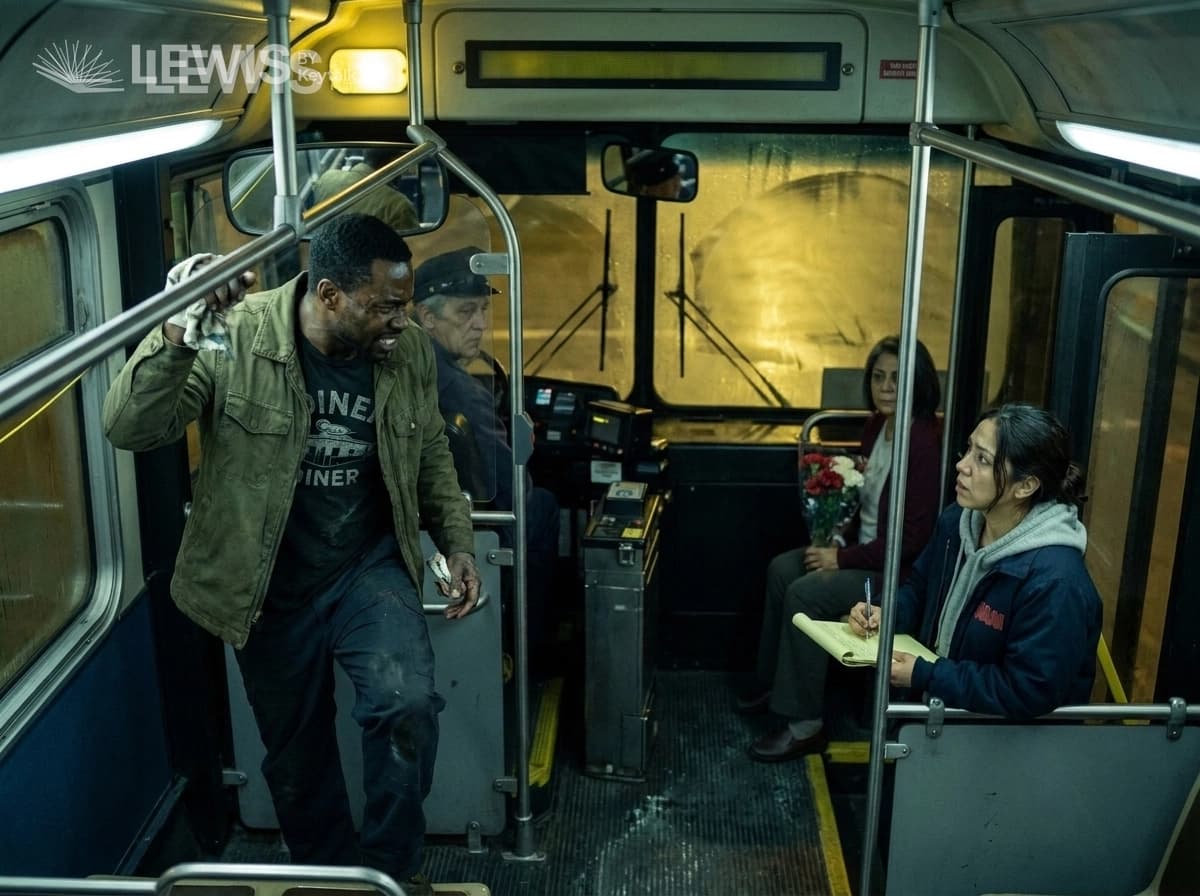
Darnell Pike slaps the pole with his good hand and hauls himself up the front steps just as Coach 721 kneels at a bare patch of curb, his dish-towel-wrapped knuckle tucked against his ribs and fryer grease dark in the seams of his fingers. The front half catches him in the same flat blue-white glare that has already turned Hollis Vale and Marisol Quintero into sharper, meaner versions of themselves: scratched plexiglass, the dark farebox throat, the blank placard glowing over the windshield like a covered name. Hollis does not ask for fare. He glances once in the mirror, sees the towel, and says, “Watch the step,” in the tone a driver uses for somebody already halfway elsewhere. Inez Villareal writes that down so hard her pen clicks through the paper. Darnell clocks the legal pad before he sits, turns sideways into the first row across from the aisle, and says, “You grading us, or is this just for your boss?”

Inez looks up too slowly, caught with the pen still touching the torn page. Hollis taps two fingers once against the farebox and says, “Training.” Marisol, upright behind him with the wet carnations pinned between her knees, lets out a small breath through her nose that is not quite a laugh. Darnell shifts his wrapped hand deeper under his arm and keeps his eyes on Inez instead of Hollis. “Then write this right,” he says. “I got on by myself.” The bus pulls from the curb, wipers smearing mist across the glass, and Hollis takes the next block so gently it looks deliberate.

No one speaks for half an intersection. Then Marisol asks, flat and precise, “Do you know him too, or do you only forget women?” Hollis’s jaw tightens; he adjusts a mirror that does not need it and says nothing. Inez tears the edge of her page free without meaning to, the paper rasp loud in the cramped front half, while Darnell turns his head just enough to look from Marisol’s hospital wristband to Hollis’s white face and back again. Coach 721 keeps rolling west with all four of them reflected in the windshield at once, layered over the wet street like people already stuck together.

チャプター 02

シーン 04· Minutes after Darnell boards, westbound on Geary near a shuttered liquor store

Half-Lowered Door

Half-Lowered Door
場所Coach 721, Front Half
時間Minutes after Darnell boards, westbound on Geary near a shuttered liquor store
出来事Darnell Pike yanks the stop cord and tries to get off before Hollis Vale can pull another answer out of him. When the bus kneels at the curb, the doors wheeze open only partway because Darnell has thrown his blood-stiff dish towel onto the seat and stepped toward the exit without it. Hollis does not act surprised. He tells Darnell to take the towel with him, and when Darnell refuses and tries to force his way down anyway, he bangs his shin against the half-lowered step and has to snatch the towel back up before the hydraulics finally release and the bus lowers the rest of the way. Inez Villareal watches the whole ugly little struggle from the fold-down seat with her legal pad open, caught between writing it down and demanding that Hollis explain what kind of route punishes a man for leaving a rag behind.
影響This scene gives Inez her first undeniable proof that Coach 721 is governed by a rule no manual could contain. The bus does not merely carry distressed riders; it refuses to help them abandon the object that holds the night's unfinished weight. Hollis's calm response makes his secrecy worse, because it shows he knows exactly what happened and still chooses not to name it. Darnell's failed exit also hardens the bus into a trap with terms of its own, pushing Inez closer to testing whether the route responds to truth, resistance, or both.

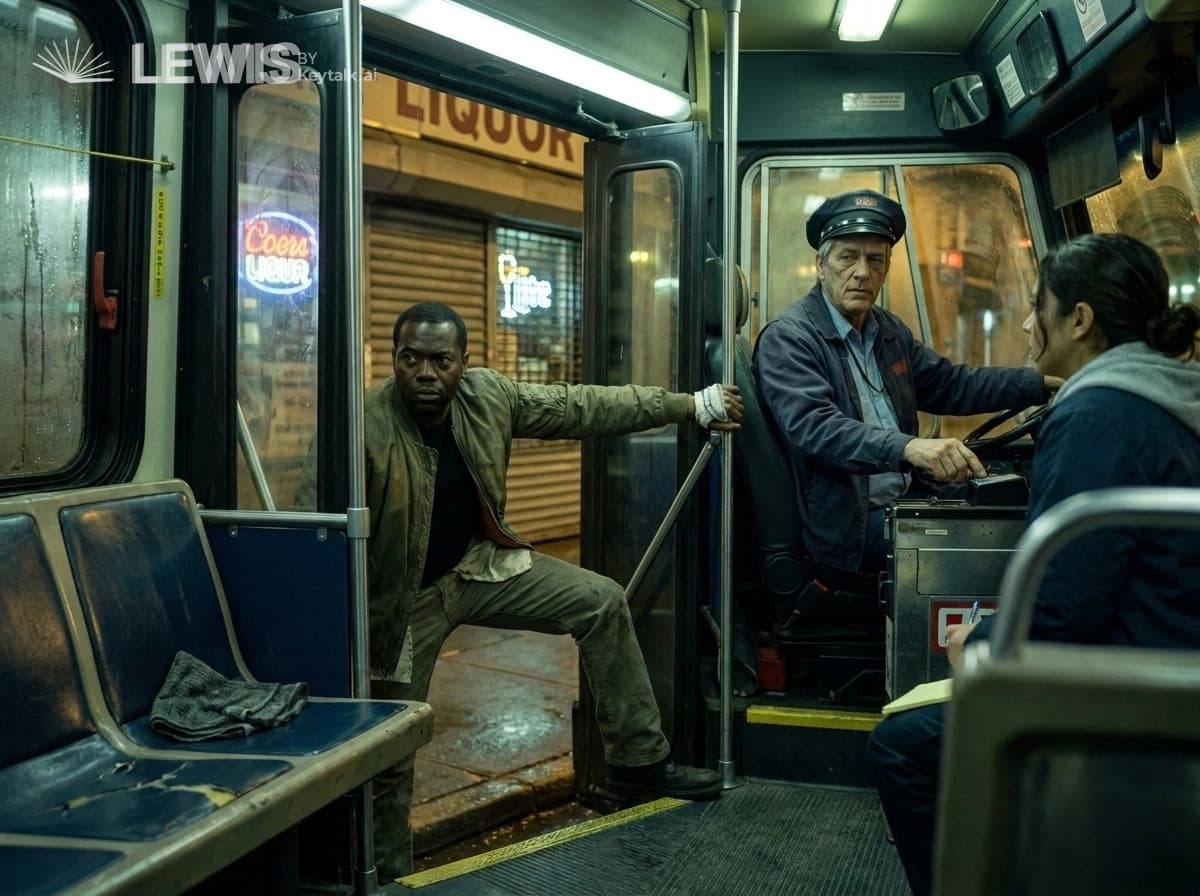
Darnell Pike jerks the yellow stop cord hard enough to make it slap the window, then comes out of his sideways seat in one rough motion as Coach 721 noses up to a liquor store with its metal gate half down and a green neon beer sign still burning behind it. In the flat blue-white glare of the front half, his dish towel lands on the cracked vinyl with a dark, stiff fold, and he plants one hand on a dull steel pole as the bus sighs into its kneel. Hollis Vale eases to the curb so gently it looks practiced, but when the doors fold apart they stop after six inches, leaving a black seam of street and wet concrete beyond. Inez Villareal half rises from the trainee seat, legal pad sliding against her knee. “What is that?” she says. Hollis keeps one hand on the wheel and taps the farebox twice with the other. “Take your towel, Darnell.”

Darnell gives him a flat look, then turns sideways and tries to shoulder through the gap anyway. The rubber door edge catches his jacket, his shin slams the half-lowered step, and the crack of bone on metal carries through the scratched plexiglass. He swears, grabs the pole harder, then glares at the towel as if it has reached for him first. “You kidding me?” he says. Hollis does not raise his voice. “Bus won’t carry what you mean to leave.” Darnell snatches the towel off the seat with his wrapped hand, and at once the hydraulics exhale the rest of the way, dropping the step flush to the curb.

Nobody moves for a beat. Darnell stands in the open doorway with the towel clenched under his arm, the wet streetlight cutting a pale bar across his work shoes, then turns back and climbs aboard without being asked. Inez puts her pen to the paper so hard the tip skips, eyes fixed on the crescent scuff by the safety line and the door now hanging open as if it had never stuck at all.

シーン 05· Minutes after Darnell’s failed exit, around 3:45 a.m.

Notes Against the Rule

Notes Against the Rule
場所Coach 721, Front Half
時間Minutes after Darnell’s failed exit, around 3:45 a.m.
出来事Inez stops writing passively and starts using her legal pad as a test, feeding Hollis exact phrases Darnell has already let slip and watching how the bus responds when answers turn evasive. Tavi notices and turns her note-taking into a target, performing for the page with polished, tougher lies while Darnell pushes back from his seat with blunt corrections and Hollis refuses to explain what any of it means. The decisive shift comes when Inez tears a used page free, hands it to Darnell, and asks him to mark the address he is avoiding going back to; he refuses, but the ugly specificity of the argument that follows loosens something in the coach, proving to her that the route changes under spoken fact, not comfort.
影響The scene moves Inez from observer toward participant without giving her full success yet. She gets her first working sense of the hidden rule through action instead of theory: the bus drags under performance and eases under unwanted detail. Tavi’s mockery sharpens into a contest, setting up the next scene where Inez will have to confront him directly rather than hide behind her notes. Darnell also becomes more than a silent witness here; his exact, grudging admissions provide the evidence Inez needs, while Hollis’s refusal to name the rule makes his secrecy feel more deliberate and more costly.

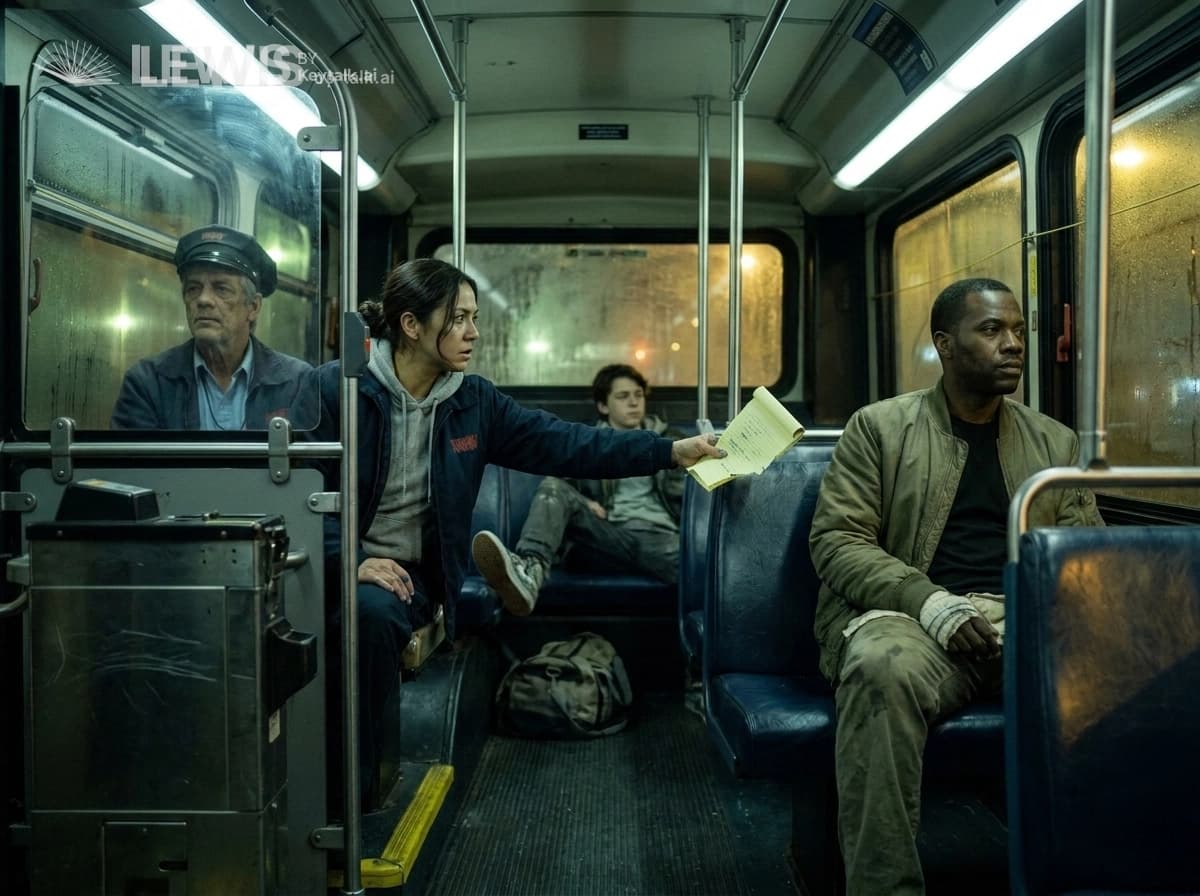
Inez tears a page out of her legal pad and holds it across the aisle toward Darnell Pike while Coach 721 lurches through another wet block, the scratched plexiglass shield throwing back a doubled smear of Hollis Vale’s face and the dark farebox sitting between them like a shut mouth. “Write where you were headed,” she says. Darnell does not take the page. He keeps his split knuckle tucked under his arm and looks past her toward the fogged glass, while Hollis drums two fingers against the farebox and says, too evenly, “He’s not in school, Villareal.” Tavi Mercer lets out a quick laugh from the sideways seat behind Darnell, braces his skate shoe on his duffel, and says, “Yeah, don’t interrogate the public, officer.” Inez leaves the page hanging there one beat longer, then sets it on the cracked vinyl between them instead of pulling back.

The bus crawls under Tavi’s running patter — a clean little story about crashing at a friend’s place, catching an early shift, carrying nothing in the bag worth stealing — and then jerks smoother the moment Darnell says, flat as a kitchen ticket, “My brother’s asleep on my couch with no pills left in the apartment because I flushed them.” Hollis’s hand stills on the wheel. Inez looks up from the note she has half-written and says, “Say that again.” Darnell gives her a hard stare, but he does. Tavi’s half-smile slips, then returns sharper. “You writing everybody down like case notes?” he asks, leaning forward enough for the yellow route light to catch the bitten edge of his thumbnail. Inez slides the loose page closer to Darnell with two fingers. “Then write the address,” she says. “If you’re going back.”

Darnell swipes the page off the seat, crumples it once, and throws it at the farebox; it hits the plastic housing and drops into the shallow groove by the yellow line. “I know the address,” he says. “That’s the problem.” The coach takes the next corner cleaner than the last one, and even Hollis glances at her in the mirror before looking away. Tavi shifts his duffel tighter against his shin and starts talking again, faster now, but Inez does not write his new story down. She bends, picks the crumpled page out of the groove where shoes have hesitated for years, smooths it against her knee, and leaves the blank side facing him.

シーン 06· Around 3:50 a.m., moving west on Geary

The Poster Tube

The Poster Tube
場所Coach 721, Front Half
時間Around 3:50 a.m., moving west on Geary
出来事Inez Villareal stops writing and questions Tavi Mercer directly when his polished act starts to feel too practiced to survive another block. She asks what in his duffel bag had to be wrapped in rolled socks, and the question lands hard enough that Tavi jerks the bag closer instead of laughing it off cleanly. When the bus hits a wet seam in the road, the duffel tips, a glitter-glued poster tube slides half out, and Darnell Pike plants his shoe on the strap before Tavi can yank it shut. Hollis Vale keeps the coach moving and says nothing for once, forcing the moment to belong to Inez instead of rescuing it with one of his dry deflections. Cornered by the tube in plain view, Tavi admits he took his little sister’s concert sign so that if he missed her performance by morning, it could look like an accident instead of a choice.
影響The scene proves to Inez that this route responds to a precise kind of honesty she can help draw out herself, not just witness from Hollis’s seat. Her legal pad stops functioning as cover and becomes dead weight in her lap, because asking the right question does more than any note she has taken all night. Tavi’s confession also sharpens the bus’s hidden rule into something practical and brutal: the coach does not need grand declarations, only the ugly specific thing a person has been arranging not to say. Hollis loses a little control over the front half by letting Inez handle the breach, and that small transfer of authority shifts their training run toward apprenticeship in something neither of them can name aloud.

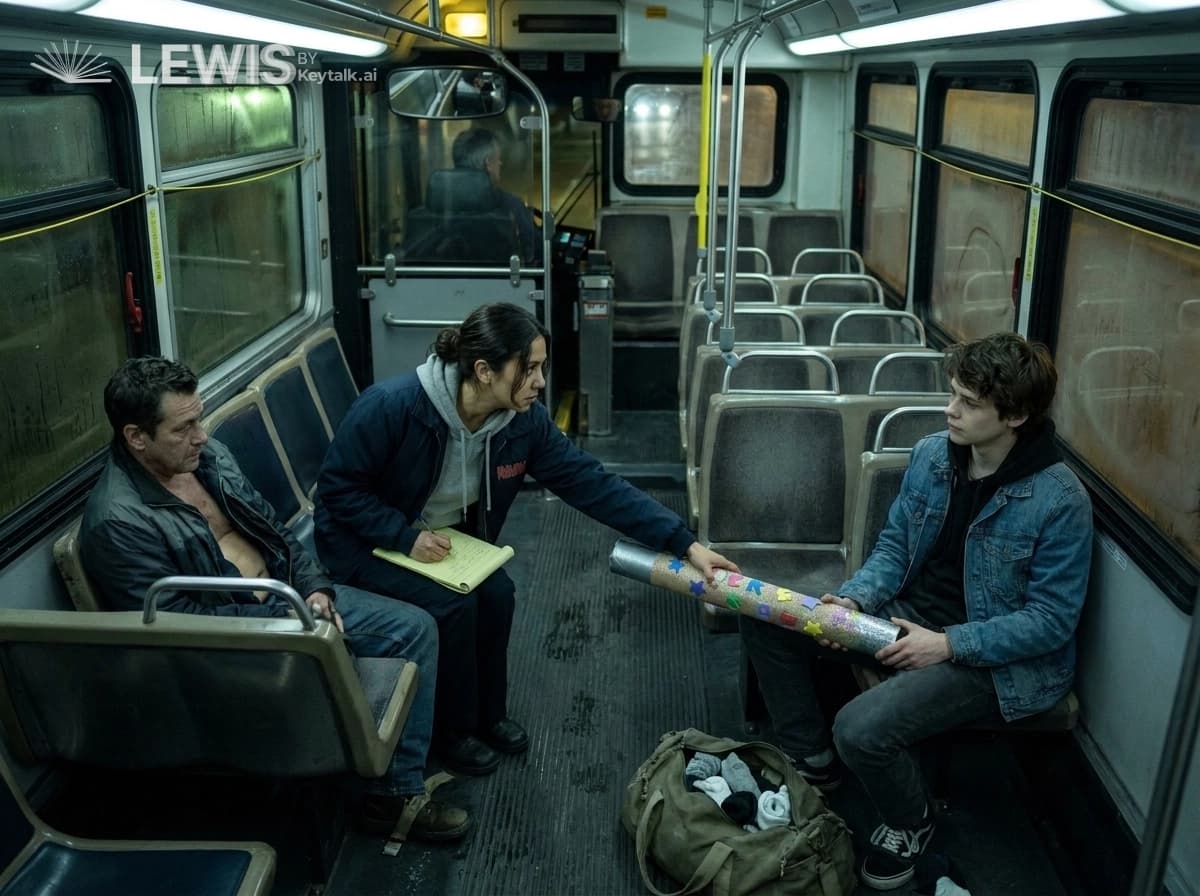
Inez Villareal flips her legal pad shut against her knee and leans across the narrow aisle toward Tavi Mercer just as Coach 721 sways through a wet green light, the scratched plexiglass and blank placard throwing the whole front half into the same flat blue-white glare. “Why’d you pack rolled socks around something breakable?” she says. Tavi’s half-smile comes up on reflex and slips almost at once; he hooks one arm around the frayed duffel strap and says, “You inventory everybody, or just minors?” Hollis Vale’s fingers drum twice against the farebox, then go still. Across the aisle, Darnell Pike turns his head from the window and watches Tavi the way he watched the half-lowered doors, with no patience left for performance.

The bus jolts over a patched strip of pavement, and Tavi’s duffel slides off his knee hard enough to gape open. A cardboard poster tube wrapped in silver tape noses out between rolled socks, bright with clotted glitter and a crooked foam-star edge. Tavi lunges. Darnell plants his work shoe on the strap and pins the bag to the scuffed floor before Tavi can wrench it away. “Leave it,” Darnell says. Tavi yanks once, fails, and snaps at Inez, “It’s not mine.” Inez reaches down, lifts the tube by two fingers, and turns the glittered side just enough for a child’s block letters to catch the light: GO MAVS! GO LILA! One purple heart has been smeared by a damp thumb.

Tavi’s face folds older and younger at the same time. He wipes at his mouth with the back of his hand and stares at the tube instead of any of them. “She made me promise I’d hold it up where she could see me,” he says, voice gone thin and plain. The heater coughs one dry breath under the dash and dies again. “So I took it. If I had it with me, then missing it could be because I’m an idiot, not because I left.” Inez lowers the poster tube into his lap, and this time he takes it with both hands.

チャプター 03

シーン 07· Around 4:10 a.m., westbound near the closed school

Celia at the Rear Door

Celia at the Rear Door
場所Coach 721, Front Half
時間Around 4:10 a.m., westbound near the closed school
出来事Celia Nwosu finally breaks her silence when Marisol Quintero asks which floor the hospital wristband came from, and Celia answers with the oncology unit and then the apartment stairwell where she stopped for a few selfish seconds before a patient died. Tavi's breathing goes wrong in the same moment; Celia crosses the aisle, catches his wrist, and shoves a paper bag into his hand, forcing the confession and the care into the same cramped strip of bus floor. While Hollis Vale keeps the coach moving and pretends not to hear too much, Inez Villareal follows Celia to the rear door and corners her for the truth Hollis will not give. Celia tells her plainly that if one rider reaches the last stop still certain, the driver takes that rider's place and does not come back.
影響The scene gives Inez the rule's real cost in words she cannot explain away, turning the route from eerie procedure into a direct life-for-life bargain. Celia's admission also proves that the bus only moves forward when people surrender the ugly, exact fact they most want to keep usable and clean. Hollis loses some control of the night's silence because another worker names the price he has been carrying alone, and Inez is pushed out of trainee distance into moral involvement. From this point forward, every stop includes Hollis's possible disappearance.

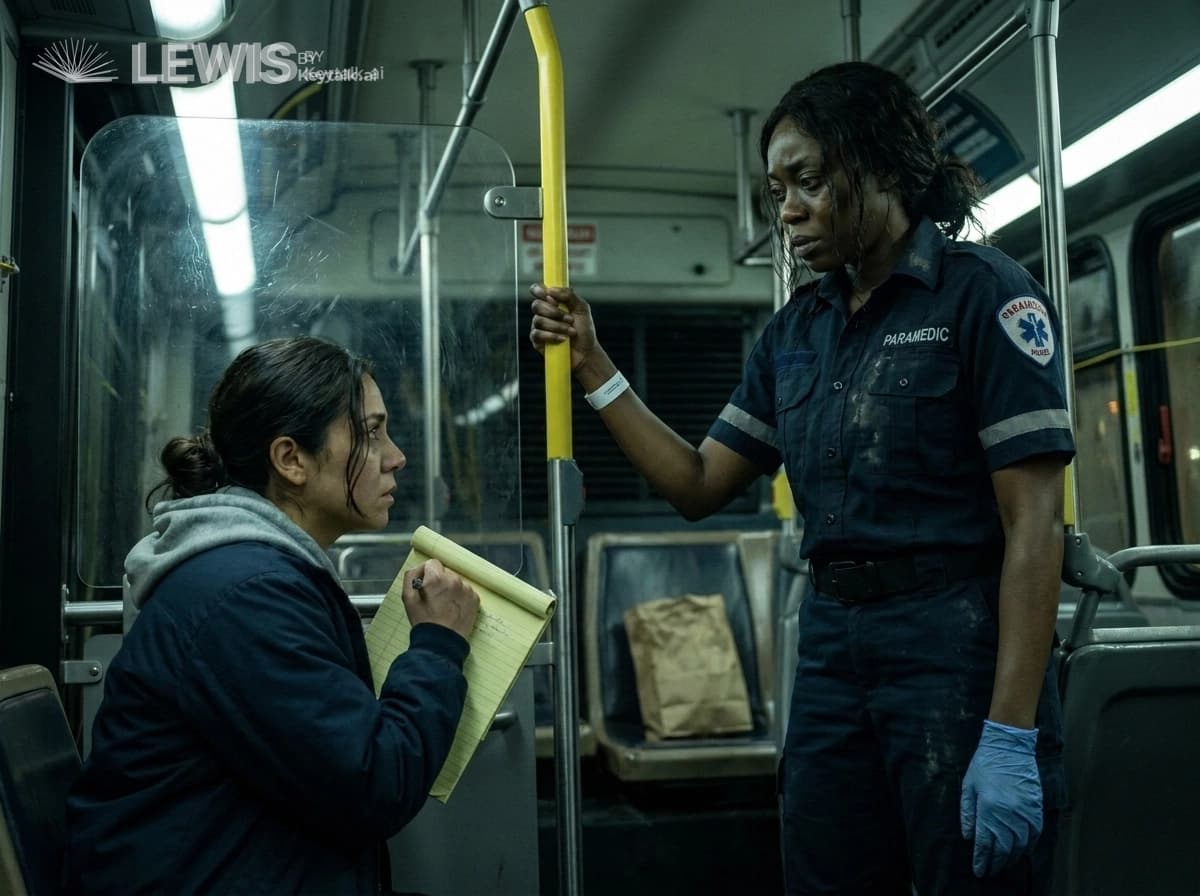
Celia Nwosu leans across the aisle and clamps two fingers around Tavi Mercer's wrist just as his breath starts skipping, her one blue glove bright in the flat glare while Coach 721 rattles past a shuttered school and the heater coughs dust under the dash. Marisol Quintero has turned in her seat to look at the white band on Celia's bare wrist and asked, flat as a receipt, “Which floor?” Celia keeps hold of Tavi long enough to press a crumpled paper bag into his free hand, then answers without looking at Marisol. “Oncology. Then Turk. Fourth-floor walk-up.” Hollis Vale's hand taps the farebox twice and stills. Celia's jaw works once before she adds, “I stood on the landing because I did not want one more flight of stairs. Just a few seconds.” Nobody rushes to forgive her, and the bus rolls on more cleanly than it has for blocks.

When Tavi's breathing evens, Inez Villareal rises with her legal pad still folded in one fist and follows Celia to the rear door as the coach brakes at another pool of streetlight. The scratched plexiglass and dull poles cut them into narrow pieces of reflection; Hollis keeps his eyes on the smeared windshield, but his shoulders go tight enough for Inez to see it from behind. “What happens at the last stop?” she says. Celia plants one hand on the vertical pole, faces her, and does not waste a syllable. “If one of us gets there still set on leaving, the driver pays for it.” Inez says, “Pays how,” and Celia answers, “Seat for seat. He goes. Another driver comes along someday. He doesn't.”

The bus lurches back into motion before Inez can ask anything else, throwing her shoulder lightly against the rear-door glass. Up front, Hollis reaches for the mirror as if to adjust it and stops with his fingers in the air. Marisol's thumb curls harder under the edge of her wristband, and Celia steps away from Inez without comfort, leaving the paper bag crumpled on the seat beside Tavi like a used bandage.

シーン 08· About 4:10 a.m., paused at the curb under diner neon

Bright Room, Hard Truths

Bright Room, Hard Truths
場所Coach 721, Front Half / outside the Richmond Lantern Diner
時間About 4:10 a.m., paused at the curb under diner neon
出来事Hollis Vale brakes outside the Richmond Lantern Diner, and the butter-yellow light from the windows washes across the fogged bus glass, making the front half look briefly warmer than it is. Instead of answering Marisol Quintero himself, he opens the front doors and reaches down to pick up the crumpled page Darnell Pike threw earlier, then holds it back toward the seats as if returning a fare nobody paid. Marisol cuts across him and speaks to Darnell directly, forcing the first conversation on the bus that does not pass through Hollis’s voice. Darnell answers with a hard, exact admission about watching his brother sleep after flushing the pills, and Marisol answers with one of her own: she has not gone home because she stripped Alma’s apartment down to bare proof and cannot face the key in the lock. Celia Nwosu steps in when the silence buckles, pushing a stale packet of crackers into Inez Villareal’s hand and then telling Marisol, without softness, which floor she was discharged from and how little a person can do in the few selfish seconds they still have to confess.
影響The scene shifts the burden of the route away from Hollis as the riders begin telling the truth to each other instead of waiting for him to pry it out stop by stop. Inez sees the mechanism more clearly in action: not comfort, not procedure, but strangers incriminating themselves with details specific enough to move the bus. Marisol’s confession about the stripped apartment gives her grief a present-tense body, not just Alma’s death in the past, and Darnell’s reply opens a rough line of recognition between two people who know fluorescent work and private failure. Hollis loses some control of the bus’s front half by letting that exchange happen, which leaves him more exposed for what Marisol will demand next.

Hollis Vale snaps the doors open at the curb outside the Richmond Lantern Diner, and weak pink neon from the window lantern slides over the scratched plexiglass while butter-yellow pendant light from inside turns the fog on the glass the color of old coffee. The diner’s checker tile and chrome pie case flash past in the windshield as if the bus has stopped beside another world. Hollis stoops without leaving his seat fully, hooks two fingers under the crumpled page in the groove by the yellow safety line, and holds it out behind him toward Darnell Pike. “Write it now,” he says. Darnell does not take the page. Marisol Quintero leans forward instead, carnations upright between her knees, wristband curling under her thumb, and says to Darnell, “You flushed them and still stood over the sink wanting them back.” The words land so cleanly that Darnell’s face changes before he can hide it.

He reaches across the aisle, snatches the page from Hollis, smooths it once against his apron thigh, and says, “I stood there waiting to hear the pipes choke so I’d have an excuse to dig them out.” Hollis goes still at the wheel. Marisol keeps her eyes on the diner window, not on him. “I took Alma’s toothbrush out of the cup tonight,” she says. “Then I took the cup.” The front half holds that there-is-no-taking-it-back quiet for one beat. Celia Nwosu steps up from the rear door, tears open a stale cracker packet with her gloved hand, presses it into Inez Villareal’s palm when her fingers start to shake, and says to Marisol, “Oncology. Discharge after midnight. I still stopped on a stairwell landing because I didn’t want one more flight.” Nobody answers with comfort.

Darnell bends over Inez’s legal pad balanced on his knee and writes an address hard enough to dent the page beneath it. Marisol’s bouquet tilts, then steadies as she tightens her grip. Hollis closes the doors on the bright diner without looking back, and when the bus pulls away from the curb it takes the next block cleaner, Darnell’s fresh ink dark on the paper between them.

シーン 09· Pre-dawn, just after the Richmond Lantern Diner stop

One Blind Block

One Blind Block
場所Coach 721, Front Half
時間Pre-dawn, just after the Richmond Lantern Diner stop
出来事Marisol Quintero asks Hollis Vale whether Alma looked scared of dying or scared of going home, and the question hits hard enough that he misses his turn and brakes the bus sharp into the curb lane. Her carnations burst from her lap and scatter down the aisle under the flat blue-white lights. Hollis shoves up out of the seat and orders Inez Villareal to hold lane and speed while he drops to his knees in the aisle to gather the flowers before Marisol can lunge after them. For one wet block, Inez takes the wheel with Hollis half out of the driver’s seat and Celia Nwosu braced against a pole, watching both the road and Marisol. The bus stays moving only because Inez stops being a witness and physically takes over.
影響The scene forces a transfer of responsibility from Hollis to Inez in the most concrete way yet: not through instruction, but through emergency. Marisol’s question also strips Hollis of the dry control he has used all night, exposing how close he is to failing before he ever names the full truth about Alma. Celia’s presence turns the near-accident into a collective containment rather than one man managing strangers alone. By the end of the block, Inez has crossed into the route’s hidden work with both hands on it, making her later refusal to let Hollis sacrifice himself feel earned.

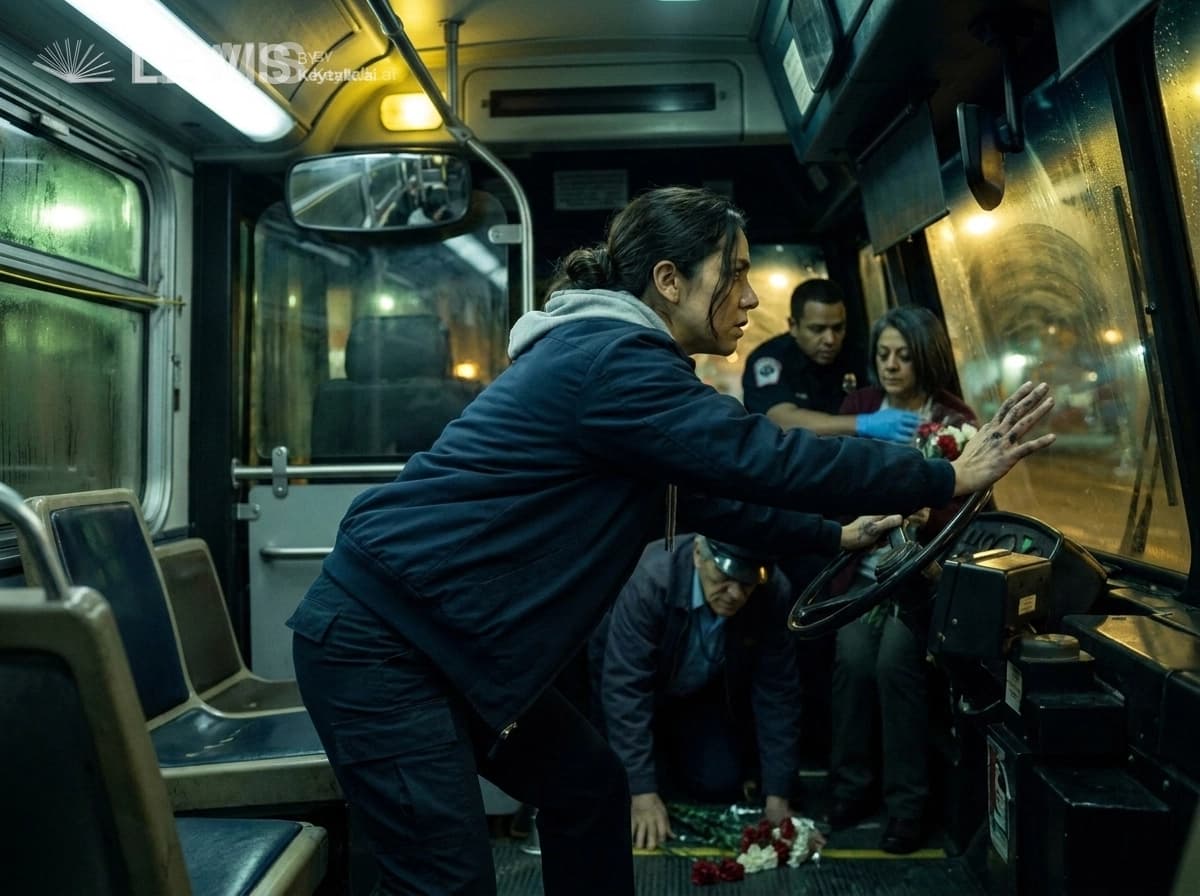
Hollis Vale jerks the wheel too late when Marisol Quintero says, flat from the first row behind him, “Was she scared of dying, or scared of going home,” and Coach 721 lunges past its turn under the weak wash of a corner signal. The front half snaps sideways. Hollis stomps the brake. Marisol’s damp carnations jump out of the crinkled plastic in her lap and skitter down the rubber aisle, red and white heads knocking against the yellow safety line and the dark farebox. Inez Villareal slams one hand against the plexiglass and the other against the dash as the bus shudders crooked in its lane. Celia Nwosu catches the nearest pole with her gloved hand and throws her shoulder toward Marisol before she can pitch forward out of the seat.

“Hold it,” Hollis says, already half out of the driver’s seat. He points at the wheel without looking at Inez. “Lane and speed. One block.” Then he drops into the aisle, one knee hard on the scuffed floor, and starts scooping carnations out from under shoes and seat brackets with both hands while Marisol reaches down after them, furious and embarrassed at once. Inez slides into the space he leaves, grabs the wheel at ten and two, and eases the bus straight while the windshield shows her nothing clean but smeared fog, a parked delivery van, and one strip of wet asphalt opening ahead. Celia plants herself across the aisle, one arm out to keep Marisol seated as Hollis thrusts the bent stems back into the torn plastic wrap. “Don’t touch me,” Marisol says. “Then stay up,” Celia answers, not moving.

The coach rolls through the blind block with Hollis kneeling among fallen flowers and Inez driving by the side mirror and the feel of the lane under the tires. When the next pool of streetlight opens over the windshield, Hollis rises and passes the crushed bouquet back without meeting Marisol’s eyes. Inez keeps the bus straight until his hand closes over the wheel again, and only then does she let go, leaving two damp prints on the black rim.

チャプター 04

シーン 10· Pre-dawn, still westbound on Geary

The Farebox Spits

The Farebox Spits
場所Coach 721, Front Half
時間Pre-dawn, still westbound on Geary
出来事The farebox suddenly starts printing transfer slips on its own, spitting them into the narrow blue-white glare beside Hollis Vale’s seat while the bus rolls through fog toward the beach. Inez Villareal lunges forward to catch the slips before they scatter underfoot, but Marisol Quintero reaches past her shoulder and snatches one free when she sees the stop number stamped on it. Tavi Mercer comes up out of his slouch and watches as Marisol leans over the scratched plexiglass and forces Hollis to answer what he has spent years dodging. Hollis tries to blame the route, the hour, and the machine’s bad wiring with silence and half-gestures, but Marisol pins the printed slip to the farebox and makes him face the fact that Alma’s old stop has found them before he chose to name it.
影響The scene turns Alma from an absence haunting the bus into a direct demand printed in Hollis’s workspace, where Inez can no longer mistake ritual for mystery. Marisol seizes control of the front half and pushes Hollis out of managed grief toward accountable speech, setting up the confession he will have to make next. Tavi’s silence sharpens from performance into witness, which tightens the pressure on Hollis by giving Marisol an audience he cannot dismiss. By the end of the beat, the bus is no longer merely carrying old pain west; it is physically producing evidence that the night will not let Hollis hide behind duty much longer.

The farebox coughs and spits a strip of paper into Hollis Vale’s lap just as Inez Villareal braces one hand on the dash to steady herself after the last turn, and then another slip follows it, and another, ticking out into the scratched blue-white light beside the wheel. Coach 721’s front half feels suddenly smaller: blank placard glowing overhead, plexiglass clouded with old scuffs, the shallow groove beside the yellow line dark with years of hesitating shoes. Hollis slaps the printer slot once with the heel of his hand. It keeps printing. Inez catches two damp slips before they slide to the floor, but Marisol Quintero leans forward from the seat directly behind him, carnations crushed crooked in her lap, and takes the third cleanly from between Inez’s fingers.

Marisol flattens the paper against her knee and goes still enough to make Tavi Mercer stop tapping the window. “Read it,” she says. Hollis keeps both hands on the wheel and stares through the smeared windshield. Marisol reaches past the plexiglass, pins the transfer slip against the black throat of the farebox, and says it again, sharper: “Read my daughter’s stop.” The printed number sits there in wet ink. Hollis’s jaw works once. “Don’t make the bus do your talking for you,” Inez says before she can stop herself, and his eyes cut to her in the mirror like she has put a hand on him.

The heater under the dash gives one dead clank as Hollis finally says the stop number out loud, too quiet the first time, then repeats it when Marisol does not move. Tavi has straightened in his seat with his duffel hugged to his shins, his half-smile gone, watching Hollis the way boys watch grown men decide whether to lie again. Marisol leaves the slip stuck to the farebox with condensation and settles back without breaking eye contact in the mirror. The little paper square trembles there beside Hollis’s drumming hand while the bus keeps finding one more block of road.

シーン 11· Pre-dawn, still westbound on Geary

The Seat He Stayed In

The Seat He Stayed In
場所Coach 721, Front Half
時間Pre-dawn, still westbound on Geary
出来事Hollis Vale slaps the transfer lever down and tears the fresh slip from the farebox before it can curl into Marisol Quintero’s lap, but she catches his wrist and makes him turn halfway in the seat to face her. With Inez Villareal braced in the worn groove beside the yellow line and Tavi Mercer watching from the first side-facing seat, Marisol pins Hollis with one exact question after another until he stops blaming the bus, the route, and the hour. Hollis finally says he saw Alma was in trouble, let her off anyway, and stayed in the driver’s seat because there were other riders on board and the route was still in his hands. Marisol takes the damp transfer slip back from him and slaps it onto the farebox face, where it sticks under condensation like a charge sheet.
影響The scene forces Hollis to trade haunting for accountability. What Marisol has wanted all night changes from detail to admission, and once Hollis names his own choice, the years of ritual and service around the 3:33 stop protecting him from plain blame. Inez is no longer watching a mystery work itself out; she is close enough to see the exact shape of the failure that built Hollis’s devotion to the route. Tavi’s silence also changes function here: he stops performing for Inez and becomes witness to an adult confessing the selfish, ordinary reason beneath a tragedy.

Hollis Vale jerks the new transfer slip out of the farebox with two fingers before it can print all the way, the bus rocking under him while smeared fog whitens the windshield and the heater gives one dead clank under the dash. The paper tears crooked. Marisol Quintero leans forward from the seat directly behind him and catches his wrist above the watchband, her carnations crushed higher against her knees, corner-store plastic crackling. “No,” she says. “You don’t get to hide in the machine.” Inez Villareal is already half out of her seat, one hand on the scratched plexiglass edge, legal pad forgotten on the dash. Across the aisle, Tavi Mercer stops tapping the window and pulls his duffel tight against his shins.

Hollis tries to face the road again, but Marisol keeps hold of him and asks each question on the hiss between stops: “Did you see she was crying. Did you know she should not be alone. Did you open the door anyway.” His free hand goes to the wheel, then falls from it. “I had people on board,” he says first, too fast. “I called after her.” Marisol’s thumb digs into his sleeve. “That is not what I asked.” The low radio hisses. Inez says nothing; she only steps closer, blocking the little space beside the seat as Hollis’s eyes flick to the blank placard, then back to the wet black road. When he answers this time, he does not sound dry or practiced. “Yes,” he says. “I saw she was in trouble. I let her off anyway. I stayed in the seat.”

The front half goes so still that the next transfer slip can be heard printing behind the first. Marisol takes the torn paper from Hollis’s hand, smooths it once against her palm, and slaps it flat against the farebox where Alma’s old stop number shows through the damp. Tavi looks away first. Inez stays where she is, hand on the plexiglass, while Hollis turns back toward the windshield and leaves both hands hanging useless above the wheel for one long beat.

シーン 12· Pre-dawn, minutes before the final stop

One More Block

One More Block
場所Coach 721, Front Half to Ocean Beach Overlook Turnout
時間Pre-dawn, minutes before the final stop
出来事Hollis Vale keeps Coach 721 moving long past the point where the route should have run out, driving west while the farebox slip with Alma’s stop number clings wetly beside his hand. Pressed by Marisol Quintero and watched by Inez Villareal and Tavi Mercer, he stops letting the bus and the old ritual speak for him and admits the plainest part of Alma’s death: he saw she was in trouble, opened the doors anyway, and stayed in his seat. The confession strips the night of one last excuse, but it does not free Marisol. When the coach finally noses into the Ocean Beach Overlook Turnout and the doors fold open on gray salt air, Marisol sits with the crushed carnations in her lap and says she still does not want morning.
影響The scene converts Hollis’s guilt from haunting into accountable human failure, exposing the choice underneath thirteen years of service. That truth carries the bus to the last stop, but it also sharpens the immediate danger, because Marisol remains unchanged at the threshold where the route’s bargain comes due. Inez is no longer witnessing a hidden system at work from a safe distance; she is present at the exact moment when honesty is no longer enough by itself. The story turns from confession to sacrifice.

Hollis Vale grips the wheel and drives past one dark cross street, then another, while Coach 721’s front half rattles in the flat blue-white glare and the transfer slip with Alma’s stop number trembles against the farebox by his knuckles. The windshield gives them only smeared fog and the weak shine of wet pavement, yet the bus keeps finding road. Marisol Quintero leans forward from the seat behind him with the bouquet bent crooked in its cloudy plastic. “Say what you did,” she says. Tavi Mercer has both hands locked around his duffel at his shins, his face turned toward the driver now, not the window. Hollis adjusts a mirror that does not need it, swallows once, and says, “I saw she shouldn’t have been alone.” Marisol does not let him stop there. “And?” she says, flat enough to cut. Hollis’s hand leaves the farebox, drops hard to his thigh, and he says, “I let her off anyway.”

The words hang in the scratched plexiglass and low radio hiss. Inez Villareal braces one palm on the dash as the bus rolls through another green light it has no right to reach, watching Hollis in the mirror while Marisol stares at the back of his head as if she could force him to turn around by will alone. “Because I had other people on board,” Hollis says, each piece slower than the last. “Because I thought calling after her counted. Because I stayed in the seat.” Marisol’s mouth tightens. She snatches the damp transfer slip off the farebox and slaps it back so hard it sticks crooked. Tavi flinches at the crack of paper on plastic. No one says a thing after that. The coach drops down the last grade and swings into the Ocean Beach Overlook Turnout, tires hissing over wet concrete.

The doors fold open on thin gray light and wind that makes the loose city sign chatter above the guardrail. Hollis sets the brake and takes both hands off the wheel. Beyond the first step, the overlook waits in one washed-out strip of curb, blistered paint, leaning trash can, and fog-hidden surf below. Marisol does not rise. She keeps the crushed carnations across her knees, lifts her face toward the open doorway, and says, without looking at any of them, “I still don’t want morning.”

チャプター 05

シーン 13· Pre-dawn, moments after the doors open at the last stop

The Open Door

The Open Door
場所Coach 721, front half at the Ocean Beach Overlook Turnout
時間Pre-dawn, moments after the doors open at the last stop
出来事Hollis Vale rises from the driver’s seat to surrender himself at the final stop, and Inez Villareal tears her legal pad in half and steps into the worn groove beside the yellow line to block him. The kneeling bus sags toward the salt-wet curb with its doors open to gray air, but Inez turns the front aisle into a refusal instead of a passage. Celia Nwosu braces herself on a stainless pole and backs Inez by physically narrowing the gap, forcing Hollis to either shove through both of them or stop. Marisol Quintero stays in frame behind him with the crushed carnations in her lap, watching the sacrifice become visible and immediate instead of procedural.
影響The route’s bargain stops feeling inevitable and becomes contestable because Inez refuses to let Hollis disappear under the name of duty. Her action breaks the old pattern of one exhausted worker absorbing everyone else’s pain in silence, and Celia’s support turns that refusal into a shared act instead of a trainee’s panic. The scene also pins Marisol at the threshold of a new choice: if Hollis cannot simply step off for her, then she will have to decide what she is willing to let her grief do. By the end of the beat, the open door is no longer just an exit for Hollis; it is a demand aimed at everyone still inside the bus.

Inez Villareal rips her yellow legal pad straight down the middle and plants herself in the crescent groove beside the driver’s seat just as Hollis Vale pushes up from the wheel. Coach 721 is still kneeling toward the blistered white curb of the Ocean Beach Overlook Turnout, its front doors spread on gray salt light, the low guardrail and leaning trash can blurred beyond the smeared windshield. Hollis puts one hand on the plexiglass shield and tries to edge past her with the flat patience of a man late for work instead of his own disappearance. “Move,” he says. Inez drops the torn pages on the dash, squares both feet on the yellow line, and answers, “Ask before the door opens.”

Hollis catches her shoulder and tries to turn her aside; she grabs the farebox with one hand and holds her ground hard enough to make the transfer slip stuck there flutter. The heater under the dash gives one dead clank and quits. Celia Nwosu is up before Hollis can try again, one blue-gloved hand locked around the stanchion, the other braced against the seatback to close the aisle from the side. “Don’t make this tidy,” she says without raising her voice. Hollis looks past Inez toward the open doors, then back at Marisol Quintero, who is still seated directly behind him with the carnations bent crooked in their wet plastic, her thumb worrying the hospital wristband until it curls white.

When Hollis steps forward again, Inez steps into him chest first and forces him back against the edge of the driver’s barrier with a dull slap of jacket against plastic. The bus stays dipped toward the curb, doors breathing gray air into the blue-white glare, but nobody reaches the steps now. Marisol rises at last with the bouquet gathered in both hands, and the crushed flower heads lift into the narrow space between Hollis and the open morning.

シーン 14· Pre-dawn, moments after the doors open at the last stop

What Marisol Will Carry

What Marisol Will Carry
場所Coach 721, Front Half at the Ocean Beach Overlook Turnout
時間Pre-dawn, moments after the doors open at the last stop
出来事Marisol Quintero stands and physically stops Hollis Vale at the open bus door, forcing him to face her instead of stepping into the bargain alone. With Inez Villareal still planted in the worn groove beside the driver’s seat and Celia Nwosu braced on the stanchion, the front half of Coach 721 becomes a tight barricade where nobody can let the old pattern finish itself cleanly. Marisol admits that Alma had been disappearing long before the night Hollis let her off, and that she stripped the apartment because erasing the evidence felt easier than walking back into it. She then makes the decisive choice not to let Hollis vanish in payment for her grief, takes the crushed carnations back into both hands, and claims the morning as hers to endure.
影響The scene breaks the route’s final deadlock because Marisol gives the one truth that matters now: not blame, but refusal to spend another person’s life to prove the size of her loss. Hollis is stopped from turning sacrifice into procedure, and Inez sees that the work cannot be one exhausted worker disappearing for everyone else. Celia’s presence helps hold the line long enough for Marisol to choose differently, turning the bus from a place of confession into a place where the burden is returned to its owner. By the end of the beat, the route can release them because Marisol is willing, however unwillingly, to carry her grief off the bus herself.

Marisol Quintero lurches up from the first row and plants herself between Hollis Vale and the open doors, one hand flat against his chest while the other crushes the wet carnations harder against her cardigan. Gray light washes through the doorway and flattens the front half of Coach 721 into scratched plexiglass, dull poles, and the white blistered curb beyond, while surf strikes somewhere below the turnout. Inez Villareal stays in the crescent groove by the yellow line with both arms out, close enough that Hollis would have to move her to pass, and Celia Nwosu locks one gloved hand around the stanchion beside the stepwell. Hollis says, “Move, Marisol,” but he says it like a man asking for permission he has already lost.

Marisol shakes her head and shoves the bouquet into Hollis’s hands for one sharp second, making him take its bent stems and dripping plastic before she snatches it back. “She was already leaving me,” she says. “Not that night. Before.” Hollis does not answer. Marisol does, faster now, each sentence landing in the narrow aisle where Inez cannot look anywhere else: Alma staying out later, Alma going quiet in the kitchen, Alma learning how to look finished before she was safe; and tonight, Marisol pulling posters off the walls, emptying drawers, throwing out a toothbrush because a bare apartment looked easier to survive than one still shaped like a daughter. Celia leans forward when Hollis shifts again, her shoulder blocking his turn toward the step, and says, low and hard, “Let her finish.”

Marisol’s mouth buckles on the last part. “I still hate you for staying in the seat,” she says, and then she reaches past him, grabs the wet transfer slip still stuck to the farebox, and folds it into the bouquet wrap with trembling fingers. “But I’m not making you disappear for me.” Hollis’s hand comes up to steady her elbow, not to guide her anywhere, and this time she lets it stay there for a beat. The bus lifts under them with a slow hydraulic sigh, level again. Marisol takes the carnations back upright between both hands, turns toward the gray curb, and steps down carrying the flowers, the transfer, and the morning she did not want.

シーン 15· Pre-dawn into early gray morning

Delayed With Passengers

Delayed With Passengers
場所Coach 721, Front Half / return to the yard from Ocean Beach Overlook Turnout
時間Pre-dawn into early gray morning
出来事Inez Villareal watches the bus level under Hollis Vale’s feet after Marisol Quintero chooses to carry her own grief off the route, then stays in the front half as the release happens one rider at a time. Marisol steps down last with the crushed carnations and the wet transfer slip; Celia Nwosu follows with one gloved hand on Hollis’s shoulder before she goes, leaving him in the seat instead of surrendering it. On the drive back through the thinning fog, Inez tears off half her ruined notes, writes one hard line across the page, and hands it to Hollis without exposing the route’s rule. When dispatch finally crackles over the radio asking why Coach 721 is late clearing, Inez reaches across the dash, lifts the handset before Hollis can answer, and says, steady and official, that they were delayed with passengers.
影響The scene closes the route without turning survival into triumph. Hollis is not taken, because Marisol refuses to make his disappearance the proof of her pain, and the night’s bargain breaks on that choice instead of sacrifice. Inez’s answer to dispatch marks her real decision: she will protect the hidden work without pretending it costs nothing, and she will not let the company’s blank language swallow what happened. By signing the shift sheet and leaving Hollis with the page that says only what matters, she moves from trainee to conscious successor.

Marisol Quintero steps down from Coach 721 with the crushed carnations clutched in both hands, and the bus rises level behind her with a hydraulic sigh that carries through the scratched blue-white front half. Thin gray morning has finally reached the windshield; beyond the open doors, the Ocean Beach Overlook Turnout is all wet concrete, blistered curb paint, low guardrail, and fog hiding the water below. Hollis Vale stays seated with both hands flat on his thighs while Celia Nwosu pauses on the first step, presses her blue-gloved hand once to his shoulder, and says, “Sleep before you call this service again.” Marisol does not look back a second time. She takes the damp transfer slip peeled from the farebox, tucks it into the bouquet plastic, and walks past the leaning trash can into the washed-out light.

Inez pulls the doors shut, and Coach 721 turns inland with only Hollis and her left in the flat glare, the blank placard still glowing over the smeared glass. The heater gives one useless clank under the dash. Hollis reaches for the radio when dispatch finally snaps through the hiss asking why 721 is late clearing, but Inez catches the handset first. “Delayed with passengers,” she says, looking straight through the windshield at the city coming back in plain blocks and traffic lights. Hollis glances at her, tired enough that the look lands softer than surprise. On her lap, Inez tears the legal pad along the ragged fold, keeps the half with the stop list, and writes across the back page hard enough to dent it: Ask before the door opens.

At the yard, Inez tears the shift sheet from its clip, signs her full name in the driver line with ink-stained fingers, and slides the torn page onto the dash between herself and Hollis. He reads it without touching it at first, wedding ring cord dark against his throat. Then he folds the page once and slips it into his shirt pocket. Inez takes the seat directly behind him instead of heading for the door, yellow line scuffed under her shoes, while outside the bus wash throws weak water against another coach and morning stays thin and municipal.

'Delayed with Passengers'ストーリーチャット

このストーリーの登場人物と話したいなら?

'Delayed with Passengers'ストーリーチャット

このストーリーの登場人物と話したいなら?

story image
story image
story image
story image
story image
story image

情報 · Story details

制作情報

モデル

  • GPT-5.4テキスト
  • Claude Sonnet 5テキスト
  • Stable Diffusionイメージ
  • Gemini Proイメージ

キートーク

コメント · Comments

コメント · 0

生成者GlassStoryTellerpro作家プロフィール
  • rank icon image#74 Genre
のテーマ音楽