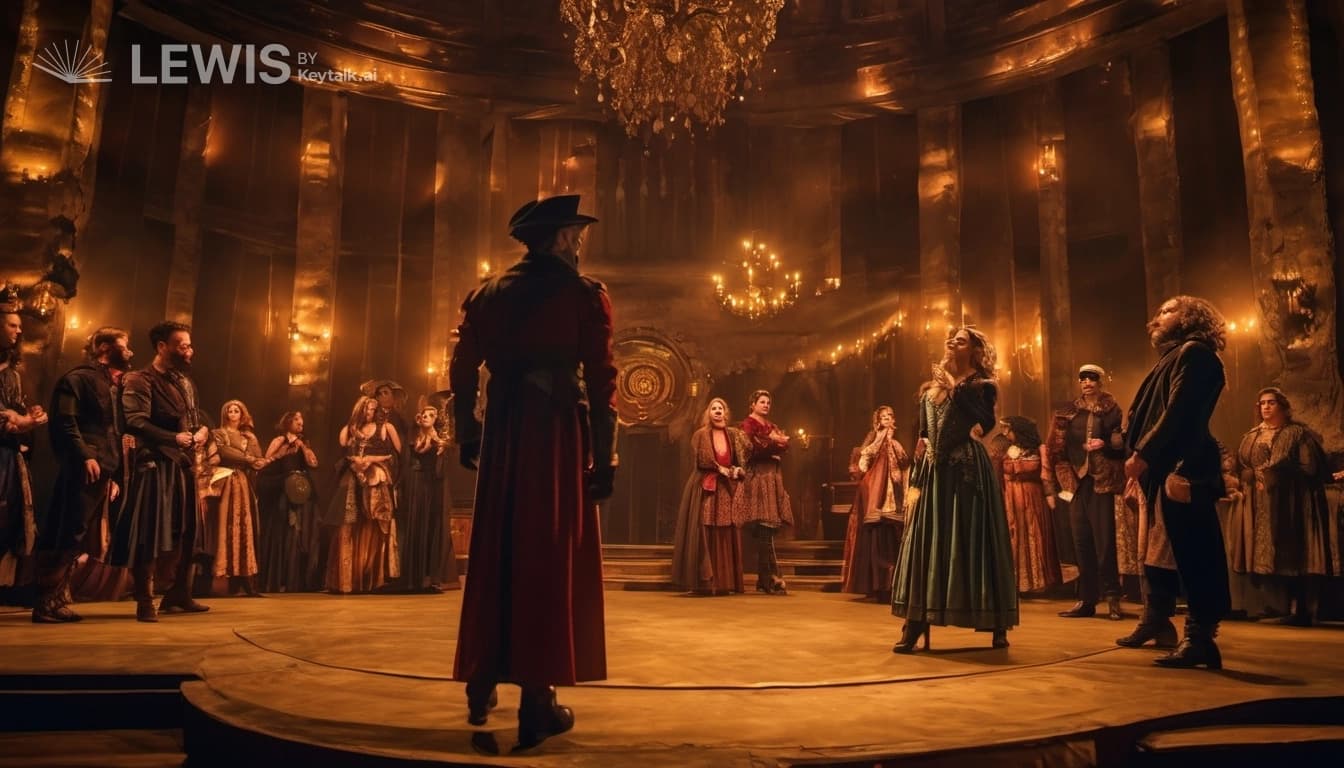
In a world precariously balanced between the laughter of humanity and the inscrutable abyss of cosmic horror, we follow Dexter Quillan Stroud, the spearhead of a notorious comedy troupe whose daring performances skirt the edges of sanity and taste. Dexter embodies a brand of satire that digs its claws into the underbelly of existence, mocking the absurdity of life with a nihilistic fervor that hides a deeper search for meaning beneath layers of jest.
On a fateful night, an act intended as their magnum opus, a contrived satire of creation myths, accidentally rends the veil between dimensions, invoking the attention of Eris Mirthshade, a being born from the nightmares of the universe itself. Her nature—an unending enigma spinning webs of madness wherever she treads—responds not with immediate vengeance but with a perverse curiosity toward the troupe, provoked by their impudent scoffing at forces beyond mortals' ken.
Beside Dexter stands Flicker Jestwhistle, his Cosmic Reliquarian, whose expertise in forbidden lore had only meant to embellish their act, now proves invaluable. As the troupe's performances increasingly stir Eris's chaotic whims, Flicker taps into his vast, esoteric wisdom, seeking a resolution that plays into the entity's appetite for mortal audacity while planning their salvation. Each night brings them closer to either breaking the spectral chains they've shackled themselves with or succumbing to a hilariously horrifying end.
The emotional journey reaches a crucial turning point when Dexter confronts his internal dichotomy: his existential mockery, once thought harmless, now has tangible, monstrous consequences. The troupe's crises heighten Dexter’s introspection, forcing him to grapple with the purpose behind his cynicism and whether it has always been a mere defense against admitting to a feared reality—that the joke, indeed, may be on them.
In an unexpected twist of fate, Eris Mirthshade’s fascination with the troupe evolves as she experiences a yearning twinge of kinship. Within this monstrous creature stirs a conflicted desire to bridge the gulf between her existence and the mortals' resilience. Her capriciousness leads her to bestow upon Dexter and his troupe a chance to undo their cosmic mistake, but only if they can outwit her in a final performance that would dwarf all their prior escapades—a confrontation teetering on the edge of hilarity and horror.
The resolution crashes down as Dexter, with a newfound respect for the gravity behind every jest, embraces the responsibility of his influence, leading the troupe in a daring gambit that mirrors the absurdist dance of existence itself. Combining the force of their collective wit and Flicker’s esoteric knowledge, they craft a spectacle that weaves their survival into the fabric of the performance, managing to satisfy Eris's cravings for amusement and connection.
In their ultimate act, the team exploits the spectacle to reimpose the boundary between realms, trapping Eris once again in the cosmic vastness from which she sprang. In doing so, they do not banish her with malice but acknowledge her unforeseen longing with a compassion born from their own existential battles.
Thus, our troupe’s adventure concludes with a reaffirmation of their bond, grounded in the shared victory that has preserved their existence. They emerge not unscathed, for their dance with oblivion has left an indelible mark upon their souls—a constant reminder that even at the height of humor, something earnest and fundamentally human lingers, defying the darkness with a smile.





























Comments
Comments · 0