Keytalk Original · 15 scenes · 5 chapters

Don't Save Me by Leaving

sound Kingfisher 4Creator’s page →

A seamstress and a harbor mechanic save for a wedding in their seaside town, stitching her dress after midnight and keeping their rings in a chipped blue sugar bowl.

When her mother needs daily care, he takes a yearlong job aboard a cargo ship to pay for it; she mistakes his packed suitcase for an escape, and he mistakes her empty place on the pier for goodbye.

He returns to find her selling the dress outside her shuttered shop, then discovers that she has spent their wedding savings keeping his injured father housed while he was away. They will marry in the repaired shop and make a home above it, but first he must stop treating departure as the only gift he can offer her.

With another paid passage waiting at the harbor, he sets his suitcase beside her sewing machine: will she help him unpack, or help him leave again?

  • 4 characters
  • 5 locations
  • 15 scenes
  • Plot 7,028 chars
Don't Save Me by Leaving cover image

Characters

Characters

Carys Penrose

Female

Seamstress selling her unfinished wedding dress outside the alterations shop she closed to care for two households

Profile

At 31, Carys Penrose wants to reopen her shop with paid orders rather than another loved one’s sacrifice, but selling her midnight-stitched wedding dress will barely cover the repairs. Carys Penrose asks Kit Trevorrow to help price the work and make a weekly household budget with her instead of accepting another passage, putting figures before him that her letters never contained. To keep him beside her sewing machine, Carys Penrose must show him the emptied wedding account and ask for something she cannot repay: his company through the uncertain months.

Carys Penrose, 31, measures a customer’s hem twice before naming a price, then quietly waives the charge when a school uniform has been let down as far as its fabric allows. When Kit Trevorrow offers money, Carys Penrose straightens the bills into a neat stack and asks about his engine repairs before answering whether she needs them. Even with the wedding dress displayed for sale, Carys Penrose keeps their rings in the chipped blue sugar bowl, lifting them out whenever she washes it and putting them back only when the china is dry.

Background

At 31, Carys Penrose had been sewing her wedding dress after midnight when Morwen Penrose’s stroke brought care schedules and unpaid shop hours into the same ledger.

After confronting Kit Trevorrow over his packed suitcase, Carys Penrose missed his departure while helping Morwen Penrose through a difficult morning after her mother dismissed the caregiver early.

Throughout his year away, Carys Penrose answered Kit Trevorrow’s practical letters with accounts of appointments and expenses, never asked him to return, and paid Oswin Trevorrow’s ground-floor rent from their wedding savings while leaving those payments out of her reports.

Description

Carys Penrose has a narrow, freckled face, gray-green eyes with faint shadows beneath them, and chestnut hair twisted into a low knot that leaves short curls loose at her temples.

Her oatmeal cotton blouse and charcoal wool skirt are carefully mended beneath a faded indigo work apron; a yellow measuring tape hangs around her neck, one end shortened and neatly rehemmed.

She holds her shoulders square and her hands close to her waist, thumb smoothing the opposite palm, while her tightly set mouth softens whenever she lifts her eyes to someone she loves.

Kit Trevorrow

Male

Harbor mechanic returning from a year repairing cargo-ship engines, with another paid passage already offered

Profile

At 34, Kit Trevorrow wants Carys Penrose to give him a place in her daily life, not merely accept the money he sends from elsewhere. Finding her selling their unfinished wedding dress, Kit Trevorrow carries his suitcase into the shuttered shop and asks to stay before either of them can show how staying will pay the bills. Kit Trevorrow must let Carys Penrose help decide which work he takes, surrendering the guaranteed passage money and the habit of making their hardest choices alone.

Kit Trevorrow, 34, writes the price of a morning’s care beside each wage payment, but crosses out “I miss you” whenever a letter starts to sound like a request. Quick with a seized bolt and slow with an apology, Kit Trevorrow reaches for his wage book when Carys Penrose cries; beside her sewing machine, he finally leaves it closed and asks, “Where would you like me to put my clothes?”

Background

On the morning of his first sailing, Kit Trevorrow searched the pier for Carys Penrose until a deckhand called him aboard, then sent his wages for Morwen Penrose’s care throughout the year despite the empty place at the railing.

In the engine room, Kit Trevorrow covered the margins of maintenance sheets with calculations of caregiver hours, answering Carys Penrose’s practical accounts with figures rather than asking why she had not come.

Returning at 34, Kit Trevorrow brings another sailing offer to the shop; when Oswin Trevorrow produces the rent receipts Carys Penrose paid from the wedding fund, he lays the offer beneath the receipts instead of signing it.

Description

Kit Trevorrow is a broad-backed man of 34, with short chestnut hair flattened at the temples, a weather-browned face, and gray-green eyes that hold steady until he has to ask for something.

His faded navy work jacket sits squarely over a washed oatmeal shirt and charcoal drill trousers; even with his sleeves buttoned, a narrow white burn scar shows above his left cuff.

He stands with his shoulders slightly forward, as though making room for someone to pass, but keeps his empty hands open at his sides instead of reaching for a tool or his wage book.

Morwen Penrose

Female

Former boardinghouse cook relearning daily tasks after a stroke, with paid care funded by Kit’s shipboard wages

Profile

At 63, Morwen Penrose wants Carys Penrose to ask before fastening her clothes or arranging her day, even when waiting for an answer holds up the shop’s work. Morwen Penrose urges Carys Penrose to accept Kit Trevorrow’s money for care, but dismisses the caregiver on his sailing morning to demonstrate that she can manage; instead, her daughter must stay to help her and misses the farewell on the pier.

Morwen Penrose, 63, plants her walking stick beside her chair without embarrassment, but pulls her blouse closed when Carys Penrose reaches for the buttons: “Let me try the top one.” At the kitchen table, Morwen Penrose questions caregivers about their hours and then offers them the better biscuit, refusing to let anyone discuss her needs over her head. After learning what the missed departure cost her daughter, Morwen Penrose practices the front-door steps with someone beside her, counting each descent aloud and asking for a hand before her balance fails.

Background

Until a stroke at 63 weakened her left hand and unsettled her balance, Morwen Penrose served school lunches and brought home handwritten menus for Carys Penrose to judge. During the first weeks of care, Morwen Penrose watched finished alterations accumulate beside the sewing machine while her daughter helped her wash, dress, and move between rooms.

On Kit Trevorrow’s departure morning, Morwen Penrose sent the caregiver home before breakfast, then could not rise safely from her chair; by the time Carys Penrose had helped her, the ship was beyond the harbor wall.

Description

Morwen Penrose has a broad, lined face and iron-gray hair pinned in a practical bun; her washed sage cardigan and cream cotton blouse retain the tidy care of someone who once served lunch to a roomful of children.

She keeps her walking stick within reach, her weakened left hand resting against her lap, but lifts her chin when anyone reaches across her to help. The oversized pearl-colored top button on her blouse is her small daily contest: she steadies the cloth with her left fingers and works it patiently with her right.

Oswin Trevorrow

Male

Retired dock fitter unable to return to paid work after a lifting accident, living in a rented ground-floor room

Profile

At 69, Oswin Trevorrow wants Carys Penrose to bring him paying repair work instead of paying his rent, but his stiff leg and slow hands earn scarcely enough for groceries. When Kit Trevorrow prepares to sail again, Oswin Trevorrow must open the biscuit tin containing Carys’s rent receipts and offer his remaining tools for her shuttered shop, giving up both his claim to manage alone and the equipment reserved for his return to work.

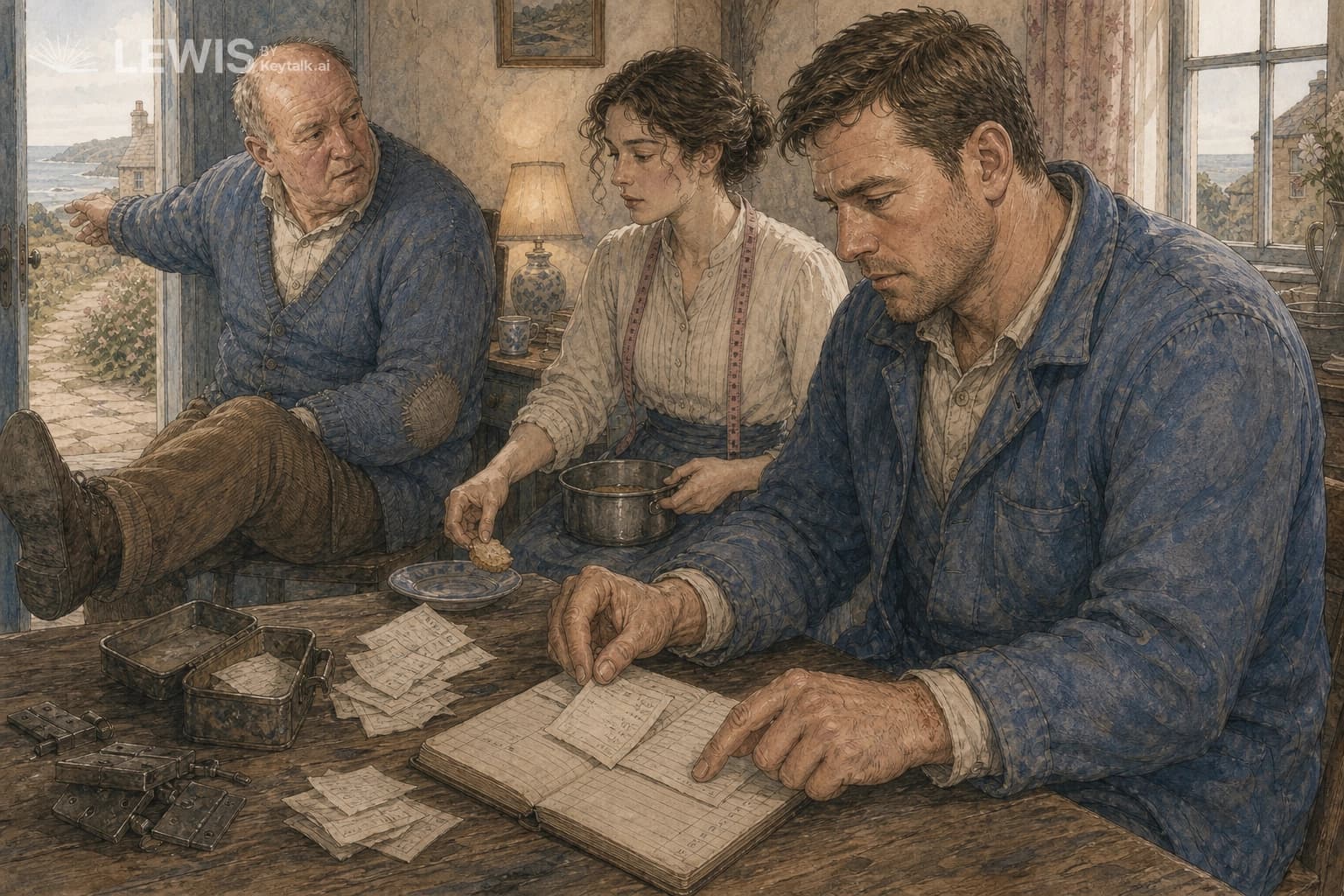
Oswin Trevorrow, 69, counts repair payments twice before buying bread, yet slips an extra biscuit onto Carys Penrose’s saucer and calls it a broken one. Asked by Kit Trevorrow about expenses, Oswin Trevorrow spreads finished hinges across the table and discusses their fit until the question passes. When Carys refuses another unpaid repair, Oswin Trevorrow puts down his screwdriver, clears her a chair, and finally lets her finish speaking.

Background

At 69, Oswin Trevorrow was still carrying timber into the boatyard until a fall left him unable to stand safely through a working day. With Kit Trevorrow away at sea, Oswin Trevorrow accepted ground-floor rooms paid for by Carys Penrose only after handing her the ladder key to his old upstairs lodging.

Oswin Trevorrow kept every rent receipt beneath the spare screws in a biscuit tin, wrote Kit only about small completed jobs, and left his largest tools wrapped against damp while Carys’s wedding money dwindled.

Description

Oswin Trevorrow has a dock fitter’s broad shoulders, now rounded above a faded brown cardigan and slate-blue work shirt whose cuffs he still buttons carefully over thick, slow hands.

At sixty-nine, his silver hair has thinned to a close fringe, and deep creases bracket a mouth that tightens whenever someone offers to carry something for him; seated, he keeps his stiff leg extended and turns his body to make room for a visitor.

A flattened brass screw hangs from his cardigan’s buttonhole on a short loop of twine, within reach of fingers that still check its thread.


Synopsis

Plot

Carys Penrose carries her unfinished wedding dress down the three steps outside Penrose Alterations and pins its hem clear of the wet pavement. She needs the sale to replace the rotten rear window frame, not to punish the man who has been gone for a year. Nevertheless, when Kit Trevorrow returns from the harbor and finds her fastening a price to its sleeve, she lets him believe the dress means what he fears. He asks whether there is someone else. Carys pulls a pin from between her lips and tells him there has scarcely been time to eat.

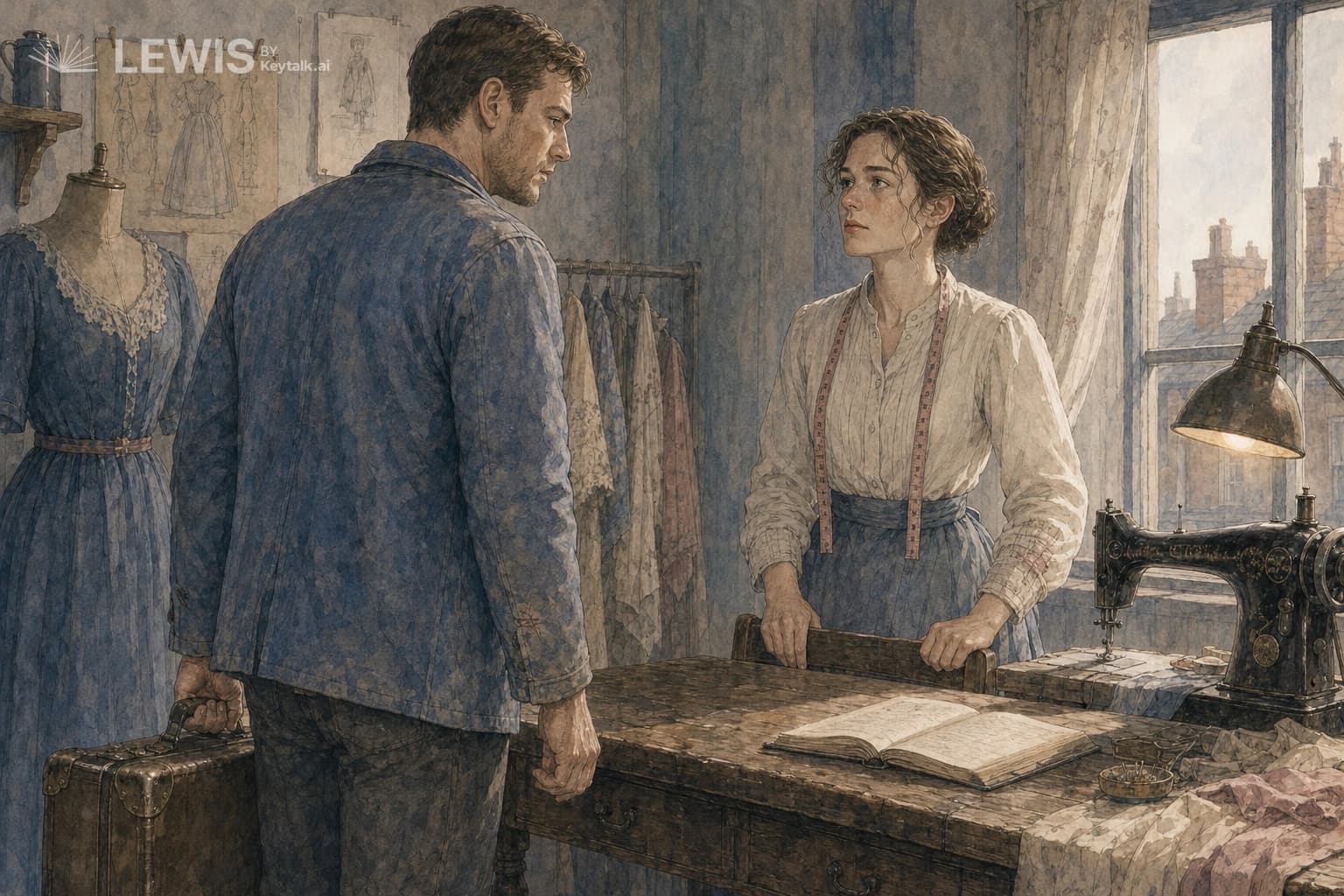
Kit sets his suitcase inside the shuttered shop. He has another cargo berth offered, sailing in six days, and enough money from his completed passage to carry them through several weeks, but not another year of two households and paid care. Carys refuses his suggestion that he take the dress down until they know how they will reopen. She wants customers, regular working hours, and a wedding that does not require another departure to fund it. When he offers his wage book, she pushes a chair toward the sewing table instead. He sits, but keeps his jacket on.

Their first attempt at a household budget breaks apart over the wedding account. Kit assumed it was untouched; Carys tells him it is empty. He asks why her letters never said so. She asks why his letters contained payments and weather reports but never asked her to wait. At the kitchen table, with two cooling cups between them, he admits that he watched the pier until the town disappeared. She tells him she spent that morning lifting Morwen Penrose from a chair after her mother dismissed the caregiver.

Morwen arrives through the level rear entrance for supper and hears the last of this. She grips the doorframe when Carys reaches to help her sit. She had wanted to prove that Kit need not go away on her account, she says; instead, she made Carys miss him. Kit starts to excuse her, but Morwen stops him. She asks Carys to bring the calendar and, slowly, marks the mornings when she will accept care. Then she makes them wait while she unfastens her own cardigan. The meal is late. For once, nobody pretends that waiting costs nothing.

Kit visits Oswin Trevorrow the next morning and finds Carys’s familiar mending on his curtains. Oswin spreads repaired hinges across his table before his son can ask about rent. When Carys comes to collect a saucepan, Oswin slips a biscuit onto her saucer and says it broke. Kit sees that neither of them will look at the other.

The truth emerges when Kit announces that the next passage would let him repay whatever Carys has spent. Oswin braces his stiff leg, pulls a biscuit tin from beneath his chair, and sets a year of rent receipts beside the hinges. After his lifting accident, he could no longer earn enough to keep the room. Carys paid rather than let him lose its safe ground-floor access. She had told Kit only that his father was managing.

Kit turns on Carys for letting him come home with plans she knew they could not afford. She stands up so abruptly that the saucepan falls from her lap. “I wanted you home,” she says, and cannot finish. He bends to retrieve it; she kneels too, and they remain beside each other on the floor while Oswin looks away. Kit finally understands that she sold neither their rings nor his place in her life. She spent the wedding because someone he loved needed a door he could still reach.

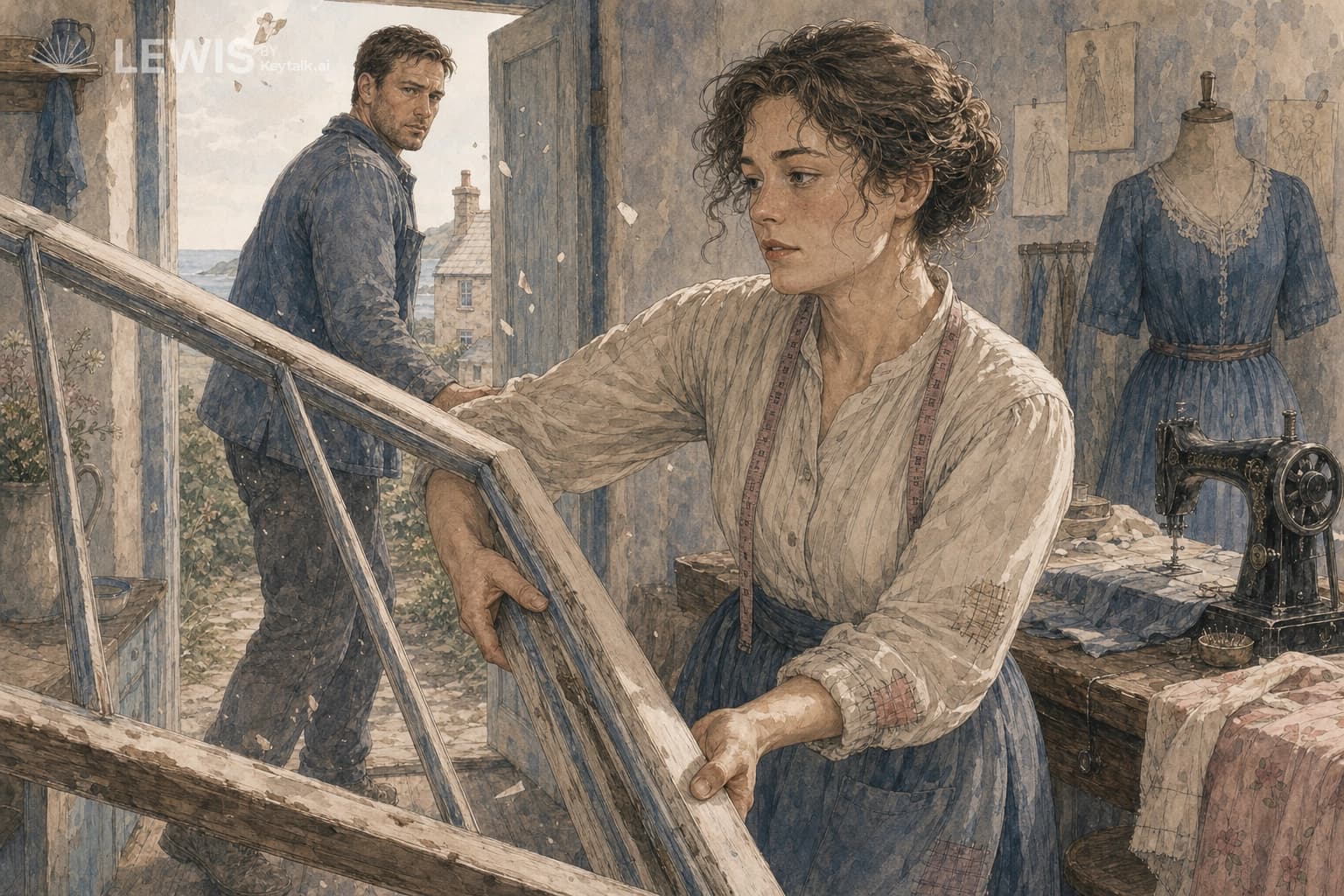
They begin repairing the shop together. Carys takes deposits only for work she can deliver, using them for the required materials rather than the household bills. Kit fits the rear frame between small harbor jobs. His scarred wrist aches in the cold, and she takes the heavier end without waiting for him to ask. They pin an opening-hours card over the pale rectangle in the window and secure enough curtain repairs and winter uniform alterations to fill the first fortnight.

Then their careful schedule fails. Morwen’s caregiver falls ill on a fitting morning. Carys closes the shop to stay with her mother, losing a customer who cannot return. Kit gives up a paid engine repair to fetch Oswin, whose leg has stiffened badly overnight. By supper, the four of them are crowded into the shop kitchen, eating bread beside untouched figures in the account book. Staying has begun to look like a promise neither can keep.

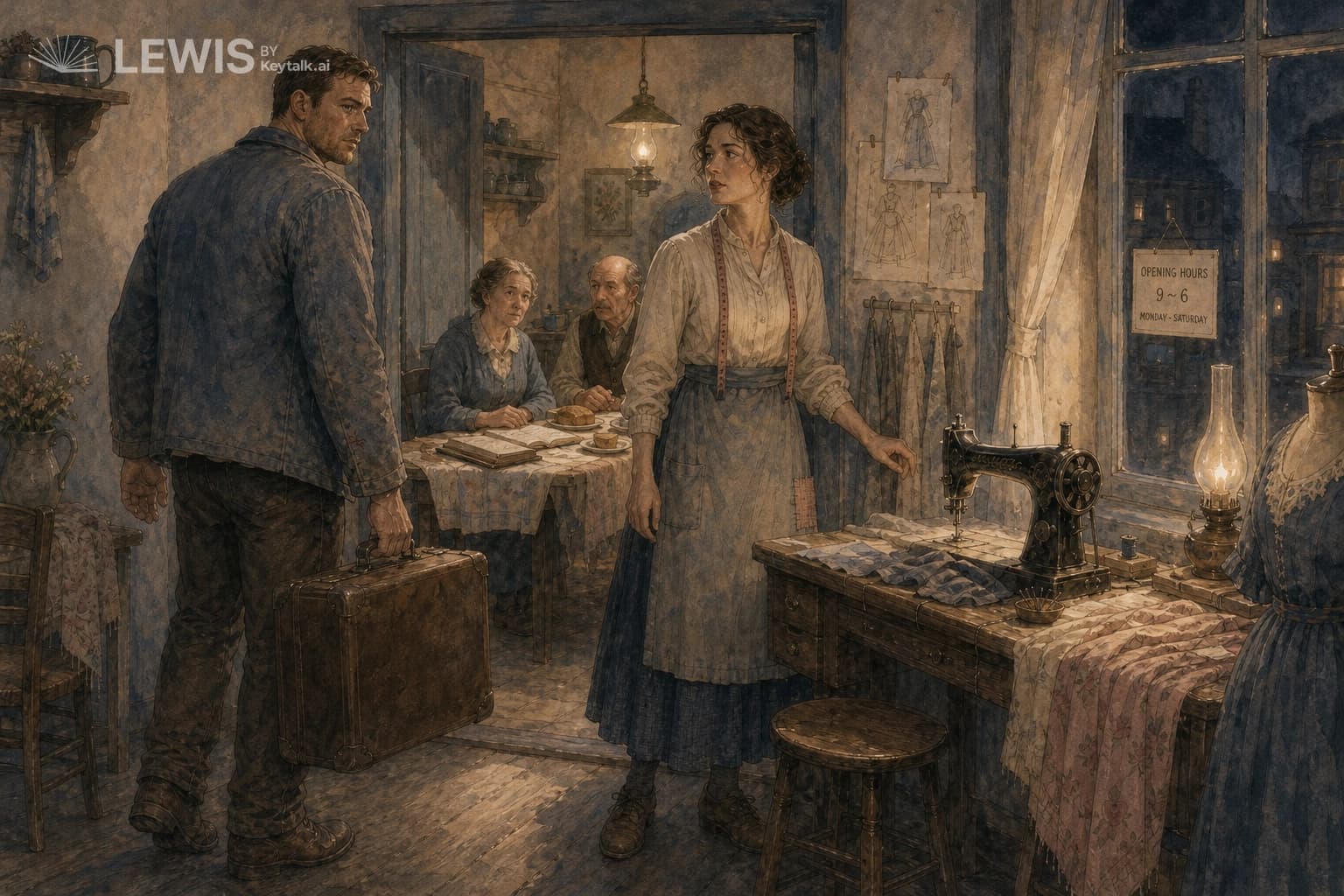
Kit lifts his suitcase from beside the machine. He says he will sail just once more, settle the debts, and return properly. Carys does not accuse him of leaving her. She asks him to put the case down while she speaks. When he keeps hold of it, she steps into the narrow passage between him and the door.

She tells him what his absence actually required: carrying supper uphill after closing Morwen’s curtains, catching the last bus to Oswin, coming back to a dress she could not bear to finish. She opens the suitcase herself and takes out his folded work shirt. Her hands shake as she asks whether he can bear to stay when she is frightened and cross, when his wages are smaller, when she cannot thank him for making everything safe.

Oswin lowers his old tool roll onto the table. He had kept it for a return to work his leg would not allow; now he offers Kit the tools for local repairs and asks Carys for small jobs he can do seated, at an agreed price. Morwen pulls the calendar toward her and asks them to arrange backup care with her, not around her. Neither offer closes the gap. Carys reads the shortfall aloud anyway.

Kit releases the suitcase handle. He takes the shirt from Carys, presses it briefly against his face, and asks, “Where would you like me to put my clothes?”

They unpack together. The next morning he declines the berth, losing its guaranteed wages. Carys removes the dress from sale. Neither action makes the winter easy. They sell unused stock, postpone decorating upstairs, and keep the kettle beside an unpainted wall. When Carys waives a uniform alteration for a struggling customer, she tells Kit that evening instead of hiding the missing payment. When he is offered work that conflicts with a care appointment, he brings the choice home.

By spring, the window is dry and the order drawer is full again. Carys finishes the wedding dress with Kit sitting across the table, turning its fastening loops while she stitches. She checks the shortened measuring tape against a wooden rule before cutting the last length; there is just enough.

Their wedding fills the repaired shop without concealing its mismatched floorboards. Morwen enters by the side passage, asks for a hand at the threshold, and walks to her chair. Oswin fastens the freshly repaired door back so everyone can come in. Carys lifts the rings from the chipped blue sugar bowl, where she has kept them through every empty month.

After the guests leave, she and Kit carry two cups upstairs. His suitcase lies open beneath their bed, empty at last. Below them, the shop clock ticks toward Monday’s appointments. Kit reaches for her hand before she can begin listing everything they must do, and she lets the kettle cool.


World

The world

representative image

setting

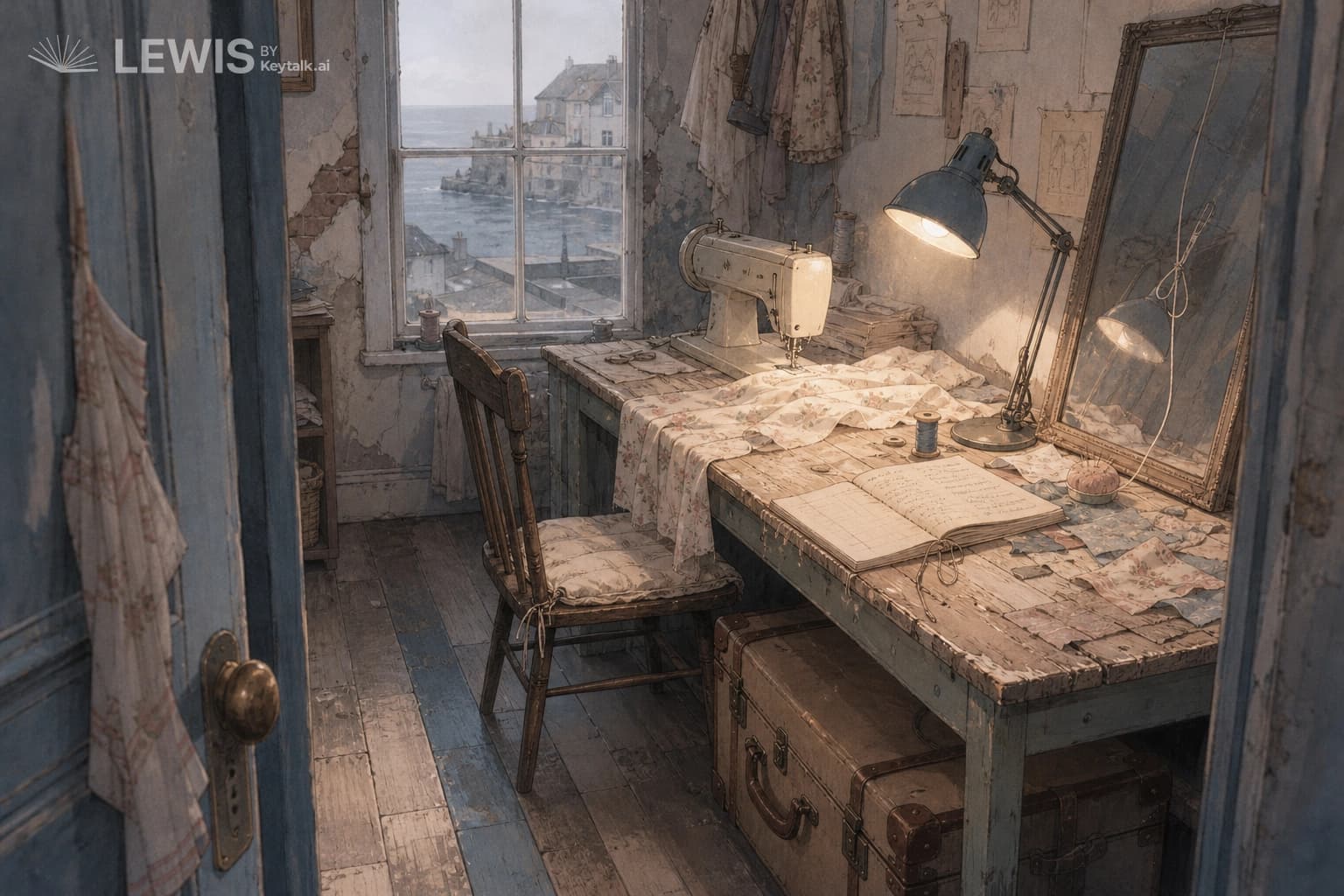
Penrose Alterations occupies a narrow former net-mender’s premises on the uphill edge of a fictional Cornish harbor town. Its shopfront stands three shallow steps above the pavement; a side passage provides level access through the rear workroom. Beyond that door, a cramped kitchen holds the chipped blue sugar bowl. A steep internal staircase leads to two rooms where Carys and Kit once planned to live after their wedding.

The harbor is close enough for a departing ship’s horn to rattle the fitting-room mirror, but invisible from the sewing table. Anyone waiting there must listen without knowing whether a vessel is leaving or merely shifting berth.

Carys closed the shop when care visits and journeys between two households consumed its working hours. During the closure, rain entered around the rear window and damaged the workroom plaster. The building remains usable, but reopening requires repairs, dependable care cover, and customers willing to return. Outside, the unfinished wedding dress hangs beneath the striped awning, its hem pinned clear of the wet pavement.

time period

Autumn 1998, beginning just after Kit returns from a year at sea. Summer visitors have gone; winter uniform alterations and curtain repairs could sustain the shop if Carys reopens soon.

The town’s working harbor is contracting. Local mechanics compete for irregular jobs, while overseas cargo contracts offer steady wages in exchange for long absences. Household telephones and posted letters carry most private news. Shipboard calls are brief and expensive, and letters collected through port agents can arrive weeks late. Silence can be mistaken for a decision.

rules

- Shipboard contracts require a fixed sailing date and months away; declining Kit’s new berth means losing its guaranteed wages, not postponing them.

- Paid care visits cover agreed hours, not the whole day; a cancelled visit leaves someone else responsible and can cost Carys a fitting, a customer, or a farewell.

- The shop takes deposits before ordering cloth and collects the balance when work is delivered; reopening can generate income, but unfinished orders cannot pay this week’s household bills.

- The upstairs rooms are reached only by the steep staircase; Carys and Kit can make a home there, but neither parent can move in without surrendering safe, independent access.

technologies philosophies

Carys works with a sturdy electric sewing machine, a steam iron, paper patterns, and a handwritten order book. Kit’s practical knowledge offers repairs she cannot afford to commission, but his labor must be scheduled alongside paid harbor work. Staying becomes a succession of ordinary appointments rather than one grand gesture.

The telephone sits in the kitchen, beyond easy hearing when the machine runs. Correspondence from Kit is kept in a biscuit tin, separate from the receipts Carys has paid. Neither collection tells the whole year’s story. Putting them on the same table reveals that both have been protecting the other from facts needed to make shared decisions.

Older harbor households prize usefulness and distrust dependence. Oswin brings repaired hinges instead of discussing rent; Morwen insists on trying her own buttons before accepting help. Their pride is understandable, but it spends their children’s time. The shop’s reopening depends on each person agreeing to specific help rather than claiming to need none.

Carys’s shortened measuring tape carries the place’s governing motif: an object can lose length and still do useful work, provided its limits are acknowledged. The repaired shop will retain its mismatched floorboards and old counter. Their wedding belongs there because the room can hold both what failed and what they choose to keep.

visual description

The shop’s colors are faded indigo, cream cotton, tobacco-brown wood, and the hard blue of the sugar bowl. Low autumn light crosses the front window for less than an hour each afternoon, making every loose thread visible. At night, the sewing lamp illuminates Carys’s hands while the rest of the room becomes glass reflections and dark corners.

Salt has roughened the brass door handle. Customer names remain pencilled on paper sleeves tucked into a shallow drawer. A pale rectangle marks where the opening-hours card once hung. The dress looks almost silver against the soot-dark shopfront, beautiful at a distance; close up, its temporary stitches and missing fastenings show how much remains undone.

The visual signature is an interrupted pair: two cups, one untouched; two hooks, one empty; two rings lifted from the bowl and set on a folded cloth. Kit’s suitcase beside the sewing machine breaks that pattern without immediately resolving it. There is barely room to walk around both.


Locations

Where it happens

location 1 image

Penrose Alterations Workroom

The sewing lamp throws a tight pool of light over cream cotton and faded indigo scraps, leaving the narrow workroom’s mismatched floorboards and damaged rear-window plaster in shadow.

Along the sewing table’s edge, old needle strikes form a ragged dotted line beside the handwritten order book; below it, Kit’s suitcase leaves barely enough space to pull out a chair. The electric machine’s chatter almost covers a ship’s horn, until the fitting-room mirror trembles and a loose thread shivers against its glass.

location 2 image

The Rooms Above the Shop

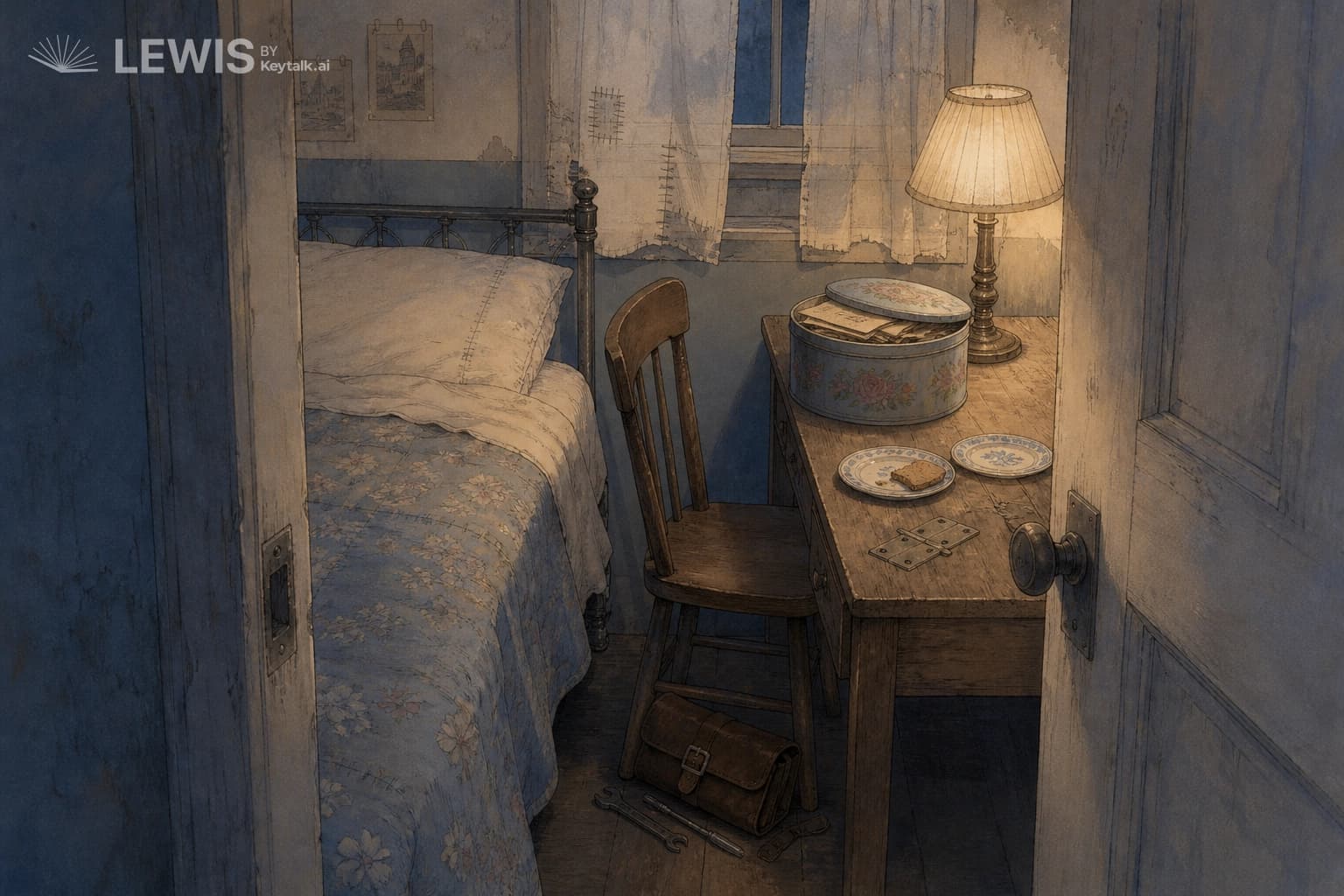
The two upstairs rooms hold a narrow bed in cool linen, tea-brown furniture, and pale plaster left unpainted; a bedside lamp casts soft light over two cups beside the kettle. Above the bed, a strip of wallpaper has been peeled back and left neatly rolled at one end, its faint pattern still visible against the bare wall.

The shop clock ticks through the floor, audible even in the second room, while an empty suitcase lies open beneath the bed and two sets of clothes share the small chest of drawers.

location 3 image

The Departure Pier

The pier stretches across rain-dark stone beneath diffuse autumn light, its salt-rough railings cutting a slate-gray line against harbor-blue water. At the boarding gap, a hinged length of railing has scraped a pale semicircle into the stone; beyond it, the gangway climbs toward the cargo ship, leaving anyone on the pier below the deck’s sightline.

Departing engines throb through the open air while wind whistles across the water, swallowing calls from shore before they reach the ship.

location 4 image

Morwen’s Front Room

Low afternoon light falls across the sage-green wool armchair in Morwen’s close-set front room, catching the smooth buttons of a cardigan laid within reach on its biscuit-gold cushion.

Two shallow hollows mark the chair arms where hands have pressed down to rise; beside it, a walking stick rests in a small notch worn into the edge of a wooden footstool. Furniture stands pushed against the walls, leaving a clear strip toward the street-level window, where stick taps alternate with slowly counted steps.

location 5 image

Oswin’s Ground-Floor Room

Oswin’s ground-floor room has a low ceiling and barely enough space between the bed and the tobacco-brown table for a chair with one stiff leg stretched beneath it. A shaded lamp catches the pewter gleam of repaired hinges beside a biscuit tin; each hinge lands with a small clink, while rent receipts lie tucked beneath the tin’s dented lid.

The curtains carry neat darns across their thinning folds, and a worn leather tool roll rests under the chair, its buckle polished brighter than its unused tools. Two saucers crowd the table’s clear corner, one holding a biscuit with a clean edge snapped off.


Scenes

Scene by scene

Chapter 01

Scene 01· An autumn afternoon in 1998, just after Kit’s return from sea

The Dress Beyond the Glass

The Dress Beyond the Glass
PlacePenrose Alterations Workroom
TimeAn autumn afternoon in 1998, just after Kit’s return from sea
ActionKit Trevorrow enters carrying his suitcase and confronts Carys Penrose about the wedding dress displayed for sale outside. She answers his question about another man without reassuring him that the dress will be kept. When he offers his wage book and moves to take the dress down, she stops him by pushing a chair toward the sewing table and asking him to sit.
ImpactThe reunion becomes a negotiation rather than an embrace. Carys keeps the dress for sale and brings Kit into the workroom to examine what reopening will require. He sets down his suitcase and accepts the chair, but leaves his jacket on; his money has not settled whether he belongs there.

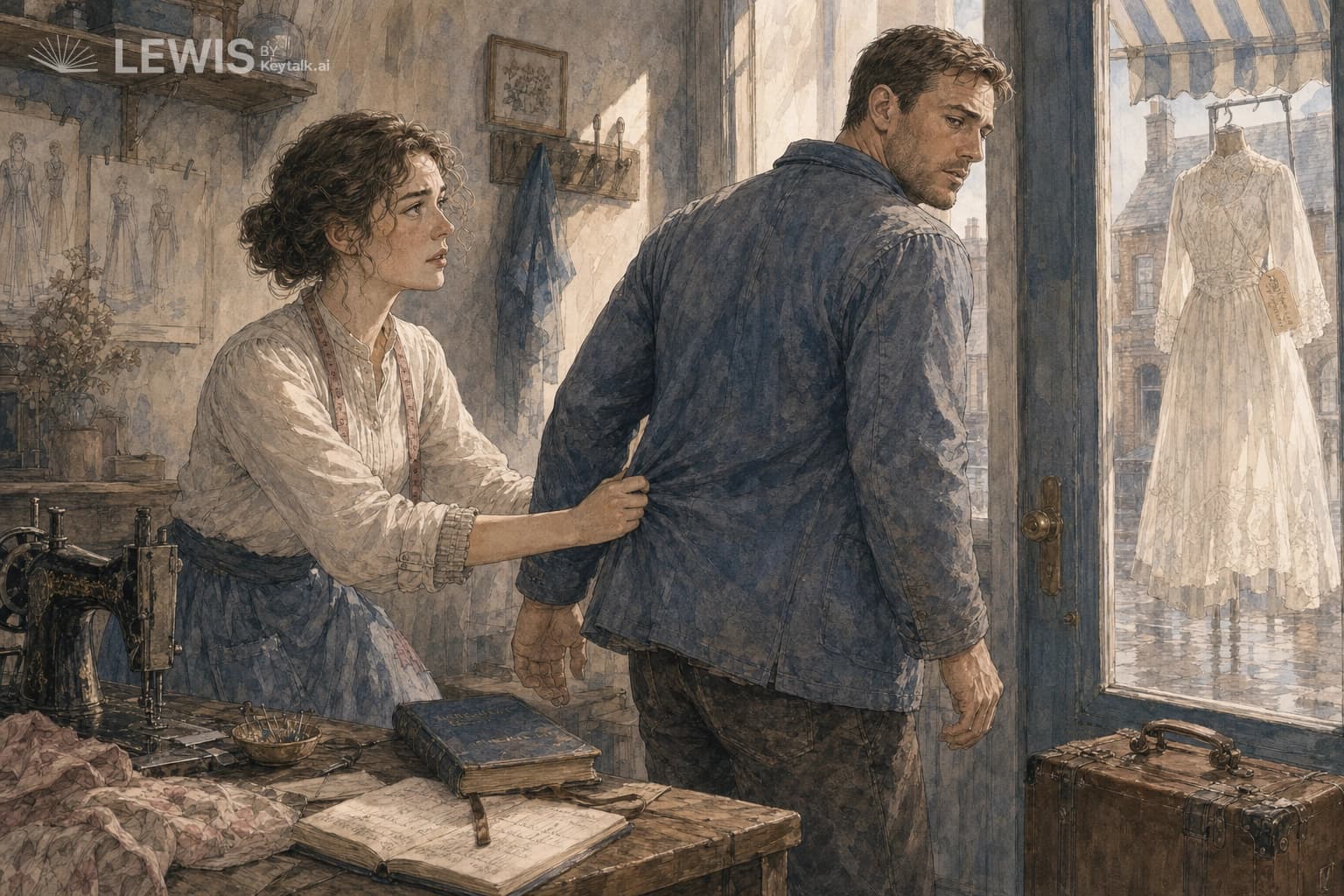
Kit Trevorrow pushes through the workroom doorway with his suitcase, and Carys Penrose draws her handwritten order book out of its path. Beyond the front glass, the unfinished wedding dress hangs beneath the striped awning, its pinned hem lifted clear of the wet pavement and a price tied to its sleeve. Low afternoon light catches the loose curls at Carys Penrose’s temples as she removes a spare pin from between her lips. Kit Trevorrow lowers the case beside the sewing machine and asks, “Is there someone else?”

Carys Penrose sets the pin in a chipped saucer. “There’s scarcely been time to eat.” Kit Trevorrow takes a wage book from his jacket, lays it beside her hand, and turns toward the front door, but she catches his sleeve before he can pass. She releases him only after saying that the dress must stay outside until they can pay for the rear window and open the shop again.

Carys Penrose pushes a chair toward the sewing table, its back striking the suitcase, and holds it there until Kit Trevorrow moves the case enough to sit. She opens the order book beneath the sewing lamp and places a pencil across the empty page, beside the ragged line of old needle strikes. Kit Trevorrow sits with his jacket still buttoned; beyond his shoulder, the price tag remains against the cream sleeve.

Scene 02· Autumn 1998, late afternoon, immediately after Kit’s return

Six Days in the Margin

Six Days in the Margin
PlacePenrose Alterations Workroom
TimeAutumn 1998, late afternoon, immediately after Kit’s return
ActionCarys Penrose draws Kit Trevorrow’s wage book beside her order book and writes repair and care costs against his remaining money. Kit reveals that his offered cargo berth sails in six days. When he proposes using their wedding savings to cover the rear window, Carys writes a zero beside the account. His demand to know why her letters concealed this turns their calculation into a confrontation over what neither of them wrote.
ImpactKit’s return now has a departure deadline attached to it, and the savings he counted on are gone. Carys refuses to let another passage become their answer before they have discussed the year apart. The reason for the emptied account remains unspoken, while their argument moves toward the farewell each believes the other refused.

Carys Penrose pulls Kit Trevorrow’s wage book beneath the sewing lamp and rules two columns in her order book, while his suitcase catches the chair leg as he edges closer. She enters the rear window repair and the weekly care visits; beneath the damaged frame, a flake of plaster drops onto the sill. Kit Trevorrow places his finger beside the remaining wages, then takes her pencil and writes “six days” in the margin.

“The berth sails then,” Kit Trevorrow says, returning the pencil with its point toward her. Carys Penrose adds another week of household expenses, but he stops her hand beside the window figure and suggests using the wedding account. She pulls her hand free and writes a zero beneath its name. “There’s nothing left.”

Kit Trevorrow pushes the wage book away and asks why none of her letters told him that. Carys Penrose presses the pencil against the table’s old needle strikes. “Yours told me what you’d sent and where it rained—you never asked me to wait.” Kit Trevorrow reaches across the page, but Carys Penrose holds its corner down, leaving the zero and his six-day deadline exposed between their hands.

Scene 03· Late afternoon, autumn 1998, immediately after the argument over their letters

The Morning Neither Saw

The Morning Neither Saw
PlacePenrose Alterations Workroom
TimeLate afternoon, autumn 1998, immediately after the argument over their letters
ActionMorwen Penrose enters through the level rear doorway as Carys Penrose explains why she missed Kit Trevorrow’s departure. Morwen admits that she dismissed the caregiver, leaving Carys to help her instead of going to the pier. She stops Kit from excusing her, asks for the calendar, and marks the mornings when she will accept care. She then insists on unfastening her own cardigan while both wait.
ImpactKit learns that Carys’s absence from the pier was not a farewell. Morwen replaces her claim of independence with specific commitments, giving their reopening calculations something firmer to work with. Carys and Kit remain at the sewing table, but neither the empty wedding account nor the approaching sailing date has been resolved.

Carys Penrose lifts her hand from the order-book corner and pulls a chair clear of Kit Trevorrow’s suitcase as Morwen Penrose pushes open the level rear door, her walking stick crossing the threshold first. Kit Trevorrow keeps his hand beside the exposed figures. “I watched the pier until I couldn’t see the town.” Carys Penrose grips the chair back and answers that she spent that morning helping her mother out of a chair after the caregiver had been sent away.

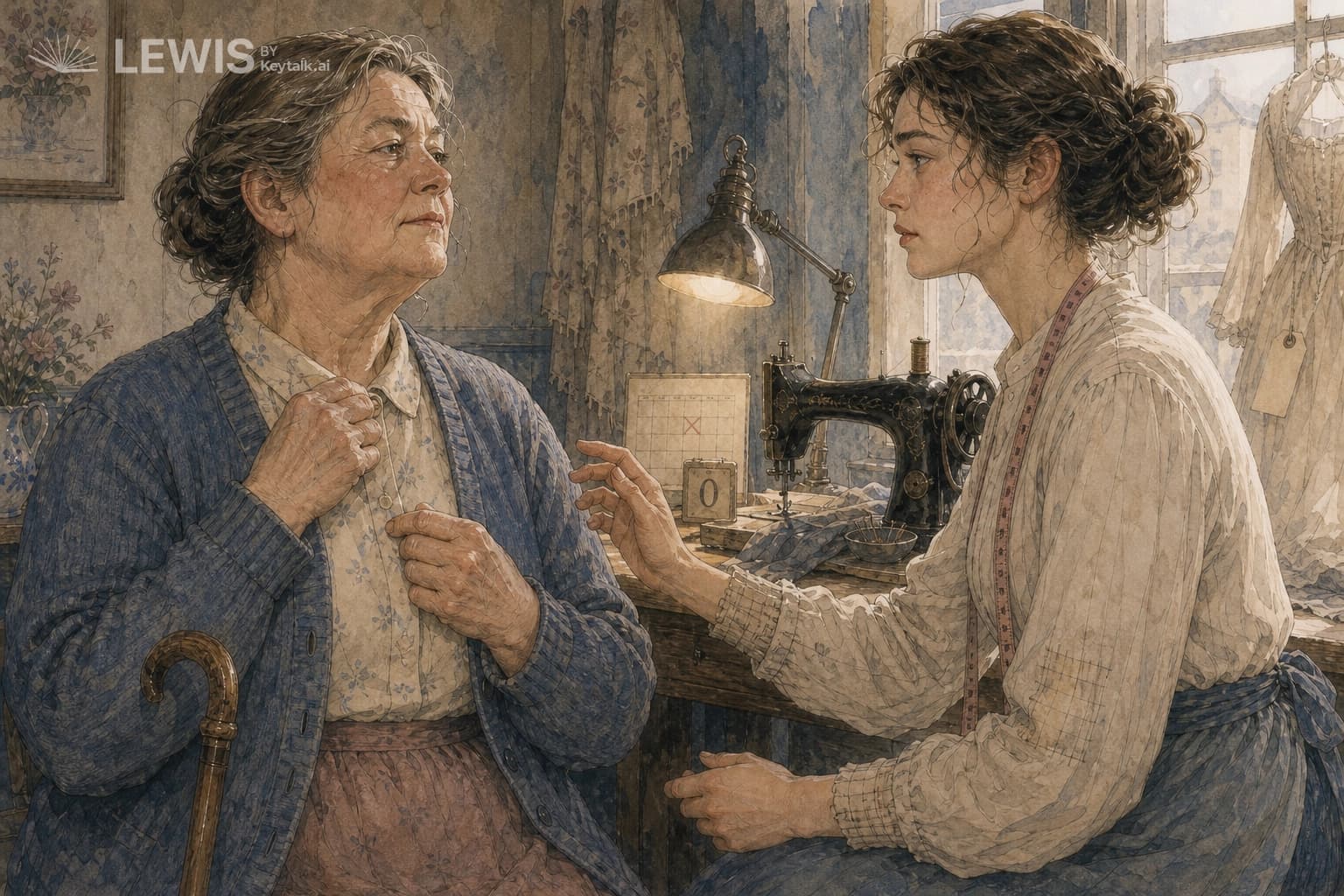
Morwen Penrose catches the doorframe when Carys Penrose reaches toward her, then takes the offered chair without surrendering her stick. “I sent her away so you wouldn’t have to go because of me,” Morwen Penrose tells Kit Trevorrow; when he begins to excuse her, she raises her right hand and asks Carys Penrose for the calendar instead. Carys Penrose lays it beneath the sewing lamp, and Morwen Penrose draws firm marks beside the mornings she will accept care, the pencil dragging a crease into the paper.

Kit Trevorrow moves his wage book aside to make room for the calendar, leaving the wedding-account zero uncovered. Carys Penrose reaches for Morwen Penrose’s cardigan fastening, but her mother closes her fingers over the button and says, “Let me.” Carys Penrose withdraws her hand and sits beside Kit Trevorrow while Morwen Penrose works the button free; beyond the front glass, the price tag still hangs from the wedding dress’s sleeve.

Chapter 02

Scene 04· The next morning, five days before the offered berth sails

Hinges Instead of Answers

Hinges Instead of Answers
PlaceOswin’s Ground-Floor Room
TimeThe next morning, five days before the offered berth sails
ActionKit Trevorrow clears a space among Oswin Trevorrow’s repaired hinges and opens his wage book to ask about rent and household expenses. Oswin fills the space again, demonstrating his repairs instead of answering. When Carys Penrose arrives to collect a saucepan, Oswin deliberately breaks a biscuit and offers it to her as though it were an unwanted fragment. Kit moves the hinges aside once more and asks both of them for the rent figure.
ImpactKit’s attempt to budget exposes a practiced exchange between Carys and Oswin that neither will explain. Their evasions now occupy the same room; Kit can question them together rather than accept separate assurances. The rent remains undisclosed, but he refuses to let the repair work end the conversation.

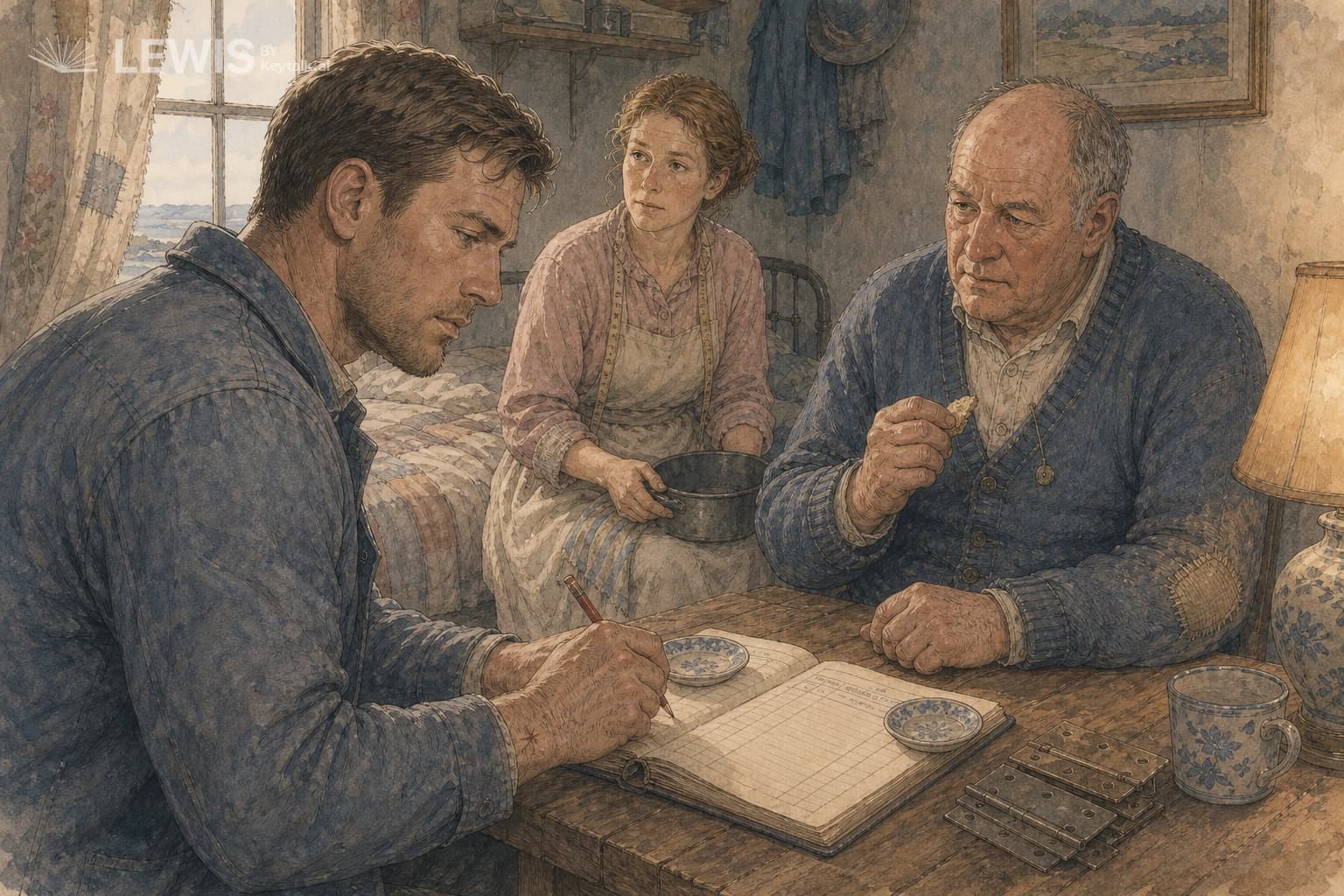
Kit Trevorrow slides three repaired hinges away from the edge of Oswin Trevorrow’s tobacco-brown table and opens his wage book in the cleared space the next morning. Beneath the low ceiling, Oswin Trevorrow stretches his stiff leg into the narrow gap beside the bed and places another hinge across the open page. Kit Trevorrow points past him to the neat darns in the thinning curtains, says, “Those are Carys Penrose’s stitches,” and asks how much the room costs each week.

Oswin Trevorrow lifts the hinge from the book, swings its leaves apart beneath the shaded lamp, and begins explaining how he corrected its fit. Before Kit Trevorrow can repeat the question, Carys Penrose enters to collect her saucepan; Oswin Trevorrow shifts his leg so she can squeeze onto the bed’s edge. He snaps a clean corner from a biscuit, puts the larger piece on her saucer, and says, “That one broke.”

Carys Penrose accepts it with the saucepan balanced on her knees, keeping her eyes below Kit Trevorrow’s face. Kit Trevorrow stacks the hinges beside the lamp and draws his wage book back into the space between their two saucers. “The rent, please,” he says, holding his pencil above the empty line while Oswin Trevorrow lowers the remaining biscuit fragment onto the table.

Scene 05· The morning after Kit’s return, autumn 1998

The Tin Beneath the Chair

The Tin Beneath the Chair
PlaceOswin’s Ground-Floor Room
TimeThe morning after Kit’s return, autumn 1998
ActionKit offers to take another passage to repay whatever Carys has spent on Oswin. Oswin retrieves the biscuit tin from beneath his chair and spreads the rent receipts across Kit’s wage book. Carys confirms that she used their wedding savings to keep Oswin in his accessible ground-floor room.
ImpactKit finally learns where the wedding account went. Oswin’s claim to be managing and Carys’s reassuring letters become facts they must answer for together. Kit’s proposed departure now rests on a debt Carys never asked him to repay.

Kit Trevorrow lays his pencil across the empty rent line and turns his open wage book toward Carys Penrose, who steadies the saucepan on her knees beside Oswin Trevorrow’s crowded table. “Another passage would let me repay what you’ve spent,” Kit Trevorrow says. Oswin Trevorrow pushes his saucer aside, braces his stiff leg beneath the low table, and bends toward the dented biscuit tin under his chair.

Carys Penrose reaches to take the tin, but Oswin Trevorrow lifts it past her hand and sets it across the wage book. He prises off the lid; folded rent receipts spill against the stacked hinges. Kit Trevorrow separates them beneath the shaded lamp, laying one dated payment after another across the page where he had left room for a weekly figure.

“The wedding account?” Kit Trevorrow asks, keeping his finger on the last receipt. Carys Penrose sets her uneaten biscuit on the saucer and answers, “Yes. I called it managing.” Oswin Trevorrow points toward the level doorway and says that another room would have meant stairs he could not climb. Kit Trevorrow draws the receipts into a single stack, but leaves his wage book trapped beneath the open tin.

Scene 06· The morning after Kit’s return, immediately after the rent receipts are revealed.

Beside the Fallen Saucepan

Beside the Fallen Saucepan
PlaceOswin’s Ground-Floor Room
TimeThe morning after Kit’s return, immediately after the rent receipts are revealed.
ActionKit accuses Carys of letting him return with wedding plans she knew they could not afford. Carys rises abruptly, sending the saucepan from her knees onto the floor, and admits that she wanted him home. Kit kneels to retrieve it; Carys kneels beside him while Oswin clears space for them. Kit asks to calculate the shop repairs together before answering the berth offer.
ImpactKit stops proposing repayment long enough to ask Carys to work beside him. They agree to price the repairs, not to another departure or a promise that staying will succeed. The receipts remain on the table, but Kit leaves his wage book closed beneath them.

Kit Trevorrow pushes the stacked rent receipts toward Carys Penrose, catching their edges against the open biscuit tin on Oswin Trevorrow’s tobacco-brown table. “You let me come home making plans you knew we couldn’t afford.” Carys Penrose rises from the bed’s edge before securing the saucepan on her knees, and it drops into the narrow gap with a sharp clang.

“I wanted you home,” Carys Penrose says, then presses her lips together before another word comes. Kit Trevorrow bends for the saucepan as Carys Penrose kneels to reach it, their hands meeting on its handle beneath the table. Oswin Trevorrow draws his stiff leg aside with both hands and turns toward the curtains, leaving them room beside the bed.

Kit Trevorrow sets the saucepan upright but stays on one knee, his shoulder level with Carys Penrose’s. “Will you work out the shop repairs with me before I answer about the berth?” he asks. Carys Penrose nods and releases the handle into his hand. When they rise, Kit Trevorrow lifts the tin, closes his wage book, and leaves the receipts on top while Carys Penrose holds the saucepan against her apron.

Chapter 03

Scene 07· Autumn 1998, over the next two days, before Kit’s berth deadline

A Card in the Window

A Card in the Window
PlacePenrose Alterations Workroom
TimeAutumn 1998, over the next two days, before Kit’s berth deadline
ActionCarys Penrose takes the heavier end of the replacement rear window frame when Kit Trevorrow’s wrist falters, helping him seat it before he leaves for a harbor job. She separates material deposits from household money and schedules a fortnight of alterations and curtain repairs around Morwen Penrose’s marked care mornings. Carys then pins an opening-hours card inside the front window, committing the shop to those hours.
ImpactTheir repair calculation becomes a working shop with orders and advertised appointments. Kit’s local work and Morwen’s care arrangements now support the same tightly fitted schedule. The deposits cannot pay household bills, and the wedding dress remains for sale while they wait for completed work to earn its balance.

Carys Penrose catches the heavier end of the replacement window frame as Kit Trevorrow’s left wrist buckles, lifting it clear of the sewing table in the narrow Penrose Alterations Workroom. Pale fragments of damaged plaster fall onto the mismatched boards while Kit Trevorrow shifts his grip and guides the frame into the rear opening. “Keep that end,” he says, and Carys Penrose holds it until he drives the first fixing home.

Across the next two days, Kit Trevorrow leaves his tools beneath the window between harbor jobs, while Carys Penrose fills the order book with curtain repairs and winter uniform alterations. At the sewing table, she takes the material deposits from the household cash and seals them in an envelope marked with the cloth costs. Morwen Penrose draws the calendar toward her and taps each agreed care morning with her finger; Carys Penrose writes the fittings into those spaces, leaving the remaining hours crossed through.

When Kit Trevorrow reaches for the finished opening-hours card, Carys Penrose holds it beside the calendar before handing it over. “These hours, not any others,” she says, and Kit Trevorrow carries it to the front glass. Carys Penrose presses the final pin into the pale rectangle where the old card hung, beneath the unfinished wedding dress’s price tag still visible through the window.

Scene 08· The next morning, during advertised fitting hours

The Same Morning Twice

The Same Morning Twice
PlacePenrose Alterations Workroom; Morwen’s Front Room
TimeThe next morning, during advertised fitting hours
ActionCarys Penrose turns the shop sign to closed after a telephone call cancels Morwen Penrose’s care visit. She leaves the prepared fitting unfinished and goes to help her mother dress and walk safely. While Carys waits through Morwen’s counted steps, she telephones to cancel the fitting and learns that the customer cannot return. Kit Trevorrow then brings Oswin Trevorrow to Morwen’s front room, having abandoned a paid engine repair to help his father rise and leave his room safely.
ImpactThe care mornings written on the calendar no longer protect the shop’s appointments. Carys loses a fitting, and Kit forfeits wages they had already included in their household calculations. Both parents now require help during the same working hours, leaving the promised income unavailable without reducing any bills.

Carys Penrose flips the sign to closed against the front glass of Penrose Alterations, then takes her coat from Kit Trevorrow’s hand while the kitchen telephone receiver lies beside the calendar. “The care visit’s cancelled,” Carys Penrose says, leaving the fitting pins arranged on a folded length of cream cotton. Kit Trevorrow pulls the coat straight across her shoulders before taking his tools toward the harbor.

In Morwen Penrose’s front room, Carys Penrose holds a cardigan open while Morwen Penrose works her weakened hand into its sleeve, then moves the footstool out of the clear strip beside the window. Morwen Penrose catches Carys Penrose’s offered arm and begins counting her steps; halfway across the room, she stops and tightens her grip. Carys Penrose stays beside her until she reaches the armchair, then telephones about the fitting with one hand still resting on the chair back. “No, I understand you can’t come another day,” Carys Penrose says, and crosses the appointment from the paper she brought in her coat pocket.

Kit Trevorrow pushes the front door open with his shoulder, supporting Oswin Trevorrow while his father draws his stiff leg across the threshold. “He couldn’t get out of the chair safely,” Kit Trevorrow says, guiding Oswin Trevorrow toward the seat Carys Penrose clears beside the window. Carys Penrose reaches for Kit Trevorrow’s tool bag, but he shows her his empty hand. “I had to give up the engine job,” Kit Trevorrow says, and Carys Penrose folds the crossed-out appointment beneath her thumb as Oswin Trevorrow lowers himself into the chair.

Scene 09· That evening, after the cancelled care visit and lost harbor job

Bread Beside the Figures

Bread Beside the Figures
PlacePenrose Alterations kitchen and adjoining workroom
TimeThat evening, after the cancelled care visit and lost harbor job
ActionCarys Penrose crosses the lost fitting payment and Kit Trevorrow’s forfeited wages out of their household calculation at the crowded supper table. Morwen Penrose and Oswin Trevorrow try to make room for the book and offer to reduce their own expenses, but the bills remain larger than the available cash. Kit Trevorrow leaves the table, squeezes past the sewing chair, and lifts his suitcase. He proposes taking another passage.
ImpactThe cancelled appointments become a visible shortfall that their new orders cannot immediately cover. Kit Trevorrow turns from their shared calculation toward the guaranteed shipboard wages, bringing departure back into the room as an action rather than a possibility. Carys Penrose follows him into the workroom before he can carry the suitcase farther.

Carys Penrose strikes out two promised payments in the account book while Kit Trevorrow moves the bread plate aside on the cramped Penrose Alterations kitchen table. That evening, Morwen Penrose draws her cup toward her cardigan to clear another few inches, and Oswin Trevorrow shifts his extended leg so Carys Penrose can pull her chair closer. Carys Penrose lays the crossed-out fitting slip beside the book and writes the smaller total beneath the unchanged rent and care bills.

Oswin Trevorrow pushes his untouched slice toward Kit Trevorrow and offers to manage with less housekeeping money; Carys Penrose slides it back onto his plate. Morwen Penrose reaches for the care calendar, but Carys Penrose sets the bills beside its marked mornings without erasing any visits. Kit Trevorrow taps the envelope reserved for cloth, and Carys Penrose covers it with her palm. “That belongs to the orders.”

Kit Trevorrow pushes his chair back, squeezes past the sewing chair in the adjoining workroom, and lifts the suitcase from beside the machine. “One more passage,” he says, turning toward Carys Penrose as she follows him through the doorway, “and I could settle this before I came back.” Behind Carys Penrose, both parents leave their bread untouched; ahead of her, Kit Trevorrow holds the case against his leg beneath the opening-hours card still pinned in the front glass.

Chapter 04

Scene 10· Autumn 1998, immediately after supper, before Kit’s berth deadline

The Space Between Him and the Door

The Space Between Him and the Door
PlacePenrose Alterations Workroom
TimeAutumn 1998, immediately after supper, before Kit’s berth deadline
ActionCarys Penrose pulls the sewing chair aside and steps into Kit Trevorrow’s route to the door. She asks him to put down his suitcase while they discuss the passage, but he keeps hold of it and insists that its wages would let him return without debt. Morwen Penrose and Oswin Trevorrow move from the kitchen to chairs against the rear wall. Carys asks Kit to hear her before carrying the case any farther.
ImpactKit’s proposed departure meets a direct request rather than another calculation. Carys interrupts his movement toward the door without claiming that staying will pay their bills. The suitcase remains in his hand, but he turns back toward the sewing table, giving her room to speak.

Carys Penrose pulls the sewing chair out of Kit Trevorrow’s path, then steps into the narrow space it leaves between him and the door. Beneath the sewing lamp, his suitcase brushes the table’s scarred edge; she keeps her hands at her sides. “Put it down while I speak.”

Kit Trevorrow shifts the handle into his right hand and turns the case edgeways to clear the table. “One more passage would let me come back without owing anyone.” Behind Carys Penrose, Morwen Penrose plants her walking stick beside a rear-wall chair while Oswin Trevorrow lowers himself into the other, drawing his stiff leg out of the passage.

Carys Penrose pushes the displaced chair beneath the table, opening a space beside the order book rather than moving toward the front door. “You came back this time, Kit. Please hear me before you leave again.” Kit Trevorrow turns toward the cleared tabletop, but his fingers stay closed around the suitcase handle.

Scene 11· After supper, autumn 1998, before the berth deadline

What the Shirt Cannot Carry

What the Shirt Cannot Carry
PlacePenrose Alterations Workroom
TimeAfter supper, autumn 1998, before the berth deadline
ActionKit Trevorrow lowers his suitcase onto the sewing table but keeps hold of its handle. Carys Penrose opens the catches and removes his folded work shirt. With Morwen Penrose and Oswin Trevorrow listening, she describes the daily work his absence left her carrying and asks him to stay without promising that staying will make their lives safe.
ImpactCarys Penrose makes a request that neither wages nor repayment can answer. Kit Trevorrow stops preparing to leave long enough to hear what she is asking, but he has not yet released the handle. The open suitcase brings their argument into the space where they must decide together, with the financial shortfall still unchanged.

Kit Trevorrow lowers the suitcase onto the cleared sewing table, and Carys Penrose flips its catches open beneath his hand, pushing the lid back beside the handwritten order book. The sewing lamp lights a folded work shirt above the cream cotton scraps; his fingers remain hooked around the handle. Carys Penrose lifts the shirt out, leaving a shirt-shaped hollow among his packed clothes.

“I carried supper uphill after closing Mum’s curtains, then caught the last bus to your father,” Carys Penrose says, holding the folded sleeves against her waist. Oswin Trevorrow starts to draw his stiff leg beneath his chair, but Carys Penrose shakes her head and continues: “Then I came back here, and there was the dress, and I couldn’t finish it.” Morwen Penrose reaches toward her daughter, then lowers her hand to the walking stick as Kit Trevorrow says, “I was trying to pay for help.”

Carys Penrose unfolds the shirt, and its hem brushes the table’s ragged line of needle marks. “Can you stay when I’m frightened and cross, when your wages are smaller, and I can’t thank you for making everything safe?” she asks. Kit Trevorrow reaches toward the shirt with his free hand, but stops short of taking it. Carys Penrose lays one sleeve across his packed clothes and keeps the other between her shaking fingers; his hand stays on the handle.

Scene 12· Autumn 1998, after supper, immediately after Carys’s request

The Figure Still Owed

The Figure Still Owed
PlacePenrose Alterations Workroom
TimeAutumn 1998, after supper, immediately after Carys’s request
ActionOswin places his tool roll beside the order book and offers Kit the tools, asking for paid repair work he can do seated. Morwen draws the calendar onto her lap and asks to take part in arranging backup care. Carys reads the remaining household shortfall aloud without reducing their parents’ needs or counting uncertain earnings. Kit releases the suitcase handle, takes the shirt from her, and begins unpacking with her.
ImpactTheir parents offer specific contributions instead of claiming they can manage without help. Those contributions do not close the financial gap, but Kit chooses to unpack without a guarantee that staying will pay. His formal refusal of the berth remains for the morning.

Oswin Trevorrow leans forward from his rear-wall chair and lowers his old tool roll beside the order book, while Carys Penrose keeps one shaking hand on the shirt draped across Kit Trevorrow’s open suitcase. Beneath the sewing lamp, Oswin Trevorrow loosens the polished buckle and pushes the tools toward his son. “Take these, and bring me repairs I can do sitting down—at an agreed price.”

Morwen Penrose draws the calendar onto her lap, steadies its curling edge with her weakened hand, and asks them to arrange backup care with her before booking more fittings. Carys Penrose pulls the account book clear of the tool roll and enters their proposed changes beside the crossed-out payments. She reads the remaining shortfall aloud, then leaves the pencil across the figure without striking anything out.

Kit Trevorrow uncurls his fingers from the suitcase handle and takes the work shirt from Carys Penrose, pressing it briefly against his face. “Where would you like me to put my clothes?” he asks. Carys Penrose clears a space beside the cream cotton scraps, and together they lift out his other shirts, socks, and folded trousers while Morwen Penrose holds the calendar and Oswin Trevorrow rolls up the empty tool cloth. Carys Penrose reaches beneath the suitcase’s lining flap for the last pair of socks; Kit Trevorrow holds the lid back for her.

Chapter 05

Scene 13· The morning after unpacking, then through winter 1998–99

The Price of Staying

The Price of Staying
PlacePenrose Alterations Workroom and adjoining kitchen
TimeThe morning after unpacking, then through winter 1998–99
ActionKit Trevorrow declines the cargo berth by telephone, surrendering its guaranteed wages. Carys Penrose cuts the price tag from her wedding dress and brings it inside. Through winter, they sell unused stock, disclose missing payments, and negotiate work and care appointments around the workroom table with Morwen Penrose and Oswin Trevorrow.
ImpactStaying becomes a binding decision with immediate costs rather than a promise made beside an open suitcase. Carys and Kit begin sharing the facts they once concealed from each other. Their dress remains unfinished and their upstairs walls unpainted, but neither is offered for sacrifice when the accounts fall short.

Kit Trevorrow lifts the kitchen telephone receiver the morning after unpacking, while Carys Penrose holds the remaining berth details flat beside his elbow. “I’m declining the passage,” he says, then listens with his free hand resting on the paper. When Kit Trevorrow replaces the receiver, Carys Penrose takes her sewing scissors outside, cuts the price tag from the dress beneath the striped awning, and carries the dress back through the shop door.

By December, Carys Penrose slides a bundle of unused cloth across the workroom table for Kit Trevorrow to tie, then places its sale money beside the household account rather than the envelope of customer deposits. Kit Trevorrow sets the upstairs paint estimate beneath the account book and draws a line through the proposed purchase. Carys Penrose opens the order book to a delivered school uniform and says, “I let this one go without payment,” keeping the page turned toward him until he enters the smaller total.

On a January afternoon, Kit Trevorrow lays a harbor job slip across a marked care appointment, and Morwen Penrose pulls the calendar back toward her before either of them moves the appointment. Morwen Penrose points to the hours she needs covered while Oswin Trevorrow sets two repaired catches beside the book and waits as Carys Penrose counts out his agreed payment. Together they write a backup arrangement in the margin; Kit Trevorrow crosses out the conflicting start time on his slip and writes a later one to request. Carys Penrose clears the finished catches from the table, leaving a narrow space beside the machine, and lays her unpriced wedding dress there.

Scene 14· A spring afternoon, before the wedding

Just Enough

Just Enough
PlacePenrose Alterations Workroom
TimeA spring afternoon, before the wedding
ActionCarys Penrose moves a customer’s curtain onto her unfinished wedding dress, postponing her own sewing again. Morwen Penrose puts their agreed care calendar beside her, and Oswin Trevorrow delivers his completed paid repairs. With those commitments met, Carys clears the curtain away, checks her shortened measuring tape against a wooden rule, and cuts the final length for her dress while Kit Trevorrow turns its fastening loops.
ImpactCarys gives the dress working time rather than whatever remains after everyone else’s needs. Their parents’ specific contributions protect that time without removing the household’s financial limits. The last piece is cut, bringing the wedding within reach of the life they have already begun sharing.

Carys Penrose lays a customer’s folded curtain across her wedding dress as Kit Trevorrow pulls his chair up to the sewing table in Penrose Alterations Workroom. Spring light crosses the mismatched floorboards, and beneath the dry rear window the order drawer stands full of pencilled paper sleeves. Kit Trevorrow lifts the curtain’s attached slip and sets it facing her: its collection date is three days away.

Morwen Penrose slides the care calendar beside the slip, holding its edge down with her weakened hand. “My hours are covered. Leave them covered.” Oswin Trevorrow sets two finished catches on the table, accepts the agreed coins from Carys Penrose, and moves his empty wrapping paper out of her cutting space.

Carys Penrose returns the curtain to its sleeve, then lays her shortened measuring tape against the wooden rule before marking the last strip of dress fabric. Kit Trevorrow turns a fastening loop with a blunt needle opposite her, pushing the tiny seam outward until she reaches across to straighten it between his fingers. “There’s enough,” Carys Penrose says, and cuts along the chalk mark without taking her hand from the cloth. She lays the cut strip beside the dress; Kit Trevorrow places the finished loop in her open palm.

Scene 15· A spring wedding afternoon, continuing into evening

Two Cups Upstairs

Two Cups Upstairs
PlacePenrose Alterations Workroom and the Rooms Above the Shop
TimeA spring wedding afternoon, continuing into evening
ActionCarys Penrose lifts their rings from the chipped blue sugar bowl and gives one to Kit Trevorrow at their wedding in the repaired shop. Morwen Penrose asks for help at the rear threshold, while Oswin Trevorrow secures the repaired door open. Afterward, Carys and Kit carry two cups upstairs. When Kit reaches for her hand, Carys sets down her cup instead of beginning Monday’s list.
ImpactThe dress becomes a wedding dress worn rather than unfinished work postponed. Both parents participate without concealing their need for help. Carys and Kit begin married life in the rooms they once planned to share, leaving the unfinished decorating and coming appointments untouched for one evening.

Carys Penrose lifts two rings from the chipped blue sugar bowl and places one in Kit Trevorrow’s open palm beside the sewing table in Penrose Alterations Workroom. Spring light catches the finished fastening loops of her dress and the mismatched boards beneath its hem. At the level rear entrance, Morwen Penrose plants her stick and says, “A hand, please,” and Kit Trevorrow helps her across the threshold before returning to Carys Penrose.

Oswin Trevorrow lowers the repaired door catch into place from his chair, holding the entrance open without having to brace it with his stiff leg. Carys Penrose pushes the ring over Kit Trevorrow’s knuckle; when he takes her hand to do the same, she spreads her fingers for him. Morwen Penrose presses a folded handkerchief beneath her eyes, and Oswin Trevorrow reaches across to straighten the edge caught under her sleeve.

That evening, Carys Penrose and Kit Trevorrow carry two cups up the steep stairs, passing the bare plaster they left unpainted through winter. Beside the narrow bed, Carys Penrose sets her cup down and begins, “Monday, the curtains—” but Kit Trevorrow puts down his own cup and offers his hand. She takes it and sits beside him, her dress brushing the empty suitcase lying open beneath the bed. The kettle cools beside their untouched cups while his thumb rests against her new ring.

'Don't Save Me by Leaving'Story Chat

Want to chat with the characters from this story?

'Don't Save Me by Leaving'Story Chat

Want to chat with the characters from this story?

story image
story image
story image
story image

Story details

Made with

Models

  • GPT-6.1 Soltext
  • Stable Diffusionimage
  • gpt_image_2image

Comments

Comments · 0

theme music