Keytalk Original · 15 scenes · 5 chapters

Mercy's Above My Pay Grade

A mafia collector walks into a rain-darkened diner to break its owner's hands and finds his oldest friend washing dishes to repay the gambling debt they once ran up together. His friend has been charging hungry customers for meals donated by a church, setting aside enough cash to buy his own release while leaving the owner liable for the balance.

The collector puts his hammer on the counter and makes his friend return the money, coin by coin, to the customers still waiting outside. When their captain arrives with a second hammer, the collector must cripple the owner or put his own hands beside his friend's on the chopping board.

  • 4 characters
  • 5 locations
  • 15 scenes
  • Plot 6,013 chars
Mercy's Above My Pay Grade cover image

Characters

Characters

Rocco Bellandi

Male

Mafia collector sent to punish a diner owner who has fallen behind on a guaranteed gambling debt

Profile

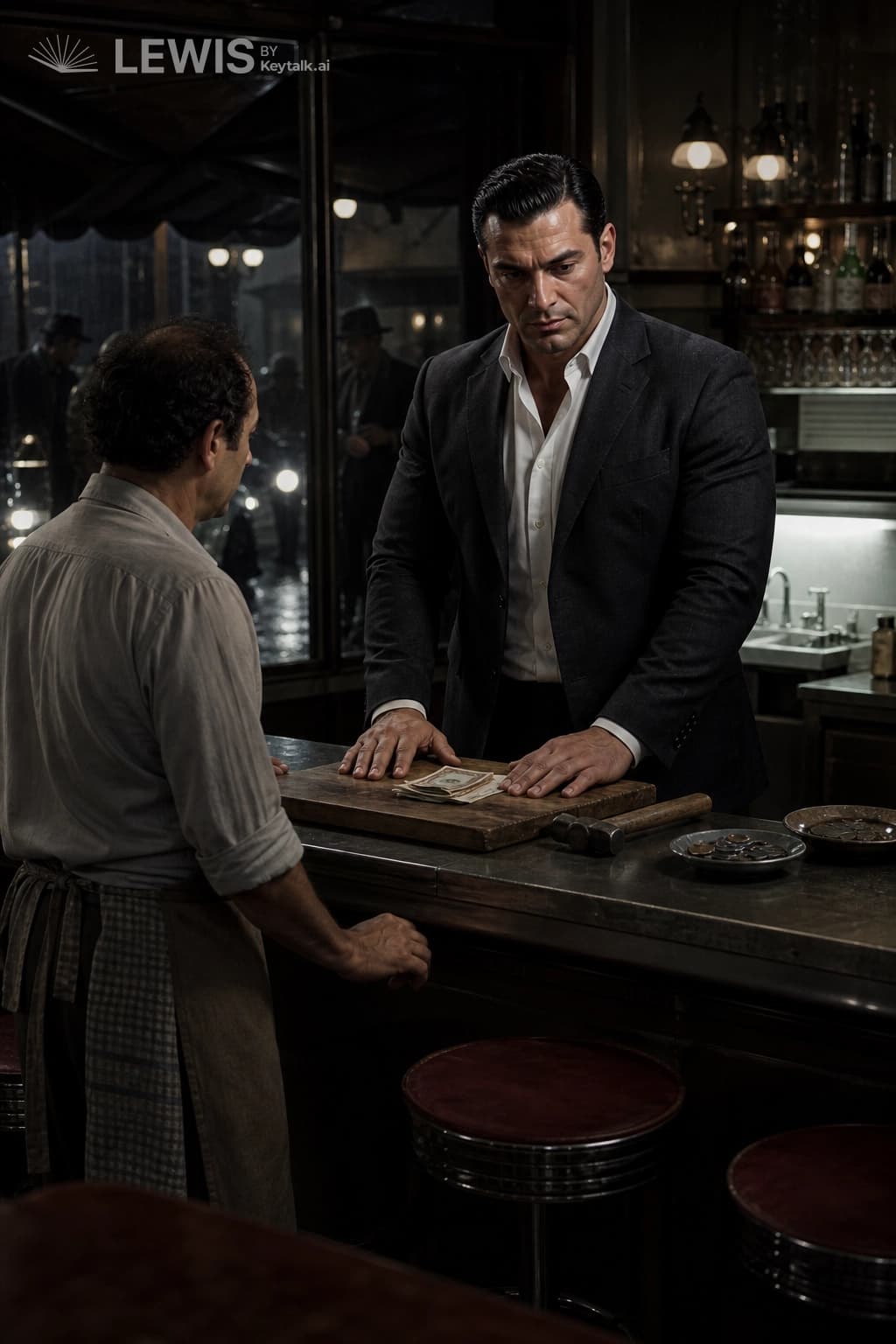
Rocco Bellandi wants to leave Inez Carbone’s diner with payment instead of another pair of ruined working hands, and demands that Tullio Serra surrender his escape money to the customers he charged for donated meals. Rocco Bellandi needs Corrado Vescio to accept that public repayment as enforcement, but the captain demands a punishment that money cannot replace. With a second hammer on the counter, Rocco Bellandi must either strike Inez Carbone or lay his own hands beside Tullio Serra’s, surrendering the tools that keep him employed and protected.

At 39, Rocco Bellandi checks whether a debtor uses the left or right hand before placing his hammer within reach, then pushes glasses and crockery clear of the counter. Rocco Bellandi makes Tullio Serra count each refund aloud, but slips a dollar into the next customer’s change beneath a folded napkin when the coins run short. When Corrado Vescio calls this softness, Rocco Bellandi straightens the wet bills into a precise stack and asks which part of the recovered money the captain objects to.

Background

As a boy, Rocco Bellandi held Tullio Serra’s bicycle steady while his older friend patched its tires; years later, Rocco Bellandi handed that same friend half their betting stake outside a bookmaker’s shutter.

Rocco Bellandi worked off his share under Corrado Vescio, learning to wrap hammer handles and returning from collections with enough money to earn another assignment while Tullio Serra’s balance kept growing.

At 39, Rocco Bellandi still receives repair bills from a cabinetmaker whose hands he broke on Corrado Vescio’s orders, and pays each one without putting his name on the envelope.

Description

Rocco Bellandi has a broad, compact build and a square face still firm at thirty-nine, with dark hair clipped close at the sides and faint creases between his brows.

His charcoal wool jacket sits neatly over a cheap cream shirt and dark trousers; he keeps his shoulders level and his mouth closed, watching other people’s hands before meeting their eyes. His left thumb repeatedly smooths the cuff over his right wrist, a small, careful movement at odds with the weight of his bare hands.

Tullio Serra

Male

Indebted gambler washing dishes at the diner while secretly selling church-donated meals

Profile

At 40, Tullio Serra has nearly filled a biscuit tin beneath the sink with enough coins to purchase a signed release, leaving Inez Carbone responsible for the unpaid balance. Tullio Serra asks Rocco Bellandi to recognize the old betting partner rather than the thief, but the discovery forces Rocco Bellandi to turn a collection into a public repayment. With the last roll of coins wedged inside his shoe, Tullio Serra begs for his stiff wrist to be spared and keeps asking whether repayment will still earn him a receipt.

Tullio Serra names each customer’s exact order while returning the money—soup without bread, beans with extra pepper—and waits for an answering nod before releasing the coins. At 40, Tullio Serra still holds his left wrist out to Rocco Bellandi as he did when they were boys, asking for protection while pressing his coin-filled shoe against a table leg. When a customer refuses to thank him, Tullio Serra recounts the refund on the counter instead of meeting the customer’s eyes.

Background

Tullio Serra once folded his betting slips around Rocco Bellandi’s, and Rocco Bellandi learned to recognize the cold-weather stiffness in his left wrist from the way he struggled to separate the damp papers.

At 40, Tullio Serra accepted dishwashing work after Inez Carbone guaranteed his remaining debt; when Inez Carbone allowed charges for donated dinners to keep the gas connected, Tullio Serra began moving part of each payment beneath the sink and writing his shrinking personal balance on the inside of the tin’s lid.

Description

Tullio Serra is a narrow-built forty-year-old with thinning brown curls, a long nose, and fine creases around eyes that search faces before settling on the money between them.

His faded mustard shirt pulls loose beneath a gray dishwashing apron, its pockets polished by repeated handling; he offers a pinched, expectant smile while holding his stiff left wrist palm-up, as though someone else should take responsibility for it.

Even when he leans forward to count change, one worn leather shoe stays braced against a table leg, keeping the hidden coin roll pinned beneath his foot.

Inez Carbone

Female

Diner proprietor who guaranteed Tullio’s remaining debt in exchange for kitchen labor and distributes church meals after closing

Profile

Inez Carbone wants Rocco Bellandi to leave her hands usable for tomorrow’s breakfast, and offers him the till while keeping the morning bread envelope beneath her apron. Naming Tullio Serra’s theft would also expose the meal charges Inez Carbone knowingly allowed to keep the gas connected. By turning the chopping board bread-side down beneath Rocco Bellandi’s hammer, Inez Carbone makes him negotiate across the very work surface his orders would render useless.

At 56, Inez Carbone tests every offer of help with a practical question—who will light the stove, carry the flour, unlock the door—and cuts off condolences by handing over a dish towel. When Rocco Bellandi sets his hammer beside the register, Inez Carbone turns the board over and tells him the bread side is not for tools. Inez Carbone pushes the open till toward him with one hand, but presses the other against her apron when a refunded customer asks whether there is any money left.

Background

Inez Carbone signed the guarantee for Tullio Serra’s debt after he brought her a paid gas bill and promised to work off the balance at her sink; she kept the receipt beside the agreement in a biscuit tin.

At 56, Inez Carbone began accepting church trays through the back door, then watched Tullio Serra take payment at the front and instructed him to leave enough in the register for the next gas installment.

When the bread supplier stopped extending credit, Inez Carbone began sealing each morning’s payment in a marked envelope before counting anything toward the debt.

Description

Inez Carbone, 56, stands square behind the counter in a faded tobacco-brown cardigan and a flour-dusted cotton apron, her broad face lined around the mouth and her iron-gray hair twisted tightly off her neck.

She turns the chopping board bread-side down before pushing the till forward, watching the collector’s face rather than his hammer; her other palm holds flat against the apron pocket, where the stiff corner of the morning bread envelope lifts the cloth.

Her chin stays level, but her work-thickened fingers spread carefully, keeping clear of the board.

Corrado Vescio

Male

Neighborhood mafia captain whose collectors must return with payment or proof that refusal carries consequences

Profile

Corrado Vescio wants Rocco Bellandi to carry out the punishment where the waiting customers can see it, refusing Inez Carbone’s till even though taking it would recover more money. By offering Rocco Bellandi the choice between striking Inez Carbone’s hands and placing his own beside Tullio Serra’s, Corrado Vescio stakes a trained collector’s future usefulness on one public answer. Corrado Vescio leaves the second hammer within reach and waits, giving Rocco Bellandi time to refuse without giving him anywhere to hide the refusal.

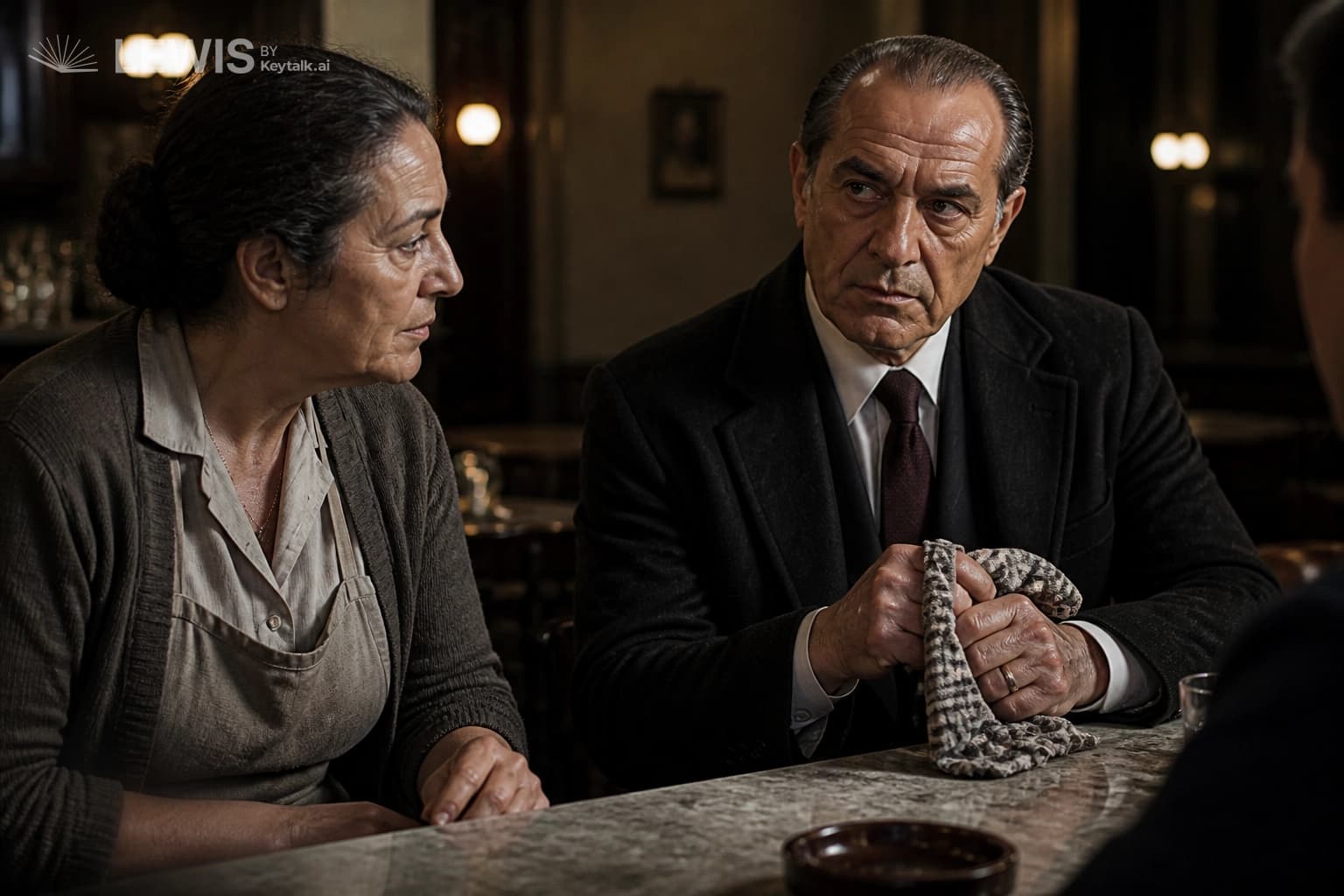
At 63, Corrado Vescio moves Inez Carbone’s bread envelope away from the wet counter before setting down his hammer, then checks that the waiting customers have a clear view of the chopping board. Corrado Vescio delivers the bargain without raising his voice; when Rocco Bellandi looks toward the door, Corrado Vescio shifts aside rather than blocks it. Corrado Vescio smooths a lifted edge of the handle wrapping with his thumbnail, but leaves Inez Carbone’s offered cash untouched.

Background

Years before this collection, Corrado Vescio taught Rocco Bellandi to wind cloth tightly around tool handles, making him undo each loose turn until the grip held against a wet palm. Corrado Vescio subsequently put Rocco Bellandi in charge of collections that other men had spoiled with shouting, broken fixtures, and debts nobody could repay.

Now 63, Corrado Vescio arrives carrying a second hammer wrapped by the same method and tells Rocco Bellandi, within the customers’ hearing, “You learned to keep hold of it. Show them.”

Description

Corrado Vescio wears a well-brushed charcoal wool overcoat over a brown suit, its cuffs neatly repaired; thinning silver hair and deep folds beside his mouth give his narrow face the settled look of sixty-three years.

He stands slightly aside, leaving both the doorway and the chopping board visible, his pale hazel eyes fixed on his former pupil without a raised chin or tightened jaw.

After moving the bread envelope clear of the wet counter, he presses a lifted turn of cloth flat against his hammer’s handle with one broad thumbnail, then sets it within reach and waits.


Synopsis

Plot

Rocco Bellandi reaches Carbone’s Diner with instructions to break Inez Carbone’s hands before the evening meal line disperses. He leaves his coat on. He expects to collect cash, report resistance, and make the missed payment disappear beneath a larger sum. He also wants Inez to offer the money without making him ask what she will eat tomorrow. When she sets the bread envelope beside the register and asks whether he intends to count that too, he pushes it back.

Through the service opening, Tullio Serra watches him from the sink.

Rocco has not seen his oldest friend in eight months. The gambling debt began at a table where they sat together; Rocco paid his share by collecting other people’s balances. Now Tullio dries his hands and asks him to take their conversation into the delivery yard. Inez stops washing a saucepan. She guaranteed Tullio’s remaining debt in exchange for work, and she will not let the two men settle anything beyond her hearing.

Rocco stays at the counter. Tullio stays behind the sink.

A man beneath the awning pushes folded coins through the partly open door and asks for two suppers. Inez reaches for them. Rocco catches her wrist, then releases it when she looks down at his hand. The aluminum carriers bear the church’s name. She says the stove cannot run on promises.

Tullio offers to fetch the gas bill. Instead, he reaches beneath the sink.

Rocco goes through the swinging partition and catches him lifting a biscuit tin. Tullio grips it against his chest until the leaking trap splashes his sleeve. Rocco pulls one edge free; coins spill into the basin among the dishes. Tullio immediately starts retrieving them.

He admits he has been saving for a personal release. He knows Inez would remain liable. He asks Rocco to remember that neither of them understood the guarantor arrangement when they began betting.

“You understand it now,” Inez says.

Rocco carries the tin to the front door. He makes Tullio stand beside him and return each customer’s money before that customer receives food. The queue moves slowly. Tullio remembers orders more accurately than he remembers names. One woman holds her palm out after he gives her change; he has omitted the charge for bread. Rocco waits until he adds it.

Inez brings her share from the till. Returning it leaves too little for the gas payment. She reaches toward the bread envelope, but Rocco puts his own dollar beneath the next customer’s coins instead. She lets the envelope remain where it is. For the first time, he cannot make the money on the counter belong entirely to somebody else.

Tullio keeps one foot rigid against the threshold. When Rocco orders him back inside, a roll of coins slips from his shoe. Tullio bends quickly, but Inez puts her work shoe on it. He must ask her to move before he can surrender the last of his reserve.

Corrado Vescio arrives as the final refund is counted. He sets a second hammer beside Rocco’s, then lifts the bread envelope clear of the damp counter. He asks Inez which hand holds the knife.

Rocco offers the remaining till money. Corrado does not touch it. He turns one stool toward the window so the waiting customers can see past it. Then he tells Rocco to bring the board.

Inez fetches it herself and places it bread-side down. Corrado explains the choice: Rocco will punish her, or put his own hands beside Tullio’s. Returning stolen money has changed no order.

Tullio begins arguing that Inez can hire help. She walks to the wall telephone.

Corrado takes the receiver from her and replaces it. He does not threaten her aloud. He keeps his hand over hers until she steps away.

Rocco notices how carefully the captain releases her fingers. Corrado taught him that care: protect a debtor’s other hand, clear the crockery, leave the business capable of paying later. Rocco has used those instructions to keep calling himself useful.

He moves Inez away from the board and puts both hands on it.

Tullio backs into the partition. Rocco tells him to come forward. His friend asks whether this will count toward the balance. Corrado says it will not. Tullio puts down his hands anyway, his stiff wrist raised slightly from the wood.

Corrado picks up the wrapped hammer. Before striking, he separates Rocco’s fingers with his free hand, arranging them as though correcting a piece of work.

Rocco withdraws one hand and catches the captain’s wrist.

For a moment neither moves. Corrado tells him to let go. Tullio starts pulling his hands off the board.

“Hold him,” Rocco says.

Tullio looks toward the door. Then he catches Corrado’s hammer arm with both hands.

The captain drives him against the counter. Crockery falls. Rocco takes his own hammer and strikes Corrado’s hand once, forcing him to release his weapon. He does not strike again. He pushes both hammers across the floor, beyond the swinging partition, while Tullio keeps hold of the captain’s coat.

Inez lifts the telephone receiver. This time nobody takes it away.

She requests an ambulance and police, giving the diner’s address twice. Rocco tells Tullio to release Corrado. The captain sits on the turned stool with a dish towel around his hand, facing the customers he arranged as witnesses. He tells Rocco that Inez’s debt remains. Rocco says he knows.

When the police arrive, Rocco steps between them and Tullio and admits the assault without calling it an accident. Tullio opens his mouth to explain, then closes it. Rocco will not name their struggle a debt his friend can repay.

The officers take Rocco out through the meal line. Corrado leaves with the ambulance attendants, carrying neither cash nor a hammer. Inez locks the kitchen partition until the fallen tools have been removed.

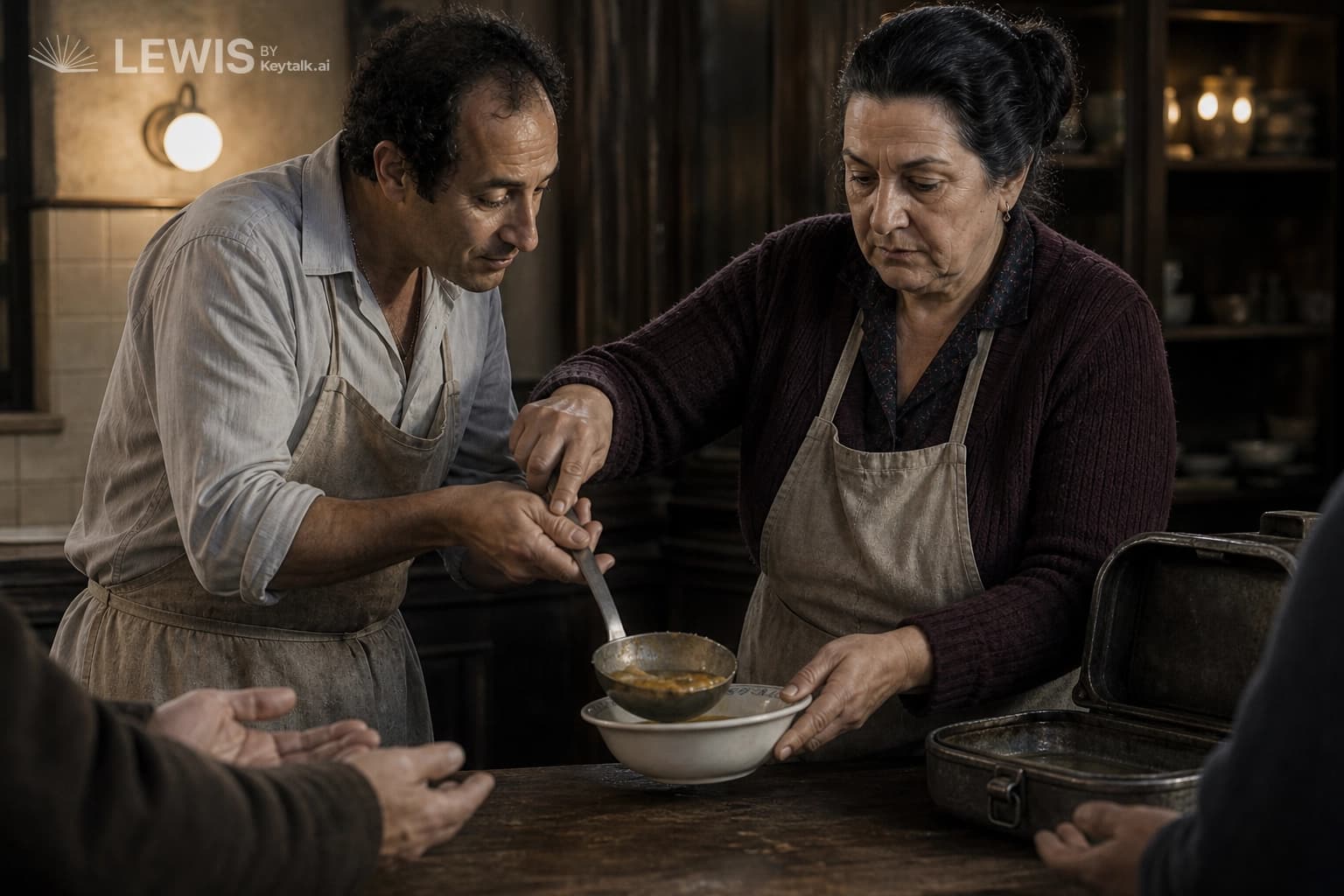
There is still food in the carriers. She puts a ladle into Tullio’s hand and tells him to serve it. He obeys while she gathers the broken crockery. Behind the register, the bread envelope remains dry. Beside it lies the empty till, and on the counter waits the board she must scrub before morning.

World

The world

representative image

setting

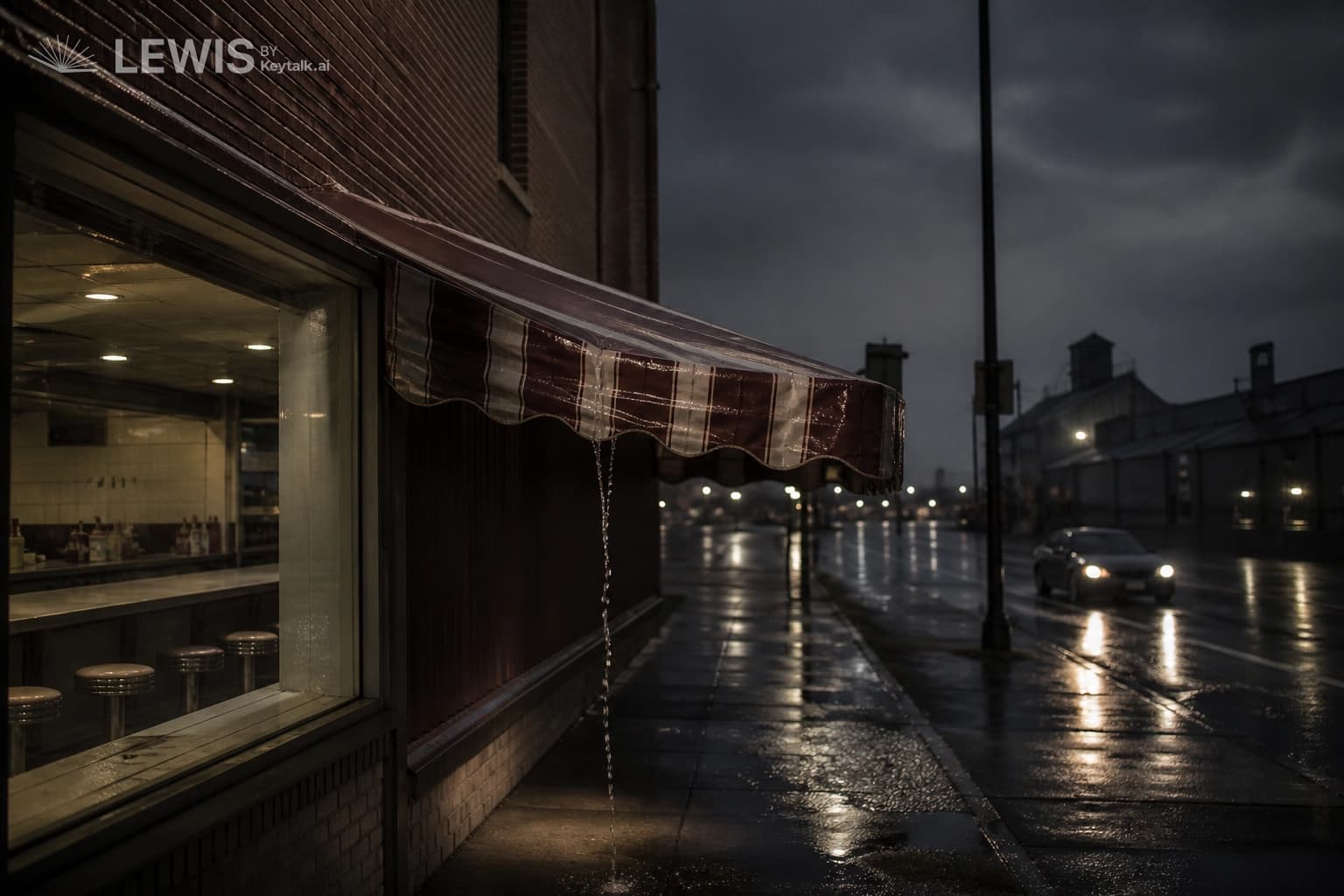
Carbone’s Diner occupies the ground floor of a narrow brick tenement in a fictional riverfront neighborhood of Newark, New Jersey. Freight warehouses stand between the neighborhood and the water; the nearest factory gate has been chained shut for eleven months. Men who once bought breakfast before their shifts now wait beneath the diner’s striped awning for church meals after closing.

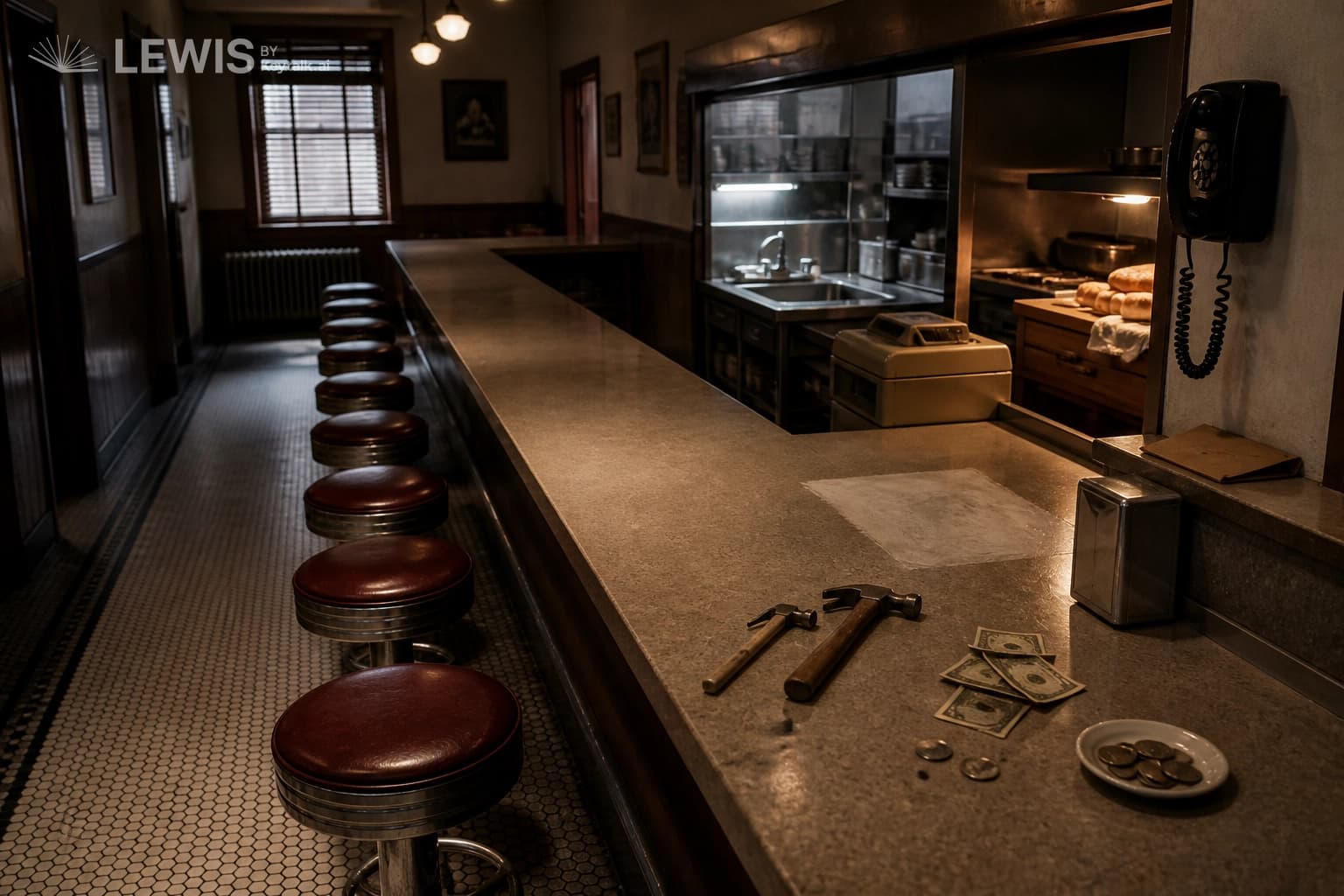
Inside, six stools face a laminate counter. A waist-high service opening exposes the dish sink and preparation table to anyone standing at the register. There is no private room in which Rocco can conceal either Tullio’s theft or his own refusal. The rear door opens onto a fenced delivery yard shared with the upstairs tenants, not a clear escape route.

Inez keeps the chopping board beside the bread drawer. Tullio’s biscuit tin fits beneath a leaking sink trap. The counter is narrow enough that a hammer, an open till, and a stack of refunded coins compete for the same dry space.

time period

Late November, 1978, on a weekday evening just after the diner’s paid service ends. Rain has soaked the customers waiting for the church delivery to become supper.

Factory closures have outlasted promises of new work. Household debts now cover groceries and heat as often as wagers. Corrado’s organization still collects according to agreements made when the neighborhood had wages to spare.

Tomorrow’s bread order must be paid in cash at dawn. Inez’s envelope holds that money; surrendering it would leave her able to open the door but unable to serve her first customers.

rules

- A guarantor remains liable for an unpaid gambling balance even after the gambler purchases a personal release; Tullio’s escape would leave Inez owing money his kitchen labor was supposed to repay.

- Church-donated meals must be served without charge; exposing the sales risks suspension of deliveries, so Inez’s silence protects tonight’s food while allowing Tullio to keep stealing.

- Only Corrado can substitute payment for an ordered punishment; Rocco’s refunds return stolen money but do not authorize him to spare Inez.

- Collectors must carry out an ordered punishment in front of available witnesses or accept the captain’s stated penalty themselves; the customers outside make Rocco’s choice public, and closing the blinds cannot undo what they have already seen.

technologies philosophies

A mechanical register, a wall telephone, handwritten account books, and carbon-copy receipts govern the diner. Cash leaves no automatic record. A signed release does. Tullio trusts paper bearing Corrado’s signature more than any promise from his oldest friend.

The church delivers meals in dented aluminum carriers and records portions supplied, not who receives them. That gap lets Inez tolerate charges to keep the gas connected and lets Tullio conceal a private reserve within a public necessity. Customers remember what they bought even where no receipt exists.

Corrado’s authority depends on people watching his instructions survive another person’s hesitation. He can afford to leave the till untouched if the neighborhood sees obedience instead. Rocco understands that arithmetic will not settle this collection, yet keeps straightening the bills.

Everything essential here passes through working hands: bread, dishes, wages, coins, signatures. Inez protects the bread side of her board because she must use it tomorrow. Rocco clears crockery before placing his hammer because he has learned to prepare a workspace for harm with the same care another man gives supper.

visual description

The diner’s colors are tobacco brown, old cream, and the green of glass bottles behind the counter. Fluorescent tubes cast a cold strip across the sink; the stove hood throws warmer light onto Inez’s sleeves. Beyond the windows, passing headlights drag white bands through rainwater and leave the faces beneath the awning dark again.

The floor consists of small hexagonal tiles worn smooth between the entrance and register. Water collects in their missing grout. A radiator knocks beneath the front window, loud enough to interrupt the counting but not conceal it.

The distinctive image is money laid out where food should be: damp bills flattened beside a bread board, coins sorted on saucers, the bread envelope lifted clear of a wet patch by the same man who brings the second hammer. Through the service opening, Tullio can see each customer receiving part of his escape.

Keytalk Prompts Used

Visual & Sound
Universe

Locations

Where it happens

location 1 image

Carbone’s Counter

The tobacco-brown laminate counter crowds six cream stools into a narrow aisle; cold fluorescent light cuts across the exposed sink while the stove casts a warmer strip over the bread drawer and folded dish towels.

A pale rectangular scar, scrubbed into the laminate beside the register, fits the chopping board exactly; two hammers, damp bills, and saucers of counted coins occupy the remaining space. Beneath the window, the radiator knocks between the sharp clicks of coins, and every stool faces the unobstructed service opening.

The wall telephone hangs within reach of the counter, its cord stretched above an empty till and a dry envelope reserved for morning bread.

location 2 image

Riverfront Supper Line

The supper line hugs the narrow pavement beneath a striped awning, soaked wool shoulders pressed toward the brick while rain hammers the fabric overhead.

Passing headlights bleach the waiting faces and slick street white, then leave them black again; a split awning seam pours a straight stream between two pairs of shoes, keeping a small, stubborn gap in the queue.

Beyond the awning’s edge, open sky hangs over the warehouse roofs, and the diner window gives everyone waiting a clear view of the hands at the counter. The pavement between the queue and the curb remains just wide enough for officers to escort a man through without anyone stepping aside.

location 3 image

The Shared Betting Table

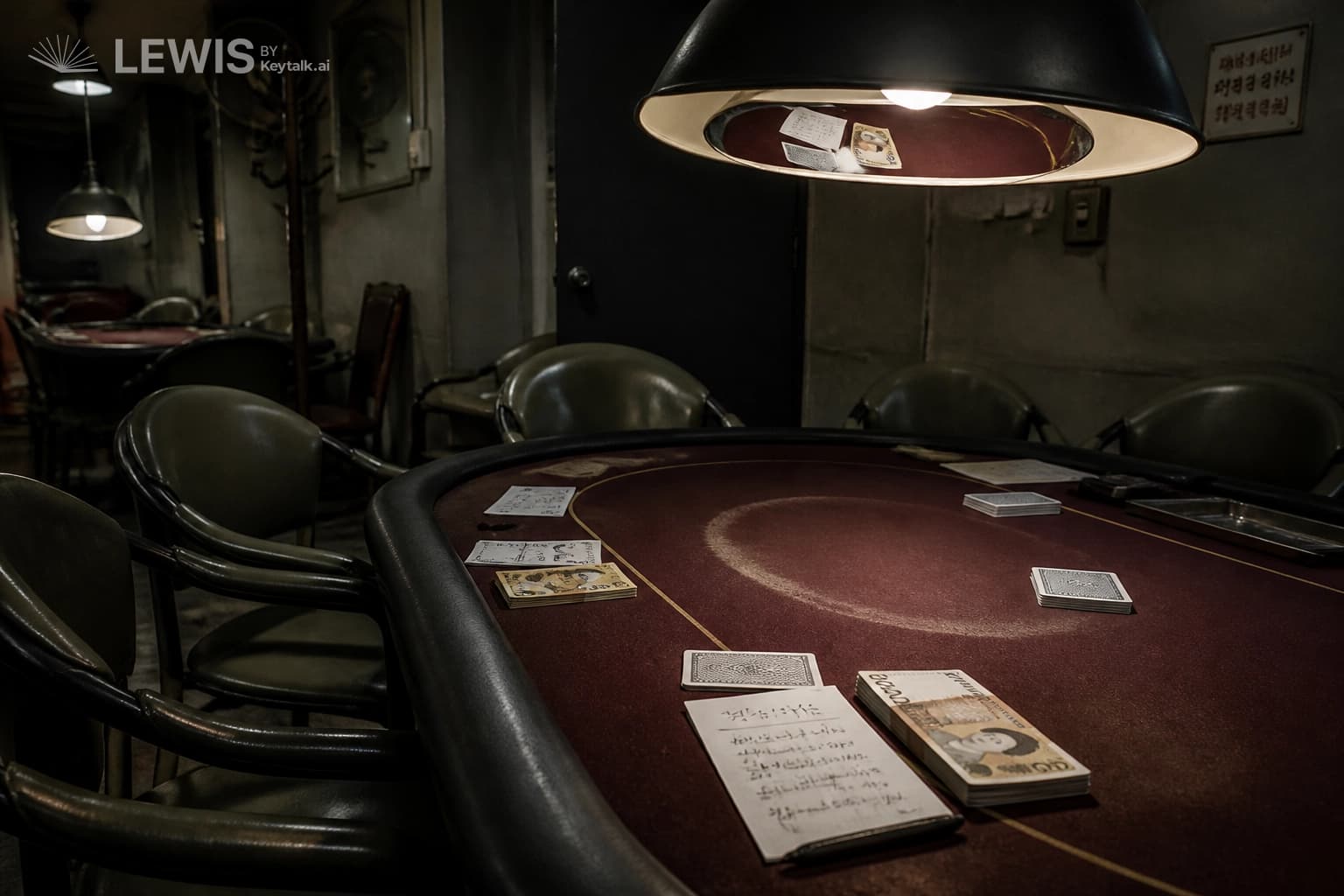
Bottle-green felt fills the cramped gambling room beneath a low amber lamp; close-packed chairs leave barely enough clearance for a seated man to pull back his elbows. Two adjoining places share a crescent-shaped abrasion in the dry felt, with thumb-worn cards laid beside handwritten slips and cash squared precisely along the table edge.

Wagers pass under the breath beneath the low ceiling, while a narrow mirror fixed inside the lamp’s shade keeps every player’s hands visible from the head chair.

location 4 image

The Chained Factory Gate

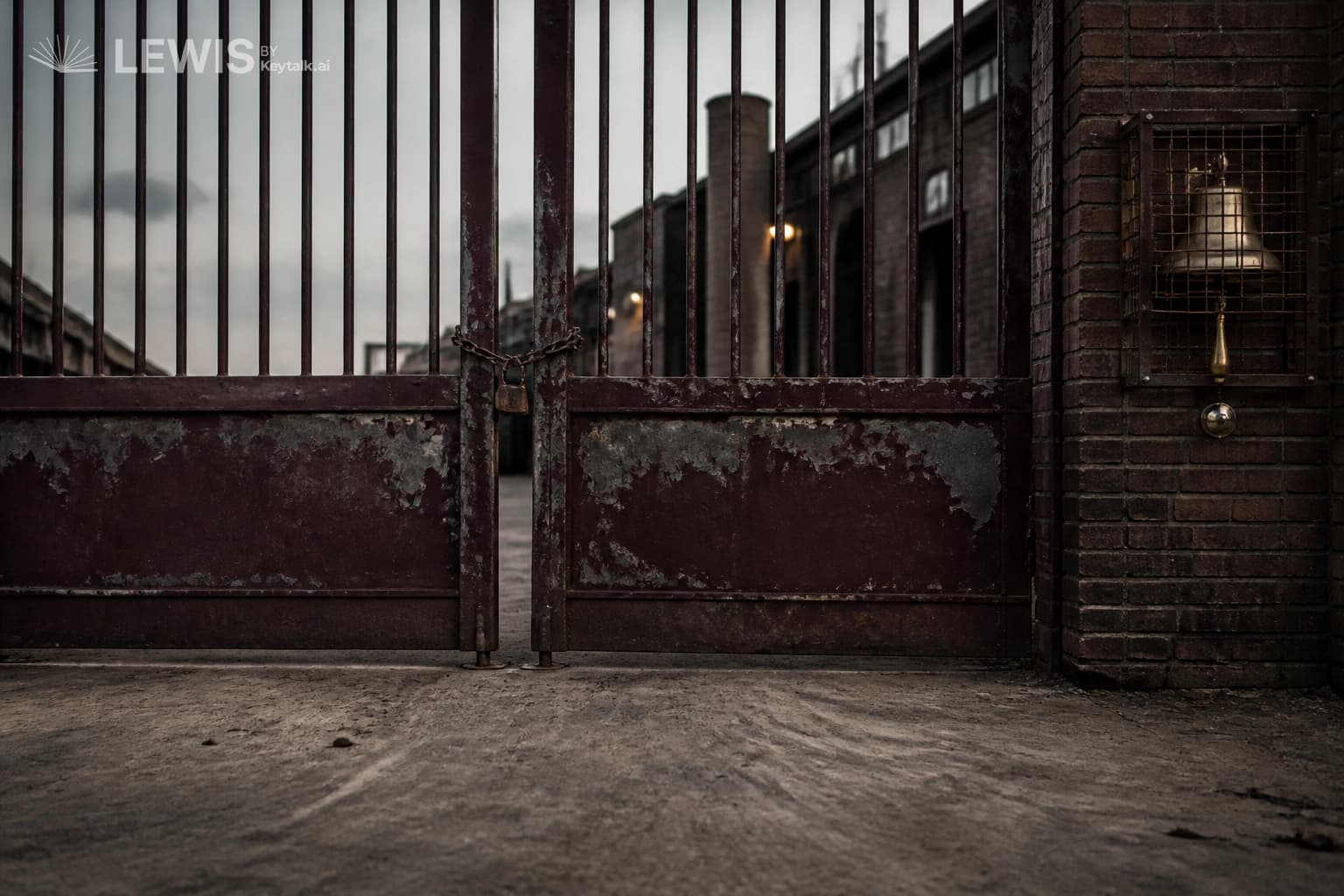
The factory gate spans a broad concrete apron, its rust-red bars chained to a center post beneath diffuse overcast light; flaking paint exposes bare iron at shoulder height, where workers once pushed through. Wind lifts one loose link against the bars with a sharp, isolated tap, and eleven months of grit pack the gate’s curved scrape marks.

Along the weathered brick jamb, an abandoned brass shift bell hangs behind a bolted wire cage, its pull handle still polished beneath the dust. The apron offers no cover, and the chain holds the two gate leaves just far enough apart for fingers, not a body.

location 5 image

Church Supper Kitchen

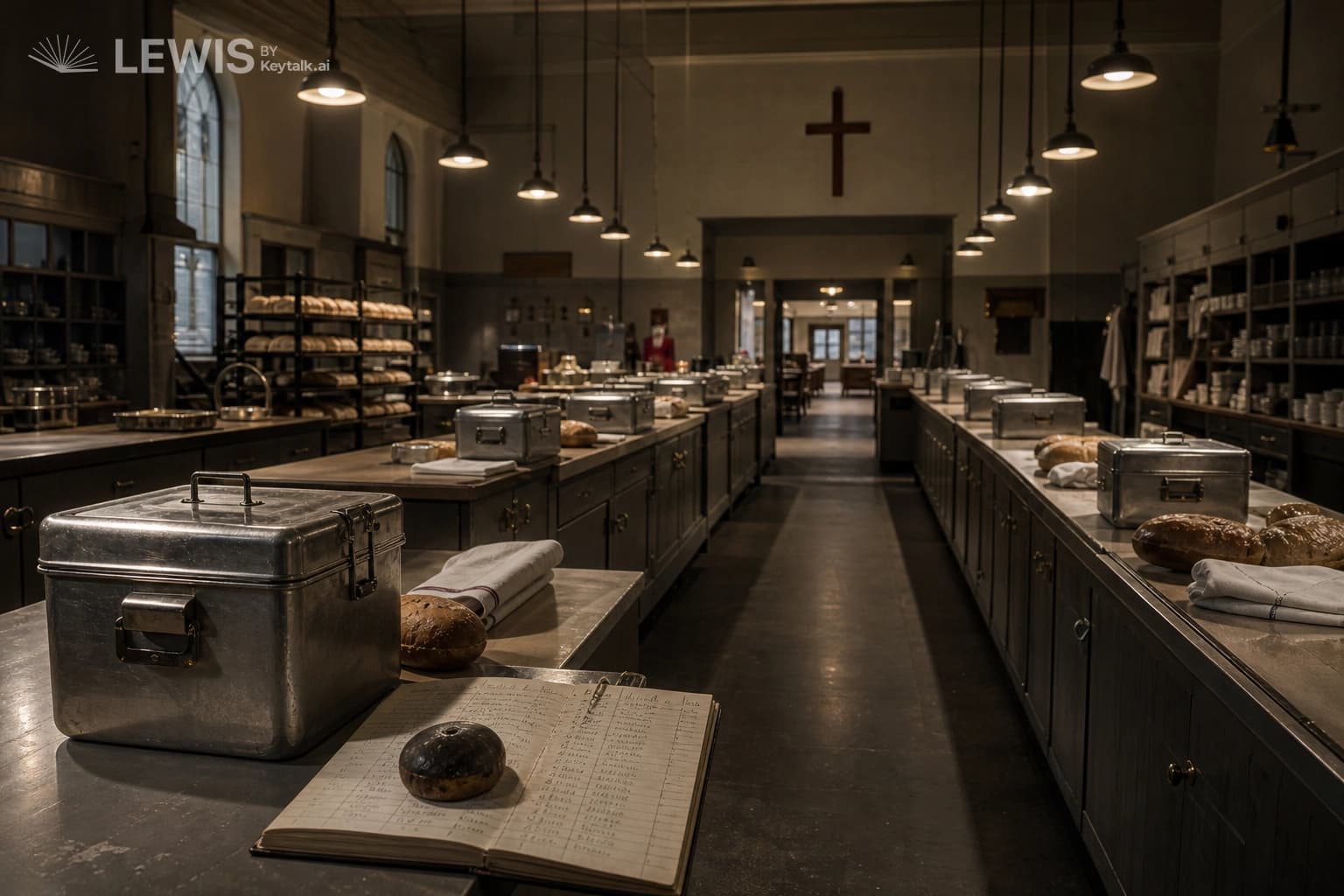
Warm overhead lamps illuminate pale-yellow walls rising above the church supper kitchen’s long, scrubbed counters, with bread-brown crusts lined beside precisely folded cotton cloths.

Dented aluminum carriers stand at measured intervals, their church-stamped lids clattering shut with sharp reports that carry across the high ceiling; the broad aisles leave every work surface exposed.

Beside the last carrier, a handwritten portion ledger rests beneath a bread-shaped paperweight, its ruled columns recording quantities and leaving no space for names.


Scenes

Scene by scene

Chapter 01

Scene 01· Late November 1978, just after paid service ends

Tomorrow’s Bread

Tomorrow’s Bread
PlaceCarbone’s Counter, Newark riverfront neighborhood
TimeLate November 1978, just after paid service ends
ActionRocco Bellandi clears crockery from the counter and lays down his hammer within sight of the supper line. Inez Carbone opens the register and places tomorrow’s bread envelope beside the available cash, forcing him to address what his collection will take. Rocco pushes the envelope back to her. As she retrieves it, he recognizes Tullio Serra washing dishes through the service opening and calls him by name.
ImpactRocco excludes the bread money from his collection without obtaining permission to cancel Inez’s punishment. The remaining cash leaves him no easy way to fulfill his orders. Finding Tullio at the sink brings their old friendship into a collection that neither man can conduct beyond Inez’s sight.

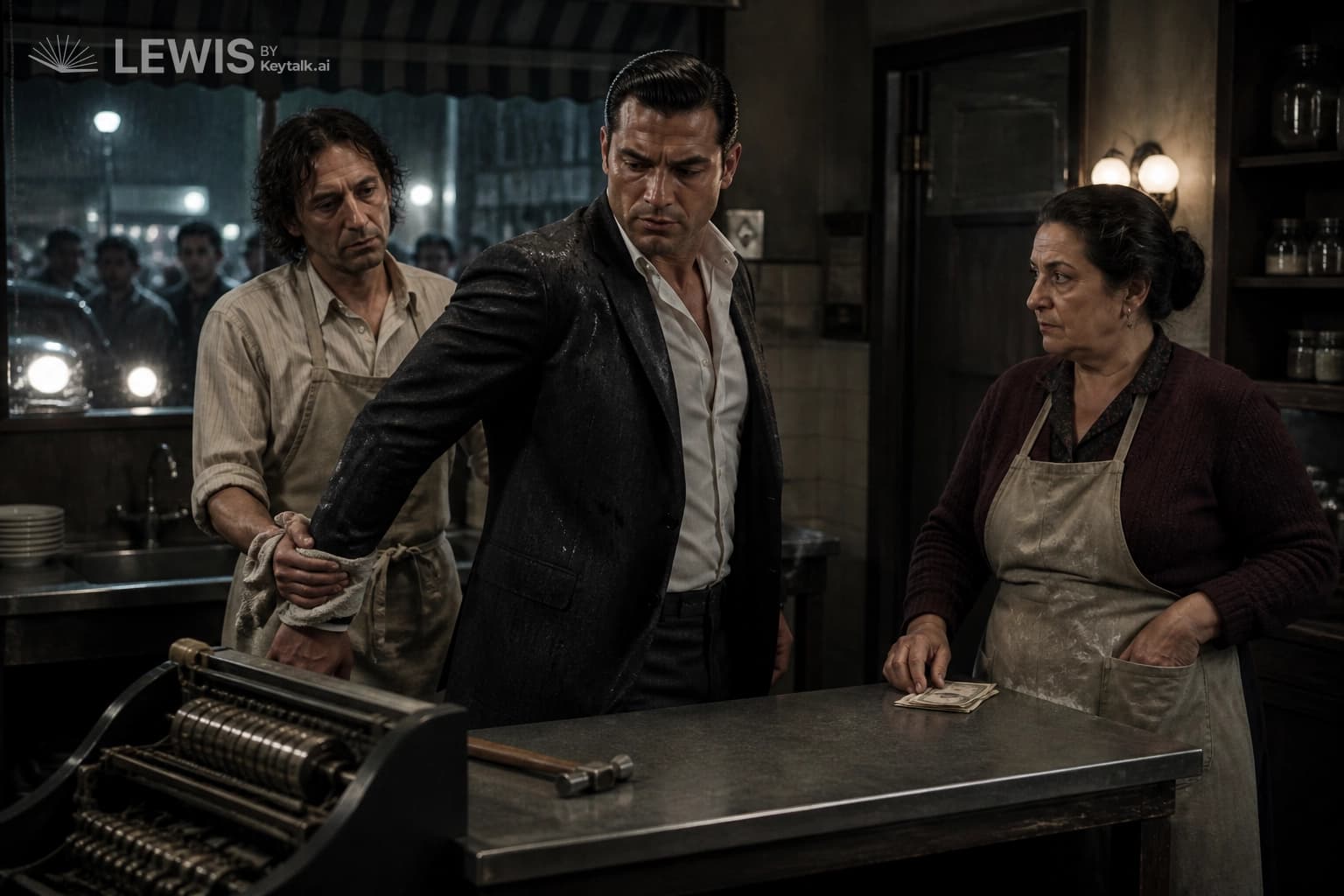
Rocco Bellandi slides two cups and a saucer away from Inez Carbone’s register, then sets his hammer in the cleared space at Carbone’s Counter. He keeps his wet charcoal jacket on; beyond the window, shoulders crowd beneath the striped awning as passing headlights sweep across the glass. Inez Carbone opens the mechanical till and spreads its few bills beside the hammer, leaving her work-thickened hands flat on the laminate.

Inez Carbone pulls a stiff envelope from her apron and places it against the bills. “Tomorrow’s bread—you counting that too?” Rocco Bellandi pushes it back with two fingers, stopping it against her hand. She takes the envelope but leaves the till open, its shallow compartments exposed beneath the cold light.

Through the service opening, Tullio Serra lowers a plate into the dishwater and stops when Rocco Bellandi turns toward him. “Tullio,” Rocco Bellandi says, and Tullio Serra draws his hands from the sink, extending his stiff left wrist before catching it in a dish towel. Inez Carbone slips the bread envelope into her apron and plants one hand beside the open till while Rocco Bellandi leaves the hammer where both of them can see it.

Scene 02· Late November 1978, just after paid service ends

No Private Yard

No Private Yard
PlaceCarbone’s Counter, Newark riverfront neighborhood
TimeLate November 1978, just after paid service ends
ActionTullio Serra beckons Rocco Bellandi toward the rear delivery yard, but Inez Carbone blocks the kitchen passage and insists that the debt she guaranteed be discussed within her hearing. Rocco stays beside the open register. When supper coins are pushed through the front door, he catches Inez’s reaching wrist beneath the church-marked meal carriers, then releases her. Tullio offers to fetch the gas bill.

ImpactTullio cannot separate his old friend from the woman liable for his debt. The attempted supper payment exposes charges for donated food, undermining Rocco’s effort to find money he can legitimately collect. Inez defends the charges as necessary to keep the stove running, while Tullio redirects the confrontation toward a bill he has not yet produced.

Inez Carbone steps across the kitchen passage as Tullio Serra, still gripping his dish towel, beckons Rocco Bellandi toward the rear door at Carbone’s Counter. “Out in the yard, just us,” Tullio Serra says, but Inez Carbone plants her palm against the doorframe: “My guarantee bought your work, not a closed door.” Rocco Bellandi stays beside the open till, with his hammer between the scattered bills and the cups he moved aside.

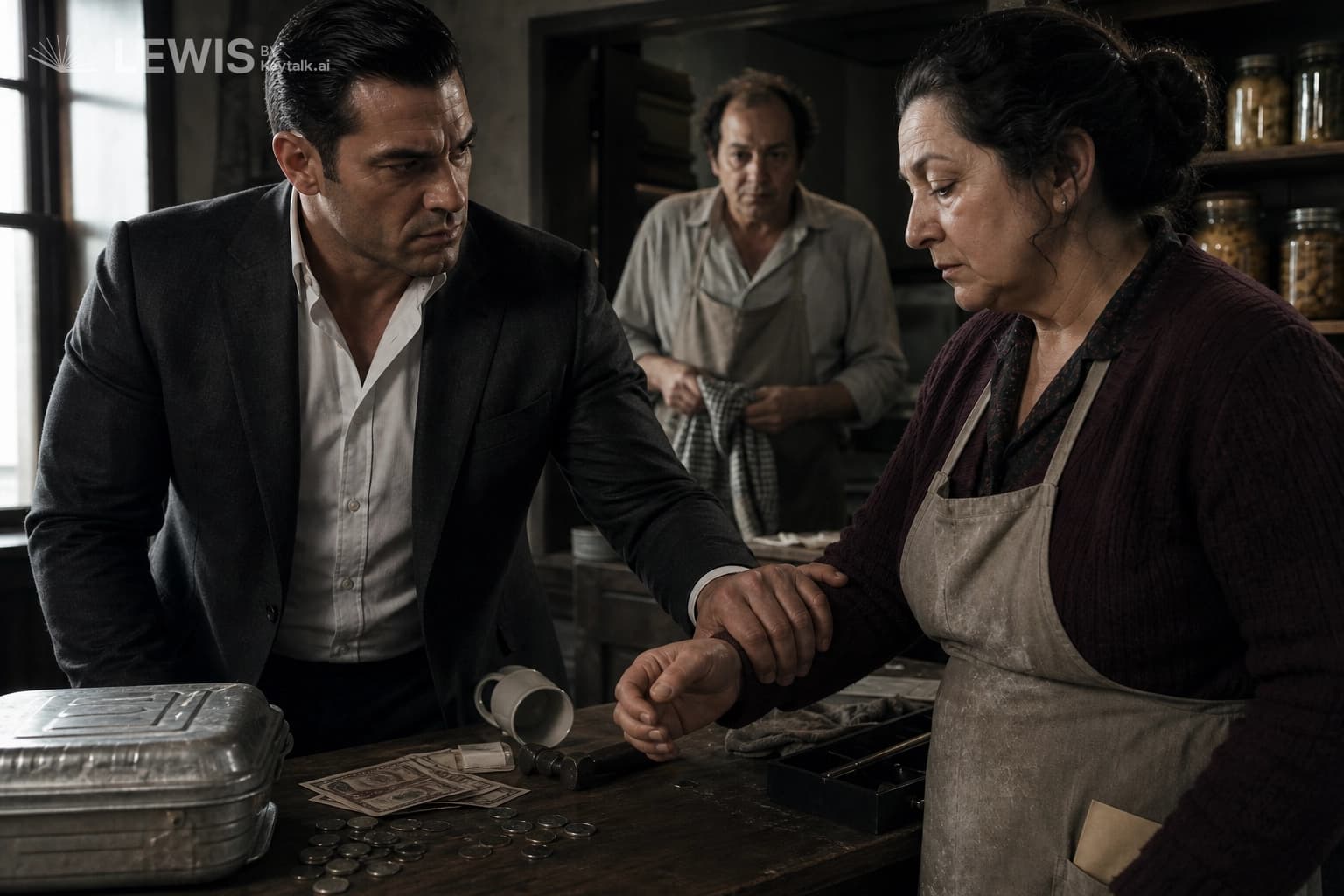
The front door opens a few inches, and folded coins slide onto the counter beneath a request for two suppers. Inez Carbone reaches for them; Rocco Bellandi catches her wrist beside an aluminum carrier stamped with the church’s name. She lowers her eyes to his grip, and he opens his hand, leaving hers suspended above the money.

“The stove cannot run on promises,” Inez Carbone says, then gathers the coins without covering the stamped name. Rocco Bellandi shifts the carrier into the clear space beside the register, its lettering facing Tullio Serra through the service opening. Tullio Serra offers to fetch the gas bill and hangs his towel over the sink edge; Inez Carbone remains in the passage while his empty hands disappear below the counter.

Scene 03· Late November 1978, immediately after Tullio offers to fetch the gas bill

Coins Among the Dishes

Coins Among the Dishes
PlaceCarbone’s Counter, Newark riverfront neighborhood
TimeLate November 1978, immediately after Tullio offers to fetch the gas bill
ActionRocco crosses the swinging partition and catches Tullio lifting a biscuit tin beneath the sink. He pulls it from his friend’s grip, spilling the savings among the dirty dishes. With Inez blocking the kitchen passage, Tullio admits he intends to purchase a personal release that would leave her liable. Rocco collects the coins and carries the tin toward the supper line, ordering Tullio to follow.
ImpactThe hidden reserve cannot serve as payment for Inez’s debt: it came from customers charged for donated food. Tullio’s admission makes his intended abandonment of Inez public within the diner. Rocco commits to returning the money without gaining permission to cancel her punishment.

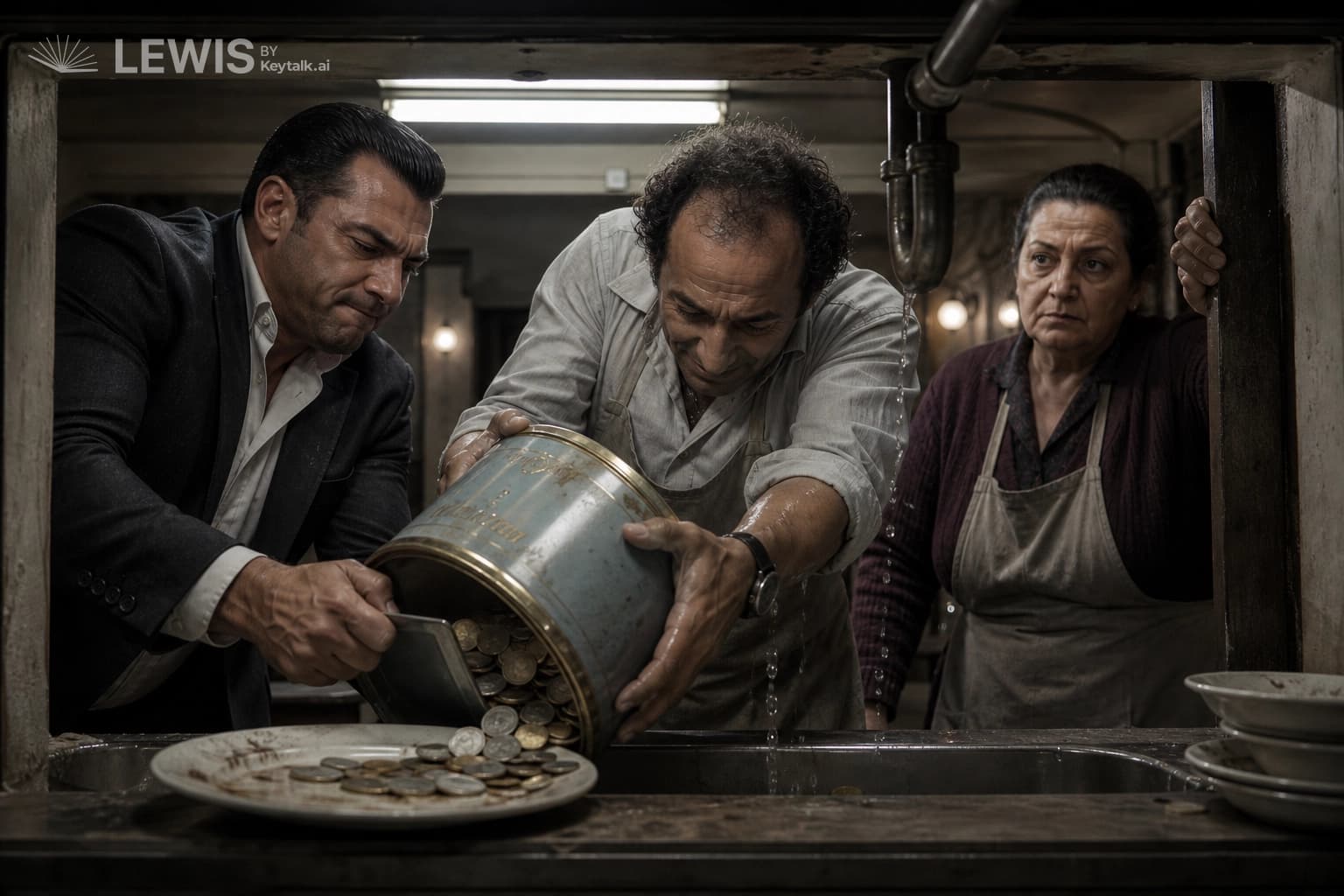
Rocco Bellandi pushes through the swinging partition at Carbone’s Counter and catches the rim of the biscuit tin Tullio Serra is lifting beneath the sink. Inez Carbone steps back against the passage frame, leaving both men exposed through the service opening beneath the fluorescent tube. Tullio Serra clamps the tin against his chest; water from the leaking trap darkens his mustard sleeve as Rocco Bellandi pulls its lower edge outward.

The lid catches against the sink rim, and coins scatter among plates filmed with supper gravy. Tullio Serra plunges his right hand into the basin, trapping a rolling quarter beneath his thumb before reaching for another. Rocco Bellandi holds the emptied tin above the dishes and says, “Tell her what you were buying.” Tullio Serra keeps his hand in the water: “My release—with his signature,” and when Rocco Bellandi asks who would owe the rest, he turns toward Inez Carbone. “You understand it now,” Inez Carbone says, keeping her palm against the passage frame.

Rocco Bellandi scoops the coins into the tin, then holds it out until Tullio Serra drops in the quarter still pinched between his fingers. Carrying the wet reserve past his untouched hammer, Rocco Bellandi pulls the front door open onto the rain-dark supper line and says, “Bring your hands, Tullio—you’re giving it back.”

Chapter 02

Scene 04· Late November 1978, just after paid service ends

Orders Instead of Names

Orders Instead of Names
PlaceRiverfront Supper Line, Carbone’s Diner doorway
TimeLate November 1978, just after paid service ends
ActionRocco Bellandi holds the recovered biscuit tin at the open doorway and makes Tullio Serra count refunds into the waiting customers’ palms. Inez Carbone serves food only after each repayment. Tullio Serra omits a woman’s bread charge, but her outstretched hand stops the line until he returns it.
ImpactThe first refunds turn Tullio Serra’s private escape reserve into a public accounting. His precise memory of the meals prevents him from passing off the missing bread charge as forgetfulness. Rocco Bellandi enforces repayment without recovering anything toward Inez Carbone’s debt.

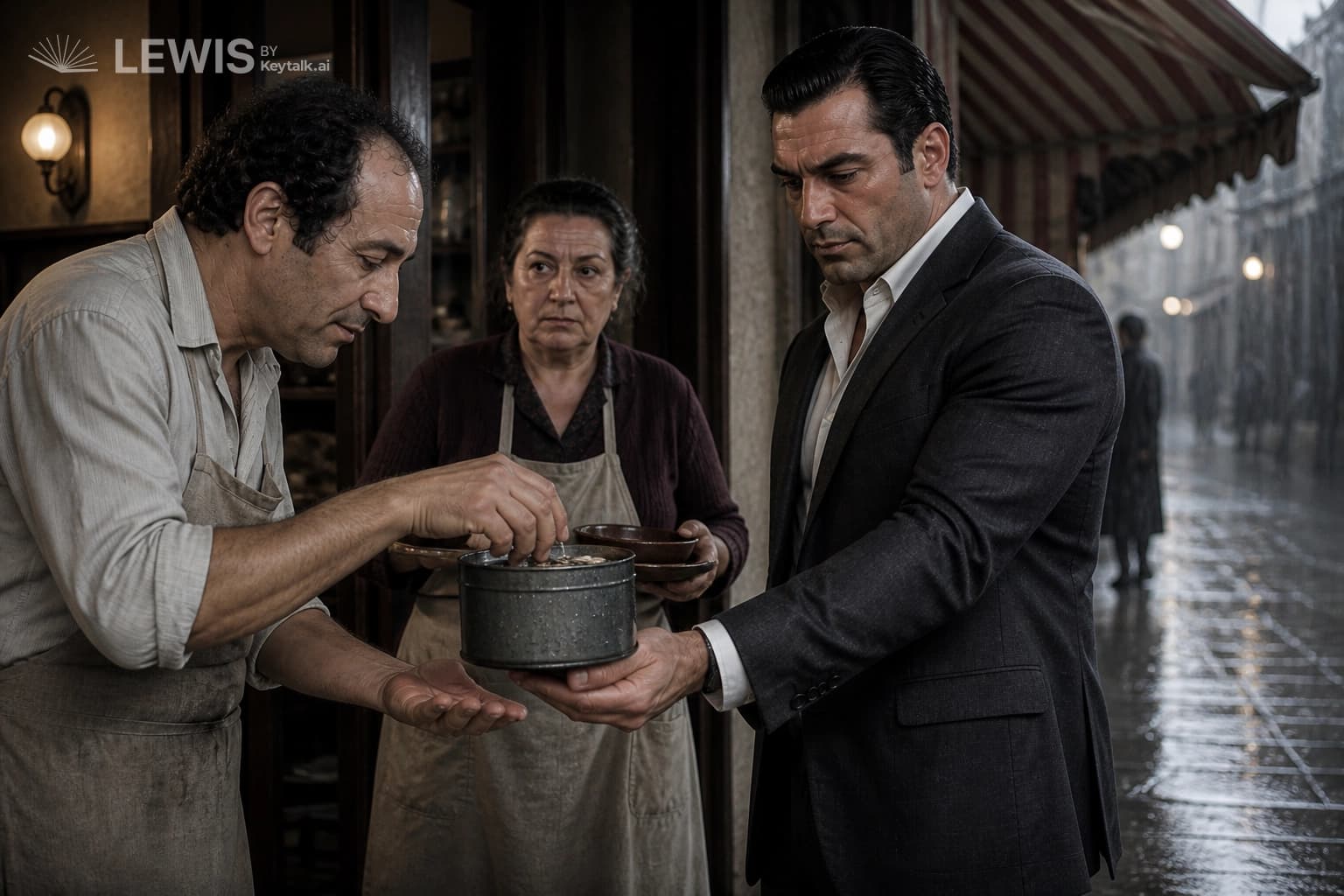
Rocco Bellandi catches Tullio Serra by the apron edge and draws him into the doorway beside the wet biscuit tin, leaving the Riverfront Supper Line within reach of his hands. Beneath the striped awning, rain pours through a split seam between the waiting shoes while Tullio Serra takes coins from the tin and says, “Two soups, no bread.” Rocco Bellandi holds the tin steady until Tullio Serra counts the refund aloud into an open palm; only then does Inez Carbone pass two filled bowls through the doorway.

Tullio Serra points to the next customer’s coat rather than her face: “Beans, extra pepper,” and lays her money across her fingers. The woman keeps her palm extended. “And the bread,” she says, pushing the coins back toward him without dropping them.

Tullio Serra separates the refund with one finger and counts it again, leaving the same sum in her hand. Rocco Bellandi lowers the tin between them, blocking Tullio Serra’s reach toward the bowls Inez Carbone has brought. Tullio Serra picks out the missing coins and adds them to the woman’s palm; she closes her hand without thanking him, and Inez Carbone passes her supper over his lowered wrist.

Scene 05· Late November 1978, evening, immediately after the bread-charge refund

The Dollar Under the Napkin

The Dollar Under the Napkin
PlaceRiverfront Supper Line, Carbone’s Diner doorway
TimeLate November 1978, evening, immediately after the bread-charge refund
ActionInez Carbone brings her share of the meal charges from the register and adds it to the refund money. When the next repayment falls short, she reaches into her apron for tomorrow’s bread envelope. Rocco Bellandi stops her by placing his own dollar beneath a folded napkin with the next refund. Tullio Serra passes the money out while keeping his coin-filled shoe braced against the threshold.
ImpactRocco Bellandi spends his own money rather than let the refunds consume tomorrow’s bread payment. Inez Carbone’s contribution leaves too little for the gas bill, and none of the returned money satisfies the punishment order. Tullio Serra retains his concealed reserve while his oldest friend pays part of the cost of his theft.

Inez Carbone tips a saucer of register coins into the biscuit tin Rocco Bellandi holds at the doorway, beside Tullio Serra’s outstretched hand. Beyond them, the Riverfront Supper Line presses against the brick beneath the striped awning; water from its split seam strikes the pavement between waiting shoes. “That leaves the gas short,” Inez Carbone says, turning the empty saucer upright.

Tullio Serra counts the next refund onto a folded napkin and spreads the remaining coins apart with his forefinger. Rocco Bellandi keeps the tin level, leaving the short payment exposed. Inez Carbone draws the corner of the bread envelope from her apron, but Rocco Bellandi takes a dollar from his jacket and slides it beneath the napkin. “Leave the bread,” he says.

Tullio Serra presses his shoe sideways against the threshold, trapping the concealed roll against his foot as he lifts the refund. The napkin opens across his fingers, exposing Rocco Bellandi’s dollar before he passes it through the doorway. Inez Carbone pushes the envelope back into her pocket and reaches past him with supper; Tullio Serra keeps his planted shoe inside while extending both empty hands toward the tin.

Scene 06· Late November 1978, evening, immediately after the short refund

Ask Her to Move

Ask Her to Move
PlaceCarbone’s Diner doorway and counter, beside the Riverfront Supper Line
TimeLate November 1978, evening, immediately after the short refund
ActionRocco Bellandi orders Tullio Serra inside to count the remaining money at the counter. As Tullio moves his planted foot across the threshold, the concealed coin roll slips from his shoe. Inez Carbone traps it beneath her work shoe before he can retrieve it. Required to ask her to move, Tullio picks up the roll and surrenders his last reserve.
ImpactTullio loses the money he withheld while Rocco paid toward the refunds himself. Inez makes him request access to the stolen cash rather than quietly retrieve it. The escape fund is exhausted, but her guaranteed debt and Rocco’s punishment order remain outstanding.

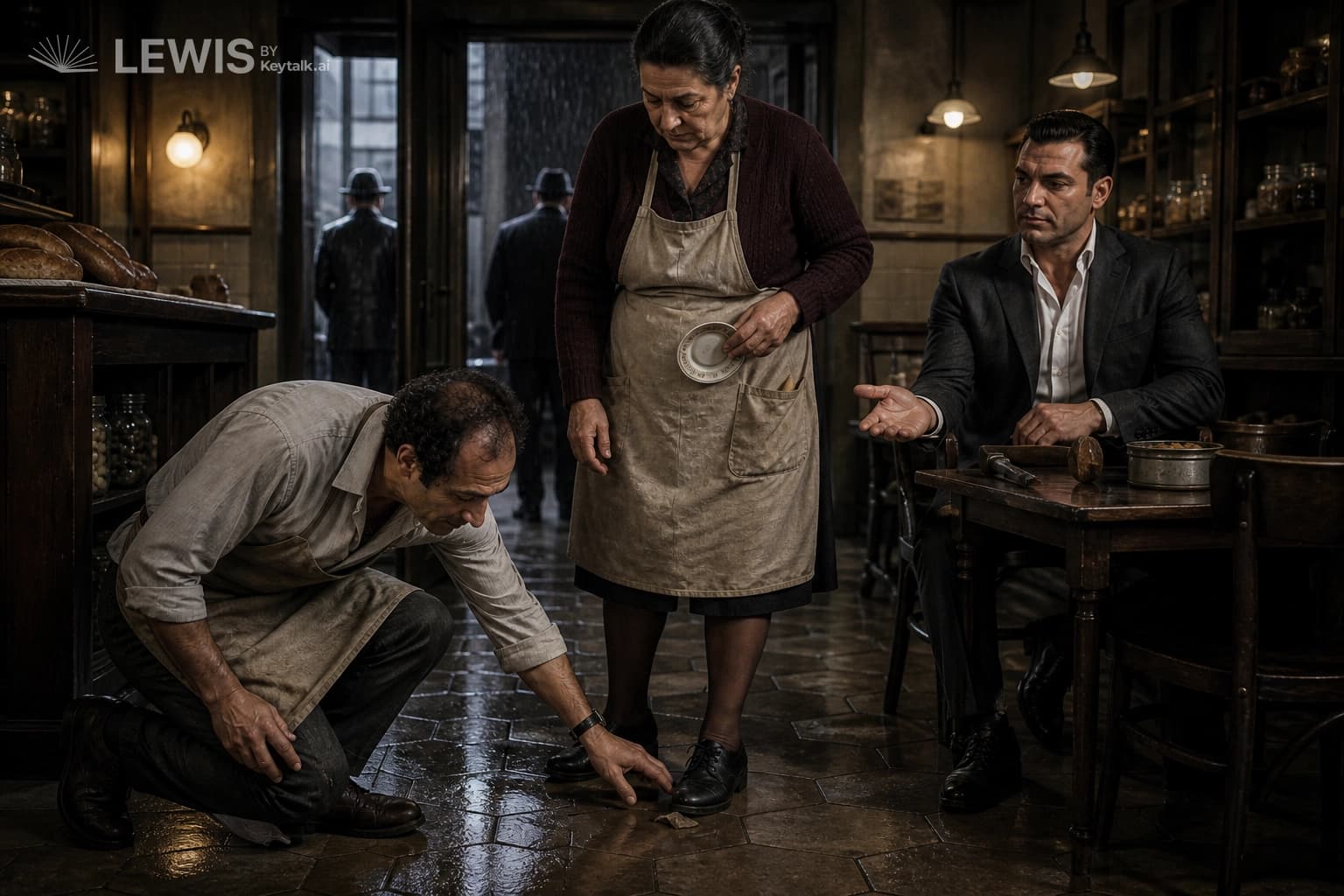
Rocco Bellandi draws the biscuit tin back into Carbone’s Diner and orders Tullio Serra across the threshold to finish counting at the counter. Tullio Serra turns with his shoe still pressed sideways against the doorframe; a paper-wrapped roll slips past his heel and drops onto the wet hexagonal tiles. He bends, but Inez Carbone plants her work shoe over it before his fingers reach the floor.

Tullio Serra grips the toe of his own shoe with his stiff left hand and reaches toward hers with the other. Inez Carbone keeps her sole planted, holding the empty saucer against her apron while rain-dark shoulders fill the doorway behind him. Rocco Bellandi sets the tin beside his untouched hammer and leaves his hand open above it. “Ask her to move,” he says.

“Will you move your foot?” Tullio Serra asks, withdrawing his fingers from beside her shoe. Inez Carbone lifts her sole only when he holds out an empty palm; he retrieves the flattened roll, tears its damp wrapper, and pours the coins into the tin beneath Rocco Bellandi’s hand. Tullio Serra shakes the paper once more, then lays it open beside the hammer, with no coins left in its creases.

Chapter 03

Scene 07· Late November 1978, weekday evening, as the final refund is counted

The Money He Will Not Touch

The Money He Will Not Touch
PlaceCarbone’s Counter, Newark riverfront neighborhood
TimeLate November 1978, weekday evening, as the final refund is counted
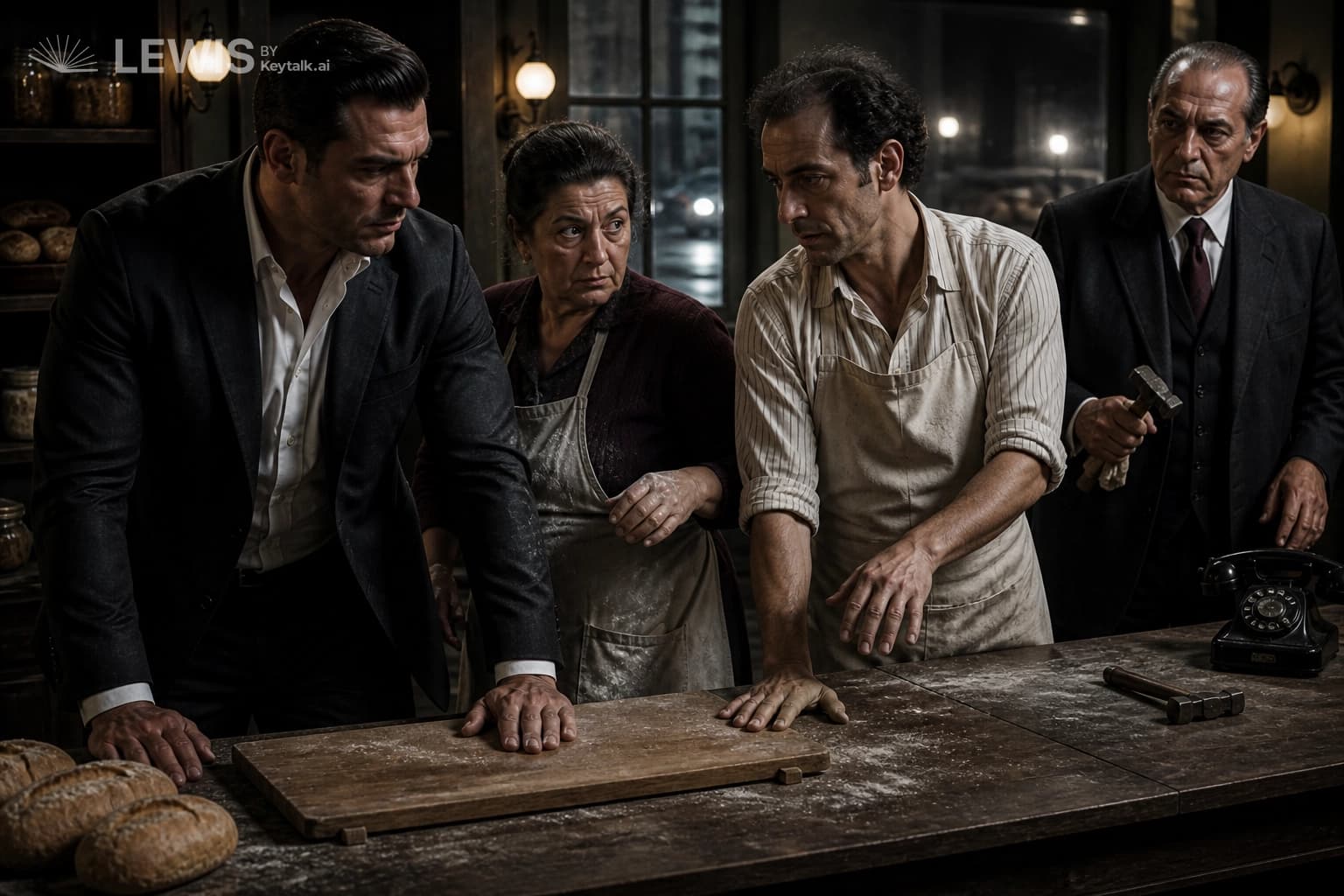
ActionCorrado Vescio enters and places his wrapped hammer beside Rocco Bellandi’s. Rocco offers the remaining till money, but Corrado moves only the bread envelope, protecting it from the damp counter. He turns a stool away from the window, removing the obstruction between the waiting supper line and the space where Inez’s hands will be placed.
ImpactRocco’s offer fails to divert Corrado from the ordered punishment. Corrado makes the counter visible to the people whose money Rocco has returned, turning those customers into witnesses to his next instruction. Inez’s bread money stays protected while her working hands remain at risk.

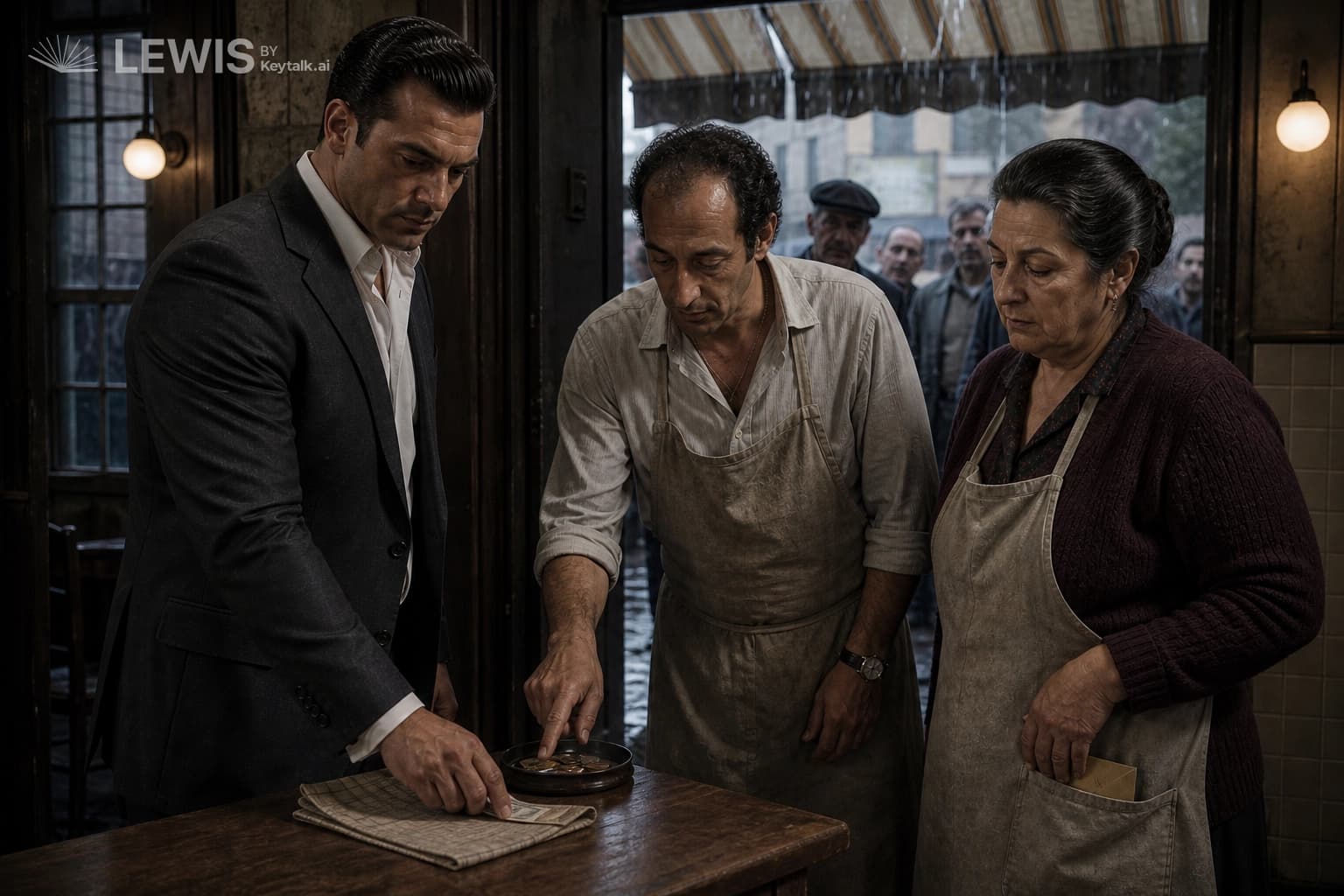
Corrado Vescio sets his wrapped hammer beside Rocco Bellandi’s as Tullio Serra counts the last refund onto a saucer at Carbone’s Counter. The torn coin wrapper lies between the handles; beyond the glass, rain streaks the shoulders gathered beneath the striped awning. Inez Carbone passes the saucer through the doorway, then returns to the register and lays the bread envelope beside the remaining till money.

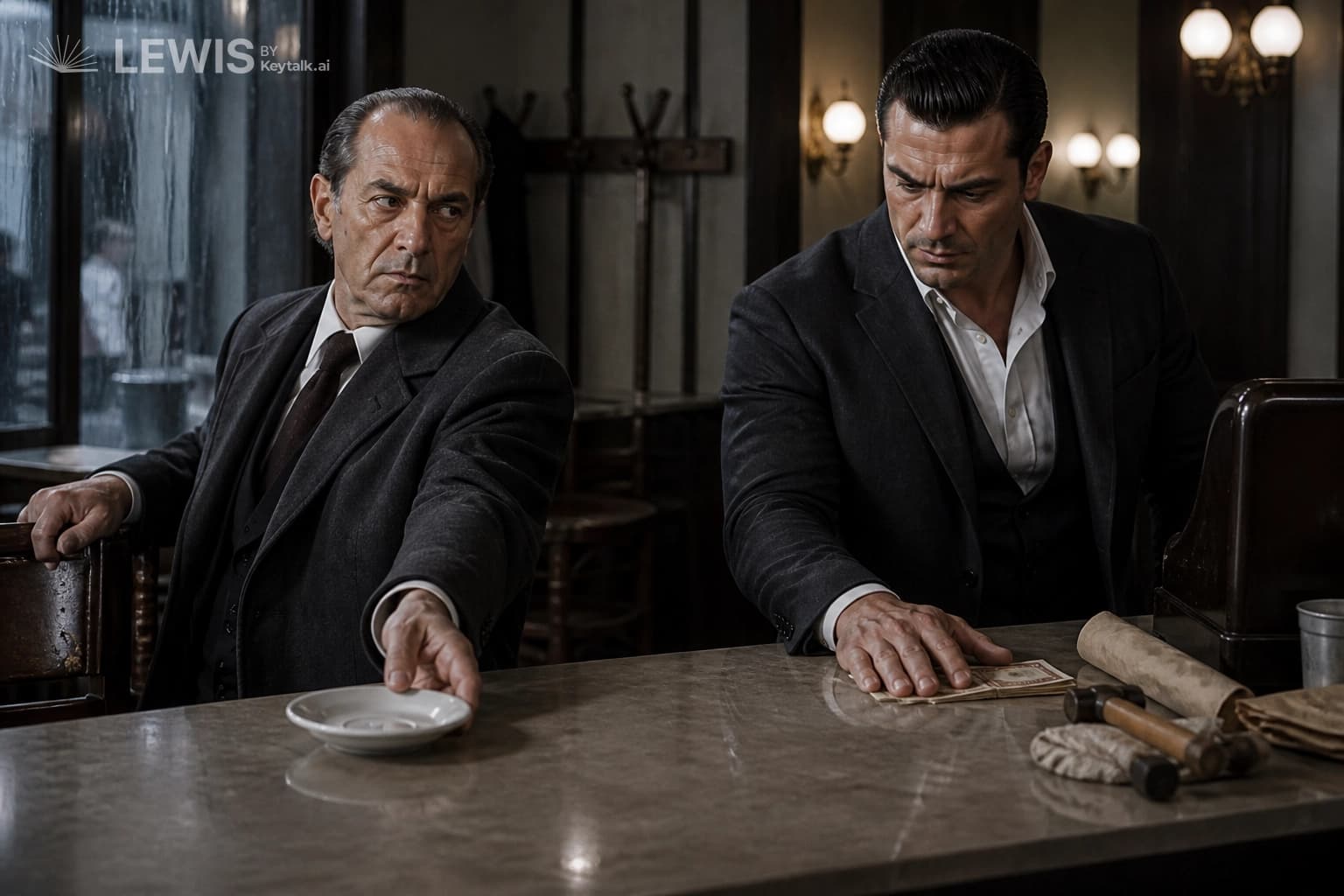
Rocco Bellandi pushes the damp bills toward Corrado Vescio, flattening their curled edges with his palm. “Take this against her balance.” Corrado Vescio lifts the bread envelope out of a spreading wet patch and places it beside the register without touching the offered cash. Tullio Serra reaches for the empty biscuit tin, but Rocco Bellandi holds its rim down, leaving his friend’s hand suspended beside the two hammers.

Corrado Vescio turns the nearest stool away from the window, its feet scraping across the wet tiles until the pale board-shaped scar on the laminate is visible from outside. Inez Carbone sets her empty saucer across that scar; Corrado Vescio slides it toward the sink. “Bring the board,” he tells Rocco Bellandi, leaving the straightened bills beneath Rocco Bellandi’s open hand.

Scene 08· Late November 1978, weekday evening, immediately after Corrado orders the board brought forward.

Bread-Side Down

Bread-Side Down
PlaceCarbone’s Counter, Newark riverfront neighborhood
TimeLate November 1978, weekday evening, immediately after Corrado orders the board brought forward.
ActionInez Carbone brings the chopping board herself and places it bread-side down between the two hammers. Corrado Vescio tells Rocco Bellandi to punish her or place his own hands beside Tullio Serra’s. When Tullio suggests hiring help, Inez reaches for the wall telephone. Corrado replaces the receiver and pins her hand against the cradle until she steps away.
ImpactCorrado turns the punishment order into an explicit choice of whose hands will be struck. Inez’s attempt to summon help is stopped in front of Rocco and Tullio. Rocco’s offered money remains untouched, and the board now occupies the space Corrado cleared for the witnesses.

Inez Carbone pulls the chopping board from beside the bread drawer and lays it bread-side down at Carbone’s Counter before Rocco Bellandi can leave the register. She pushes the torn coin wrapper out from beneath its edge; cold fluorescent light falls across the exposed wood, with both hammers within reach. Corrado Vescio points to the board and tells Rocco Bellandi, “Strike her, or put your hands beside his.”

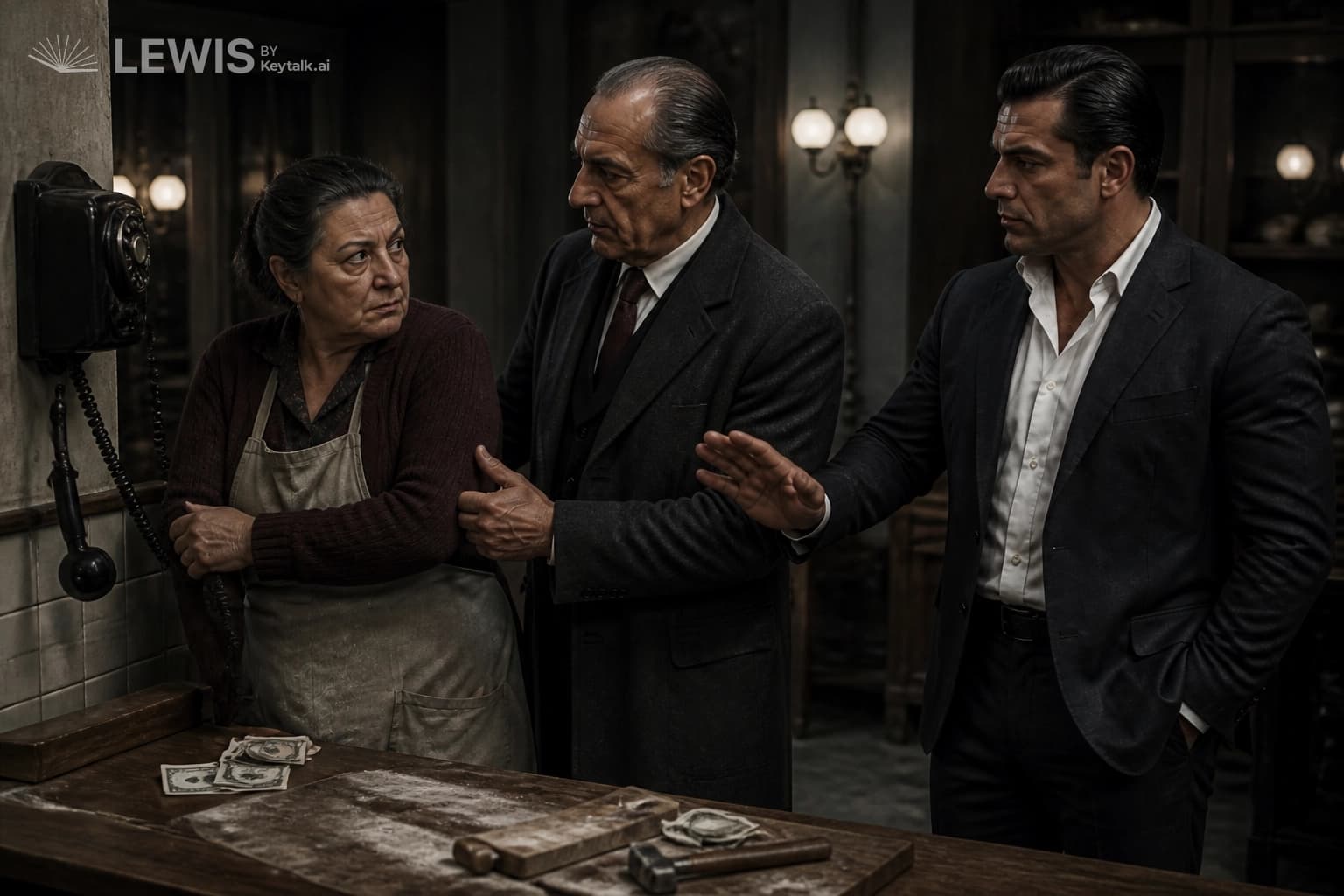
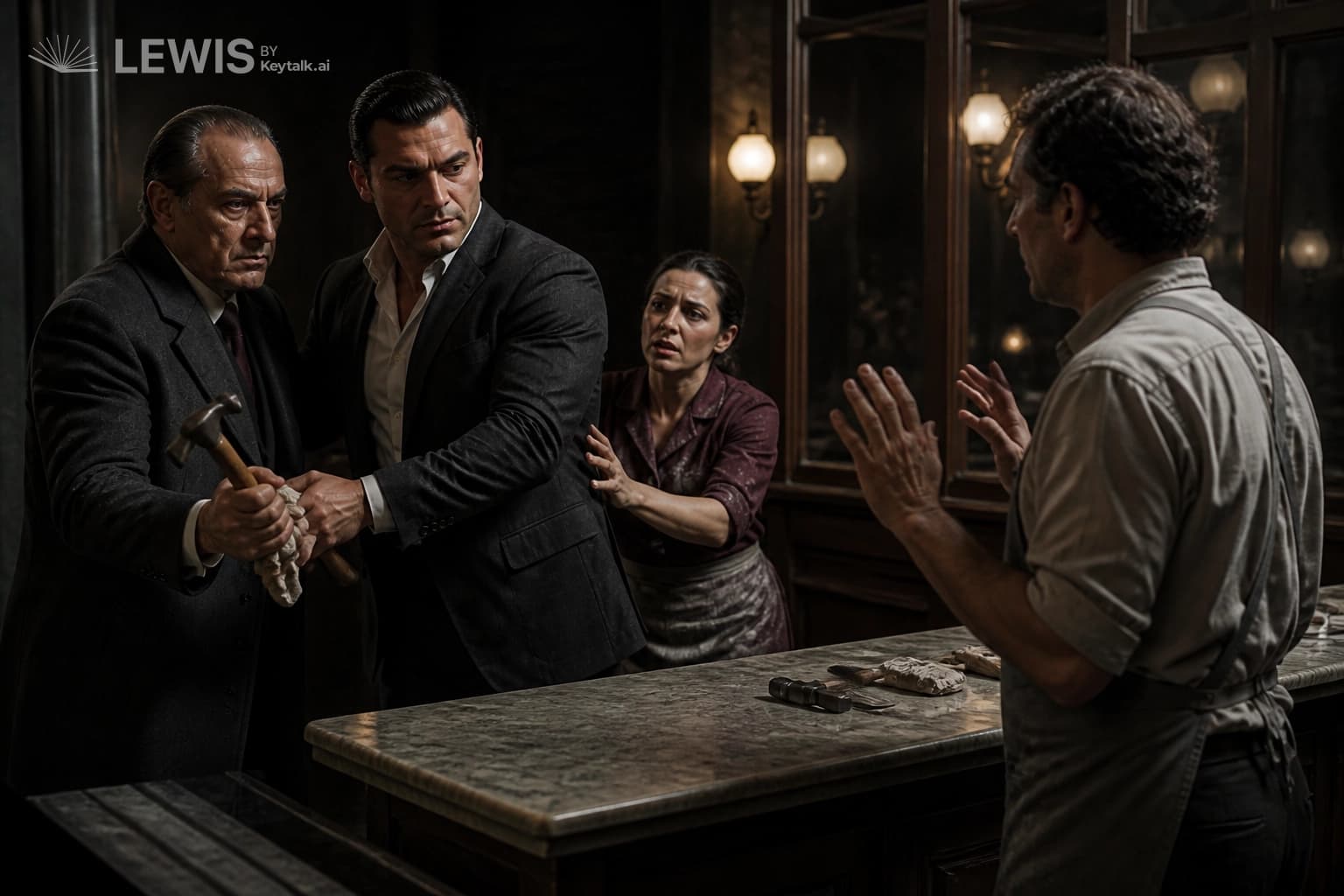
Tullio Serra releases the empty biscuit tin and says, “She could hire someone to help.” Inez Carbone wipes her palms on her apron, passes behind Rocco Bellandi, and lifts the wall telephone receiver. Before she can turn the dial, Corrado Vescio takes the receiver from her and seats it firmly in its cradle. He keeps his free hand over hers against the telephone while the stretched cord hangs above the remaining till money.

Rocco Bellandi leaves the damp bills and takes one step toward the telephone; Corrado Vescio maintains his grip, with the board still visible through the cleared window. Inez Carbone steps back, drawing her elbow close to her apron until Corrado Vescio loosens his hand enough for her to withdraw. Corrado Vescio lifts his thumb from her fingers one at a time, and Rocco Bellandi’s open hand stops beside the untouched receiver.

Scene 09· Late November 1978, evening, immediately after Corrado releases Inez’s hand

Four Hands in the Light

Four Hands in the Light
PlaceCarbone’s Counter, Newark riverfront neighborhood
TimeLate November 1978, evening, immediately after Corrado releases Inez’s hand
ActionRocco Bellandi moves Inez Carbone away from the chopping board and places both hands on it instead. Tullio Serra retreats toward the swinging partition, but Rocco calls him forward. After Corrado Vescio confirms that the punishment will reduce none of the debt, Tullio places his hands beside Rocco’s, and Corrado lifts the wrapped hammer.
ImpactRocco abandons his attempt to purchase permission and publicly takes Inez’s place beneath the hammer. Tullio joins him without receiving the credit or release he still seeks. Inez’s hands are clear of the board, but Corrado retains control of the punishment and its witnesses.

Rocco Bellandi draws Inez Carbone away from the chopping board by her sleeve, releases her, and lays both hands palm-down beneath the fluorescent light at Carbone’s Counter. Beside the telephone, Corrado Vescio finishes lifting his thumb from the fingers he held against the wall; Rocco’s hand opens in the same careful sequence before flattening against the wood. Inez Carbone catches her displaced sleeve and pulls it straight, leaving the board between Rocco and the two hammers.

Tullio Serra backs into the swinging partition, pushing it open with his apron while keeping his stiff left wrist against his chest. “Come here,” Rocco Bellandi says, without lifting either hand. Tullio Serra stops the partition with his heel and asks Corrado Vescio whether this will count against the balance. “Not a cent,” Corrado Vescio says, moving the torn coin wrapper out of the space beside Rocco’s fingers.

Tullio Serra lets the partition close and comes forward, placing his right hand on the board before lowering his left, its wrist held slightly above the wood. Inez Carbone reaches toward the crowded edge, but Rocco Bellandi slides his elbow across her path and she draws back with her empty palm still open. Corrado Vescio takes up the wrapped hammer; passing headlights cross the cleared window and bleach all four hands white.

Chapter 04

Scene 10· Late November 1978, moments after Corrado lifts the hammer

The Fingers He Arranges

The Fingers He Arranges
PlaceCarbone’s Counter, Newark riverfront neighborhood
TimeLate November 1978, moments after Corrado lifts the hammer
ActionCorrado Vescio separates Rocco Bellandi’s fingers on the board with his free hand. Rocco pulls one hand loose and catches Corrado’s hammer wrist, stopping the blow. Corrado orders him to release it, but Rocco holds on while Tullio Serra begins withdrawing from the board.
ImpactRocco changes his refusal from accepting punishment to physically resisting the captain. Inez Carbone remains clear of the board, but Tullio’s retreat leaves Rocco holding the armed man alone. The hammer stays in Corrado’s possession, suspended above the counter.

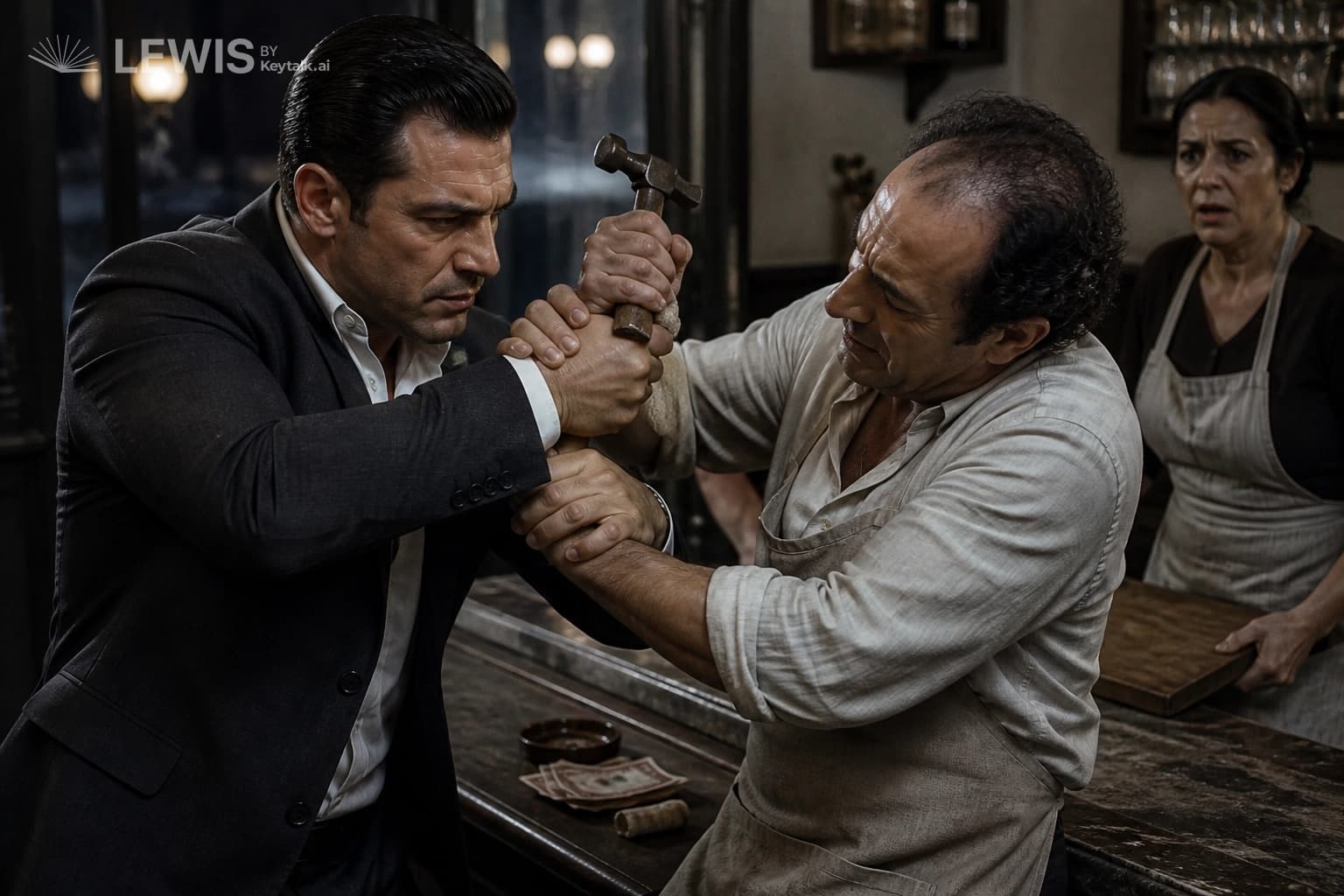
Rocco Bellandi pulls his right hand off the bread-side-down board and catches Corrado Vescio’s hammer wrist at Carbone’s Counter. Corrado’s free thumb remains between Rocco’s left fingers, where he has been spacing them beneath the fluorescent light. The wrapped handle tilts toward the window, but Rocco holds the hammer head above the wood.

Corrado Vescio closes his free hand around Rocco Bellandi’s fingers and presses them flat again. “Let go.” Rocco tightens his grip instead, drawing the captain’s wrist toward the edge of the counter while leaving his own hammer untouched beside the torn coin wrapper. Inez Carbone reaches for the board; Rocco shifts his elbow across its edge, keeping her hand out from beneath the suspended tool.

Tullio Serra lifts his stiff left wrist first, then slides his right palm backward until his fingertips leave the wood. His apron catches against the swinging partition as he retreats, pulling the fabric tight across his waist. Rocco Bellandi keeps Corrado Vescio’s wrist clamped in his hand and turns his face toward Tullio Serra, whose empty palms are already against his chest.

Scene 11· Late November 1978, seconds after Rocco catches Corrado’s wrist

Both Hands on His Arm

Both Hands on His Arm
PlaceCarbone’s Counter, Newark riverfront neighborhood
TimeLate November 1978, seconds after Rocco catches Corrado’s wrist
ActionRocco Bellandi orders Tullio Serra to hold Corrado Vescio’s hammer arm. Tullio looks toward the door, then returns and grips the arm with both hands. Corrado drives him against the counter, scattering crockery and releasing Rocco’s pinned fingers. Rocco transfers his grip and uses his freed hand to strike Corrado’s weapon hand once with his own hammer.
ImpactTullio abandons his retreat and physically joins Rocco against the captain. The single blow forces Corrado to release his hammer, interrupting the punishment in full view of the window. Both weapons remain within the cramped workspace, and Inez has not yet reached the telephone.

Rocco Bellandi pulls Corrado Vescio’s captured wrist toward Tullio Serra at Carbone’s Counter, keeping the wrapped hammer suspended above the bread-side-down board. “Hold him,” Rocco Bellandi says, with his left fingers still trapped beneath the captain’s free hand. Tullio Serra turns his face toward the rain-striped door, then catches the hammer arm with both hands, his stiff left wrist bent against the charcoal sleeve.

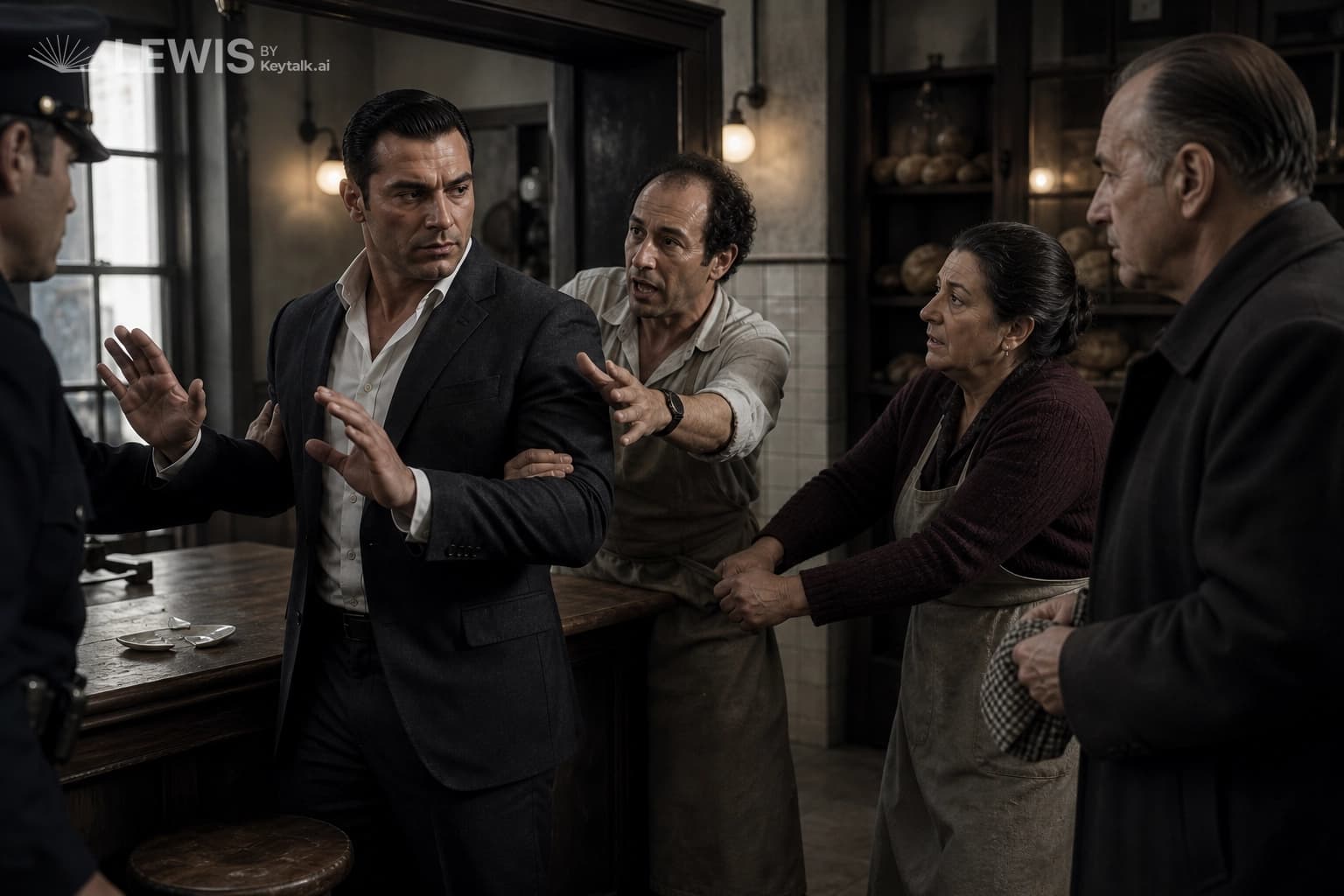
Corrado Vescio steps into Tullio Serra and drives him backward against the laminate edge, dragging Rocco Bellandi’s grip sideways. A saucer falls and breaks on the wet tiles; Inez Carbone catches the slipping board against her apron and backs clear. Corrado Vescio releases Rocco Bellandi’s fingers to shove Tullio Serra again, but Tullio keeps both hands closed around the raised arm.

Rocco Bellandi clamps his freed left hand above Corrado Vescio’s wrist and reaches across the torn coin wrapper for his own hammer. He lifts it only far enough to strike Corrado Vescio’s gripping hand once, while Tullio Serra holds the arm against his chest. The wrapped hammer drops onto the counter beside the untouched bills, and Rocco Bellandi stops with his own hammer head lowered against the laminate.

Scene 12· Late November 1978, evening, immediately after the single blow

The Receiver Stays Up

The Receiver Stays Up
PlaceCarbone’s Counter, Newark riverfront neighborhood
TimeLate November 1978, evening, immediately after the single blow
ActionRocco Bellandi stops striking and slides both hammers off the counter, then pushes them across the wet tiles beyond the swinging partition. Tullio Serra shifts his grip from Corrado Vescio’s arm to his coat, keeping him away from the tools and telephone. Inez Carbone lifts the receiver, dials, and requests police and an ambulance, repeating the diner’s address.
ImpactCorrado Vescio loses access to both weapons and cannot stop Inez Carbone’s call. Rocco Bellandi leaves the punishment unfinished and summons no excuse for the blow he delivered. Help is now coming to a diner where the debt remains unpaid and the struggle has been visible through the window.

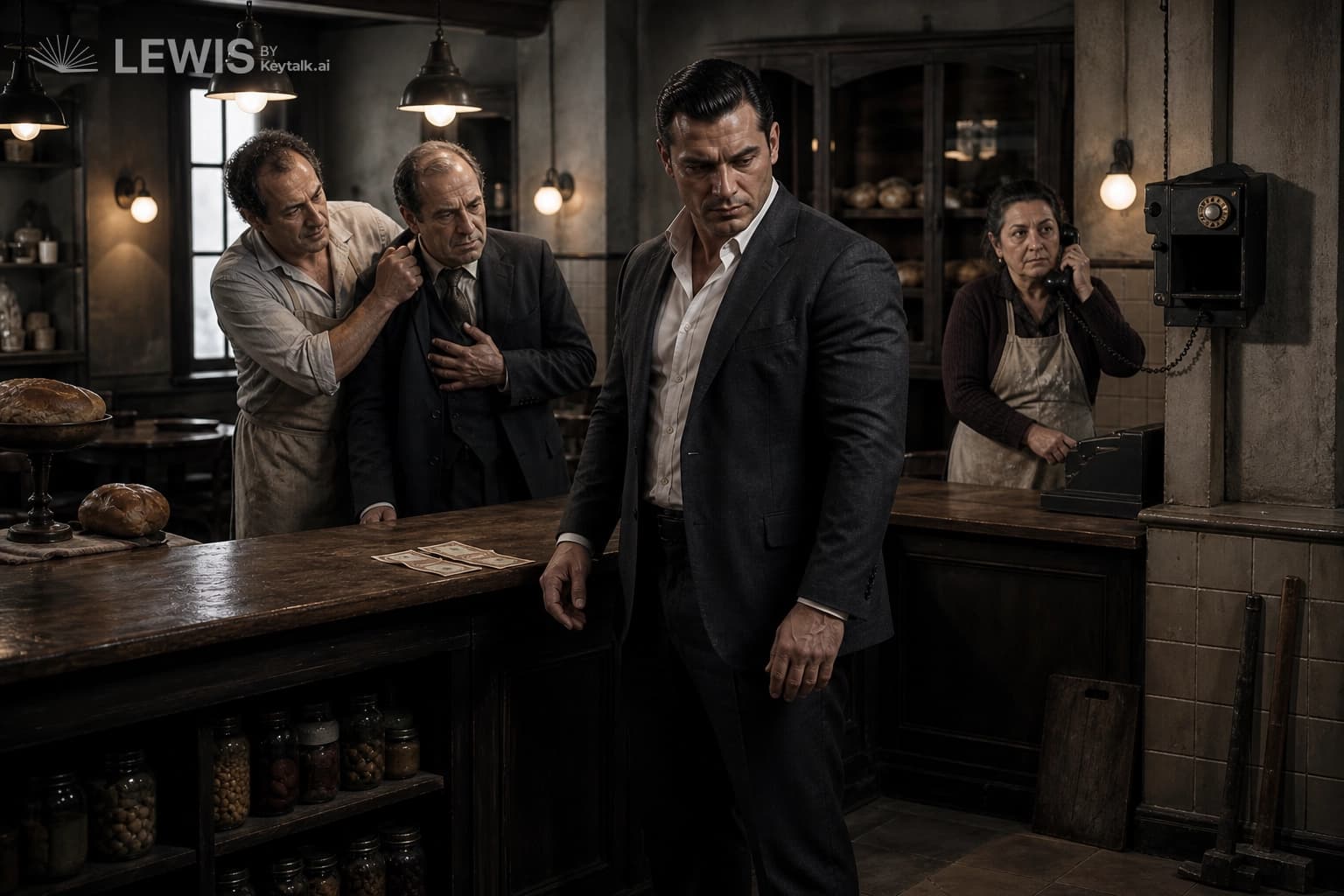
Rocco Bellandi slides both hammers off Carbone’s Counter while Tullio Serra catches Corrado Vescio’s coat below the collar and pulls him away from the falling tools. Rocco Bellandi sends them across the wet tiles with the side of his shoe; the wrapped handle catches against a stool leg before a second push carries it beyond the swinging partition. Inez Carbone sets the board against the bread drawer, clear of the broken saucer, and reaches for the wall telephone.

Corrado Vescio turns toward her, but Tullio Serra gathers another fistful of coat and holds him against the counter. Rocco Bellandi releases the captain’s wrist and steps into the narrow space between Corrado Vescio and the telephone. Inez Carbone lifts the receiver and turns the dial, letting each number return before entering the next. “Police and an ambulance,” she says, then gives the diner’s address.

Rocco Bellandi lowers his empty hands beside the damp bills without gathering them. Inez Carbone repeats the address more slowly, pressing the receiver to her ear while Corrado Vescio holds his injured hand against his overcoat. The telephone cord hangs above the open till; this time, nobody reaches across it.

Chapter 05

Scene 13· Late November 1978, immediately after Inez’s call for help

The Towel Around His Hand

The Towel Around His Hand
PlaceCarbone’s Counter, beside the wall telephone
TimeLate November 1978, immediately after Inez’s call for help
ActionInez Carbone puts down the telephone receiver and brings Corrado Vescio a folded dish towel. Rocco Bellandi orders Tullio Serra to release the captain’s coat, allowing Corrado to sit on the stool facing the window. Inez places the towel beneath his injured hand, but Corrado refuses to let the treatment interrupt his claim: her debt remains.
ImpactThe physical struggle ends without another blow, and the narrow aisle becomes accessible to the help Inez has summoned. Corrado no longer controls the weapons, but he keeps his demand intact before the same witnesses he arranged for the punishment. Inez gives up a clean working towel without receiving any concession.

Inez Carbone sets the receiver into its cradle and pulls a folded dish towel from beside the bread drawer at Carbone’s Counter. Across the narrow aisle, Tullio Serra still holds Corrado Vescio’s coat in two fists, stretching its collar while the captain presses his injured hand against his chest. Rocco Bellandi takes Tullio Serra’s forearm and says, “Release him.” Tullio Serra opens his fingers one hand at a time; Corrado Vescio pulls the creased coat straight with his uninjured hand.

Inez Carbone draws the turned stool back far enough for Corrado Vescio to sit, then spreads the towel on the laminate beneath his hand. Corrado Vescio lowers himself facing the window, where passing headlights expose the wet shoulders beneath the awning. When Inez Carbone brings the towel’s loose corner over his knuckles, he catches the cloth and finishes the fold himself. “Your debt remains,” Corrado Vescio tells Rocco Bellandi, leaving Inez Carbone beside him with her empty hands.

Rocco Bellandi answers, “I know,” and moves Tullio Serra away from the broken saucer to clear the aisle. Inez Carbone slides the untouched bills out of Corrado Vescio’s reach and into the open till, then leaves it open. Corrado Vescio pins the clean towel against his overcoat; beside the register, Inez Carbone sets its empty place against the dry bread envelope.

Scene 14· Late November 1978, moments after Inez’s emergency call

Through the Waiting Line

Through the Waiting Line
PlaceCarbone’s Counter and Riverfront Supper Line
TimeLate November 1978, moments after Inez’s emergency call
ActionRocco Bellandi steps between the arriving officers and Tullio Serra and admits striking Corrado Vescio. Inez Carbone clears the officers’ route without allowing anyone near the fallen hammers. Tullio Serra starts to explain, but Rocco Bellandi offers no excuse, and the officers escort him through the waiting supper line.
ImpactRocco Bellandi’s resistance becomes an admitted assault rather than a struggle the men can conceal or settle privately. Inez Carbone loses the collector who intervened for her while Corrado Vescio remains seated in her diner with his demand intact. Tullio Serra stays behind, with neither escape money nor an explanation his friend will accept.

Rocco Bellandi steps between Tullio Serra and the officers entering Carbone’s Counter, lifting his empty hands above the laminate where the chopping board had been. Inez Carbone pulls a cream stool against the counter to widen their route, keeping its legs clear of the broken saucer. “I struck his hand with the hammer,” Rocco Bellandi says, while Corrado Vescio holds the folded towel against his coat.

Tullio Serra reaches past Rocco Bellandi’s shoulder and opens his mouth, but Rocco Bellandi turns toward the officers instead. “It wasn’t an accident.” Inez Carbone catches Tullio Serra’s apron at the waist and draws him back from the aisle as an officer takes Rocco Bellandi’s arm; through the service opening, both hammers remain on the wet kitchen tiles.

Inez Carbone opens the front door and holds it against the rain while the officers lead Rocco Bellandi beneath the striped awning. The waiting customers keep their refunded coins in closed hands as he passes through the narrow strip between their shoulders and the curb. Behind Inez Carbone, Tullio Serra lowers his outstretched hand, and Corrado Vescio uses his good hand to pull the towel’s slipping corner back into place.

Scene 15· Late November 1978, moments after Rocco’s arrest

Food Still in the Carriers

Food Still in the Carriers
PlaceCarbone’s Counter, Newark riverfront neighborhood
TimeLate November 1978, moments after Rocco’s arrest
ActionInez Carbone bolts the kitchen partition while the ambulance attendants help Corrado Vescio through the narrow aisle. She refuses Tullio Serra access until the officers remove both hammers from the kitchen floor. Once the tools are gone, she opens the partition, puts a ladle into Tullio Serra’s hand, and makes him serve the remaining donated supper without charge.
ImpactCorrado Vescio leaves without payment or either weapon, but his claim against Inez Carbone remains. Tullio Serra stays to work under her direction rather than purchase his release. Supper resumes beside the wreckage, with tomorrow’s bread money preserved and the gas payment still short.

Inez Carbone slides the bolt across the kitchen partition as Tullio Serra reaches for its edge, shutting both hammers behind the barrier at Carbone’s Counter. The ambulance attendants guide Corrado Vescio past the cream stools; he carries her folded towel against his coat and leaves the money behind. Inez Carbone holds the front door until his repaired overcoat cuffs disappear beneath the dripping awning, then shuts it against the rain.

Tullio Serra pulls at the partition again, but Inez Carbone keeps her palm over the bolt. “Not with those on the floor.” Only after the officers carry both hammers through the doorway does she open the partition and lift the lid from a dented church carrier.

Inez Carbone presses the ladle into Tullio Serra’s right hand and slides a bowl beneath it, keeping her fingers on the rim until he fills it. “No charge,” she says, and he pushes the bowl toward the waiting hands without reaching for the register. Inez Carbone gathers the broken saucer into a folded apron corner, then lays the chopping board beside the sink; behind her, the bread envelope stays dry beside the empty till.

'Mercy's Above My Pay Grade'Story Chat

Want to chat with the characters from this story?

'Mercy's Above My Pay Grade'Story Chat

Want to chat with the characters from this story?

story image
story image
story image
story image

Story details

Made with

Models

  • GPT-6.1 Soltext
  • Stable Diffusionimage
  • gpt_image_2image

Keytalk

Comments

Comments · 0

theme music