Keytalk Original · 15 scenes · 5 chapters

His Own Worst Defendant

During a routine day on the bench, a judge famous for strict adherence to the Constitution receives a police call saying his wife is in custody for breaking into a condemned apartment building.

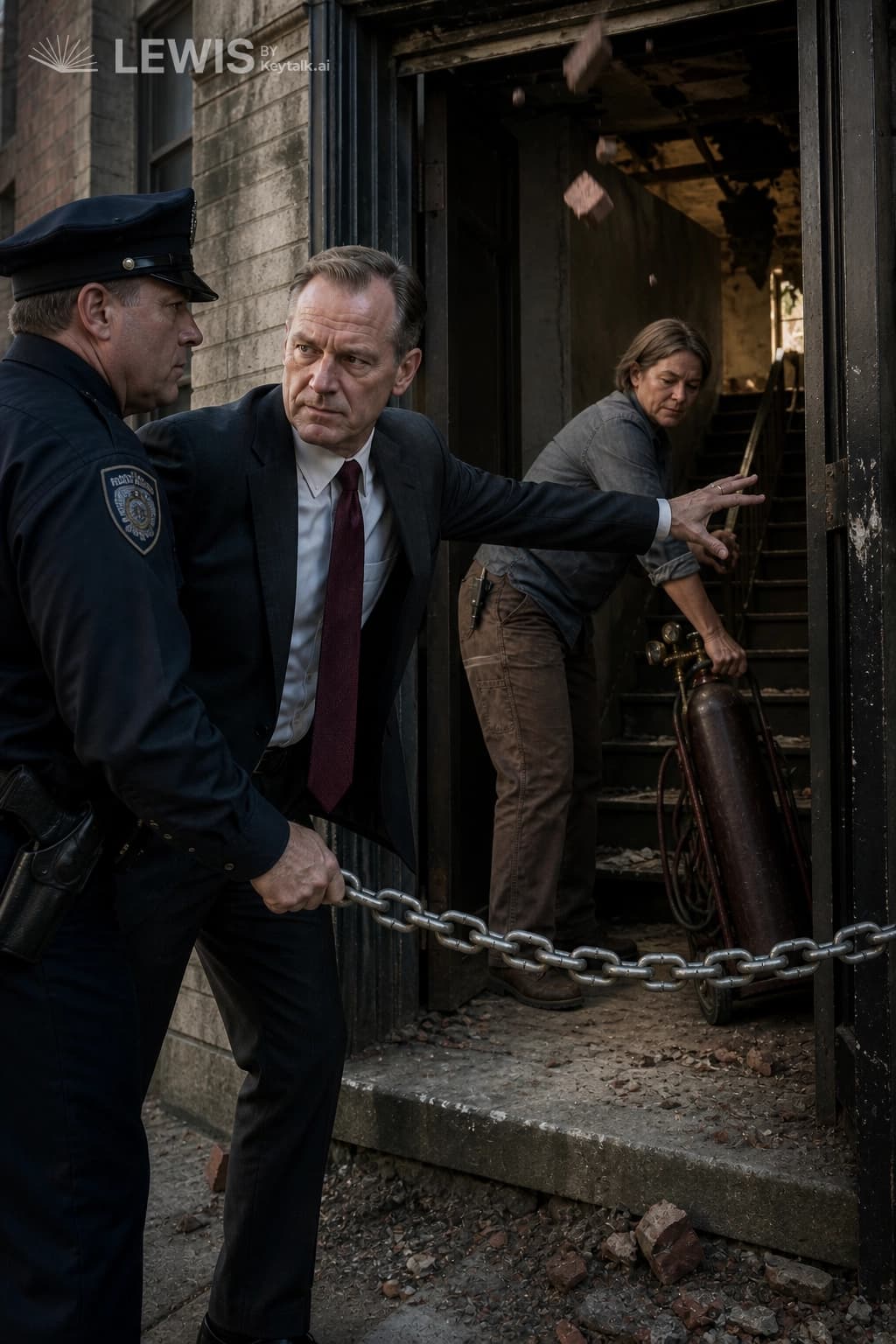
She entered to bring out her elderly father, who refused to leave after an eviction the judge himself upheld, but she slipped away from the officers and climbed back inside. The judge arrives to find her behind a chained door, dragging her father's oxygen cylinder toward the stairs while bricks fall into the street.

He starts toward the entrance, but an officer blocks him and warns that forcing his way through will mean arrest. Behind the officer, a ceiling beam cracks, leaving him seconds to stay behind the police barrier or break the rule he would enforce against anyone else.

  • 3 characters
  • 5 locations
  • 15 scenes
  • Plot 3,980 chars
His Own Worst Defendant cover image

Characters

Characters

Scott Hopper

Male

Trial court judge known for enforcing constitutional protections and refusing special treatment, now facing a police barrier outside the condemned building whose eviction order Scott Hopper upheld.

Profile

Scott Hopper wants to bring Marian Hopper, Scott Hopper’s wife, and her elderly father out of the condemned apartment building without demanding favors from the officers guarding it. When the officer blocks the entrance, Scott Hopper must either remain outside as the ceiling gives way or cross the barrier and accept the arrest Scott Hopper would expect for anyone else.

Scott Hopper lets frightened defendants finish speaking, then reads unfavorable rulings without softening a word. At the police barrier, Scott Hopper begins with “Officer, I understand,” but keeps edging toward the chained door whenever Marian’s oxygen cylinder scrapes across the floor.

Background

Scott Hopper once reported a courthouse colleague for quietly moving a relative’s hearing ahead of other cases, then ate alone in the courthouse cafeteria for months.

After upholding the eviction affecting Marian’s father, Scott Hopper brought home the written ruling; Marian left it beside an untouched dinner plate and drove to the building with empty packing boxes.

Description

Scott Hopper is 56, broad-shouldered and lean, with a receding sweep of iron-gray hair and deep creases running from his nose to his tightly held mouth.

His matte black judicial robe hangs squarely over a charcoal wool suit and white shirt; even without the robe, he holds his shoulders level, listening with his chin lowered while one foot inches forward. His left thumb presses against the underside of his plain gold wedding band, a small movement beneath an otherwise still face.

Valerie Hopper

Female

Medical equipment dispatcher who arranges home oxygen deliveries and handles her father’s replacement cylinders herself

Profile

Valerie Hopper wants Scott Hopper to help secure her father’s oxygen cylinder to the stair rail so she can guide him down without carrying its weight. By returning inside after police detained her, Valerie Hopper risks prosecution and forces Scott Hopper to choose between standing behind the barrier and joining her without protection from arrest. Valerie Hopper refuses to ask for the eviction ruling to disappear; she calls through the chained door for a pair of hands.

Valerie Hopper checks an oxygen gauge twice, then tells her father there is plenty left even as she pulls the cylinder faster. When an officer orders her outside, Valerie Hopper answers politely but keeps one foot braced against the door. Valerie Hopper usually straightens Scott Hopper’s collar before difficult public appearances; at the barrier, she tells him to take off his robe if he intends to help.

Background

For six months before the eviction, Valerie Hopper brought her father apartment listings, packed his kitchen, and unpacked it again when he refused to eat from paper plates. After Scott Hopper upheld the order, Valerie Hopper set a place for her father at their dining table, but the chair remained empty.

On the morning police cleared the building, Valerie Hopper found a full oxygen cylinder still beside her father’s untouched breakfast and carried it past the posted condemnation notice.

Description

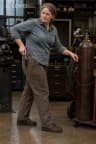
Valerie Hopper has a sturdy build, a square face with fine lines around the eyes, and chestnut hair threaded with gray, cut just below her jaw and tucked behind her ears.

Her faded teal cotton shirt, charcoal work trousers, and flat leather shoes are practical enough for a delivery depot; a small brass cylinder key hangs from a retractable clip at her waist. She listens with her chin lowered and her hands ready, her mouth holding a courteous half-smile while her shoulders remain set against being moved.

Morris Connor

Male

Local newspaper photographer assigned to document the evacuation of the condemned apartment building

Profile

Morris Connor wants Scott Hopper, a friend since childhood, to let the camera record whatever happens at the police barrier, including an arrest, rather than ask for the photographs to disappear afterward. Morris Connor puts a spare camera battery into place and tells Scott Hopper that helping Valerie Hopper will not erase the eviction ruling or its consequences. Keeping the camera raised may cost Morris Connor the friendship; lowering it would give Scott Hopper the protection Morris Connor has refused to give strangers.

Morris Connor straightens Scott Hopper’s collar before raising the camera, then steps back far enough to include the officer blocking the entrance. When an editor calls for a close-up of Scott Hopper’s face, Morris Connor keeps the chained door in the frame instead. Morris Connor answers Scott Hopper’s sharpest objections without lowering the camera, but presses the shutter only after checking where the falling bricks have landed.

Background

At seventeen, Morris Connor photographed Scott Hopper accepting a school debate trophy and delivered a print to the Hopper kitchen before breakfast.

Decades later, Morris Connor published a photograph of Scott Hopper laughing beside a defendant’s family after a hearing; Scott Hopper stopped taking Morris Connor’s calls for three weeks, then invited Morris Connor to dinner without mentioning the picture.

Assigned to the evacuation that morning, Morris Connor has already photographed the elderly father refusing to leave when Scott Hopper arrives at the barrier.

Description

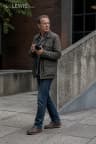
Morris Connor is a lean, long-faced man of 57, with silver curls cropped close and deep creases beside watchful hazel eyes; his faded olive field jacket hangs over a charcoal cotton shirt and dark straight-leg jeans. A camera strap repaired with a square of red stitching crosses his chest, the one bright mark on clothes chosen to go unnoticed.

He holds the camera steady in both hands, elbows tucked against his ribs, while his tightly pressed lips suggest words he has decided not to say.


Synopsis

Plot

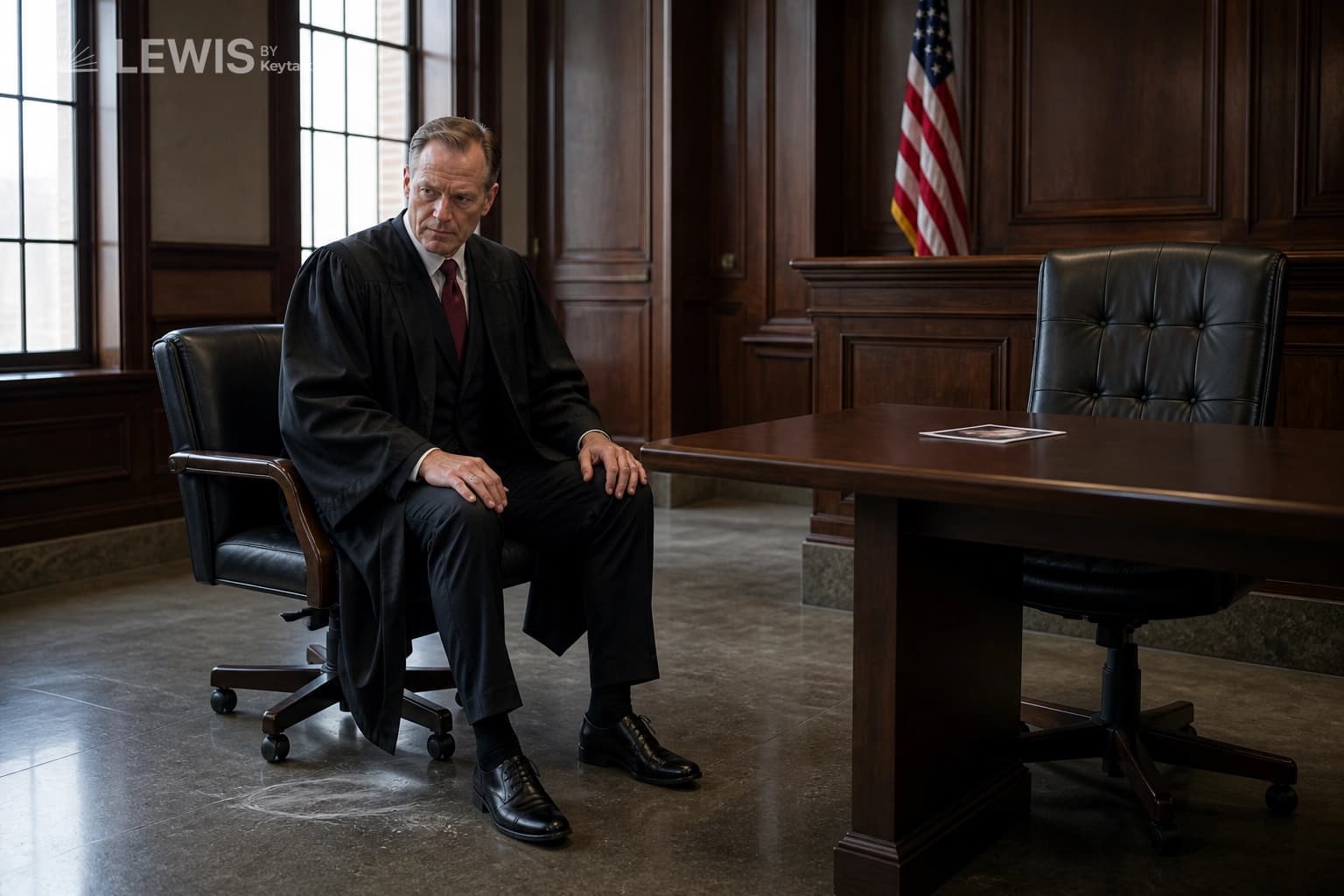
At his judicial review, Scott Hopper is offered a chair beside his lawyer. He moves it back to the same distance from the panel as the witness chair. On the table lies a photograph taken by Morris Connor, his oldest friend: Scott pressed against a police officer, one hand reaching toward the entrance of Bellwether Court. Asked whether he would cross the cordon again, Scott asks to explain what happened before answering.

That morning, Scott had left a courtroom full of people waiting for decisions. A police call reported that his wife, Valerie Hopper, had been detained for breaking into the condemned building, then slipped back inside for her father. Scott arranged coverage with the clerk and hung up his robe. His external task was simple: bring them out alive. The harder task was to stop treating his own compliance as proof that he had done everything he could.

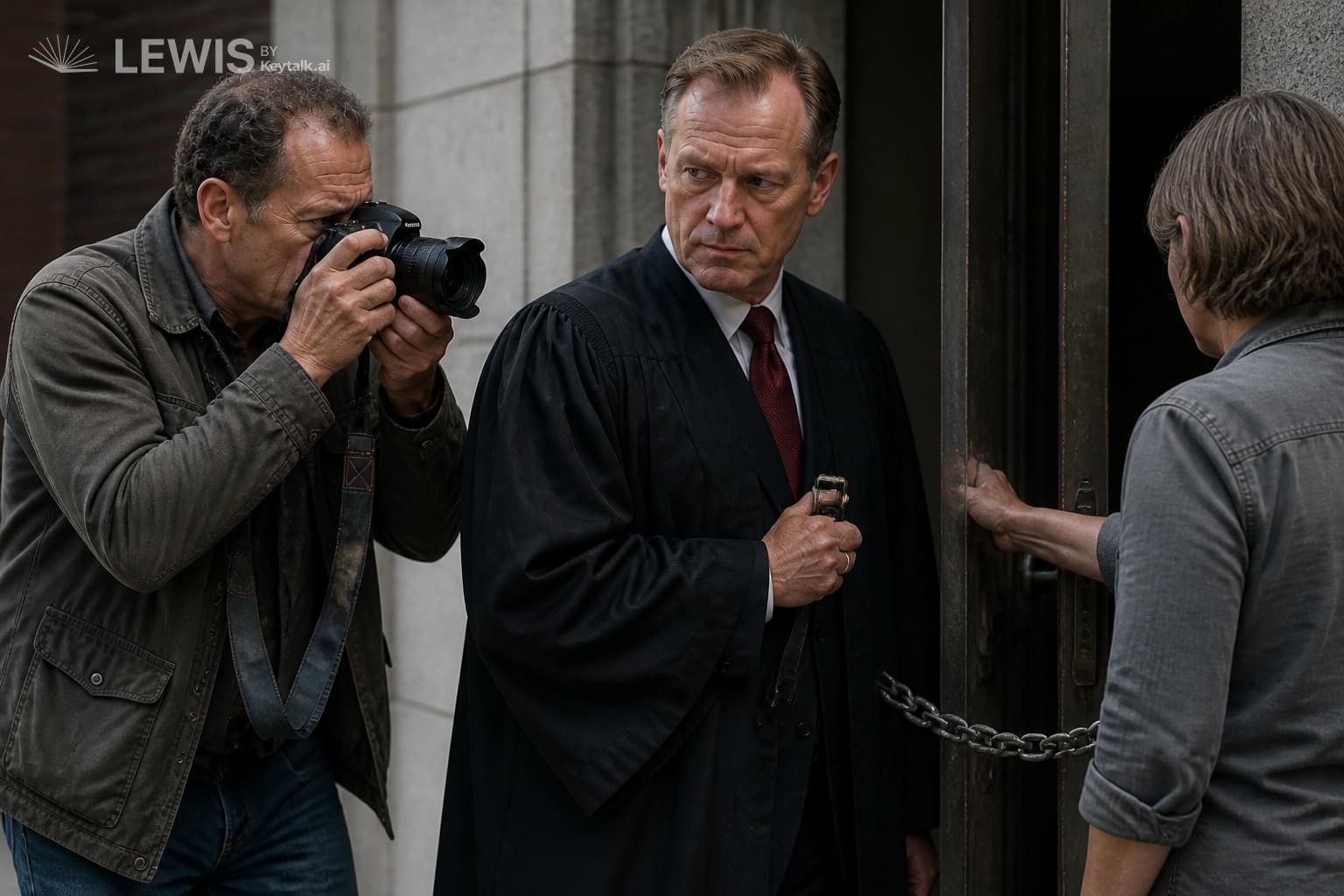
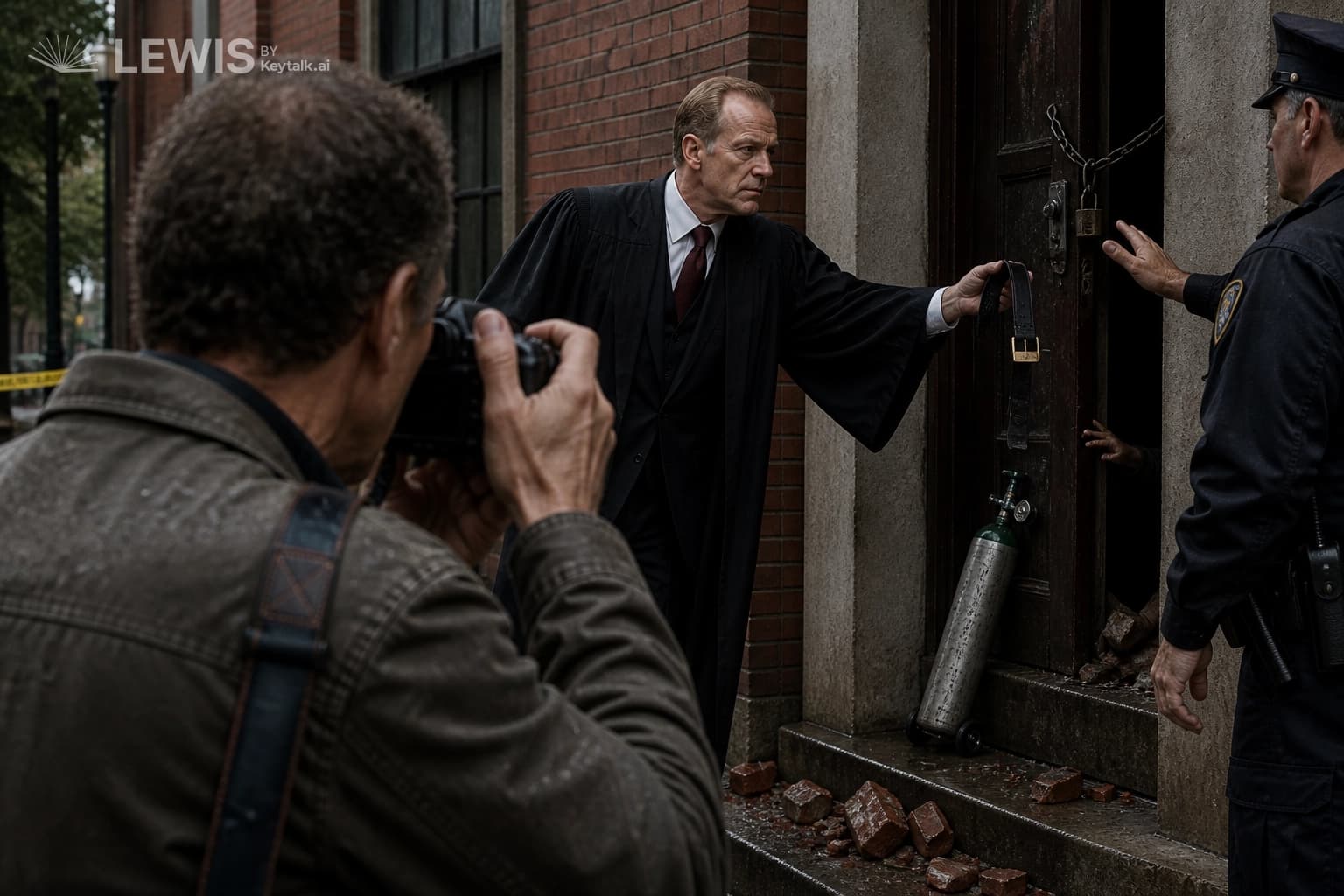
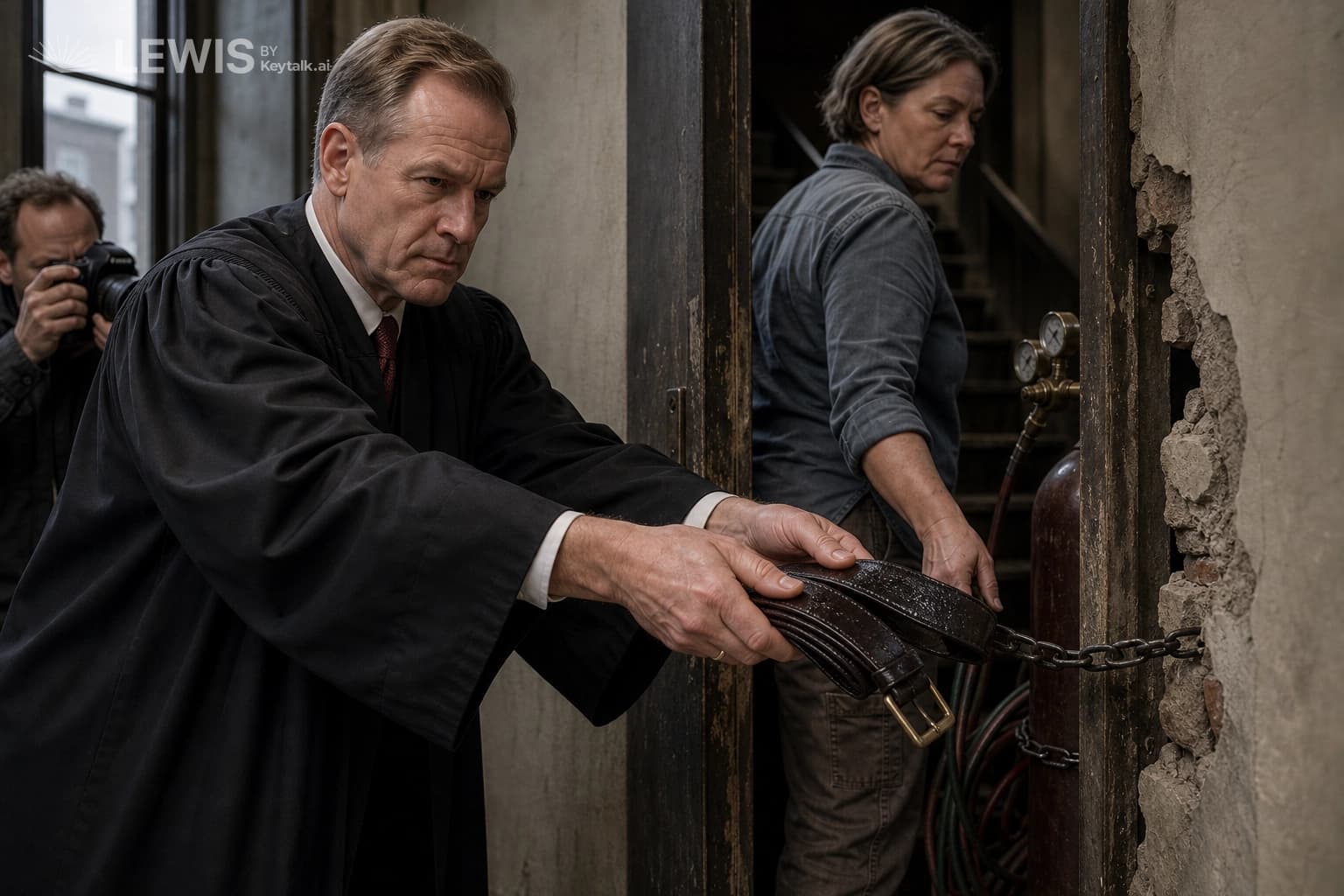
At Bellwether Court, the guarding officer stopped him beside a heap of fallen bricks. Through the chained entrance, Valerie asked Scott to find something that could secure her father’s oxygen cylinder to the stair rail. She needed both hands to move him. Scott loosened his belt, then stopped: even that small practical answer required getting past the officer.

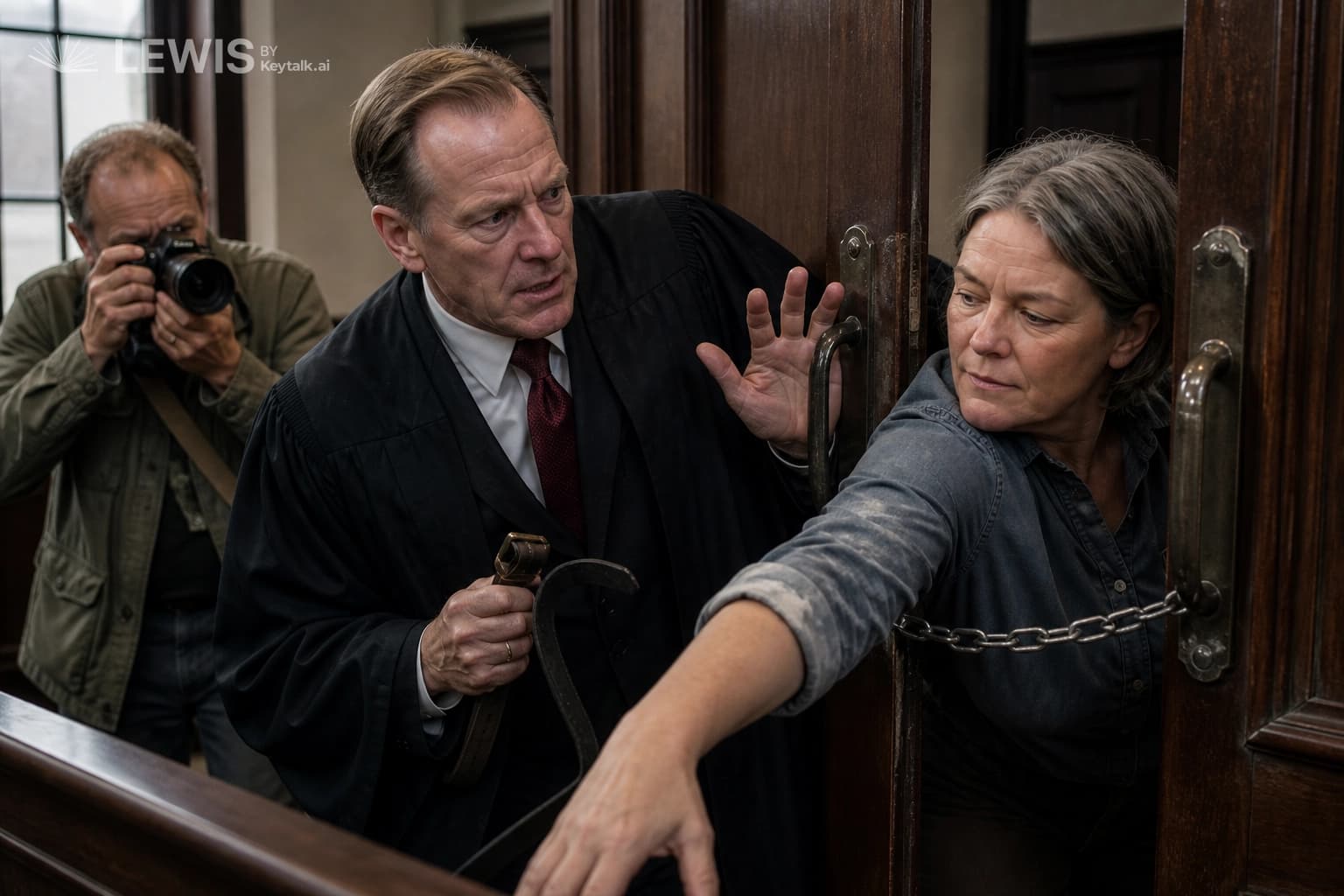
The doors opened inward. Valerie’s father had chained their handles because he feared being removed without his belongings; now he could not find the key. Scott asked Valerie to describe where she and her father stood. As she answered, he watched the officer look from the narrowing door gap to the damaged lintel. The officer was not withholding a favor. He was trying to prevent another person from becoming trapped.

Morris raised his camera. Scott asked him to lower it, and Morris refused. When his editor called for a close-up, Morris stepped farther back, keeping the officer and entrance visible. Scott’s anger cost him several seconds before Valerie called his name again.

A firefighter approached with bolt cutters, but dust spilled from above the doorway and the lead responder ordered a retreat. Inside, Valerie’s father caught the banister and demanded his suitcase. Scott offered to replace its contents. The old man answered that Scott’s signature had already taken his home. Scott gripped his loose belt and let the accusation stand. Arguing would not move either foot down a step.

Then a beam cracked. Valerie’s hand vanished from the gap.

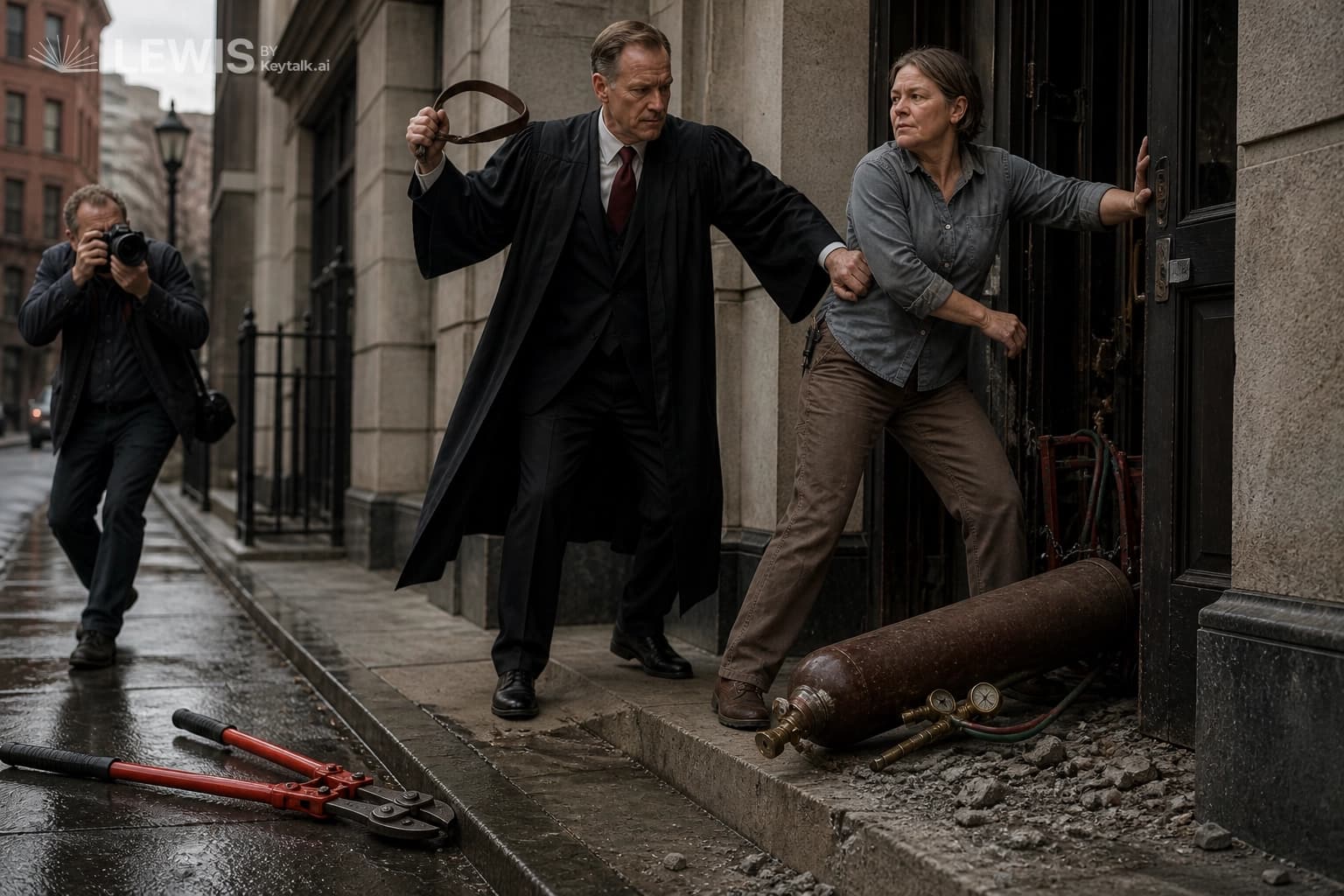
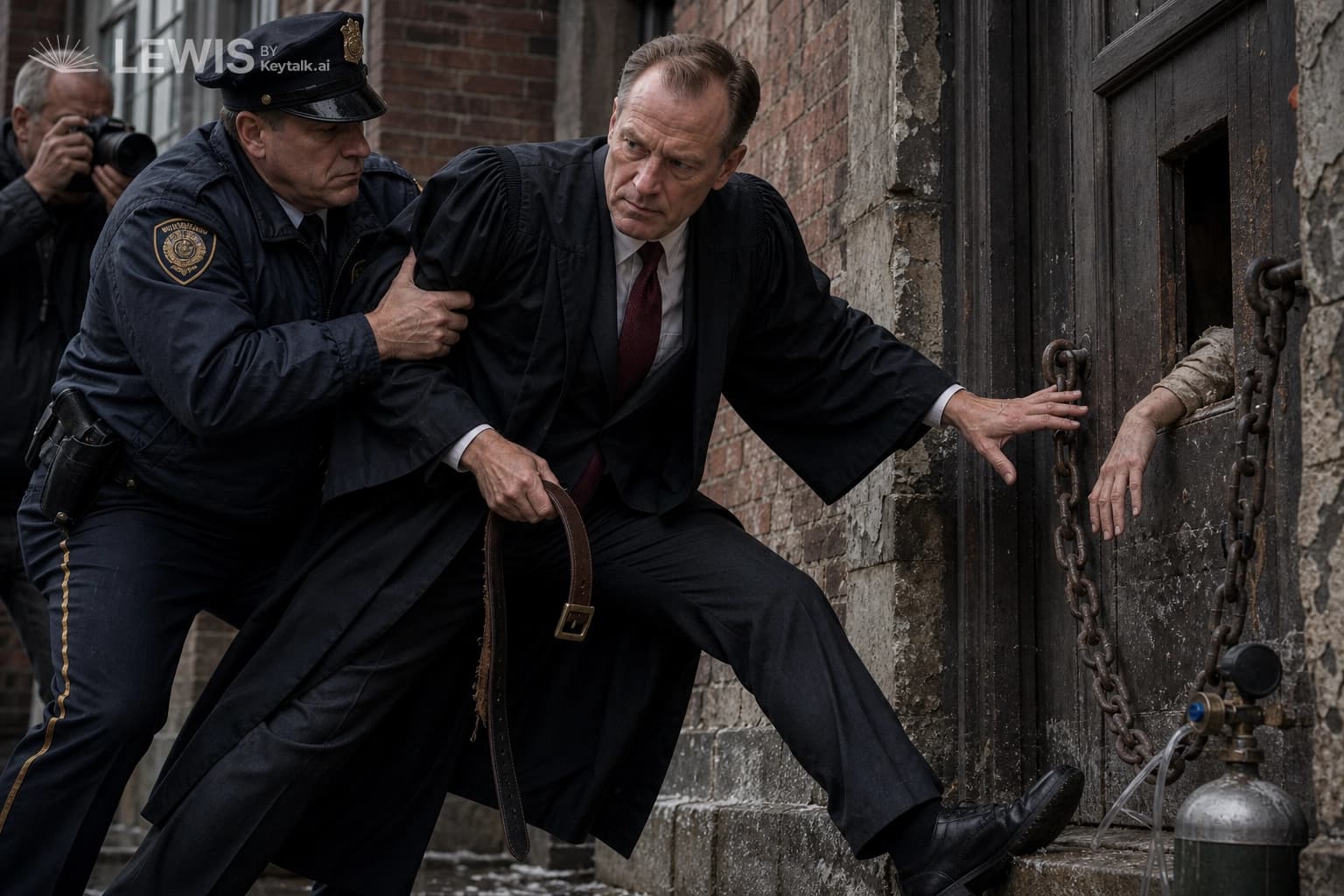
Scott passed beneath the officer’s arm. Caught before he reached the doors, he stopped pulling away and warned that pushing them would strike Valerie. He asked the officer to arrest him once she was outside. The lead responder saw movement beneath the falling plaster and authorized a brief entry.

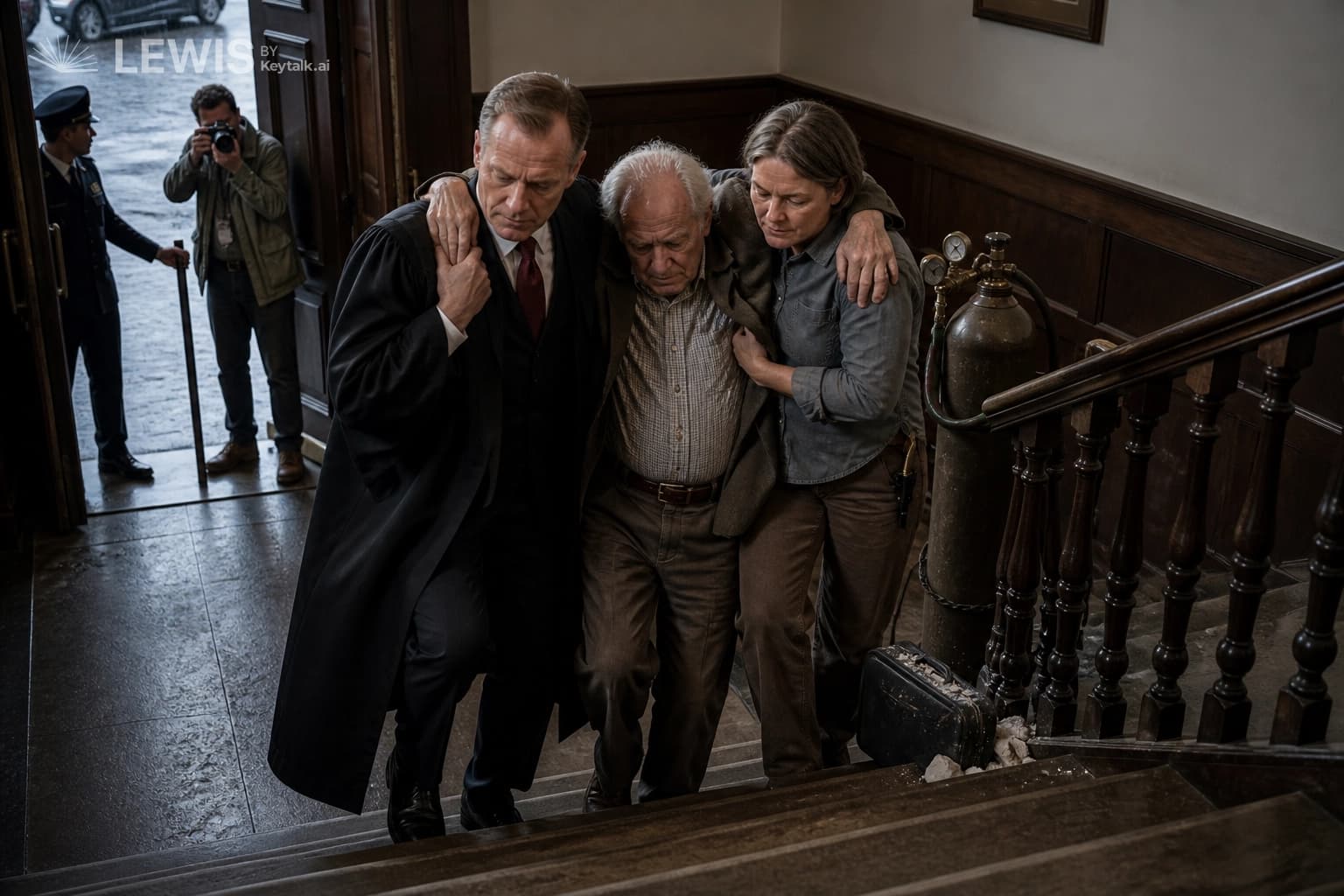
The firefighter cut the chain. Scott and the officer steadied the doors until Valerie could move clear. Inside, Scott fastened the cylinder to the rail with his belt. Valerie released its weight and took her father beneath one shoulder; Scott took the other. They lifted him away from the suitcase. At the threshold, the firefighter received him while the officer hauled Scott out by his collar. Ceiling debris struck the floor they had just crossed.

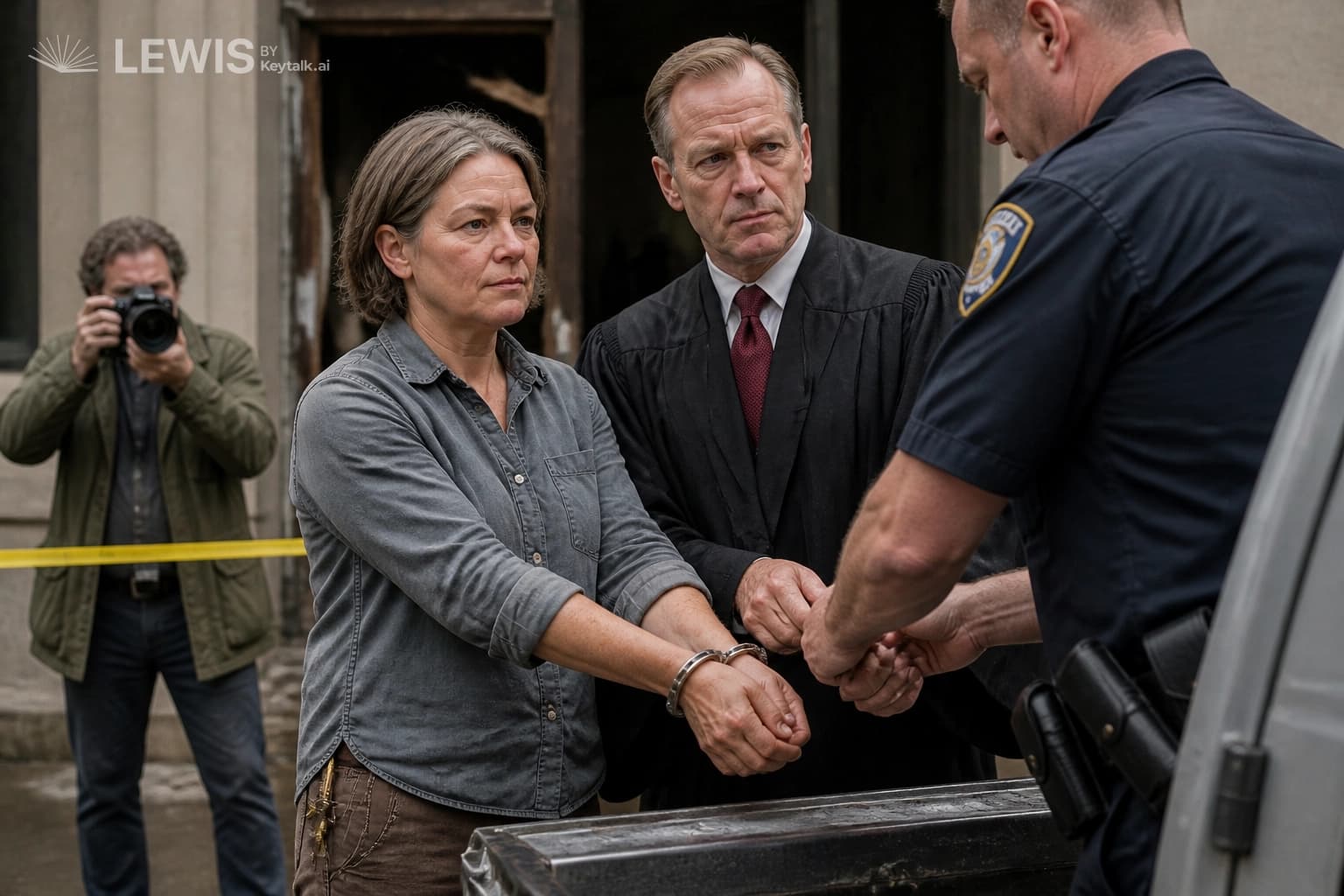
After paramedics settled her father, Valerie presented her wrists. Scott stood beside her and did the same. Morris photographed the arrests.

Another judge later imposed fines and community service on both spouses after considering the rescue. Scott sought no private intervention. He returned to his courtroom weeks later, moved a chair for an elderly witness who could not manage the step, and resumed the docket. Valerie waited outside to drive him to their first service shift.

Now, before the review panel, the guarding officer demonstrates how Scott ducked past him. Scott stands where he is directed and does not dispute the account. Morris places the uncropped photograph on the table.

The panel repeats its question.

“Yes,” Scott says. Then he sits while the officer finishes describing what that choice made him risk.
World

The world

representative image

setting

The county trial courthouse occupies a former customs house beside the river in a fictional American city. Its public entrance sits above flood level, reached by twenty stone steps. Staff enter through a basement passage that smells of wet coats and old pipes. Both routes lead to the same security desk; Scott Hopper passes through screening like everyone else.

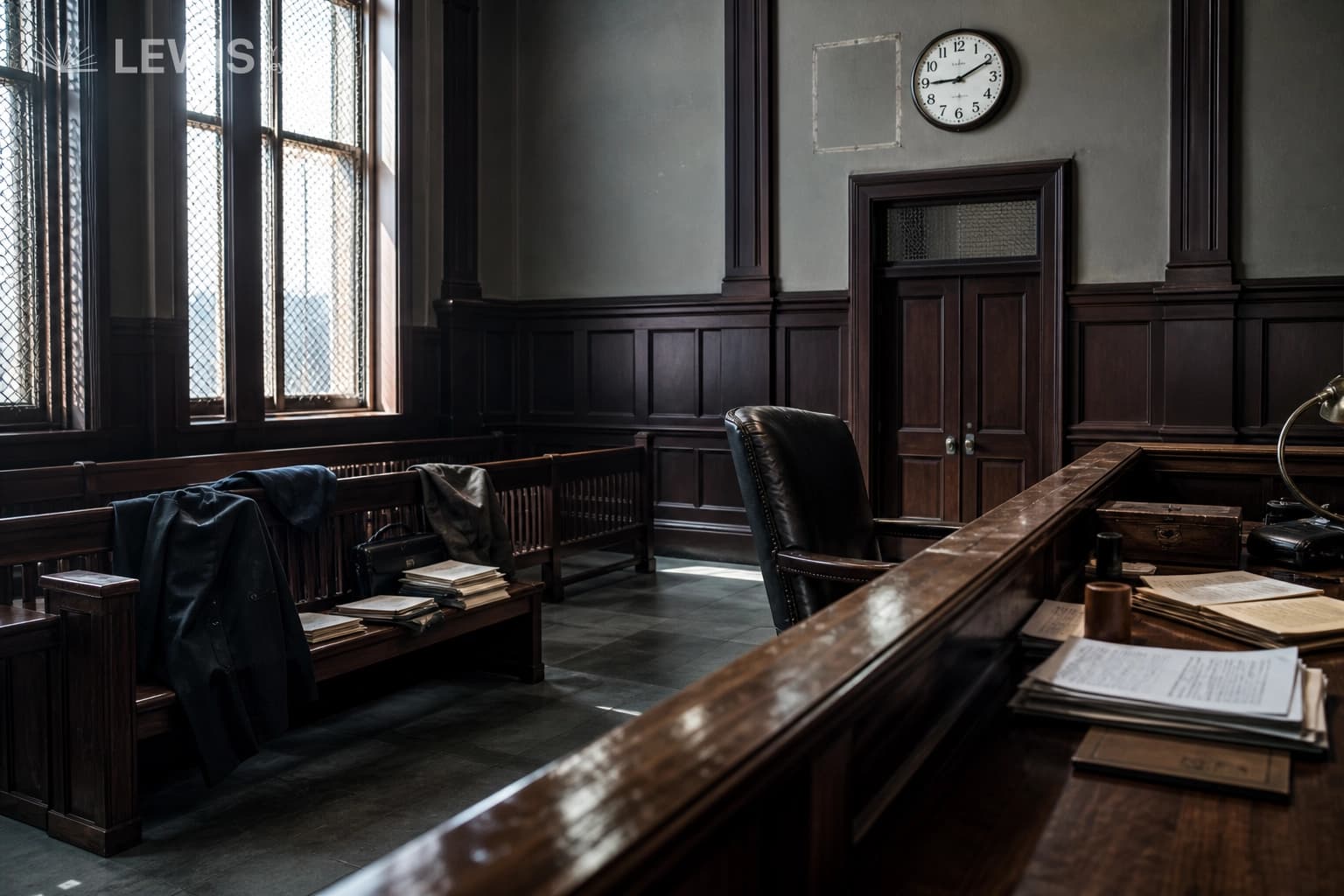
Scott’s courtroom is on the second floor. From the bench, he can see the witness chair, the public benches, and a clock mounted above the exit. He cannot see the street. Tall windows admit daylight through wired glass without giving him a clear view outside.

This is the story’s first pressure chamber: a place built to keep proceedings orderly even when lives beyond its walls are not. Scott receives the police call in a small consultation room behind the bench. His next case is already waiting. Twelve minutes away, at Bellwether Court, Valerie has returned inside for her father.

Scott’s empty chair becomes the courthouse’s most closely watched object. The clerk must explain the interruption without announcing private details. People waiting for their cases watch the side door, expecting the judge to return.

time period

The present day, during a rain-soaked autumn weekday.

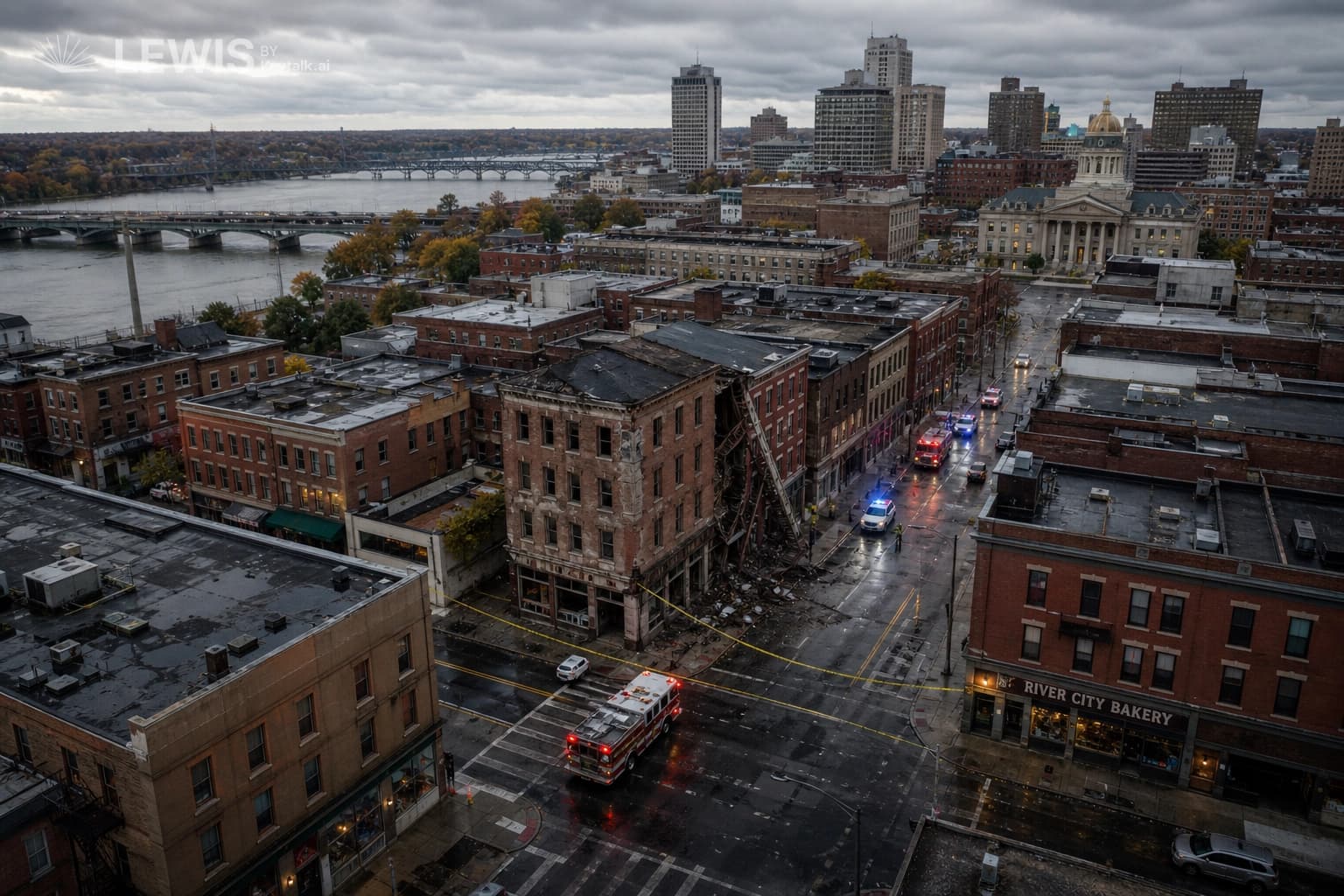
The morning docket has run into lunch. Courthouse heating has not yet been switched fully on, and visitors keep their coats buttoned. Outside, overnight rain has exposed dangerous movement in Bellwether Court’s front wall.

The eviction hearings are over. The emergency evacuation is not. Scott leaves a building where delays are measured in scheduled recesses for one where a delay may be measured by the next falling brick.

rules

- Scott cannot decide any proceeding involving his wife; helping Valerie cannot include using his courtroom to remove her legal exposure.
- Only authorized responders may cross the police cordon; forcing past the guarding officer exposes Scott to arrest, whatever his title.
- The rescue crew must obtain its lead responder’s approval before entering the unstable stairwell; Valerie must keep moving her father while that decision remains unresolved.
- Bellwether Court’s inward-opening entrance cannot admit a person until its security chain is cut; pushing the doors from outside could strike Valerie instead of freeing her.

These limits leave Scott with actions he can take as a husband but cannot guarantee as a judge. An arrest would not establish guilt. Any claim that the emergency justified his conduct would have to be examined afterward by someone else.

technologies philosophies

The courthouse uses digital calendars and scanned filings, but proceedings still depend on people entering a room, speaking clearly, and waiting their turn. A phone can deliver news from Bellwether Court in seconds. It cannot shorten the drive or hold up a ceiling.

Scott has made a practice of refusing private requests about pending cases. Friends know not to approach him in courthouse corridors. Valerie has lived with that boundary for years; her call for help is not a request to erase the eviction, but a request for another pair of hands.

The courtroom’s audio recorder captures testimony, rulings, and formal recesses. It does not capture the police call behind the bench. Morris’s photographs may become the more complete record of Scott’s day.

At the courthouse, leaving his chair means others must wait. At the chained entrance, remaining where he is may mean Valerie cannot. Neither place allows him to choose without leaving someone exposed.

visual description

The courthouse palette is tobacco brown, dull cream, and the gray of rainwater on stone. Brass fittings shine only where hands repeatedly touch them. Beneath the courtroom clock, the wall holds a clean rectangle where an older clock once hung.

Fluorescent light flattens faces in the corridors. Inside the courtroom, narrow strips of daylight lie across the benches like empty seats. A custodian pushes a bucket beneath a ceiling stain without interrupting the clerk’s announcements.

Scott’s robe hangs from a hook in the consultation room after he leaves. One sleeve rests against a box of unused court forms. His chair remains turned slightly toward the side door.

At Bellwether Court, there is no corresponding stillness. The door gap offers only fragments: Valerie’s hand, a cylinder’s metal shoulder, dust dropping through dim air. Morris’s camera can record what Scott does, but not the person Scott can hear struggling beyond the entrance.

Keytalk Prompts Used

Visual & Sound

Locations

Where it happens

location 1 image

The Vacant-Bench Courtroom

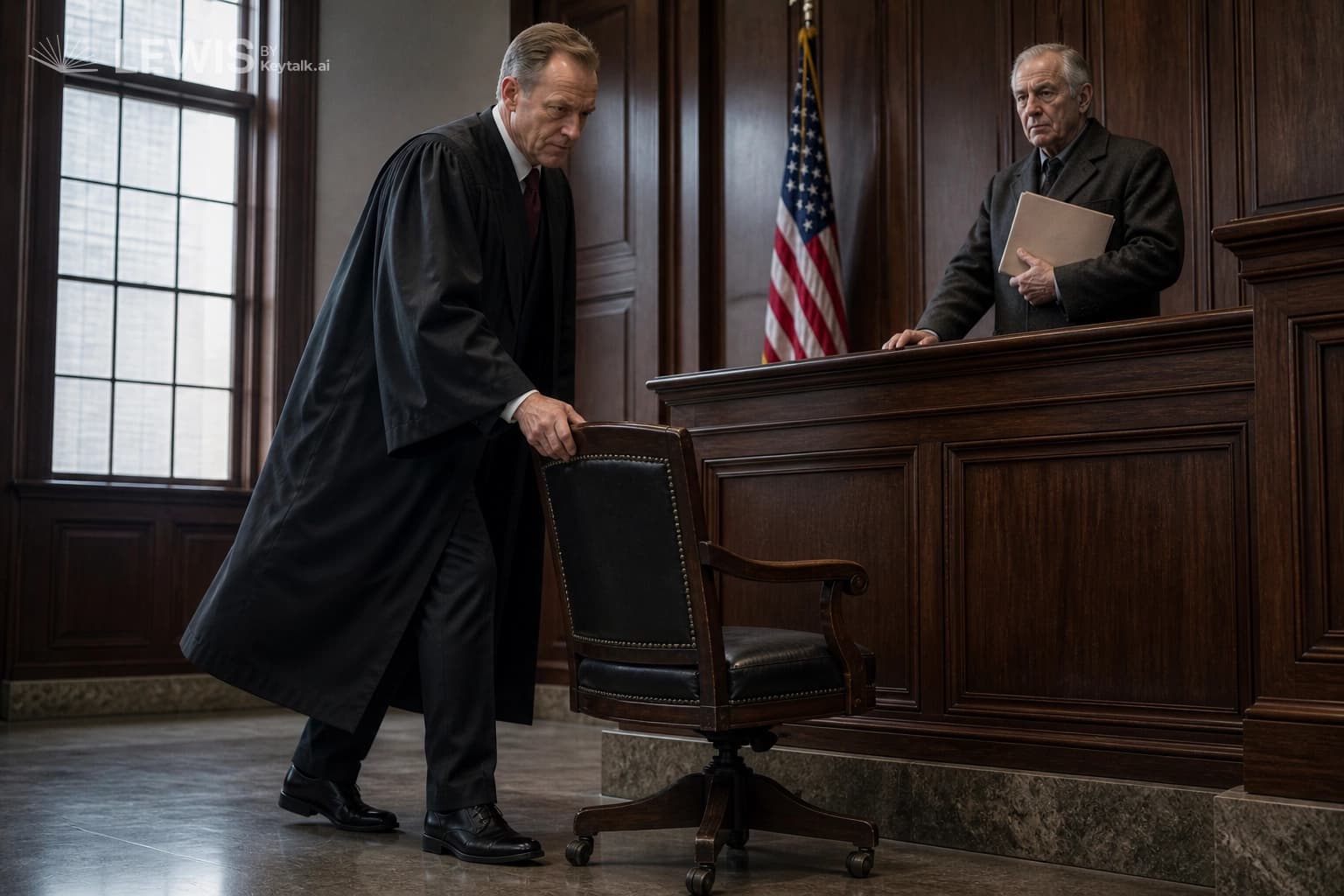
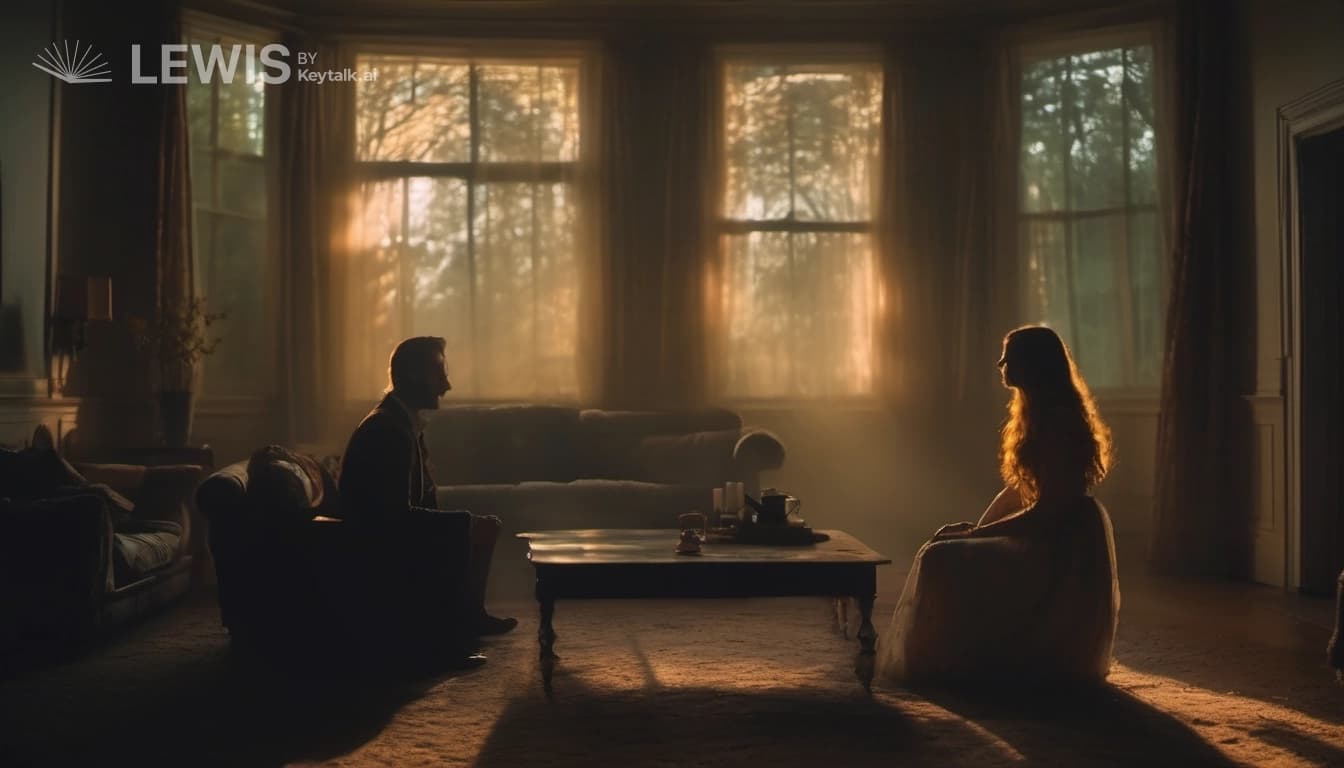
Scott’s empty chair sits slightly turned toward the side door in the spacious second-floor courtroom, behind a tobacco-brown wooden bench polished pale along its working edge. Thin daylight filters through tall wired-glass windows, striping the public benches where buttoned coats and stacks of dry paper remain motionless.

Above the exit, the clock ticks over waiting whispers; its second hand crosses a clean rectangle left by an older clock, while every face stays angled toward the closed side door.

location 2 image

Bellwether Court’s Chained Entrance

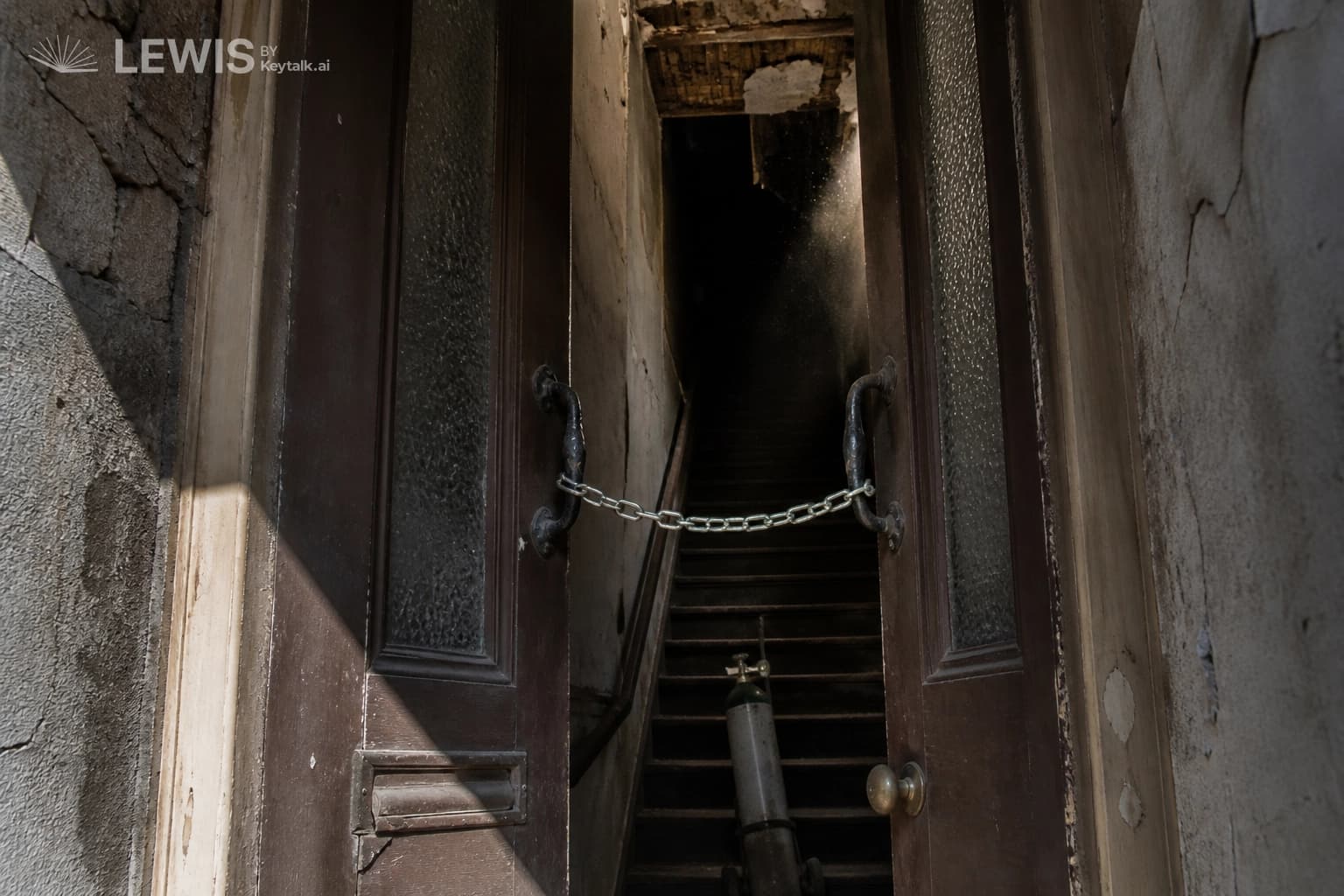
The chained entrance holds its inward-opening doors a hand’s width apart, with one iron link worn bright where it grinds against the handles. Fractured daylight cuts across gritty plaster at the threshold; beyond it, the lowest stair treads disappear into green-gray shadow beneath a split lintel.

An oxygen cylinder scrapes against a step, stops, then scrapes again, while timber cracks overhead and fresh dust sifts through the narrow gap.

location 3 image

The Fallen-Brick Police Cordon

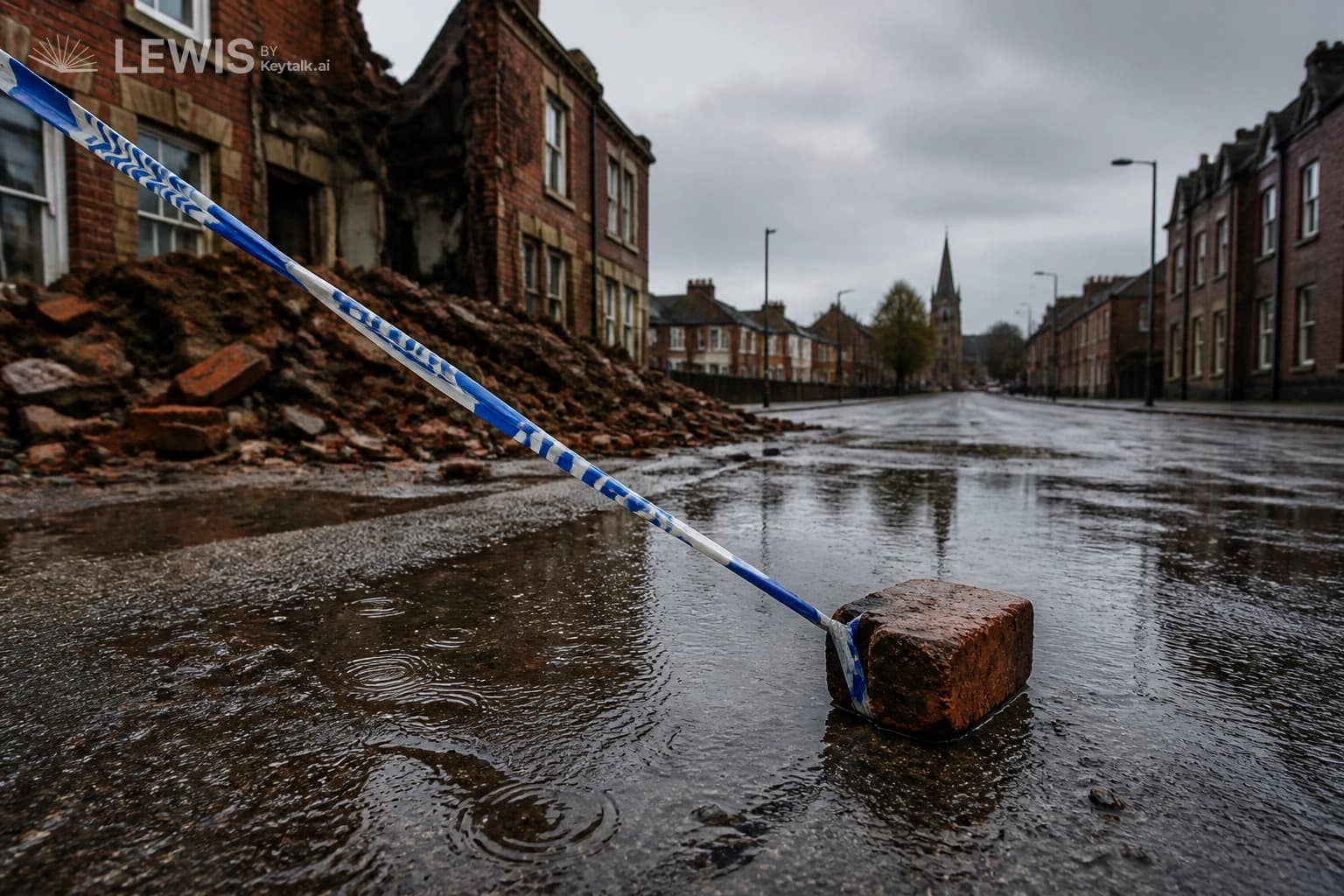
Police tape stretches across slick asphalt beneath a flat autumn sky, with a heap of broken bricks spilling past it into rainwater-silver puddles. A single brick pins a twisted length of tape to the road; each gust pulls the strip taut without lifting it free.

Rain strikes the rubble beneath shouted orders, while the guarding officer stands between the debris and the open stretch of street, his raised arm filling the gap beneath the tape.

location 4 image

The Bakery Across the Cordon

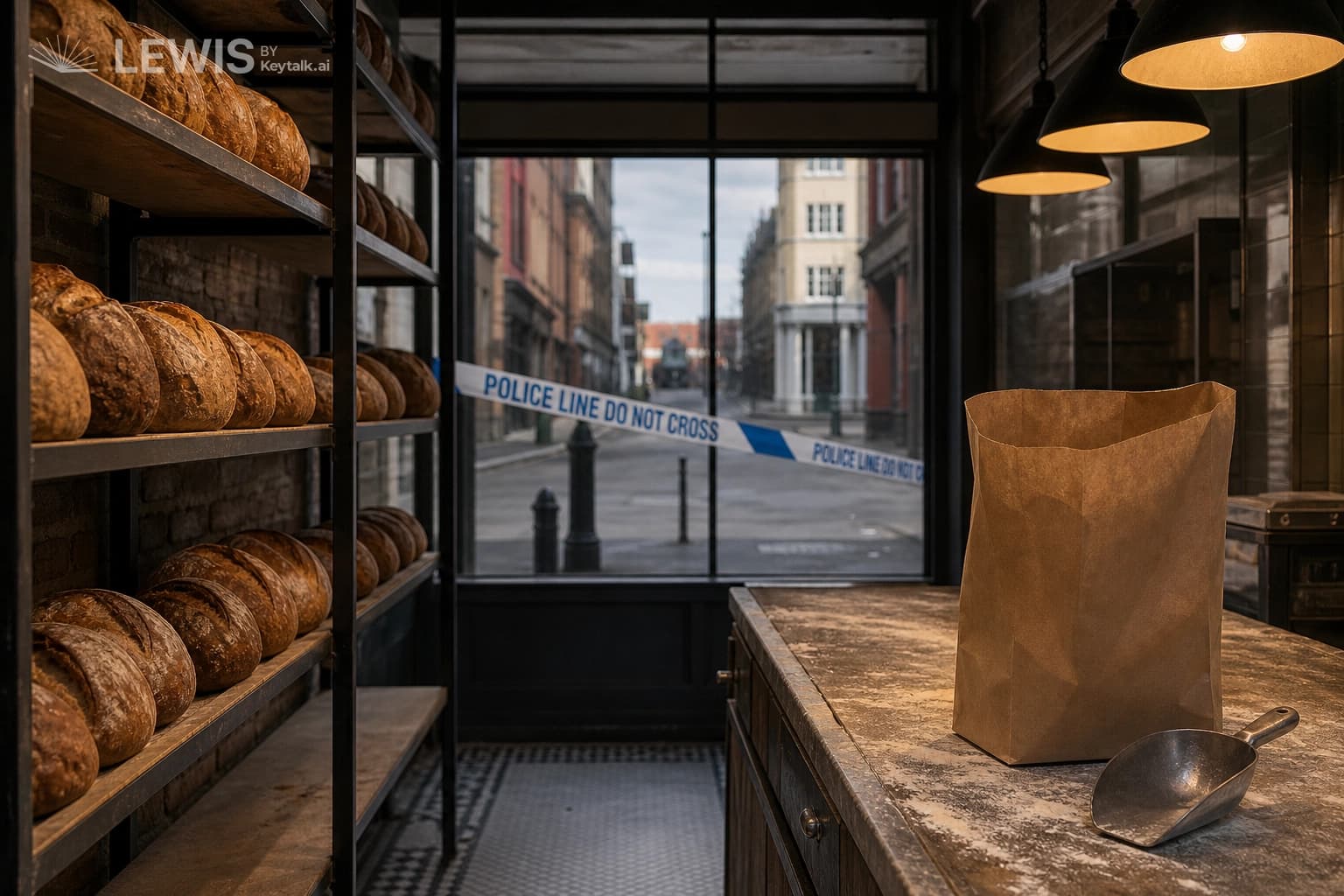
The bakery’s narrow aisle runs between bread-crust-gold loaves and a flour-dusted counter, where warm light catches a paper bag held open beneath the scoop. Customer chatter stops abruptly; faces turn toward the front window, and the bag remains unfilled.

Across the lower pane, police tape cuts through the view at throat height, leaving everyone inside to watch the rescue through the strip of glass above it.

location 5 image

The Judicial Review Room

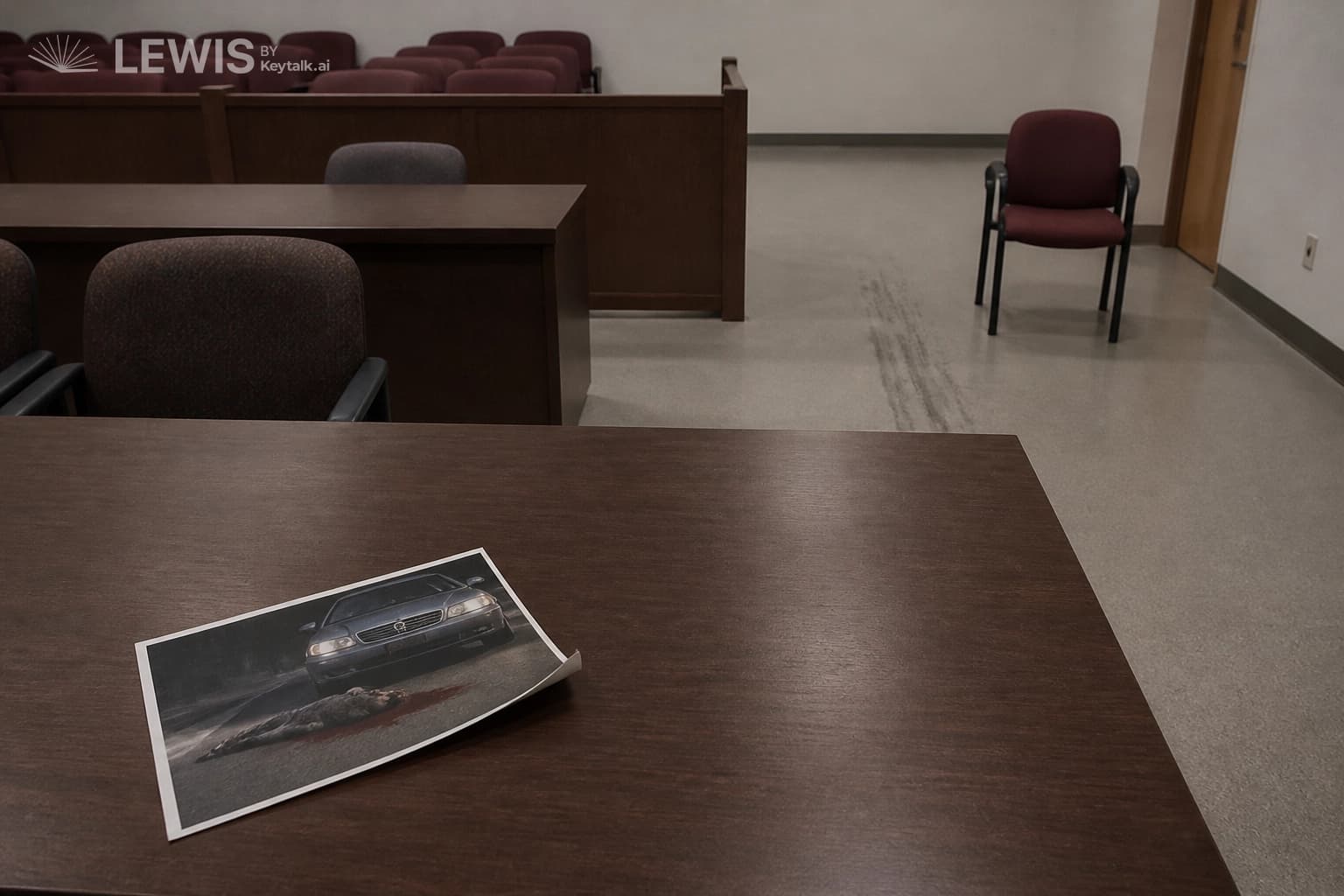
Dull cream walls enclose the upper-floor hearing room, where fluorescent light exposes every worn thread in the chairs’ woven upholstery and leaves no shadow beneath the panel’s smooth laminate table.

Two parallel scuff marks run back from the chair beside the lawyer’s place, ending level with the solitary witness chair across a bare stretch of floor. Chair legs drag loudly before each measured question; on the table, an uncropped photograph lies beneath the light, its curled corner casting the room’s smallest shadow.


Scenes

Scene by scene

Chapter 01

Scene 01· Weeks after the rescue, at the opening of Scott Hopper’s judicial review.

Level with the Witness

Level with the Witness
PlaceThe Judicial Review Room
TimeWeeks after the rescue, at the opening of Scott Hopper’s judicial review.
ActionScott Hopper drags the chair offered beside his lawyer’s place backward until it stands level with the witness chair. He leaves the photograph untouched and reads the question before him aloud. Instead of answering whether he would cross the police cordon again, he asks to begin with the morning’s events.
ImpactScott gives up the sheltered position offered at the table without disputing the evidence against him. His request delays the answer but commits his account to a starting point before the rescue: the courtroom and the people he left waiting. The question remains open.

Scott Hopper drags his offered chair back from the laminate table in the upper-floor Judicial Review Room, its legs scraping two pale tracks across the floor. He stops level with the witness chair, leaving the place beside his lawyer’s empty. Fluorescent light exposes the worn upholstery and the curled corner of the photograph still lying within reach on the table.

Scott Hopper bends forward over the photograph without picking it up: his own hand reaches past an officer toward a narrow entrance, while the officer’s arm cuts across his chest. He sets his open hand beside the photographed one, then withdraws it to his knee. “Would I cross the cordon again?” he reads aloud from the question before him.

Scott Hopper pulls the chair a final inch backward; the photograph is now beyond his reach. “Before I answer, may I explain that morning—starting in my courtroom?” He sits with both shoes planted beside the fresh scuff marks and his hands empty.

Scene 02· Late morning on the rain-soaked autumn weekday, recalled at the review

Before the Side Door Closed

Before the Side Door Closed
PlaceThe Vacant-Bench Courtroom and consultation room behind the bench
TimeLate morning on the rain-soaked autumn weekday, recalled at the review
ActionScott Hopper closes a case file only after allowing the frightened defendant’s statement to finish, then denies the request for more time. He leaves the bench to answer a police call in the consultation room. Told that Valerie Hopper was detained for breaking into Bellwether Court and has returned inside for her father, he pulls the consultation-room door shut.
ImpactScott’s account establishes that his ordinary courtroom practice continued until the call interrupted it. The news puts his wife inside the condemned building whose eviction he upheld, while another case remains waiting outside. He has not yet arranged coverage or removed his robe.

Scott Hopper closes the case file on the tobacco-brown bench, carrying his account back to that morning’s second-floor courtroom. Beneath the wired-glass windows, narrow daylight falls across the public benches; the clock above the exit has passed noon. He leaves his hand on the cover until the frightened defendant’s last words die away, then says, “Your request for more time is denied.”

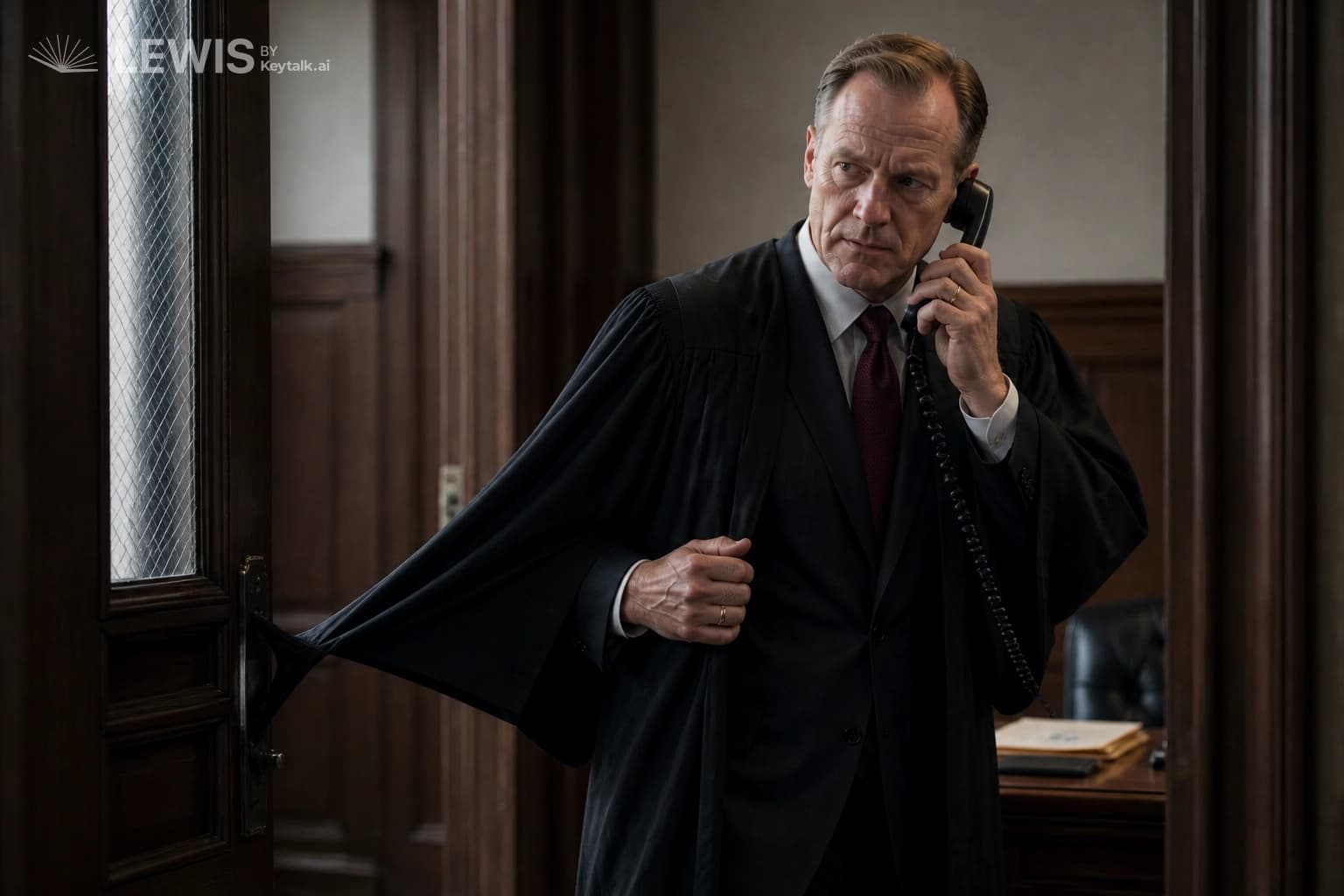
He places the file beside the waiting docket and rises to take the police call behind the bench, leaving his chair turned toward the side door. In the consultation room, he lifts the telephone receiver while his robe catches against the door latch. The voice on the line reports that Valerie Hopper was detained for breaking into Bellwether Court, slipped away from the officers, and went back inside for her father.

“Is she out now?” Scott Hopper asks. The answer is no; her father is still inside with her. Scott Hopper frees his sleeve from the latch and pulls the door shut, leaving the next case’s unopened file on the bench.

Scene 03· Just after noon, during the rain-soaked autumn weekday

The Empty Chair

The Empty Chair
PlaceThe Vacant-Bench Courtroom and consultation room
TimeJust after noon, during the rain-soaked autumn weekday
ActionScott Hopper uses the consultation-room telephone to arrange coverage for his waiting docket. He requests no intervention in Valerie Hopper’s case and gives no instructions to the police. He removes his robe, hangs it beside unused court forms, and leaves through the side door without returning to the bench.
ImpactScott’s departure becomes an action he must account for, separate from whatever happens at Bellwether Court. The waiting cases have been assigned coverage, but his own chair remains empty. He leaves for his family without carrying any authority to control the rescue or its legal consequences.

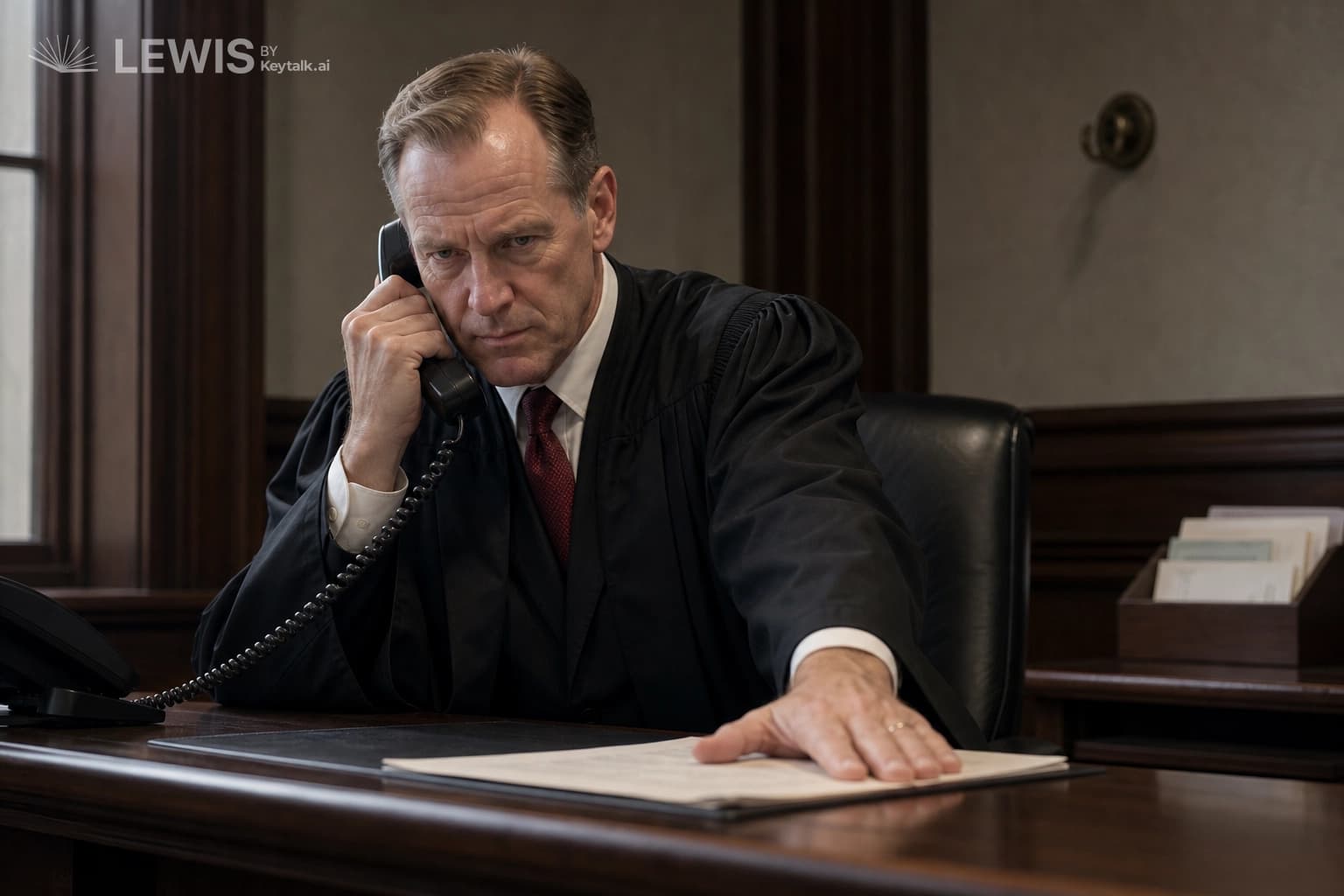
Scott Hopper presses the telephone’s cradle, ends the police call, and places a call to arrange coverage from the consultation room behind the bench. His robe pulls tight across his shoulders as he reaches for the docket sheet beside the telephone. “I need coverage for the remaining cases,” he says, holding the sheet flat with his free hand.

He waits with the receiver against his ear, then reads out the next case number and the matters still awaiting hearings. “A family emergency. I cannot give you a return time.” After the coverage is confirmed, he replaces the receiver without placing another call.

Scott Hopper pulls off his robe and hangs it on the wall hook, where one sleeve settles against a box of unused court forms. He opens the door, puts the docket sheet beside the unopened file on the bench, and leaves through the side door. The door closes behind him; beneath the clock, his empty chair stays turned toward it.

Chapter 02

Scene 04· Shortly after noon, twelve minutes after Scott leaves the courthouse

A Pair of Hands

A Pair of Hands
PlaceThe Fallen-Brick Police Cordon, outside Bellwether Court
TimeShortly after noon, twelve minutes after Scott leaves the courthouse
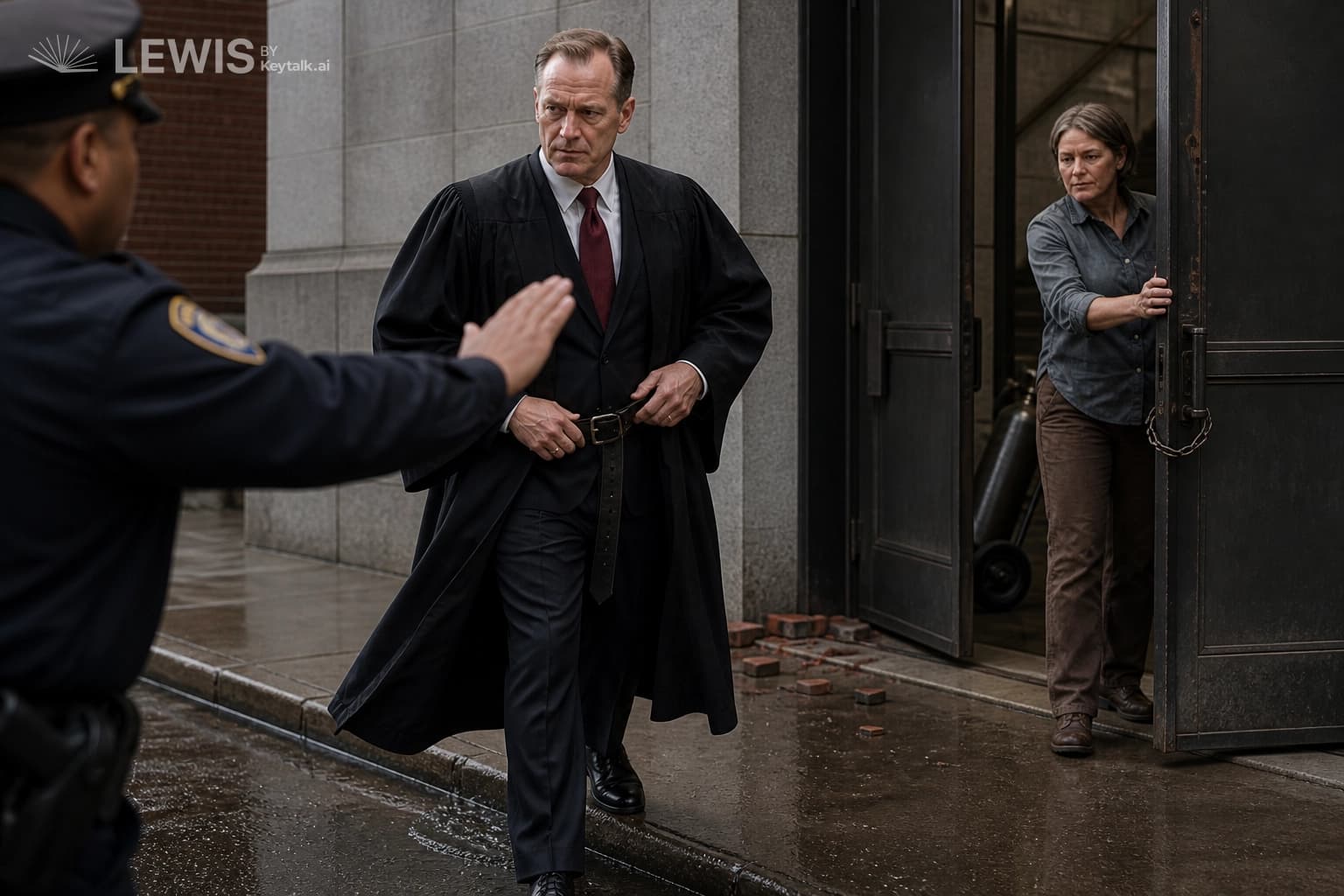
ActionScott Hopper advances toward the chained entrance, but the guarding officer blocks him beside the fallen bricks. Valerie Hopper calls through the door gap for something to fasten her father’s oxygen cylinder to the stair rail. Scott unbuckles his belt and begins pulling it free, turning her request into a practical offer without obtaining permission to approach.
ImpactScott now has something Valerie can use, but the cordon keeps it beyond her reach. His first attempt to help stops at the officer’s arm rather than at the building’s door. The cylinder continues catching on the steps while Scott works the belt out of his clothing.

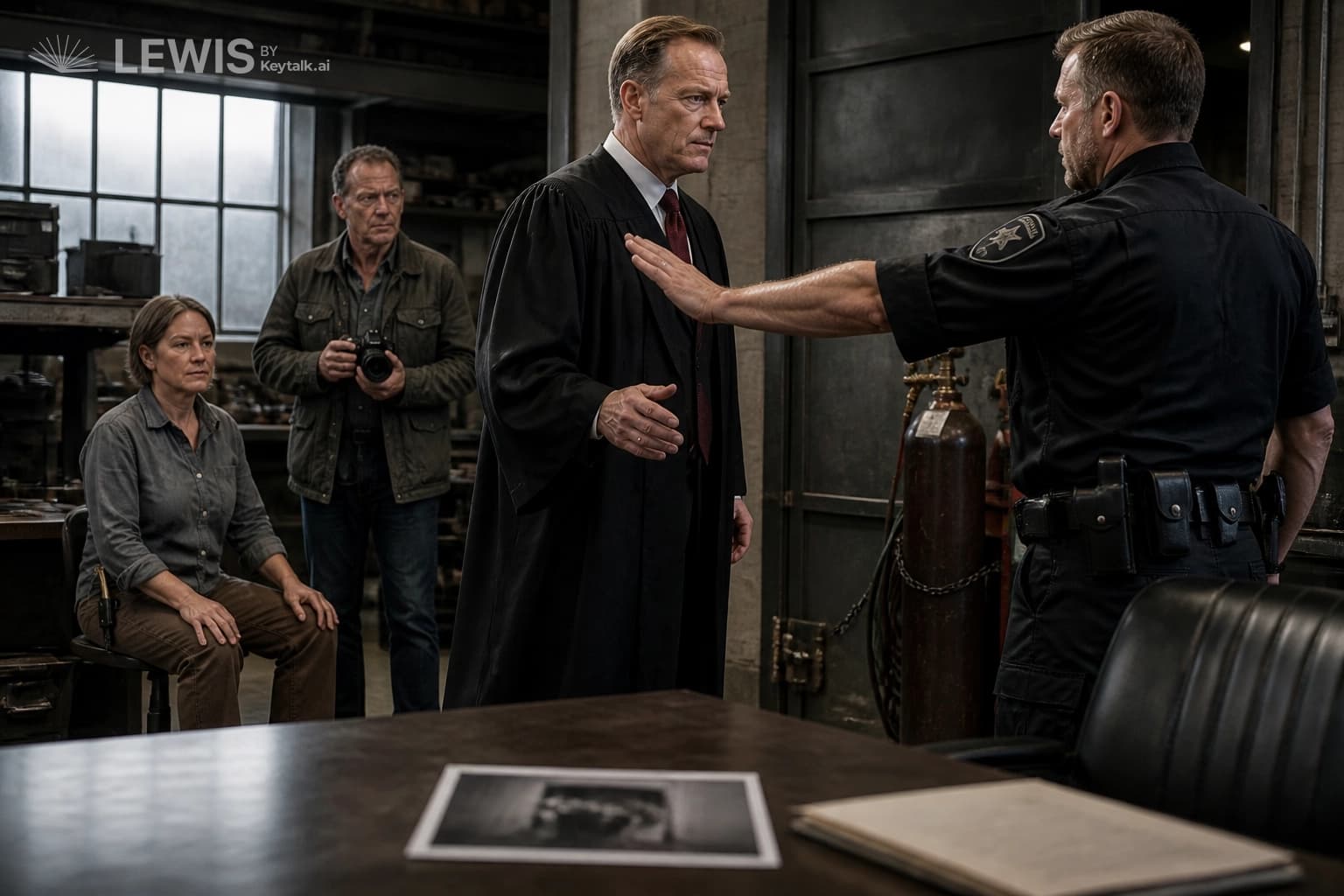
Scott Hopper steps toward Bellwether Court’s entrance, and the guarding officer thrusts an arm across his path beside the heap of fallen bricks. Scott stops with one shoe at the edge of a rainwater-filled hollow; farther along the police tape, a brick pins a twisted strip to the asphalt. Morris Connor catches Scott’s sleeve and draws him half a step away from the rubble.

Through the hand-width gap between the chained doors, Valerie Hopper reaches toward Scott, then withdraws her hand as the oxygen cylinder scrapes against a stair tread. “Something to fasten this to the rail,” she calls. “I need both hands for Dad.”

Scott pulls his sleeve free of Morris’s fingers, opens his coat, and unbuckles his belt. “Officer, I understand—can you get this to her?” he asks, drawing the leather through the first loop while the officer keeps his arm across the approach. Beyond that arm, Valerie’s fingers reappear against the door edge; Scott pulls again, leaving the brass buckle hanging over the wet road.

Scene 05· Just after noon, during the rain-soaked evacuation

The Door Opens Inward

The Door Opens Inward
PlaceThe Fallen-Brick Police Cordon and Bellwether Court’s Chained Entrance
TimeJust after noon, during the rain-soaked evacuation
ActionValerie Hopper pulls one door against its chain, trying to widen the gap for Scott Hopper’s belt. Scott asks her to locate herself, her father, and the lock before anyone pushes from outside. Her answers establish that the doors open toward her and that her father chained the handles but cannot find the key. Scott withdraws his extended belt when the guarding officer points toward the split lintel.
ImpactThe belt is free of Scott’s clothing, but the entrance cannot safely receive it or another person. The officer’s refusal now has a visible cause: opening the doors by force could strike Valerie, while approaching beneath the damaged lintel could leave another person trapped. Scott stops advancing without putting the belt away.

Valerie Hopper pulls the door toward herself until the chain jerks tight between the handles, widening the gap barely enough to show her teal sleeve beneath Bellwether Court’s split lintel. At the police cordon, Scott Hopper draws his belt through the last loop and extends the leather past the guarding officer’s arm. Morris Connor catches the dangling buckle before it drops into the puddle, then places it in Scott Hopper’s palm.

“Where are you standing, Valerie—and where is your father?” Scott Hopper asks, lowering the belt. Valerie Hopper braces the door with her shoulder and answers, “At the bottom step, behind this door; Dad’s beside the rail.” She lifts the chain into the gap: “He locked the handles together, and he can’t find the key.”

Scott Hopper angles the belt toward the opening, but Valerie Hopper releases the door to catch the cylinder as it slips against a tread; the gap narrows and hides her wrist. The guarding officer blocks Scott Hopper’s next step and points from the door to the split lintel. “It opens into her,” Scott Hopper says, drawing the leather back against his coat. Morris Connor releases Scott Hopper’s sleeve and lifts his camera while Scott Hopper closes his fist around the unused buckle.

Scene 06· Rain-soaked autumn afternoon, immediately after Scott frees his belt

Keep the Door in Frame

Keep the Door in Frame
PlaceThe Fallen-Brick Police Cordon, outside Bellwether Court’s Chained Entrance
TimeRain-soaked autumn afternoon, immediately after Scott frees his belt
ActionScott Hopper asks Morris Connor to lower his camera. Morris refuses and backs across the slick asphalt, keeping Scott, the guarding officer, and the chained entrance together in frame despite his editor’s request for a close-up. Scott begins to argue, but Valerie Hopper calls from behind the doors and turns him back toward the rescue.
ImpactScott’s request for privacy costs time without securing either privacy or access. Morris keeps the blocked doorway in the record rather than isolating Scott’s face. Scott ends the exchange with the belt still unused and Valerie still beyond his reach.

Morris Connor backs across the slick asphalt with his camera raised as Scott Hopper reaches toward the lens, the loose belt trailing from Scott’s other hand. Rain beads on Morris’s repaired camera strap; behind Scott, the pinned police tape strains beside the fallen bricks. “Lower it, Morris,” Scott says, holding his palm between the camera and his face.

Morris steps sideways until Scott’s hand no longer blocks the chained entrance. His phone sounds, and he answers on speaker without lowering the camera; when his editor requests a close-up, Morris says, “I’m keeping the door.” Scott drops his raised hand and takes a step toward him. “You can give us this much—”

“Scott!” Valerie Hopper’s fingers hook around the narrow door edge, then slip back inside as the cylinder scrapes against a tread. Scott turns away from Morris with the rest of his sentence unspoken. He lifts the belt toward Valerie’s vanished hand and stops behind the guarding officer’s arm, its brass buckle hanging short of the door.

Chapter 03

Scene 07· Rain-soaked autumn afternoon, immediately after Valerie calls Scott back

Cutters in the Rain

Cutters in the Rain
PlaceBellwether Court’s Chained Entrance and the Fallen-Brick Police Cordon
TimeRain-soaked autumn afternoon, immediately after Valerie calls Scott back
ActionA firefighter carries bolt cutters toward the chained entrance while Scott Hopper holds out his loose belt behind the guarding officer’s arm. Valerie Hopper lifts the chain toward the opening, but fresh dust spills from the split lintel before the cutters can reach it. The lead responder orders a retreat, and the firefighter withdraws with the chain still intact. Morris Connor moves sideways across the wet asphalt to photograph the withdrawal without losing the doorway.
ImpactThe attempt to open the entrance stops before the chain is cut. Scott’s belt remains outside while Valerie must turn back to her father and the oxygen cylinder. The responders’ withdrawal leaves Scott trying to help through the same narrow gap, now beneath visibly worsening masonry.

The firefighter advances past Scott Hopper’s outstretched belt with bolt cutters held low, their steel jaws passing above the rain-filled hollow beside Bellwether Court’s entrance. Scott Hopper folds the dangling leather into his palm to clear the approach, but the guarding officer keeps an arm across his chest. Through the gap, Valerie Hopper raises the chain until its bright, worn link catches against a door handle.

Before the firefighter can set the jaws around it, a sheet of dust pours from the split lintel onto the cutters and Valerie Hopper’s sleeve. “Back—withdraw,” the lead responder calls. The firefighter pulls the tool away and retreats across the threshold’s gritty apron, leaving the lifted chain untouched.

Morris Connor steps sideways on the slick asphalt, keeping the retreating firefighter and Valerie Hopper’s hand in the same frame. Scott Hopper raises his belt again, but Valerie Hopper drops the chain and reaches inside as the oxygen cylinder strikes a tread. The firefighter lowers the unopened cutters beside the rubble; beyond them, Valerie Hopper’s fingers close around the door edge.

Scene 08· Rain-soaked afternoon, immediately after the responders withdraw

What the Suitcase Holds

What the Suitcase Holds
PlaceBellwether Court’s Chained Entrance
TimeRain-soaked afternoon, immediately after the responders withdraw
ActionValerie Hopper tries to draw her father away from the banister, but his fixed grip stops them at the bottom step. She calls through the chained doors that he refuses to leave without his suitcase. Scott Hopper offers to replace its contents; the reply from inside names Scott’s signature as the thing that already took his home. Morris Connor keeps the doorway in frame as Scott’s outstretched belt drops back toward his coat.
ImpactScott’s offer fails to move Valerie’s father or free her hands. The eviction ruling enters the rescue as a direct accusation, leaving Scott poised to defend himself while Valerie continues supporting her father. The chain remains intact, and the suitcase keeps them inside without ever appearing through the gap.

Valerie Hopper pulls at her father’s arm inside Bellwether Court’s chained entrance, then catches the door edge as his grip on the banister stops her. Her teal sleeve presses into the hand-width opening, streaked with plaster from the responders’ abandoned approach. “He won’t let go, Scott—he wants his suitcase.”

Scott Hopper unfolds his belt and holds it toward her, the brass buckle resting on his open palm. “Leave it. I’ll replace what’s inside.” Valerie Hopper turns from the gap and repeats the offer; Morris Connor shifts his camera past Scott Hopper’s shoulder without cutting the chained handles out of the frame.

From behind the door comes her father’s reply: “Your signature already took my home.” Scott Hopper draws the buckle back, opens his mouth, and raises his empty hand toward the gap. Valerie Hopper reaches inward again; her sleeve slides out of sight while Scott Hopper’s raised hand remains outside.

Scene 09· Rain-soaked afternoon, immediately after the accusation

No Answer Through the Door

No Answer Through the Door
PlaceBellwether Court’s Chained Entrance
TimeRain-soaked afternoon, immediately after the accusation
ActionScott Hopper lowers his raised hand and closes it around the unused belt instead of defending his eviction ruling. He asks Valerie Hopper where she can place her father’s next foot, and she braces the door to answer while reaching back toward him. A beam cracks overhead, pulling her away from the opening. Morris Connor keeps the camera raised as her hand disappears.
ImpactScott abandons an argument that cannot move anyone toward the exit and gives Valerie a practical instruction instead. Before she can complete the movement, the failing structure interrupts them. The chain remains intact, and Scott loses even the narrow view through which he has been trying to help.

Scott Hopper lowers his empty hand and clamps it around the folded belt outside Bellwether Court’s chained entrance, trapping the brass buckle between his palms. Rain darkens the leather while Valerie Hopper’s sleeve brushes back into the narrow opening. “Where can you put his next foot?” Scott Hopper asks, leaving the accusation unanswered.

Valerie Hopper hooks her fingers over the door edge and reaches behind her with her other arm. “Bottom step—if I can get him to turn.” She pulls inward; the door shifts against the chain, and the oxygen cylinder knocks against a tread. Behind Scott Hopper, Morris Connor raises his camera a fraction to keep her fingers above his shoulder in the frame.

A beam cracks above the stairs, and Valerie Hopper’s fingers jerk off the edge as she turns inside. Fresh plaster drops through the gap; Scott Hopper thrusts the belt forward, but its buckle hangs short of the threshold. Morris Connor keeps the camera raised while the chain draws taut between the handles and Valerie Hopper’s hand does not return.

Chapter 04

Scene 10· Rain-soaked afternoon, immediately after the beam cracks.

Caught Before the Door

Caught Before the Door
PlaceBellwether Court’s Chained Entrance and the Fallen-Brick Police Cordon
TimeRain-soaked afternoon, immediately after the beam cracks.
ActionScott Hopper ducks beneath the guarding officer’s arm, carrying the belt toward the chained entrance. The officer catches him short of the doors. Scott stops pulling against the grip, warns that opening the doors by force would strike Valerie Hopper, and asks to be arrested after she is outside. Morris Connor keeps the restraint and entrance in the same frame.
ImpactScott has crossed the cordon, but the officer prevents him from reaching Valerie. His request does not grant him permission or remove the threat of arrest. The chain remains intact, and the belt remains outside.

Scott Hopper ducks beneath the guarding officer’s arm and lunges toward Bellwether Court’s chained entrance, the loose belt swinging above the rain-dark bricks. The officer catches his upper arm and pulls him short of the threshold; the brass buckle strikes Scott Hopper’s trouser leg. Scott Hopper twists toward the hand-width opening, but the officer plants a foot between his shoes and the doors.

Scott Hopper stops pulling and opens his empty hand toward the chained handles. “Don’t push them—Valerie’s behind the door.” Inside, Valerie Hopper presses her dusty teal sleeve into the gap, then withdraws it as the oxygen cylinder knocks against the bottom step.

“Arrest me after she’s outside,” Scott Hopper says, lowering his open hand without putting away the belt. Morris Connor steps sideways across the slick asphalt and presses the shutter, keeping the officer’s grip and the narrow opening visible beside Scott Hopper’s shoulder. Fresh plaster falls onto the threshold while the officer holds Scott Hopper back, his belt hanging within inches of the uncut chain.

Scene 11· Rain-soaked afternoon, immediately after Scott is restrained

Two Free Hands

Two Free Hands
PlaceBellwether Court’s Chained Entrance
TimeRain-soaked afternoon, immediately after Scott is restrained
ActionThe lead responder authorizes a brief entry when Valerie moves beneath the falling plaster. The firefighter cuts the chain, and Scott and the guarding officer control the inward-opening doors while Valerie moves clear. Scott fastens the oxygen cylinder to the stair rail with his belt, freeing Valerie to help lift her father.
ImpactThe entrance is open, and Valerie no longer has to divide her strength between her father and the cylinder. Scott can now give the help she requested, but the officer remains beside him and the ceiling continues shedding plaster. They lift her father off the bottom step without his suitcase; the threshold is still ahead.

The firefighter closes the bolt cutters around the bright link at Bellwether Court’s entrance as the lead responder points toward Valerie Hopper’s moving sleeve and calls, “Brief entry—get them out.” The chain breaks onto the gritty threshold, and the guarding officer releases Scott Hopper’s arm to catch one door while Scott Hopper grips the other. “Move clear, Valerie,” Scott Hopper says, holding the door until her shoulder disappears behind its edge.

Scott Hopper steps inside and crouches beside the oxygen cylinder, threading his rain-dark belt around its neck below the valve and through the stair rail. Valerie Hopper keeps her father braced against her hip while Scott Hopper pulls the leather tight and seats the buckle tongue. She opens her hand beneath the cylinder; it drops an inch, then hangs against the rail with its tubing clear.

Valerie Hopper immediately puts her freed hand beneath her father’s arm, and Scott Hopper takes his weight from the other side. Together they lift him from the bottom tread, leaving the suitcase against the banister as fresh plaster strikes its lid. Beyond the open doors, Morris Connor raises his camera to include the guarding officer holding their exit clear.

Scene 12· Moments after the chain is cut, during the rain-soaked autumn evacuation

The Offered Wrists

The Offered Wrists
PlaceBellwether Court’s entrance and the wet pavement beyond the cordon
TimeMoments after the chain is cut, during the rain-soaked autumn evacuation
ActionScott Hopper and Valerie Hopper carry her father across the threshold into the firefighter’s arms. The guarding officer pulls Scott clear as ceiling debris strikes the entrance behind him. Once paramedics have settled her father and secured his oxygen supply, Valerie presents her wrists to the officer. Scott follows, and Morris Connor photographs both arrests.
ImpactThe rescue succeeds, but Scott’s request to delay arrest has reached its limit. Neither spouse asks for special treatment or tries to stop Morris from recording what follows. The chapter closes with their father safely under medical care and both spouses in custody.

Scott Hopper and Valerie Hopper lift her father across Bellwether Court’s gritty threshold, passing his weight into the firefighter’s arms beneath the split lintel. As Valerie follows him out, the guarding officer catches Scott by the back of his collar and hauls him onto the wet pavement. Ceiling debris strikes the floor behind Scott’s heels; the open door jolts against its stop.

Scott pushes himself upright while the firefighter retrieves the cylinder from the lowest stair rail, releasing the belt and carrying the oxygen supply clear. Valerie walks beside her father until the paramedics lower him onto a stretcher and check his tubing. She reaches toward his blanket, but a paramedic draws it over his knees before her hand arrives. The guarding officer approaches, plaster caught along the shoulder of his uniform.

Valerie turns from the stretcher and holds out both wrists. Scott steps beside her and extends his own hands without speaking. Across the rain-pinned police tape, Morris Connor raises his camera; neither spouse turns away as the officer closes the cuffs.

Chapter 05

Scene 13· Weeks after the rescue, before the first community-service shift

The Chair Within Reach

The Chair Within Reach
PlaceThe Vacant-Bench Courtroom
TimeWeeks after the rescue, before the first community-service shift
ActionScott Hopper moves a chair below the witness stand’s step so an elderly witness can give evidence without climbing. Valerie Hopper brings their community-service instructions to the side door, but Scott does not leave with her. He resumes the docket while she waits to drive them to their assigned shift.
ImpactScott returns to judicial work without removing the penalties imposed on either spouse. His practical adjustment lets the waiting testimony proceed rather than making the witness struggle to fit the room. The review panel’s question remains unanswered; neither his return nor this small act closes the record.

Scott Hopper pulls a chair from beside the tobacco-brown bench and sets it below the witness stand’s step as the elderly witness grips the rail. Thin daylight through the wired glass stripes the witness’s buttoned coat and the papers held against it. Scott Hopper turns the chair toward the bench, leaving its seat within reach of the hand on the rail.

“Please sit here,” Scott Hopper says, stepping back rather than offering an arm the witness has not requested. The witness releases the rail and sits, laying the papers across both knees. At the open side door, Valerie Hopper holds out two community-service instruction sheets, each bearing one spouse’s name beneath the printed reporting time. Scott Hopper takes his copy, folds it once, and places it beneath his closed appointment book.

“We have to leave on time,” Valerie Hopper says, keeping her own sheet in her hand. Scott Hopper nods, returns behind the bench, and opens the next file while Valerie Hopper withdraws beyond the side door. “Please continue,” he says; below the unused step, the witness lifts the first page.

Scene 14· Weeks after the rescue, during Scott Hopper’s review

Nothing Outside the Frame

Nothing Outside the Frame
PlaceThe Judicial Review Room
TimeWeeks after the rescue, during Scott Hopper’s review
ActionMorris Connor places the uncropped photograph on the panel’s table, exposing the officer’s restraint and the blocked doorway together. Valerie Hopper confirms that she asked Scott Hopper for practical help, not intervention in her case. Scott leaves both accounts unqualified and steps onto the bare floor at the guarding officer’s direction to demonstrate his crossing.
ImpactThe photograph enters the review without the framing Scott once requested from his friend. Valerie’s statement does not excuse his conduct, and Scott offers no correction that would turn it into an excuse. His account now gives way to a physical demonstration controlled by the officer he passed.

Morris Connor slides the uncropped photograph across the laminate table toward Scott Hopper in the Judicial Review Room, then withdraws his hand from its curled corner. Beneath the fluorescent light, the officer’s grip, Scott Hopper’s reaching hand, and the chained entrance occupy the same print. Scott Hopper moves his folded account aside, leaving the photograph unobstructed.

Valerie Hopper draws her chair forward across the worn floor and places both hands on her knees. “I asked Scott for help with the cylinder, not help with my case,” she says. Scott Hopper opens his mouth, closes it, and lowers his hand from the edge of the table.

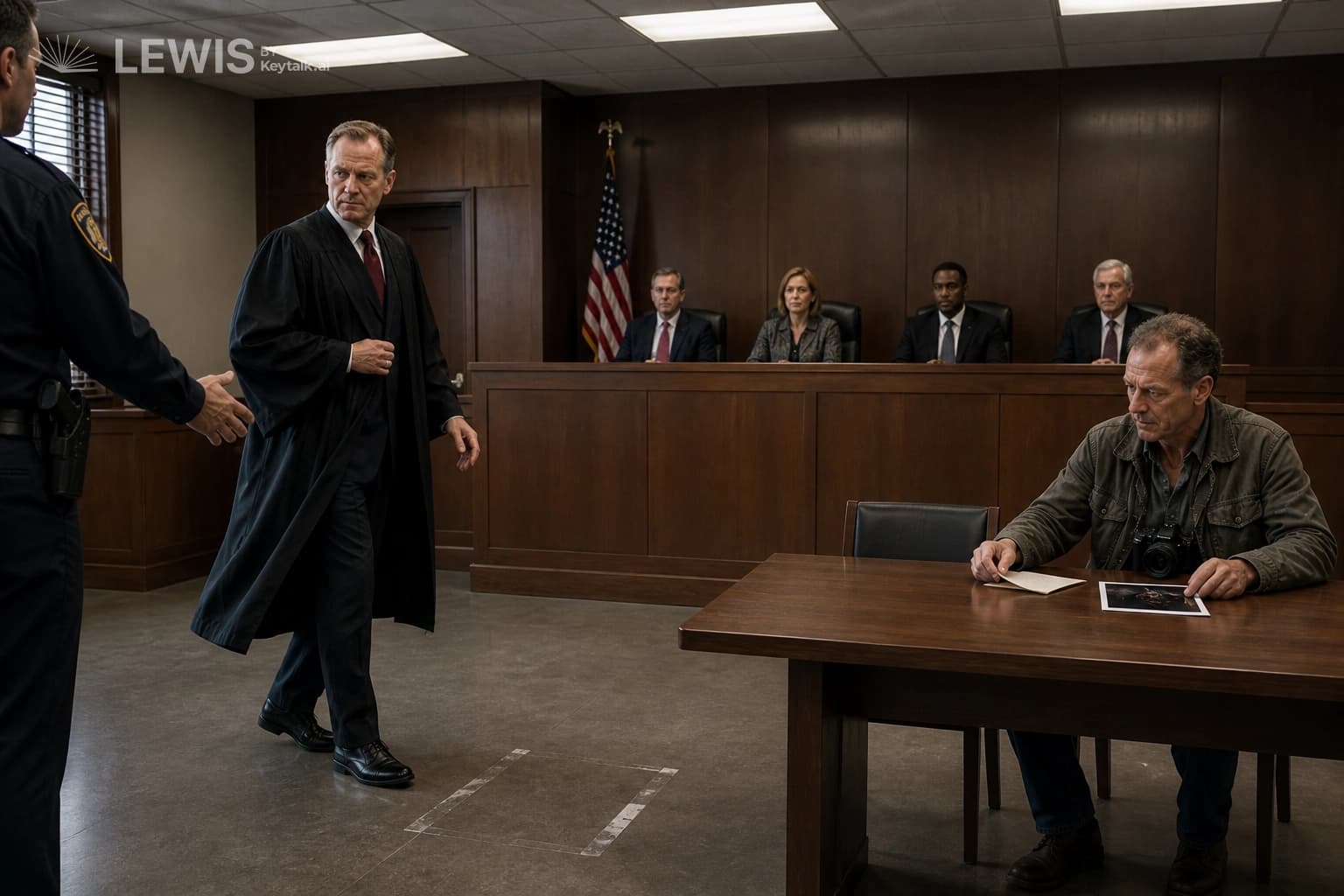
The guarding officer points to a place on the bare floor between the chairs and raises his arm to the height shown in the photograph. Scott Hopper gets up without moving the print or looking toward Morris Connor. He steps into the indicated space and stops with the officer’s forearm across his path.

Scene 15· Moments after the officer begins the demonstration

The Answer Stays

The Answer Stays
PlaceThe Judicial Review Room
TimeMoments after the officer begins the demonstration
ActionScott Hopper steps back from the officer’s extended arm to the scuff marks beside his chair. When the panel repeats its question, he answers “Yes” and sits. Valerie Hopper withdraws a hand she has begun to extend toward him, while Morris Connor keeps the uncropped photograph exposed. Scott lets the officer finish describing the danger without interrupting.
ImpactScott commits his answer to the record without disputing the evidence against him. Neither the rescue nor the penalties already imposed brings the examination to an early close. The hearing ends without a ruling that promises to protect his position.

Scott Hopper steps back from the guarding officer’s forearm and returns to the parallel scuff marks in the Judicial Review Room, leaving the bare floor clear for the demonstration. Under the fluorescent light, Morris Connor moves Scott Hopper’s folded account farther from the photograph’s curled corner. The panel repeats the question: “Would you cross the cordon again?”

“Yes,” Scott Hopper says. He sits, the chair legs scraping across the floor, without turning toward Valerie Hopper or Morris Connor. Valerie Hopper reaches toward his sleeve, then draws her hand back onto her knee.

The guarding officer plants his foot where he stopped Scott Hopper and shows how reaching for him left less room to retreat from the falling masonry. Scott Hopper keeps both hands open on his thighs until the officer finishes and the panel closes the hearing without announcing a decision. Morris Connor leaves the uncropped photograph on the laminate table as Valerie Hopper rises beside Scott Hopper’s chair.

'His Own Worst Defendant'Story Chat

Want to chat with the characters from this story?

'His Own Worst Defendant'Story Chat

Want to chat with the characters from this story?

story image
story image
story image

Story details

Made with

Models

  • GPT-6.1 Soltext
  • Stable Diffusionimage
  • gpt_image_2image

Keytalk

Comments

Comments · 0

theme music