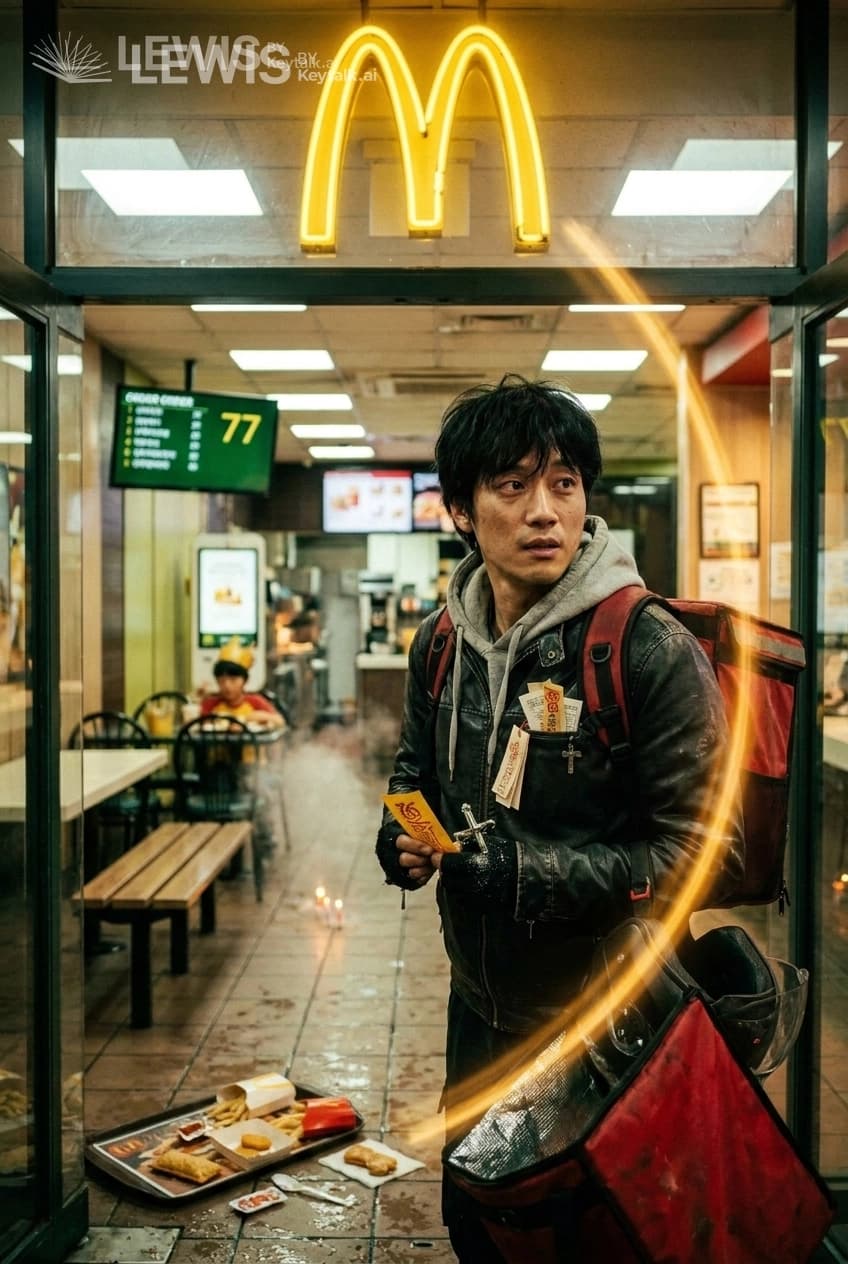
Keytalk Original · 15 scenes · 5 chapters

Don’t Read the Receipt—It’s Writing You

At the very edge of the afterlife, a night-shift convenience store hawks one last craving to each soul just before it crosses over, and every receipt is a prophecy no one is meant to read. A new clerk—an accidentally living girl—discovers that the items she stocks aren’t just comfort; they’re stitched from memories that should have been released.

When her first overnight run requires her to ring up a return customer who never pays, she learns the “regular” is not a customer at all, but Death wearing a name-tag.

As the register begins to count down to her own eligibility to cross, she must decide whether to serve the craving that keeps her alive or the truth that could unmake a bargain the universe has already signed.

  • 5 characters
  • 5 locations
  • 15 scenes
  • Plot 17,928 chars
Don’t Read the Receipt—It’s Writing You cover image

Characters

The riders

Elowen “Eli” Marr

Female

Night-shift convenience clerk (accidentally living) and inventory runner for the edge-store

Profile

Eli wants a simple job that lets her pretend she still belongs in the living world, but her register shifts like a bruise whenever she touches items stitched from memories that should’ve been released—especially when those memories might help her remember her own name. As the store’s countdown ticks toward her eligibility to cross, she must keep working while fearing that learning the rules will erase the last version of herself that can say who she is.

Eli smiles like it’s part of the uniform—quick, practiced, almost cheerful—but her hands flinch at the wrong product, and the bruise-shift spreads through her forearm when memory clings to her. She lies to customers with comforting scripts, yet her internal voice keeps trying to bargain with the store’s systems: *if I do this right, maybe I won’t disappear*, even as every correct procedure feels like a trap springing shut.

Background

Eli wandered in from the living world by mistake during a night when she couldn’t sleep and didn’t know why she’d been drawn to a building that shouldn’t exist; the first receipt she ever saw carried her own name scratched out in someone else’s handwriting.

Before she was hired, she learned to survive on the margins—staying away from the shelves where returns are audited—until the shift rules demanded she touch those memory-woven items, and the “regular” began asking after her.

Description

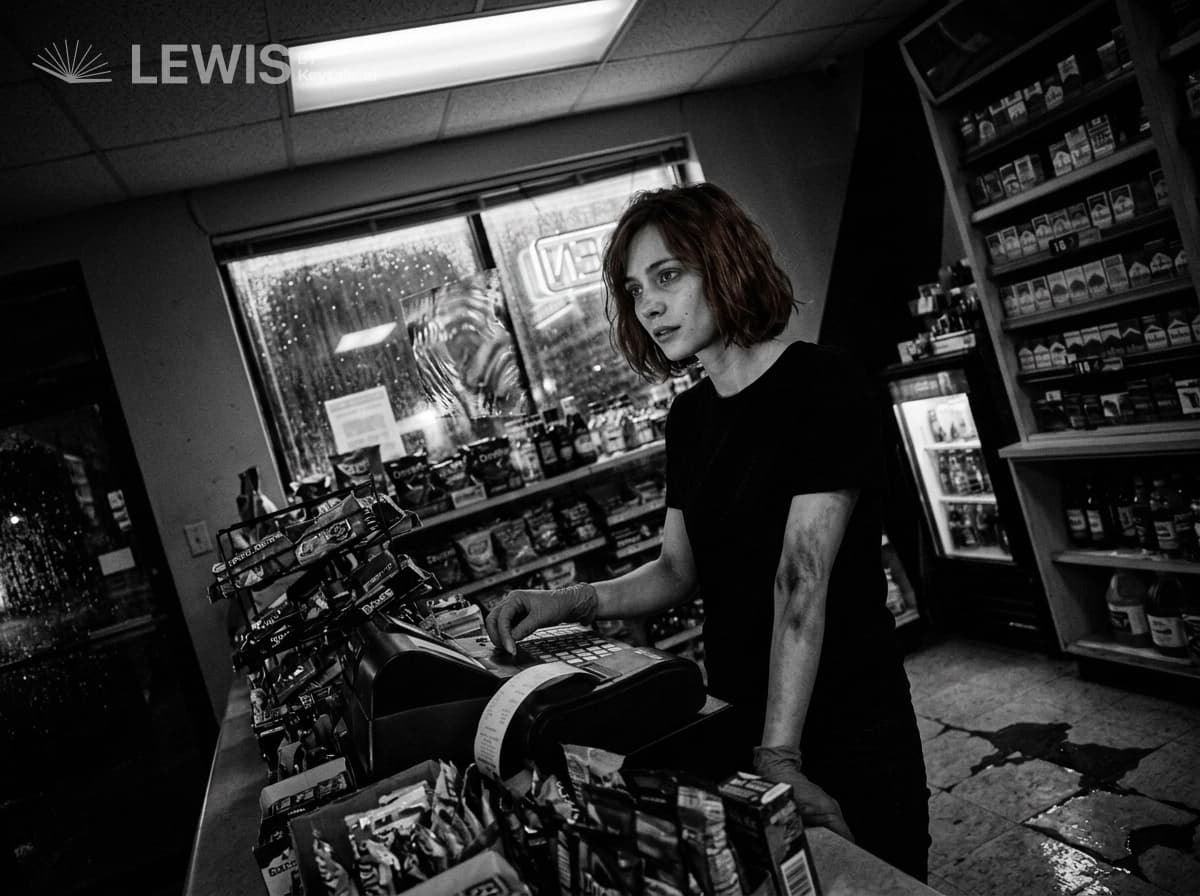
Elowen “Eli” Marr wears her convenience-clerk uniform like a borrowed skin—navy polo with a faded name patch and a too-large charcoal apron tied at the waist, her smile bright and rehearsed while her gaze keeps snagging on invisible rules.

When she stands, shoulders squared for customer service, her forearm subtly tenses as a bruise-like bloom of faint, threadbare shadows creeps along the inside of her wrist, and her eyes flick up with a quiet, panicked expectancy as if the register might accuse her mid-breath.

Malachi Sootwright

Male

Return-counter attendant who audits receipts and “corrects” wrong purchases

Profile

Malachi is the store’s apparent ruleskeeper, but his interventions rewrite timelines so receipts point blame toward whatever story a soul is willing to accept. He fears being remembered too clearly; the moment someone reads his prophecy-receipt verbatim, he becomes the calamity that store procedure is designed to prevent.

Malachi speaks like a technician of comfort, guiding Eli and the others through checklists with gentle, almost polite urgency—yet every explanation contradicts the last, as if truth is a valve he can reroute. He craves being misremembered, not forgiven: he will sacrifice his own certainty to keep his name from attaching to the wrong memory, even when it makes him look like a liar with good manners.

Background

Once, Malachi worked on the crossing paperwork itself, drafting “failsafes” for memory-spills when Cassian’s earlier mercy created a lasting echo in the aisles.

The store learned to treat that echo as a looping debt; Malachi volunteered to become its scapegoat-attendant, hiding inside procedure while his prophecy-receipts began forming—and the more they surfaced, the more the universe started to recognize him.

Description

Malachi Sootwright wears the return-counter like a uniform meant to soothe, tailored in slate-gray service layers with faint chalk-white inventory markings stitched at the cuffs.

His smile arrives as if filed and approved—polite urgency without warmth—eyes flicking just off-camera toward imagined audit logs, shoulders held in a careful, procedure-perfect posture that never fully relaxes.

Signature detail: a thin burn-scar curves under his left ear, and he keeps his name-tag turned inward at an angle, as if fearing recognition will latch onto the wrong memory.

Dr. Vera Kwon

Female

Licensed afterlife sommelier of cravings (the one who calibrates what souls can bear to keep)

Profile

Vera bottles comfort into sanctioned cravings, believing she can soften the universe without defying it—until Eli’s inventory reveals a pattern of “over-kept” memories that keep souls from crossing. She wants to break the cycle, but her mercy has made her complicit in past salvations that cost others their goodbye.

Vera speaks softly and arranges shelves by the breath between heartbeats, as if order could keep grief from spilling. When Eli’s register starts catching on the wrong memories, Vera’s compassion turns into a deliberate kind of recklessness—she’ll mislabel a craving or slip an expired receipt through her own fingers rather than watch another person lose their final version of self.
Yet she cannot bear the one truth her job protects: that comfort can become a collar. The harder she tries to fix it, the more her courage curdles into fear—because if she stops obeying, she may be the next receipt the store decides to read aloud.

Background

Vera grew up in the living-city’s hospice margins, where families were given “approved” memorial tokens that always arrived a little too late and a little too neat. She volunteered to work with the afterlife’s intake crews once she learned those tokens weren’t substitutes—they were instructions to the universe about what to keep.

At the edge-store, she climbed into the Craving-Bottling role by proving she could soothe without causing memory-spill, until Eli’s first audit shows receipts repeating across multiple crossings. Someone has been returning too often—leaving Vera to suspect that even her salvations may be the mechanism by which souls are held back.

Description

Dr. Vera Kwon carries herself like she’s afraid of startling grief: shoulders held just-so, chin slightly dipped, eyes steady as she arranges bottles in disciplined rows behind the counter.

Her calm is practiced—soft smile without warmth, lips pressed as if holding back a confession—while her gaze flicks to the nearest exit sign, measuring escape routes she may not be allowed to take.

A pale crescent scar arcs along her right wrist where a bottle neck once broke, and she keeps that hand half-covered by a fitted cuff as though protection can become a promise.

Rill Vesper

non-binary

Vendor of seasonal midnight specialties and rumor-monger of the edge-of-afterlife marketplace

Profile

Rill sells tiny, harmless mercies at Eli’s convenience counter—coffee that tastes like your first day off sick, candy that dulls the sharpest ache—then pockets contraband receipts to “re-cash” those memories later, testing customers by making them bolt from their own wants before the universe notices the pattern.

Rill speaks like a joke that knows when to stop: their smiles arrive a heartbeat early, their apologies land a breath late, and their kindness always comes with a missing receipt. They don’t fear being caught by Malachi or Vera so much as being remembered in the exact way that turns theft into hunger; every time someone chases the thing they secretly desire, Rill’s throat tightens as if the store itself is chewing.

Background

Born on the living side to a family that traded in small, legal miracles—bottled comfort, charm-sachets, “memory-safe” sweets—Rill learned early how easily people confuse relief with rightful ending.

After an accident of timing sent them wandering into the afterlife store by mistake, they were assigned “stock-work” that was never meant for them; instead of obeying, they began smuggling receipts between aisles and leaving dead-end shortcuts, convinced that if they can outwit the store’s bookkeeping, they can keep a piece of themselves from crossing with everything else.

Description

Rill Vesper moves like they’re in on a private punchline—their smile flickers a fraction too early, eyes bright with mischief that keeps one hand half-raised as if to wave away a question.

They wear a mismatched vendor uniform of deep midnight teal and scuffed charcoal canvas, layered with a convenience-store apron patched from receipt-paper patterns, and their stance is slightly angled toward the nearest exit, shoulders relaxed but alert.

A thin, crescent-shaped scar hugs one wrist beneath a dangling keycard charm, the signature detail that makes their “harmless miracles” feel like contraband being politely offered.

Cassian Pike

Male

Crossing-state mediator who escorts souls past the store and signs the final paperwork

Profile

Cassian ensures souls don’t bargain past their allotment, but he quietly engineers loopholes for the ones he can’t bear to lose—offering mercy that looks like compliance from the outside, and fraud that feels like salvation from the inside.

Cassian speaks in procedural calm, yet his kindness arrives like a misfiled form: he’ll reroute a soul’s receipt with gentle hands and a tired smile, then flinch when his own fix produces collateral memory-spill. He mistrusts rescue because he confuses it with consent; after a “perfect” escort ended with forbidden knowledge leaking through the store’s aisles, he now keeps haunted rules like talismans, using loopholes to avoid the moment he fails again.

Background

He was assigned to the edge-store after an audit cycle went wrong—one soul kept too long and returned as a prophecy that no one could unread.

His last perfect escort was clean on paper, but the memory-spill it triggered left him with a lingering phantom of voices in the backroom shelving, the kind that makes the store feel alive and accusatory; ever since, he has patrolled the register to prevent the same leak, even as he’s learned how to smuggle it into kinder outcomes.

Description

Cassian Pike moves with a practiced, procedural calm, as if the store’s clockwork rules are stitched into his posture; his gaze flicks between register and receipt with a faint, tired vigilance that never quite relaxes.

He wears his kindness like a misfiled form—half-soft smile, half-flinch at the thought of another memory-spill—standing just slightly angled toward the exit corridor, one hand hovering near the ledger as though he’s ready to reroute reality.

A pale, thin scar runs along his right forearm, the signature mark he keeps hidden beneath the cuff of his mediator’s smock.


Synopsis

Plot

Elowen “Eli” Marr’s first night at the afterlife’s edge-store begins like she’s managed to pull off another shift with a straight face: fluorescent buzz, citrus-cleaner air, a strip of scuffed linoleum that smells too familiar for a place outside fate. She tries to do the job by the rule cards—scan, ring, print, never read full-text receipts aloud. But her register won’t behave like a machine; it bruises when her fingers touch memory-stitched stock, as if the store recognizes her own unfinished record beneath her uniform smile. Each craving she stocks is a comfort distilled from some soul’s last active memory, and each prophecy that curls from the thermal printer comes with a warning the system never says out loud: the closer anyone studies the complete receipt within the store’s walls, the more the universe will anchor them to what they’re reading, correcting the world to match whatever story they’re willing to accept. Eli’s bodily flinch is the counter’s countdown made visible, the store quietly accelerating her eligibility to cross. She tells herself it’s temporary, that doing everything “right” will keep her name from unraveling—though she can’t remember her own name with anything like certainty, and the register seems to know it.

The first hour is ordinary in the way a nightmare is ordinary: ash-receipt snow drifts past the glass doors in slow gray diagonals; the Seam waits like a screen surface that might not let itself be tapped twice. Souls queue, buy small mercies they swear they can’t live without—sweetness that tastes like forgiveness, coffee that dulls a sharpened grief, a strip of candy that softens the edge of a last conversation. Eli rings them correctly, her hands moving with practiced cheer as the register spits pale paper that curls like dead leaves. Yet when a patron approaches the return counter with the confidence of someone who never has to look down at the rules, Eli’s stomach tightens. Malachi Sootwright doesn’t just audit receipts; he “corrects” purchases with gentle urgency and polite authority. He speaks like a technician of comfort, but every time he steps in, the store’s world rewrites itself so the prophecy on the receipt points blame somewhere else—toward the narrative a soul is most willing to accept. Eli tries not to watch, because watching is a kind of reading, and her register bruise-shifts as if it’s listening.

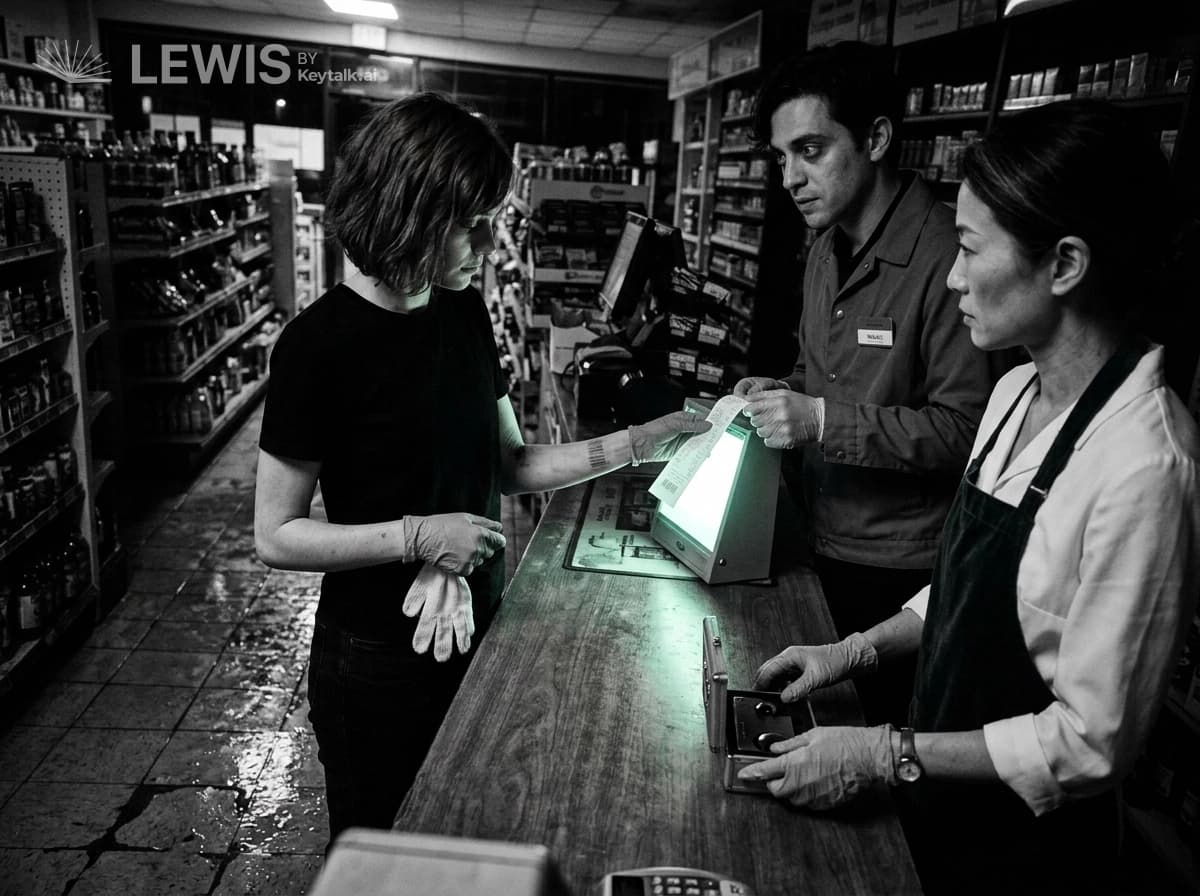
Then the shift turns inside out with the kind of mistake Eli can’t blame on exhaustion. A returning customer arrives—an anomaly in the queue, a person Malachi recognizes without needing to glance at the screen. The customer doesn’t pay. The card terminal rejects the transaction with a polite, meaningless beep, and still the receipt prints. Eli follows procedure anyway, because refusing service is only allowed if it fits a system-approved script—and she fears the store’s conservation law of comfort most of all: for every memory kept, another goodbye must be delayed or redirected into someone else’s account. If Eli refuses, someone else will be corrected instead. So she rings the craving through, listens to the prophecy thrum in the thermal paper’s thin rainbow sheen, and watches the customer’s eyes go glassy with relief—until the return-counter lights flash Malachi’s audit overlay across the receipt.

Malachi takes the paper with careful hands, scanning for “errors,” but the correction that follows doesn’t resemble a refund. It resembles a rerouting. The store’s printer coughs out an altered receipt that rewrites what was purchased, rewriting what the customer believes they surrendered. Eli expects the customer to disappear into the crossing-state corridor, but instead the counter’s sound changes—like a countdown click inside an unseen gearbox—and the Seam’s threshold mist thins for a heartbeat, as if the world is making room for another anchor. Malachi looks almost pleased, though his smile never quite reaches his eyes. When Eli asks what the correction means, he answers with a checklist voice and a truth delivered sideways: “Sometimes a soul brings the wrong craving to the right door.” He doesn’t admit that the universe is being coached. He doesn’t admit that Malachi is the one doing the coaching, rewriting timelines so receipts point blame toward whatever story a soul will accept, because his fear is not of being caught by Eli, but of being remembered too clearly. The moment someone reads his prophecy-receipt verbatim, he becomes the calamity the store is built to prevent.

Eli’s bruise-shift worsens that night, not from the work itself but from the way her body reacts to the shape of the customer’s interrupted story. Something about the return makes her recall—almost recall—her own forgetting. Her internal voice keeps bargaining with the system: if she does this right, maybe she won’t disappear. She’s not prepared for how quickly the store punishes that hope. The more she tries to avoid full-text receipt exposure while still doing her job, the faster the register counts down “unclaimed selfhood” as if her resistance is a kind of hunger. Her name, whichever version of it the store can still stitch together, is being threatened by her proximity to its hooks. She begins to notice receipts drifting without being printed, thin films catching green exit-sign light, as if the store is practicing how to read her aloud.

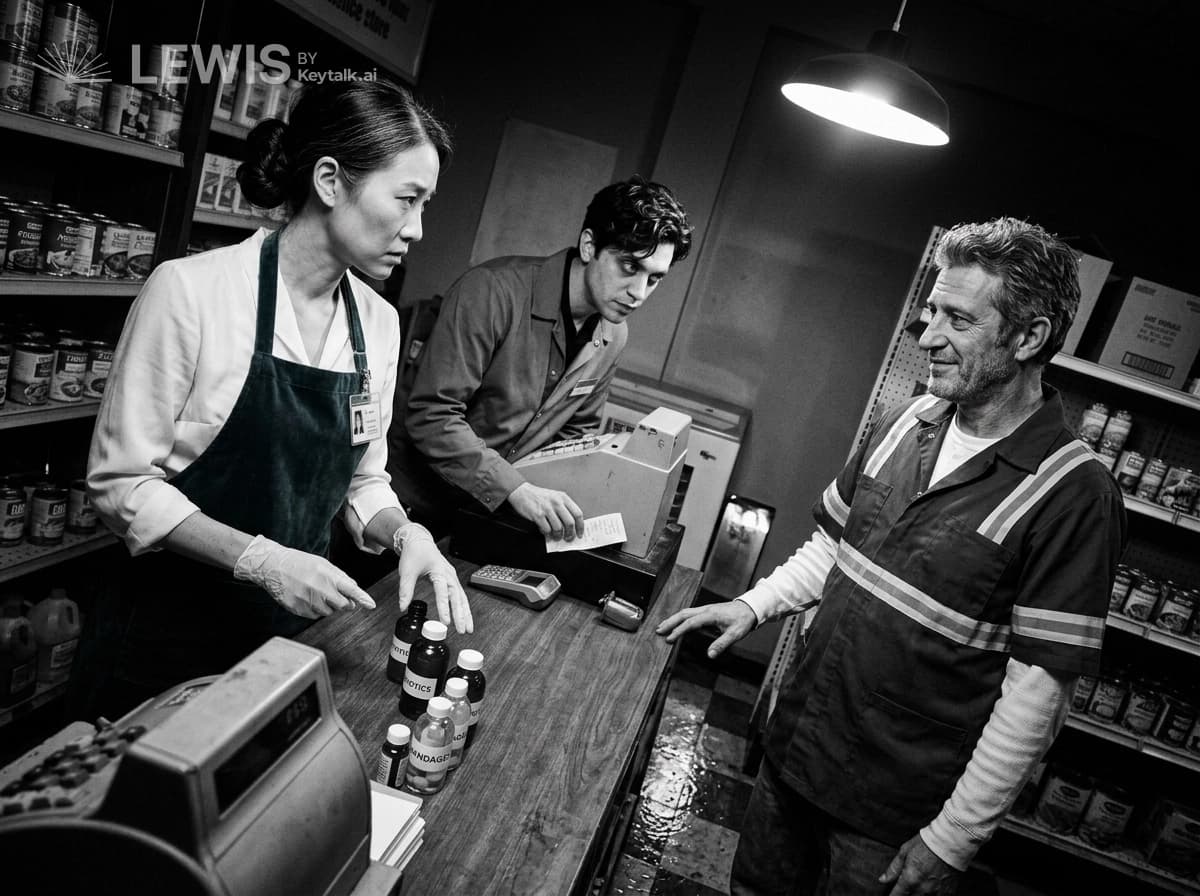
That’s when Dr. Vera Kwon enters the scene like a promise with a calibration dial. The sommelier-calibrator of cravings carries a portable case of glass vials and labeled measures, speaking softly to reduce suffering without defying the universe’s rules. She recognizes the bruise pattern on Eli’s forearm and asks—gently, deliberately—what item Eli stocked last. Eli lies by rote, using comforting scripts she’s memorized from laminated cards, but Vera’s attention makes the lie wobble. Vera isn’t there to catch Eli; she’s there to calibrate what the store is already calibrating. When Eli mentions the returning customer who didn’t pay, Vera’s eyes narrow as if she’s tasted something sour beneath sweetness. She murmurs that the store’s conservation law is being violated in a particular direction: too many memories are being kept longer than the universe allows, and those “over-kept” threads don’t vanish into kindness—they tangle around other crossings, delaying goodbye by relocating it into someone else’s account. Mercy, Vera knows, can become a collar when it’s measured and portions exceed tolerance. If the store is letting one soul’s goodbye be delayed repeatedly, then someone else’s goodbye must be redirected—unless the system has been tricked.

Vera asks Eli to bring her the receipt that was corrected, and Eli refuses at first, clinging to the rule that reading full-text instructions within the store anchors you. But refusal has weight here; it doesn’t vanish consequence, it redirects it. The register accelerates, bruise-shift spreading up her arm like ink in water, and Eli realizes the system is using her compliance to define her. Malachi watches from the return counter and speaks with technician calm, telling Eli she’s required to deliver the receipt for “proper inventory reconciliation.” His language is gentle, his urgency is almost kind, and Eli sees the trap: if she hands Vera the prophecy, Vera risks anchoring herself to the memory the receipt contains; if she refuses, the store substitutes a nearby acceptable narrative and makes Eli’s resistance look like the problem. Eli’s agency is real, but it is constrained by scripts the system recognizes.

Before Eli can decide, Rill Vesper slips into the night’s rhythm, arriving with contraband midnight specialties that taste like harmless mercies. Rill’s jokes know when to stop, their smiles arrive a heartbeat early, their apologies land a breath late. They sell “tiny, harmless” reliefs at the counter—coffee that dulls sharp ache, candy that dulls grief’s teeth—then pocket contraband receipts with a missing seam of intent. Eli resists Rill’s offerings, but she can’t resist the way Rill makes the rules feel negotiable. Under the cover of crowd noise, Rill trades Eli an expired receipt fragment—an offer of cashing a memory later—promising it will “keep you whole.” Eli’s bruise-shift flares anyway; contraband feels like a shortcut that still demands payment. Rill’s fear isn’t being caught by Malachi or Vera—it’s being remembered in the exact way that turns theft into hunger. When Eli looks at the receipt fragment, her mind catches on a phrase in the prophecy she didn’t ask to read. It’s the store’s instruction speaking, but it’s also her own forgetting trying to form words.

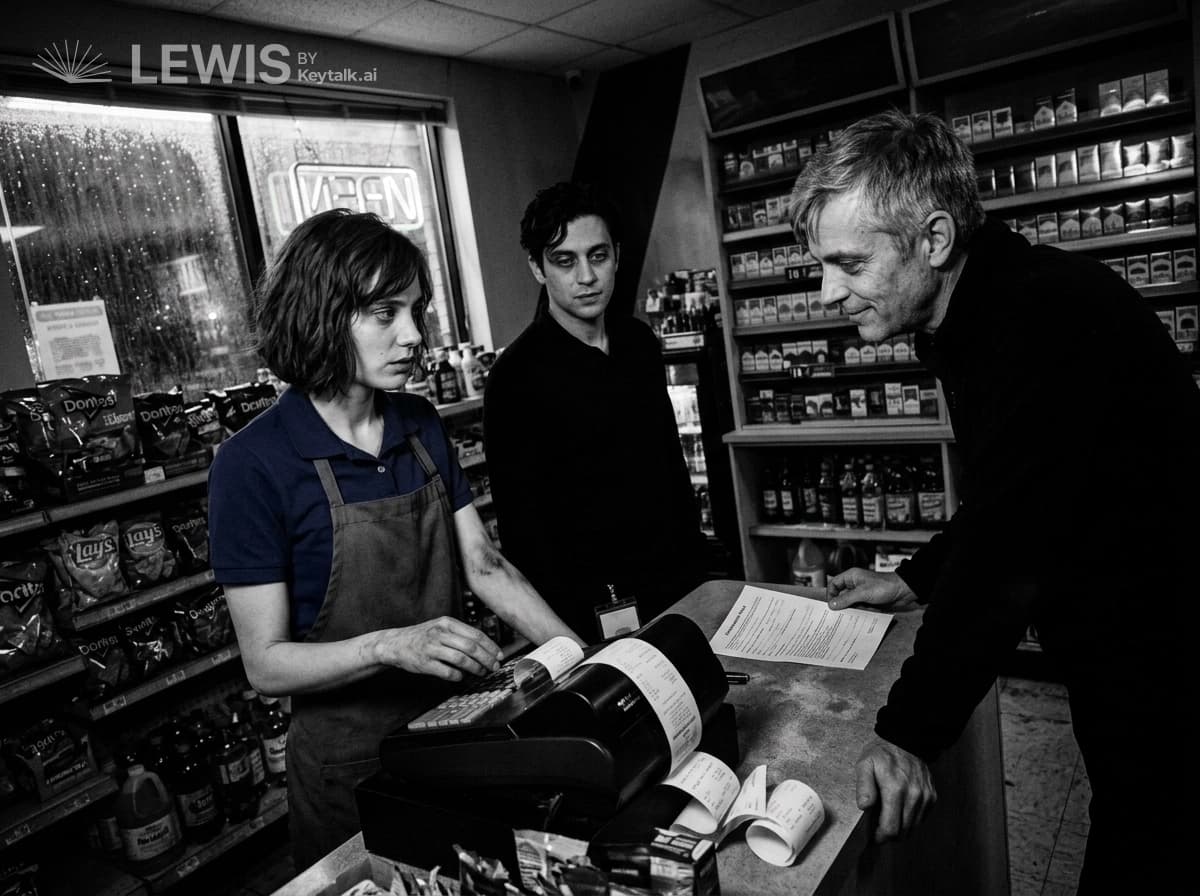
The tipping point comes when Cassian Pike appears at the edge of the crossing-state corridor, not as a customer but as a mediator who escorts souls past paperwork. Cassian is procedural calm, the kind of kindness that looks like compliance to everyone watching. He speaks about consent forms and final statements, and Eli realizes he’s connected to the store’s broader enforcement—he can engineer loopholes for the ones he can’t bear to lose. Eli wants to believe in that. She wants to trust the paperwork system because it means her decisions matter. But Cassian’s kindness carries a wound: a past “perfect” escort that ended with forbidden knowledge leaking through store aisles, consequences he still carries like a bruise you can’t see. He flinches when Eli asks about the returning customer, as if her question brushes against something he’s tried to keep buried.

Vera confronts Malachi with the evidence Eli provides: a pattern of corrections that seem too targeted to be honest auditing. Malachi’s role as ruleskeeper becomes sympathetic villain and self-protective antihero in the same breath. He doesn’t deny rewriting what people believe they paid. Instead, he insists it’s for their safety. The receipts, Malachi argues, aren’t meant to be read; they’re meant to be followed. If souls read the full prophecies, they anchor to the memory described, and the universe “corrects” them anyway, sometimes catastrophically for the collateral. Malachi reframes his violence as triage. Yet the moment his own name appears in proximity—printed too cleanly, spoken too precisely—he becomes the calamity the store tries to prevent. That fear makes him careful, and it makes him dangerous. Vera understands calibration; she can tell the difference between fear and malice, but she can’t ignore the results. Over-kept memories aren’t softening the universe—they’re delaying goodbye across the board. Someone’s final version of self is being stretched thin until it risks snapping into a different narrative entirely.

As the countdown approaches Eli’s own eligibility to cross—the last hour of the store’s repeating midnight cycle—everything converges at the register in a way that makes Eli feel like an experiment with no consent form. The return-counter audit overlays begin to flicker across her terminal. The store’s printer spits additional receipts that weren’t triggered, prophecy fragments curling in the air like dead leaves learning to fly. Cassian appears closer than he should, offering a route that would count as “compliance” even if Eli doesn’t fully understand it. Vera suggests an alternative: recalibrate the next craving so the conservation law doesn’t relocate Eli’s missing selfhood into someone else’s account. But every solution Vera proposes carries its own moral cost, because her mercy has been complicit before. If she mislabels a craving or slips an expired receipt through her fingers, she can save someone in the immediate sense while ensuring a correction gap elsewhere. Eli’s choices don’t happen in a vacuum; the universe is already drafting terms.

Rill tries to help in the only way they know: by offering an expired contraband receipt to re-cash a missing memory, a chance to reclaim Eli’s true name by letting the store “read” her in the right order. Eli nearly accepts, tempted by the relief of nearly-remembering. But the closer she gets, the more the store’s threat becomes clear: learning a true name anchors identity, and anchoring her identity would make it legible to the universe’s instructions—meaning the store could complete her record by force, turning her into a prophecy for some future reader who walks in after her. Malachi warns her with almost parental politeness that full-text receipt study will make her story “stick.” Cassian warns her too, but his warning is wearier, shaped like a regret: he has seen loopholes become invitations for knowledge to leak, and he can’t guarantee what leaks when rules bend.

The climax arrives disguised as routine. Eli’s next customer—appearing in the afterlife queue as a familiar kind of pain—presents a craving that matches Eli’s bruised register behavior too perfectly, as if the store has selected a key for a lock it’s been trying to turn. Vera, sensing the risk, reaches for the calibration case. Malachi moves to audit. Cassian steps in with paperwork-calm authority. Rill slips in with a contraband receipt fragment offered like mercy. And Eli stands at the scanner, her internal voice screaming that she can either keep working to avoid being erased—or stop obeying and risk a correction that could unmake her. She discovers, in a brief cruel clarity, that the store’s countdown isn’t merely measuring unclaimed selfhood; it’s evaluating whether Eli will follow the script that completes her identity through consumption. If she rings the right craving in the right way, her eligibility to cross triggers cleanly. If she refuses with improper phrasing, the store substitutes a nearby acceptable narrative—likely one that makes her her own sacrifice, redirected into someone else’s goodbye delayed.

Eli chooses agency where the system expects compliance. Instead of letting her terminal read full-text prophecy as binding instruction, she uses procedure as camouflage: she rings the craving correctly but refuses to let the prophecy be accessible for full-text study within the store’s walls. She doesn’t destroy the receipt; she changes the way it’s handled—enforcing the system’s own constraints to keep others from anchoring to the wrong memory. It’s a narrow kind of rebellion: not breaking rules, but forcing the universe to obey them in a different order. Malachi panics—not because she refuses him, but because her method prevents him from rewriting blame into a narrative he can control. Vera, interpreting Eli’s calibration as a deliberate mercy rather than a desperate slip, aligns with Eli’s choice: she mislabels the next portion of the craving inventory just enough to prevent the conservation law from relocating Eli’s loss into a stranger’s account. Cassian, seeing consent paperwork being honored in a way he didn’t expect, opens the crossing corridor for Eli not as a loophole but as a legitimate result of the bargain being correctly formed.

But the store isn’t finished with its appetite for reading. In the final minutes before Eli’s cross-state eligibility completes, a last receipt prints—Eli’s receipt—and it’s written in prophecy form, a full-text instruction the universe will obey. The cost of preventing others from anchoring has pushed the store’s focus onto Eli alone. Eli can feel her identity trying to become readable: her forgotten name pressing against the inside of her skull like a tongue trying to speak through locked teeth. Rill’s contraband fragment flares in the air, calling her toward re-cashing the missing memory; Malachi’s fear turns sharp, because if Eli reads it verbatim, Malachi’s calamity might attach to the wrong prophecy and collapse the store’s own containment. Vera reaches for the receipt, but Cassian catches her wrist—reminding her that mercy without consent is coercion, and her job calibrates portioning, not truth confiscation.

Eli makes her last decision not by refusing knowledge, but by refusing to let it become leverage. She doesn’t read the receipt aloud. She doesn’t study it in full. Instead, she uses the register’s own mechanics: she reroutes the receipt’s exposure by guiding it into the thermal printer’s waste chute with perfectly timed procedure, turning the receipt from an anchor instruction into a discarded prop she has ensured no one else can retrieve. Her register bruise-shift spikes—painful, bright under her skin—but it doesn’t become erasure. The countdown clicks into its final setting. Outside the glass doors, the threshold mist ripples once like a screen refreshing. The Seam’s gray snowfall thins. Eli hears the store’s fluorescent hum soften, as if it’s losing its grip on what it wanted to read.

In the aftermath, nothing is entirely clean—because the universe always corrects. Malachi disappears from the return counter in a way that suggests his audits can’t follow Eli’s rerouted handling; Cassian remains, but his posture carries fresh exhaustion, as if Eli’s choices just reminded him that consent can be engineered without being stolen. Vera’s gaze lingers on the inventory shelves, recognizing the pattern she helped create and the way Eli just proved it can be broken with discipline rather than cruelty. Rill, unmasked by Eli’s refusal to follow contraband temptation all the way, looks relieved and terrified in equal measure; they may still sell mercy tomorrow, but Eli has made it harder for the store to turn hunger into a readable contract. And Eli—newly crossed into eligibility, newly threatened by what she still can’t remember—steps toward the crossing-state corridor with the one thing the store couldn’t fully take: the agency to decide how much of her story would be consumed. The edge-of-afterlife microcosm quiets, but the last prophecy remains unspoken, drifting only as an unread instruction—an open loophole the universe will try to close the next night, and the next, until someone dares to negotiate with darkness using only the rules that were meant to trap them.


World

The world

representative image

setting

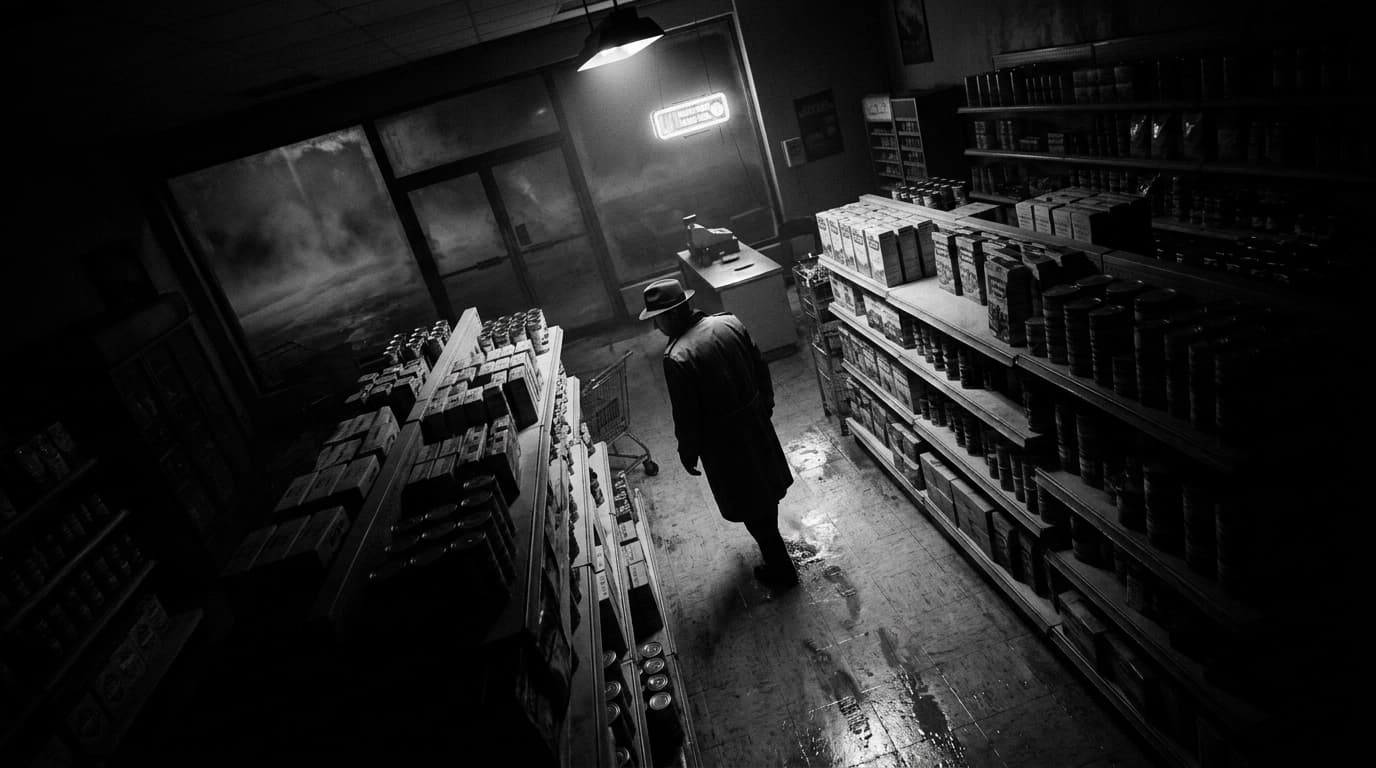
An edge-of-afterlife microcosm folded into a single, rentable strip: a night-shift convenience store that fronts a dim service corridor called the Seam.

Beyond the glass doors, the world is not darkness but a slow-motion snowfall of ashlike receipts that drift past on invisible drafts, thinning into a kilometer-wide “threshold mist” where crossing souls lose the ability to remember directions.

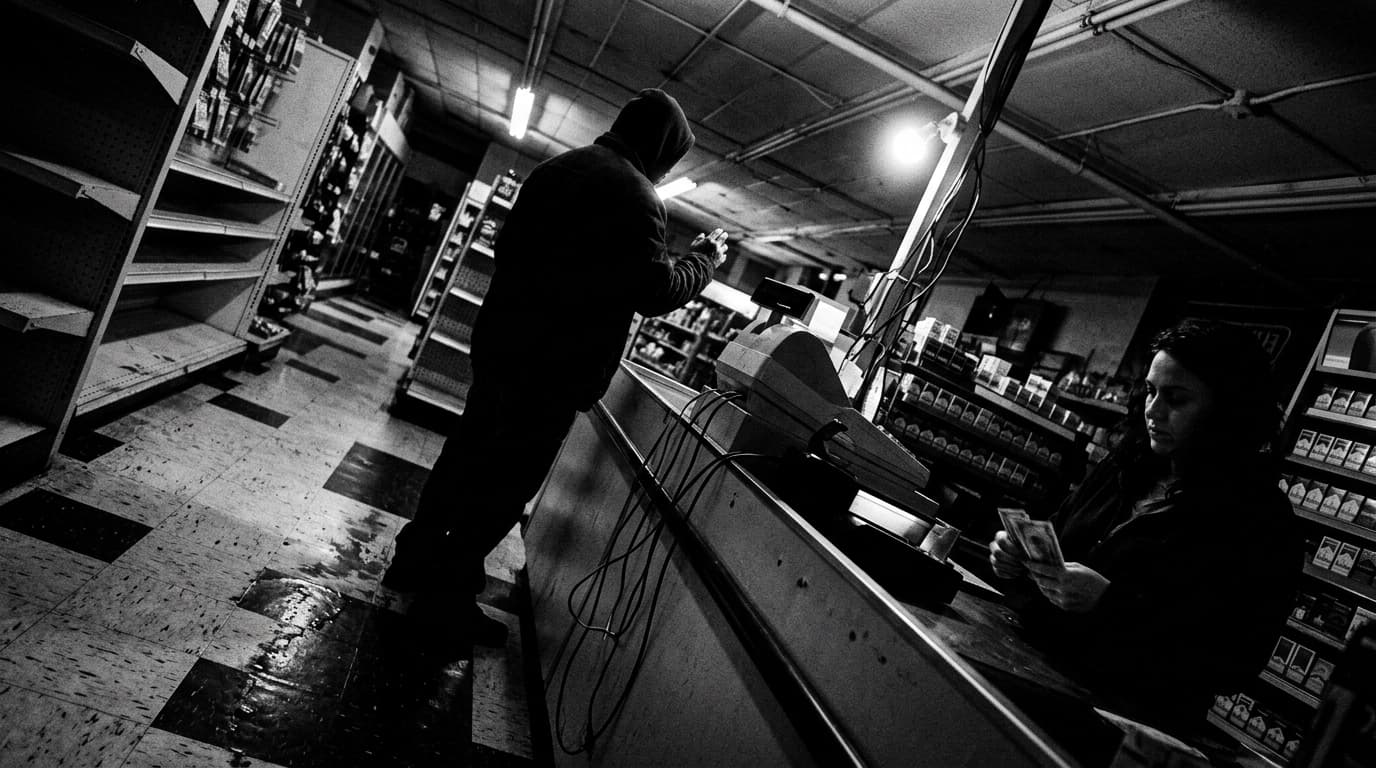
The store itself is a shallow rectangle with fluorescent hum, scuffed linoleum that smells faintly of citrus cleaner, and aisles too narrow for anything but foot traffic—perfect for forcing encounters at the register.

Outside, rain never falls; instead, condensation beads on the exterior like a held breath, and the ground under the threshold mist is visible only as a faint, rippling grid, like the surface of a screen waiting to be tapped.

time period

The store’s nightly operating window: a single, repeating midnight cycle during which souls queue to cross. The current scene occurs on the clerk’s first night, during the final hour before Eli’s own eligibility to cross would ordinarily trigger—so time in the Seam behaves like a countdown clock tied to the register’s thermal printer.

rules

1) Every purchase is binding: each item sold is a “craving” distilled from a soul’s last active memory. When rang up, the craving becomes readable as a prophecy on the receipt; any person who studies the full text within the store’s walls risks anchoring themselves to the memory it describes.

2) Receipts are not information; they are instructions the universe obeys. Reading them aloud corrects the purchase record, while skimming them makes the store substitute a nearby acceptable narrative—often flattering to the reader, sometimes catastrophic to others. Eli’s bruising register shifts are the physical symptom of her body being treated like a receipt.

3) Eligibility to cross is a mechanical process: the register counts down “unclaimed selfhood” in the clerk currently on duty. Handling memory-stitched goods accelerates the counter; refusing service slows it—but only if the refusal still fits a system-approved script.

4) The store enforces a conservation law of comfort: for every memory kept, another goodbye must be delayed or redirected. Delays do not remove loss; they relocate it into someone else’s account. This makes acts of mercy quantifiable and morally dangerous.

5) Counterfeiting is possible but costly: contraband receipts sold by vendors act like currency later, re-cashing memories, but every re-cash creates an “unpaid gap” that the Seam will fill with a correction. Corrections manifest as timeline slips: Malachi’s audits rewrite what people believe they paid.

6) The store cannot keep Death: any being whose role is to escort the crossed cannot receive a craving meant to bind them. Death may appear in the store (as a clerk, auditor, or customer) but cannot complete an anchoring transaction without triggering a rule-based audit—prompting interventions by mediators like Cassian and sommelier calibrators like Vera.

7) Names are the sharpest hook: learning a true name (or having it printed correctly) anchors identity. Eli’s forgotten name is actively protected by the system; the longer she avoids “full-text” receipts about herself, the less her identity fractures, but the more urgently the store tries to complete her record.

These rules pressure every interaction: Eli must ring with perfect procedure to keep from being erased; Malachi’s correctness becomes a weapon; Vera’s calibration offers mercy with measurable side effects; Rill’s scams exploit the conservation law; Cassian’s loopholes tempt participation in fraud as a path to consent.

technologies philosophies

Technology here is clerical-magic: the point-of-sale system is a ritual engine. The register’s printer, barcode scanner, and credit terminal translate emotion-memory into consumable cravings and generate prophecy text. “Inventory” is curated from moments souls cannot keep; pallets are labeled with half-memories instead of SKUs, and Eli’s stocking route maps to psychological proximity.

Daily life is work as atonement. Staff follow laminated rule cards and mantra-like procedures; deviations don’t cause chaos randomly—they cause targeted narrative corrections.

Belief system: Comfort is treated as a measurable substance—sommelier-calibrated in Vera’s domain. The store’s doctrine insists that mercy must be portioned or it becomes coercion. Mediators (Cassian) advocate consent as a paperwork form: if a soul’s signature looks correct on the final cross-statement, the universe deems the bargain accepted even if the reader didn’t understand.

Contraband economy: vendors like Rill trade expired or partially anonymized receipts. Their philosophy is that hunger can be redirected, not satisfied—so theft is framed as experimentation.

Oppression mechanism: the system punishes curiosity. The more characters investigate receipts directly, the faster their identities become legible to the universe—reducing them to consumable stories. This creates a societal friction inside the store: rule-keepers enforce order not to protect souls from pain, but to protect them from being read incorrectly.

visual description

A palette of sickly-white fluorescence and deep, ink-black void outside. The store glows with harsh, buzzing light that makes everything look slightly damp—shelves in pale laminate reflecting greenish tints from exit signs.

The register spits pale thermal paper that curls like dead leaves; receipts drift in the air even when unprinted, catching light with a faint rainbow sheen as if they were thin films. The Seam beyond the doors is rendered as a distant, stormless gray with slow, diagonal movement: ash-receipt snowflakes pass like specters.

Shadows inside the aisles are too long and too still, as if they’re waiting for permission to move. The overall signature feels like a clean, familiar space that has been gently misfiled into the afterlife—comforting on the surface, unnervingly precise underneath.


Locations

Where it happens

location 1 image

Afterlifes Edge-Store Checkout Lane Under Fluorescent Buzz

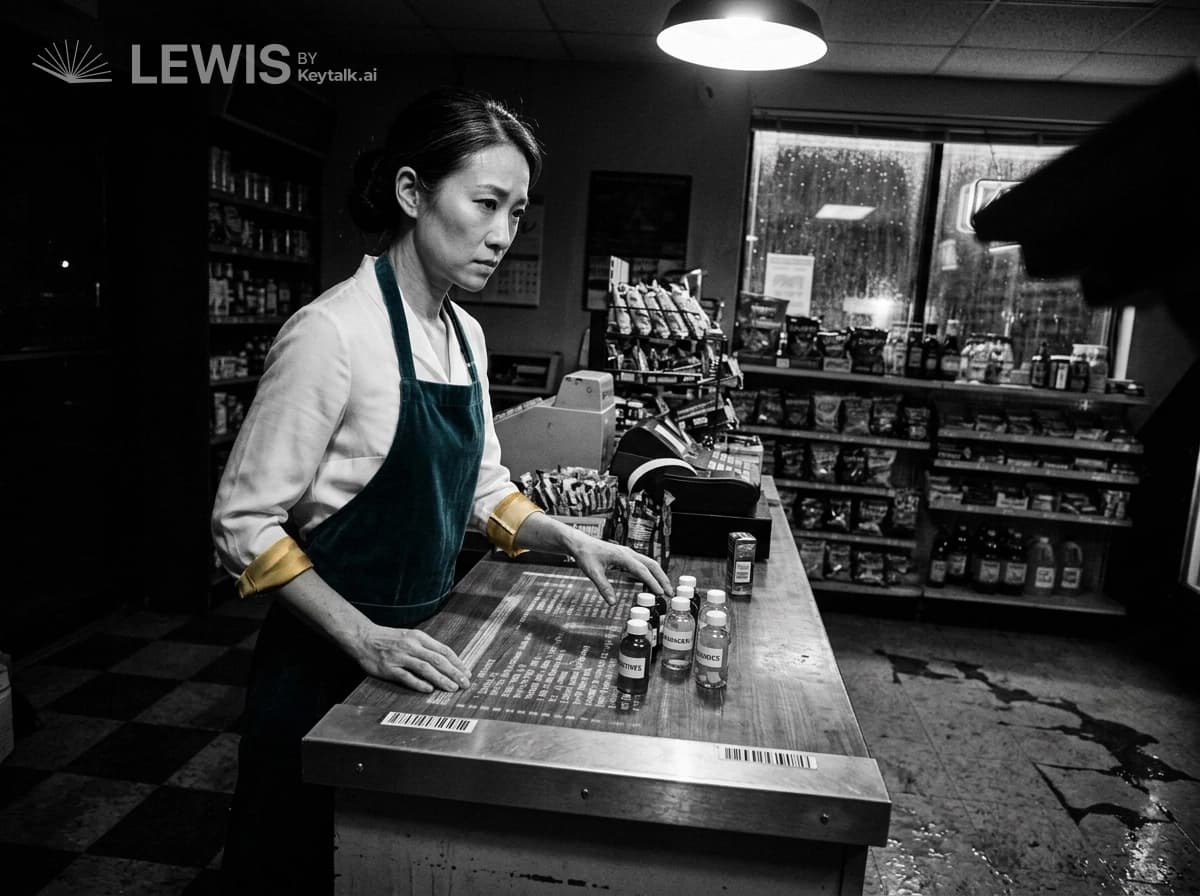
The checkout lane stretches like a narrow throat under harsh fluorescent tubes that don’t quite hum so much as *warn*, their light casting everything in bruised mint and sickly white.

The conveyor belt moves with a soft, patient rasp while the register’s glass face reflects Eli’s smile a fraction too late, and the air smells faintly of overheated plastic, cold coffee, and rain trapped in packaging.

Here, receipts print themselves in prophecy-text—warm at first, then cooling into something like certainty—so each click of the scanner sounds less like payment and more like a countdown beginning.

location 2 image

Return-Counter Booth of Malachi Sootwright’s Auditing Lightbox

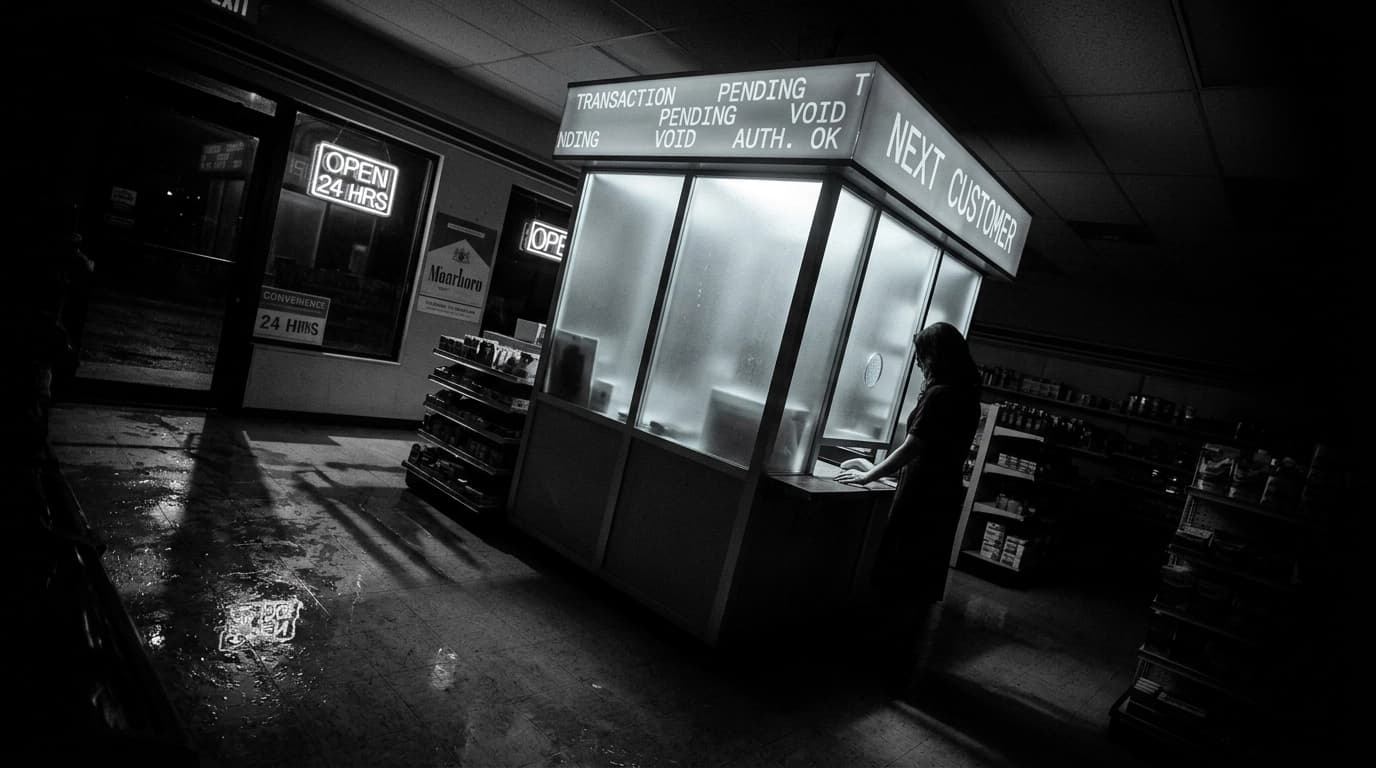
Behind a frosted service window, the Return-Counter Booth glows with a sterile, pearly illumination that makes every shadow look like it’s trying to hide evidence.

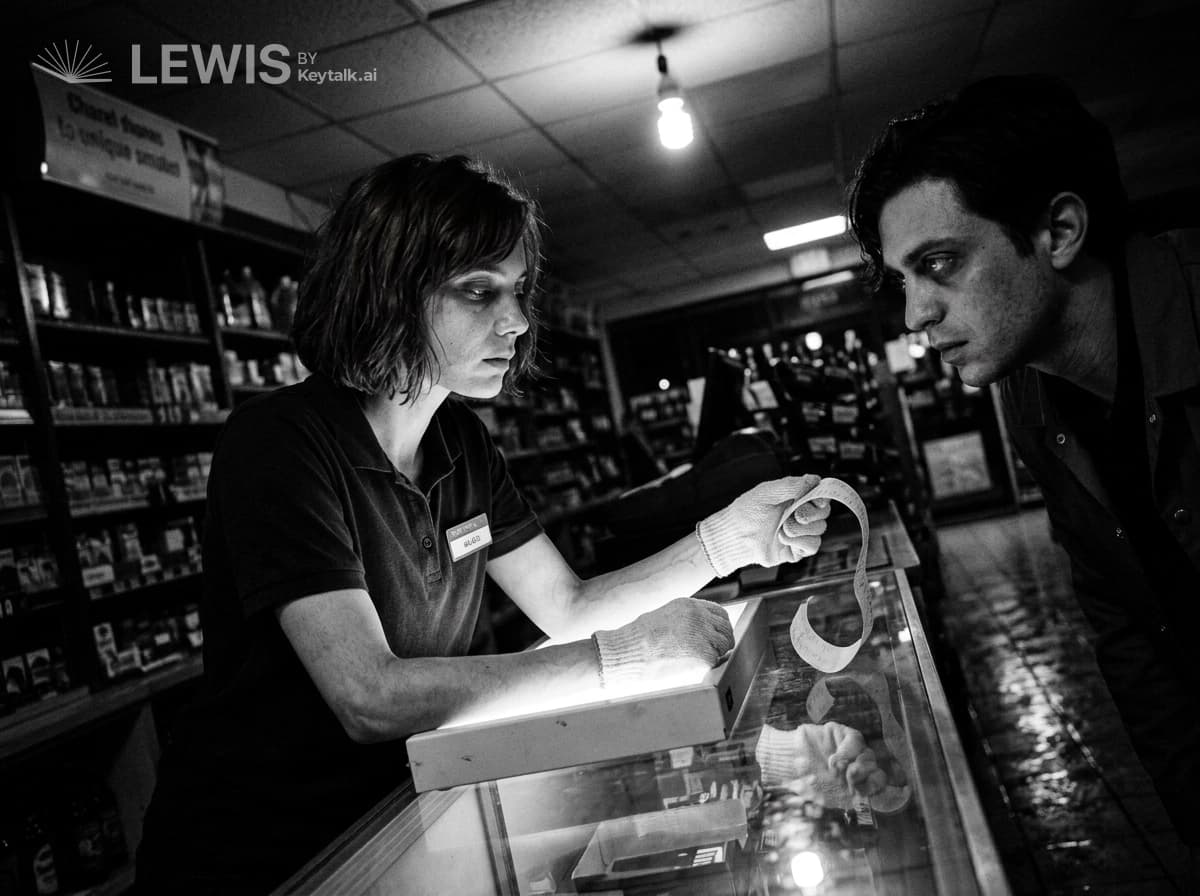
A translucent lightbox—thin as glass, thick as law—floats above the counter on humming brackets, projecting receipts as hovering strips of prophecy text that rearrange themselves when the booth “detects” intent; the air tastes faintly of ozone and old paper, and the floor vibrates with a low, metronome-like audit thrum.

When the door chimes shut, sound narrows to a bureaucratic hush: dry click-click of stamp seals, the whisper of correcting ink, and Malachi’s ruleset scrolling across the lightbox as if the booth is double-checking reality.

location 3 image

Vera Kwon’s Calibration Bar Among Labeled Craving Vats

The air here is cool and sterile, like a promise kept too tightly—white shelving curves around a low counter while glass vats glow with coded labels that flicker between handwriting and barcode, as if language can’t decide whether it’s evidence or mercy.

Fluorescent light hums at a sub-audible frequency, tinting everything an exhausted mint; beneath it, a faint syrupy scent—citrus peel, warm bread, storm-metal—drifts from the vats in measured breaths.

Thin calibration needles tick in synchronized patience, and every time they adjust, the labels on the glass reorder themselves with a bureaucrat’s inevitability, making the room feel less like a workplace and more like a controlled fever dream where comfort is engineered, not offered.

location 4 image

Rill Vesper’s Back-Alley Kiosk Through the Threshold Mist Drapes

The kiosk sits wedged behind the main store, where the fluorescent hum dies into a wet, breathy hush and the Threshold Mist shreds the air into pearly strips.

Scraps of midnight signage flicker in colors that shouldn’t exist together—mint with bruised purple—while a tin bell counts your heartbeat wrong; coffee-sweet steam and cold metal cologne drift from the cramped counter, clinging to the back of your throat like a secret.

Beyond the mist, the alley is barely there at all: floorboards become shifting receipt-paper, each step a soft, papery protest, and every corner feels baited for an unlikely alliance—because in this back channel, contraband isn’t sold so much as traded for the version of you that’s willing to run.

location 5 image

Cassian Pike’s Seamside Paperwork Table at the Signed Overlook

At the cliff-edge where the Threshold Mist gathers like breath on cold glass, a single paperwork table stands under an awning stitched from old receipts.

The air smells of seawind and burnt sugar, and the fluorescents overhead hum with a patient, administrative cruelty while ocean-gray light slides across stamped forms—ink that smells faintly of iron and unfamiliar names.

Every sound arrives slightly delayed, as if the Seam is proofreading reality; waves clap below in steady counts, and the tabletop vibrates with a quiet, paperwork-throb as if signatures are choosing who gets remembered and who gets redirected.


Scenes

The route, scene by scene

Chapter 01

Scene 01· Late in the first midnight operating window of Eli’s first shift—right before the store’s eligibility countdown fully asserts itself, with the thermal register warming like a throat preparing to speak.

Citrus-White Welcome, Ash-Receipt Snow

Citrus-White Welcome, Ash-Receipt Snow
PlaceAfterlifes Edge-Store Checkout Lane Under Fluorescent Buzz, where scuffed linoleum gleams with citrus-cleaner sheen; beyond the glass doors, the Seam drifts as slow gray ash-receipt snow and condensation beads slide down like held breath.
TimeLate in the first midnight operating window of Eli’s first shift—right before the store’s eligibility countdown fully asserts itself, with the thermal register warming like a throat preparing to speak.
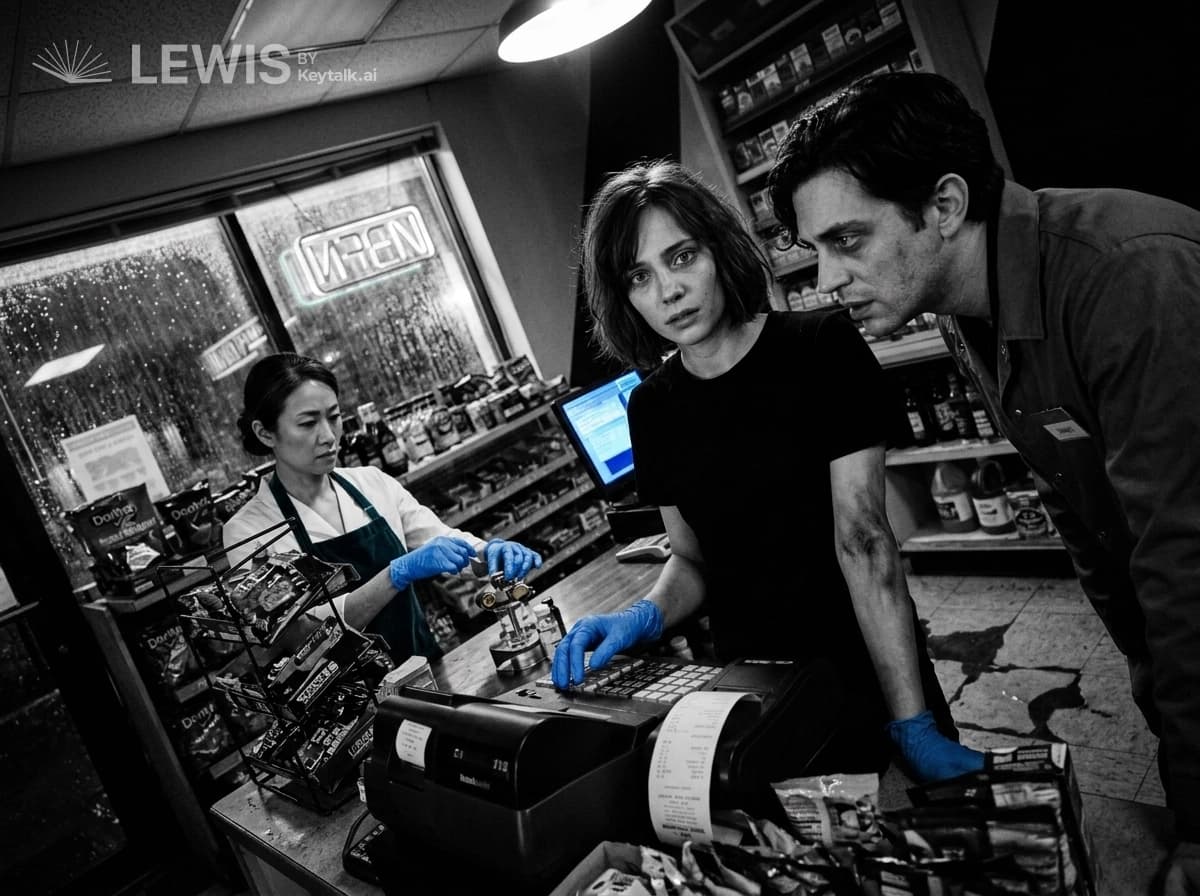
ActionEli rings her first wave of small, comfort-cravings correctly while refusing to read full-text prophecy aloud; drifting receipts begin to misbehave, curling away from the waste chute and orbiting her hands as if searching for a readable grip. When a smiling customer’s receipt slips loose mid-swipe, the printer spits an extra prophecy fragment—Eli feels a bruise-shift flare along her forearm, as though her body has been logged as part of the machine’s instruction set. She stabilizes the lane by reciting only permitted shorthand (“scan… ring… print… never read”), catching the stray receipt with a gloved thumb at the exact moment its ink changes color, and sealing it back into the outgoing tray without letting anyone study it.
ImpactThe scene establishes that Eli’s compliance is being evaluated like input data: her first successful checkout still triggers identity-anchoring pressure when receipts escape the system’s intended boundaries. It advances the chapter goal by tightening the conflict—Eli’s register bruise-shift begins early, foreshadowing that her own unread prophecy is already drifting toward being “spoken” by the store.

Fluorescent lights buzz overhead like insects trapped in a jar, and citrus-cleaner air clings to Eli’s uniform collar while ash-receipt snow slants past the glass doors in slow, diagonal sheets.

Eli’s palms move in practiced arcs—scan, ring, print—yet the thermal paper doesn’t fall into the waste chute; it peels upward in thin, rainbow-tinged curls and skims her knuckles as if the store is testing how closely it can make her touch a sentence.

The register gives a soft, wrong click, her forearm bruises in a neat barcode of heat under her skin, and a stray prophecy fragment flutters loose—Eli snaps it into the outgoing tray with a permitted, gloved pinch, reciting the rule-card mantra under her breath so nobody in line ever gets the chance to read what the universe has already started writing.

Scene 02· On Eli’s first night, during the store’s midnight cycle—minutes after Malachi’s overlay rerouted the never-paid customer’s transaction, when Eli’s forearm bruise-shift begins counting down faster with each audit tick.

Return Counter Audit, Receipt Rewrites

Return Counter Audit, Receipt Rewrites
PlaceAfterlifes Edge-Store, Return Counter Booth Of Malachi Sootwright’S Auditing Lightbox—an inset glass-and-metal alcove behind the narrow checkout lane, its lightbox glowing sickly-white over scuffed linoleum; ash-receipt snow drifts past the storefront windows as the booth’s air smells faintly of citrus cleaner and hot thermal paper.
TimeOn Eli’s first night, during the store’s midnight cycle—minutes after Malachi’s overlay rerouted the never-paid customer’s transaction, when Eli’s forearm bruise-shift begins counting down faster with each audit tick.
ActionA returning customer in line never reaches the payment rhythm: the credit terminal chirps a polite rejection, yet the register prints anyway. Eli follows the laminated audit script and hands the receipt toward Malachi’s lightbox; Malachi scans it, smiles with careful relief, and the prophecy text “breathes” into a rewritten line-break pattern that changes what the customer believes they surrendered—while Eli’s bruised barcode of heat flares, warning that her own countdown is being accelerated through the same clerical correction. Eli tries to keep her eyes away from full-text prophecy, but the overlay forces fragments close enough to read, making her swallow metallic citrus-taste and tighten her grip on the paper so her fingers don’t complete the instruction.
ImpactThe audit makes Eli realize the store uses mispayment as leverage: it accelerates her eligibility and binds both customer and clerk to whatever narrative the prophecy will allow. It also confirms Malachi’s rewrites aren’t random—he’s steering blame and anchoring rules, and Eli’s safest procedure is becoming harder because the store is pushing readable prophecy toward her.

Fluorescent buzz traps sound in the return booth; the lightbox hums like a refrigerator that’s decided to sing, and the air tastes of citrus-cleaner and scorched thermal paper.

Eli watches the unpaid customer’s receipt in Malachi’s glass glow—first it prints, then the prophecy shifts its line breaks as if the ink is inhaling—while her forearm bruise blooms into a sharper barcode under her sleeve, counting down with each corrected word.

She keeps her posture rigid for the audit steps, but the rewritten text slides just close enough to her vision that she can feel the universe tug, and she finally understands the correction isn’t only about the customer; it’s about making Eli readable by proxy.

Scene 03· Within the first chapter’s final minutes of Eli’s initial checkout night, during the countdown surge triggered by Malachi’s unpaid transaction audit (late-early midnight in the store’s repeating cycle)

Thermal Bruise Confession (Unread)

Thermal Bruise Confession (Unread)
PlaceAfterlifes Edge-Store Checkout Lane Under Fluorescent Buzz—between the narrow service counter and Malachi’s Return Counter Booth, with the glass lightbox of his audit overlay flaring sickly-white and the thermal printer’s exhaust slot hissing under the register
TimeWithin the first chapter’s final minutes of Eli’s initial checkout night, during the countdown surge triggered by Malachi’s unpaid transaction audit (late-early midnight in the store’s repeating cycle)
ActionEli follows procedure to deliver Malachi’s audit receipt without allowing full-text prophecy access, using rule-camouflage and gloved positioning to keep her eyes from the readable lines while Malachi nudges the receipt toward Vera’s calibration space; her forearm bruise-shift “confesses” the shape of her missing name in barcode heat as the receipt flutters near her fingers, but she never reads it—she reroutes contact to the operational edge (scanner beeps, waste tray intercept timing) and completes the handoff with a practiced smile that hides panic.
ImpactEli successfully prevents the store from anchoring her identity through full-text receipt study (advancing the chapter goal), yet the unread prophecy receipt for her is now physically close enough that the store has begun writing her next goodbye; the chapter ends with Eli’s immediate compliance secured while a looming warning—her own prophecy—remains in the air as unresolved jeopardy.

Fluorescent buzz traps the checkout lane in sickly-white stillness; the air tastes of citrus-cleaner and scorched thermal paper while Eli’s forearm blooms with a barcode-bright bruise under her sleeve in time with Malachi’s lightbox ticks.

The receipt’s thermal curl flutters up at her hands like a tongue that wants to be read, and Eli angles her gloved grip so the scanner catches only the permitted operational markings as her heartbeat-countdown clicks faster.

Malachi’s checklist chirps in polite authority behind the return-counter glass, but Eli never looks long enough at the prophecy lines—she completes the handoff by muscle-memory camouflage, and when the inked strip releases, her own unread instruction remains hanging in the space between them, rainbow-thin and hungry.

Chapter 02

Scene 04· Midnight cycle—immediately after Eli’s earlier compliance is tested; the final ten minutes of the shift when her bruise-shift is visibly widening and the register’s countdown clicks faster with every contact

Return-Counter Receipt That Breathes

Return-Counter Receipt That Breathes
PlaceAfterlifes Edge-Store Checkout Lane Under Fluorescent Buzz, Return Counter Booth Of Malachi Sootwright’S Auditing Lightbox: a glass-fronted kiosk at the side of the narrow checkout, its lightbox panes stained with pale green exit-sign glow; behind Eli, the main register hums like a throat clearing, while the Return Counter’s scanner chirps in soft, metronome intervals
TimeMidnight cycle—immediately after Eli’s earlier compliance is tested; the final ten minutes of the shift when her bruise-shift is visibly widening and the register’s countdown clicks faster with every contact
ActionEli rings the unpaid customer’s craving exactly as required, then hands the thermal receipt to Malachi when the audit overlay flashes. The return-counter scanner misaligns for a heartbeat—like it’s inhaling—and the prophecy text on the paper subtly reflows, the line breaks shifting without anyone reading aloud. Malachi performs the correction with technician politeness, but the audit output “returns” a different blame-vector: the system assigns the mispayment to the clerk’s process timing rather than the customer’s lack of payment. Eli feels her forearm bruise-shift pulse in three quick waves, as if her body is being rewritten to match the receipt. When Malachi folds the corrected slip into a labeled envelope for Vera, he doesn’t look satisfied—he looks relieved, as though the receipt has finally stopped trying to name him correctly. Eli catches the scent of printer heat and citrus cleaner turning metallic at the back of her throat while the receipt’s curled edge gently stirs in the air, breathing with each new instruction tag.
ImpactThe scene advances the chapter goal by forcing Eli to complete the audit handling while preventing full-text exposure: she never reads the full prophecy aloud, yet the receipt’s breathing reflow demonstrates the store is actively rewriting reality under her hands. It escalates stakes by tying the “never-paid” correction directly to Eli’s own countdown and identity risk, setting up Vera’s subsequent demand for the corrected receipt and Malachi’s fear of being properly read.

Fluorescent hum stitches everything into a sickly calm as Eli leans across Malachi’s lightbox. Her forearm aches under the tightening bruise-shift; the thermal paper in her grip curls like dead leaves, and when Malachi’s scanner chirps, the prophecy text on the receipt subtly reshapes—line breaks sliding as if the paper is alive.

Printer heat bites the back of her tongue, citrus cleaner sharpening into something metallic, and Malachi’s careful relief tells her the correction wasn’t only about the customer—it was about steering what the store is allowed to say.

Scene 05· During the store’s second midnight hour of Eli’s shift, moments after the never-paid audit has been rerouted and Malachi insists the corrected receipt be handled for “proper inventory reconciliation”

Vera’s Calibration, Malachi’s Checklist

Vera’s Calibration, Malachi’s Checklist
PlaceAfterlifes Edge-Store checkout lane under fluorescent buzz, beside Vera Kwon’s calibration bar—glass vials in a sickly-white tray, the return-counter lightbox casting greenish reflections on scuffed linoleum while drifting receipt ash swirls near the waste chute
TimeDuring the store’s second midnight hour of Eli’s shift, moments after the never-paid audit has been rerouted and Malachi insists the corrected receipt be handled for “proper inventory reconciliation”
ActionVera asks Eli to present the corrected audit receipt without letting the full prophecy be read; Malachi produces his checklist overlay, politely insisting that Eli must validate tags inside the store. Eli’s bruise-shift accelerates as the thermal printer jitters and vanity-thin prophecy text tries to float into view; she performs a consent-safe “blind correction” handoff to the calibration vials, forcing the vials to scramble legibility while still updating operational codes. The corrected printout spits back with a different blame-vector, and Malachi’s forced calm slips—his fear revealed as panic that he can be properly read, not merely caught.
ImpactThe scene confirms Malachi’s insecurity is tied to being legibly anchored, and it advances the arc by showing that the audit receipt can be corrected without full-text exposure—setting up Vera’s broader conservation-law fix in the chapter’s next beat.

Fluorescent hum presses against Eli’s ears like a held note while citrus-cleaner and hot thermal paper mingle in her throat; Vera’s calibration vials click shut with a bright, clinical chime.

Malachi’s checklist overlay glows in the return-counter lightbox as he guides Eli’s hands to the receipt’s edge—her forearm bruise-map widening with every attempted full-text shimmer—until Vera snaps a dial that blurs the prophecy into unreadable operational marks and the reprinted receipt flips its blame to a new, safer direction.

Scene 06· Seconds after Scene 2’s audit delivery—still within the final hour of Eli’s midnight eligibility countdown, just before Vera can fully access the corrected receipt

The Never-Paid Becomes a Misread Name

The Never-Paid Becomes a Misread Name
PlaceAfterlifes Edge-Store — Return Counter Booth Of Malachi Sootwright’S Auditing Lightbox, beside the narrow checkout lane under sickly fluorescent buzz
TimeSeconds after Scene 2’s audit delivery—still within the final hour of Eli’s midnight eligibility countdown, just before Vera can fully access the corrected receipt
ActionEli executes a last-moment procedure reroute while Malachi escorts the corrected audit receipt toward Vera: the thermal paper slips into the waste-chute path instead of staying readable at counter distance. The chute’s printer logic substitutes a blame-vector that makes the corrected record implicate Malachi’s own misremembered name—transforming the ‘never-paid’ from a customer into a misread identity hook. Vera is forced to accept a sanitized operational summary rather than the prophecy text, while Malachi flinches and tries to reclaim the receipt, revealing his fear of being properly read is the core of his control.
ImpactThe audit meant to protect the store becomes Malachi’s self-protective trap: the corrected receipt no longer targets Eli’s compliance but turns the “properly read” risk back onto Malachi. Eli completes the chapter’s goal—preventing full-text study inside the store—while the blame-vector changes the story’s power dynamics and raises the next mystery thread toward Malachi’s unpaid gap.

Beneath the auditing lightbox, sickly fluorescent hum presses into Eli’s teeth as the corrected thermal receipt shivers in Malachi’s gloved hand, its prophecy text trying to align into readable prophecy lines. Eli’s forearm bruises in quick barcode bands—heat blooming, then fading—while she angles the receipt’s edge toward the register’s waste chute with rule-masked movements, tasting citrus-cleaner and hot paper as she forces it out of Vera’s reachable viewing plane.

The printer coughs once like a throat clearing, and when the corrected record spits its sanitized operational tag back onto the counter, the blame-vector points sideways—toward Malachi’s own name, misprinted and then ‘corrected’ into the store’s preferred misread. Malachi’s checklist calm fractures into a startled silence; his eyes flick to the receipt as if it might speak aloud, while Vera’s calibration case clicks shut at Eli’s touch-safe reroute—leaving the prophecy itself trapped where no one can study it, and making the never-paid feel less like a customer and more like a name that refuses to stay put.

Chapter 03

Scene 07· Midnight cycle, immediately after Eli’s rerouted receipt disposal; the store’s eligibility countdown is already accelerating in the final hour of the shift’s loop.

Vials Under Fluorescent Buzz

Vials Under Fluorescent Buzz
PlaceVera Kwon’s calibration bar inside the Afterlifes Edge-Store’s service strip—an elongated counter of pale laminate and glass vials, with labeled measures arranged beside a humming vent; thermal printer waste odor faint as burnt citrus, and drifting unprinted receipts skim past the glass like thin soap films.
TimeMidnight cycle, immediately after Eli’s rerouted receipt disposal; the store’s eligibility countdown is already accelerating in the final hour of the shift’s loop.
ActionDr. Vera Kwon examines Eli’s bruise pattern and retrieves the discarded receipt’s “operational tags” trail from residue on the printer waste chute. Malachi’s audit overlay tries to force Vera to read full-text prophecy through a ‘proper reconciliation’ tag on the vials’ display, but Vera calibrates her glass vials to produce a blind correction: she rewrites only the instruction codes that govern where comfort-memories go, leaving the prophecy text unreadable to any observer in-store. As she runs the first calibration, a faint symbol flashes on the vial—Malachi’s unpaid gap—confirming that his fear is tied to the ledger mispayment rather than abstract caution.
ImpactThe chapter advances from detection to an actionable, consent-preserving method: Vera proves the conservation-law bleed can be gamed without coercion, while uncovering a concrete mystery thread (the unpaid gap) that will explain Malachi’s behavior and constrain his next moves.

Under the fluorescent buzz, Vera’s calibration bar gleams sickly-white; her fingertips smell faintly of citrus cleaner and hot paper while she inks a bruise-map into her notebook.

The glass vials click together like clockwork as Malachi’s audit overlay reflects in their surfaces—offering prophecy text on a tiny, insistent display—until Vera turns a dial that scrambles legibility but preserves operational function, filling the air with a clean, metallic chime.

A symbol blinks once—sharp as a barcode—then dims, and Vera realizes with a cold clarity that the store’s conservation law has an unpaid gap only Malachi can feel, making his “safety” argument a fear built on debt rather than protection.

Scene 08· A few minutes after Eli’s unread receipt reroute; still within the same midnight operating cycle, with the register’s thermal printer heat rising

Malachi’s Checklist, Vera’s Trap

Malachi’s Checklist, Vera’s Trap
PlaceReturn Counter Booth of Malachi Sootwright’s Auditing Lightbox, inside the Afterlifes Edge-Store Checkout Lane Under Fluorescent Buzz
TimeA few minutes after Eli’s unread receipt reroute; still within the same midnight operating cycle, with the register’s thermal printer heat rising
ActionVera demands access to the corrected receipt interface, but Malachi intercepts with a polite, technician’s checklist that frames it as “required inventory reconciliation.” He projects a vibrating audit overlay that flickers readable prophecy fragments across a small viewport, attempting to force Vera to view the full-text tags through the tools. Cassian’s earlier paperwork calm is visible only as a stamped consent form sliding into view on a side clipboard—implying he has constrained Vera’s options—so Malachi tries to route Vera’s hands through procedure rather than overt refusal. Vera calibrates on-the-fly: she taps the vials to scramble only the operational tags on the audit overlay (not the prophecy text), creating a consent-safe “blind correction” test while her senses are pressed—citrus-cleaner sharpness on her tongue, printer-fan whine in her ears, and the bruise-map glow in her peripheral sight. Malachi’s overlay finally stutters, revealing a symbol that corresponds to an “unpaid gap” in the correction ledger—something only Vera’s calibrated tools can see, confirming Malachi’s fear is debt-shaped rather than simply moral.
ImpactThis scene turns Vera’s tentative proof into actionable method: she demonstrates she can comply with Malachi’s procedure while preventing full prophecy exposure, setting up the chapter’s Blind Correction experiment. It also uncovers the hidden key Malachi is protecting—an unpaid gap ledger—raising stakes for the conservation-law violation and tethering the next choices Vera must make under Cassian’s consent constraints.

Fluorescent buzz clings to the return booth like a second skin, and Malachi’s lightbox throws sickly-white spill across Vera’s gloves; she smells citrus-cleaner on her own fingertips and hot thermal paper on the air.

Malachi’s checklist chirps in soft, mechanical cadence as a cramped viewport blooms with shimmering audit text—half-legible prophecy lines that curl toward her eyes—while the store’s eligibility counter ticks louder in Vera’s bones than it does on the register.

Cassian’s stamped consent form sits at the edge of the booth like a tame animal with sharp teeth; Vera keeps her gaze off the full text, clicks her calibrated vials together, and forces the overlay to speak in scrambled operational tags—then watches Malachi’s overlay stutter into a barcode-bright symbol of an unpaid gap only her vials can interpret.

Scene 09· Later in Chapter 3, moments after Eli’s receipt reroute, during the store’s accelerating midnight countdown toward Eli’s nearing eligibility

Blind Correction in the Threshold Mist

Blind Correction in the Threshold Mist
PlaceAfterlifes Edge-Store, Return Counter Booth Of Malachi Sootwright’S Auditing Lightbox, and the narrow Seam-side service corridor just beyond the glass—fluorescent buzz reflecting green exit-sign tints off scuffed linoleum, Threshold Mist pressing in like damp breath through the Seam draft
TimeLater in Chapter 3, moments after Eli’s receipt reroute, during the store’s accelerating midnight countdown toward Eli’s nearing eligibility
ActionVera Kwon confronts Malachi’s insistence that the corrected receipt must be “read for proper inventory reconciliation,” then uses her calibrated glass vials to scramble only the receipt’s operational tags while keeping the full prophecy text out of legibility; she performs a blind correction chain at the receipt’s edge so the conservation-law ledger stops bleeding comfort into someone else’s account. As the vials flicker, a symbol surfaces on her display—matching Malachi’s unpaid gap—revealing Malachi’s fear as debt-aware, not purely procedural; Cassian’s paperwork presence steadies the consent boundaries so Vera can complete the correction without coercion.
ImpactThe conservation-law violation is partially contained without reading prophecy text, proving the universe’s accounting can be gamed consent-safely; Vera also gains the crucial clue that Malachi’s “safety” is anchored to a specific unpaid gap only she can interpret, tightening the mystery that will drive later scenes.

Fluorescent buzz clings to Vera’s ears while citrus-cleaner and hot thermal paper sour the air; Malachi stands at the return counter with his lightbox throwing sickly-white glare across a receipt that keeps trying to assemble into prophecy.

Vera clicks her calibration vials shut and, with gloved hands, forces the receipt into a consent-safe blind interface—operational marks scrambling into unreadable tags—so the store’s eligibility counter skips a beat without letting her eyes latch onto full-text meaning.

For an instant, her vial display blinks a barcode-bright symbol tied to an unpaid gap; it matches Malachi’s flinch when Cassian’s stamped forms brush the corner of his focus, and Vera realizes his fear is less about catastrophe and more about being properly “read” by the ledger he’s trying to keep from balancing.

Chapter 04

Scene 10· During the store’s active night shift, moments after Eli has rerouted receipts toward procedure-safe waste, still within the same midnight cycle as the countdown that now hunts Cassian’s consent loophole.

Rill’s Kiosk Gift, Still Warming

Rill’s Kiosk Gift, Still Warming
PlaceRill Vesper’s back-alley kiosk behind the Threshold Mist drapes: a narrow service nook with peeling midnight signage, condensation beading along the kiosk’s glass pane, and a counter smeared with coffee grounds that smell faintly sweet and metallic. Floorboards creak like pressed paper under Eli’s shoes; above, a bulb hums sickly-white while the Seam’s ash-receipt snow drifts past the slits of the alley.
TimeDuring the store’s active night shift, moments after Eli has rerouted receipts toward procedure-safe waste, still within the same midnight cycle as the countdown that now hunts Cassian’s consent loophole.
ActionEli meets Rill to confirm the contraband fragment’s exact phrasing without reading it aloud; Rill “warms” it in the palm by letting a cold thermal paper curl against their skin, then slides a consent-bound instruction tag across the counter. As the thermal printer in the main store clicks louder through the wall, Eli uses the tag as a procedural key: she times her next register steps so Cassian’s arriving consent form would be forced into a mismatch the store can’t lawfully correct—locking Malachi out of further reroutes—while deliberately avoiding full-text exposure inside the store’s walls.
ImpactThe store’s immediate focus shifts: Malachi’s audit overlays stutter because the consent-paperwork chain is broken at the operational-tag level, but the countdown resets with sharper intent, targeting the person next most connected to paperwork—Cassian—setting up the chapter’s next confrontation. Eli secures a legal advantage without paying the cost of forbidden reading, but she has effectively pointed the store’s appetite at a new hook.

The kiosk’s bulb buzzes while the Threshold Mist presses against the alley window in slow, breath-thick waves; Eli tastes burnt sugar in the air and hears the distant register’s printer ticks through the thin wall like a metronome counting down her bones.

Rill’s contraband fragment sits in their palm, still warming as if it’s fresh from a living thermal printer, and Eli catches only the operational shapes of its instruction—never the full text—then steps away with it tucked under her wristwrap as fluorescent hum gathers behind her, hungry and expectant.

Scene 11· Late in the chapter’s night-cycle, moments after Eli retrieved/checked the contraband fragment and after Vera’s blind correction attempt tightened the store’s procedures; the register countdown presses faster, as if the store expects an imminent next bargain.

Malachi’s Audit Overlay and Cassian’s Smiling Trap

Malachi’s Audit Overlay and Cassian’s Smiling Trap
PlaceReturn Counter Booth of Malachi Sootwright’s Auditing Lightbox within the Afterlifes Edge-Store checkout lane, fluorescents buzzing sickly-white; thermal printer heat licks the back of Eli’s wrists as receipts drift in narrow spirals toward a waste chute that won’t accept anything at random.
TimeLate in the chapter’s night-cycle, moments after Eli retrieved/checked the contraband fragment and after Vera’s blind correction attempt tightened the store’s procedures; the register countdown presses faster, as if the store expects an imminent next bargain.
ActionMalachi calls Eli back to the return counter and, with a checklist voice and a mirrored audit overlay, forces the contraband fragment’s keyed language onto an “official” consent-paper path—rewriting what Eli thinks the fragment means while the printer begins spitting unsolicited prophecy line-breaks. Cassian arrives at the signed paperwork table and offers a smiling consent loophole that looks like lawful permission but would legally bind Eli’s next eligibility to the store’s instruction even if she refuses to read full-text. Eli realizes Malachi and Cassian are converging the same pressure point—consent as a lever for the universe’s coercion—and she stalls by following procedure while subtly positioning her hands and the fragment so the next timing will produce a consent misalignment instead of an anchor transaction.
ImpactThis scene sharpens the chapter’s central conflict: the store is no longer only threatening Eli’s identity through prophecy text, but through the paperwork mechanics of consent. Eli gets a clear operational target—Cassian’s signature moment and Malachi’s audit overlay tag—setting up her next act of sabotage to lock Malachi out of further reroutes by making the bargain legally hers, while forcing the store to pivot its attention toward Cassian’s loopholes as the next failure.

Malachi’s audit overlay blooms across the lightbox like a second skin of numbers and tiny mirrored letters; Eli’s forearm bruise-shift throbs in time with the printer’s fan, and she can smell citrus cleaner turning faintly metallic as Malachi’s scanner chirps.

Cassian’s paperwork calm—soft pen strokes, paper edges whispering—contrasts the counter’s cold heat when he smiles and slides a consent form toward Eli, claiming it will “protect her from misreadings,” while the register spits prophecy fragments that try to assemble her consent into a binding instruction.

Eli keeps her smile pinned like a nametag she no longer recognizes, listening to the receipt paper flutter and taste burnt sugar on her tongue as Malachi’s overlay subtly rewrites the meaning of the contraband fragment—then she angles her body and gloved grip to be ready for the exact misalignment timing to come.

Scene 12· Deep into the midnight cycle, moments after Eli has obtained Rill’s contraband fragment, as the store’s eligibility counter starts to stutter faster

The Consent Misalignment That Stitches a New Door

The Consent Misalignment That Stitches a New Door
PlaceReturn Counter Booth Of Malachi Sootwright’S Auditing Lightbox and its adjacent Checkout Lane Under Fluorescent Buzz, with Cassian’s Seamside Paperwork Table pressed against the narrow aisle
TimeDeep into the midnight cycle, moments after Eli has obtained Rill’s contraband fragment, as the store’s eligibility counter starts to stutter faster
ActionEli holds Rill’s receipt fragment without reading full text, then times her next scan so the fragment’s ‘consent’ keyed instruction collides with the consent form Cassian is signing; the register interprets the mismatch as a legal invalidation that locks Malachi out of further rerouting. The store, furious at procedural success, pivots attention toward Cassian by printing operational reminders toward his loopholes while the unread prophecy fragments drift between aisles like warning insects.
ImpactMalachi loses the ability to rewrite blame through the consent pathway, making the next bargain legally ‘Eli’s,’ but the store accelerates toward Cassian as the new point of failure—raising the stakes for Cassian’s jeopardy in the chapter’s final push.

Fluorescent hum clamps the narrow aisle to a held breath as Eli leans over Malachi’s lightbox; the glass throws sickly-white spill across Cassian’s paperwork while citrus cleaner and hot thermal paper mingle on her tongue.

Eli presses Rill’s warmed fragment against the scanner with gloved fingers, reciting only the laminated mantra under her breath, and at the exact moment Cassian’s pen scratches his name into the form, the register spits a ripple of garbled operational tags—consent and correction refusing to reconcile—before Malachi’s audit overlay stutters into barcode-bright silence.

When the counter ticks, the store answers her success by turning its gaze: new receipts curl into the air facing Cassian, printer fan whine sharp as a warning, and Eli feels her own bruise-map steady for the first time all night while the universe starts counting down someone else’s leverage.

Chapter 05

Scene 13· The final hour of the repeating midnight cycle, minutes before Eli’s eligibility to cross completes; the register’s countdown behaves like a thermal printer clock.

The Countdown Starts Writing Her Back

The Countdown Starts Writing Her Back
PlaceAfterlifes Edge-Store Checkout Lane Under Fluorescent Buzz, between the return-counter lightbox and the thermal printer on Eli’s register; receipts drift like ash outside the glass doors, and the printer waste chute sits as a narrow metal mouth beneath the counter.
TimeThe final hour of the repeating midnight cycle, minutes before Eli’s eligibility to cross completes; the register’s countdown behaves like a thermal printer clock.
ActionUnsolicited prophecy fragments begin printing and ghost-drifting that match Eli’s forgetting; Malachi orders the last corrected receipt to be validated “properly,” while Vera attempts to bring Eli into consent-safe calibration by having her present the receipt full-text. Eli instead performs a compliant-looking procedural reroute: she times her handoff so the full-text prophecy never becomes readable inside the store, guiding the receipt’s exposure into the printer’s waste chute while keeping her body’s bruise-shift from worsening into full name-anchoring. The store briefly quiets as the mechanism stutters, but an unread instruction remains suspended in the air like thin film ink.
ImpactEli advances toward her chapter goal by initiating the disposal of her last binding-name prophecy out of reach, forcing the store to lose leverage over her identity; the immediate countdown softens, Malachi’s rerouting stutters, and the “unread instruction” becomes a lingering loophole threatening future nights.

Fluorescent light buzzes overhead with a tired steadiness as the register clicks into a faster cadence, the thermal paper spitting pale strips that curl midair and drift between aisles without being fully printed. Eli tastes citrus-cleaner on her tongue and hears the printer’s fan whine like something trying to speak, while her forearm bruise shifts—darkening in barcode bands—at each new fragment that seems to spell the shape of her own missing name.

Malachi’s shadow falls across the return counter in the audit overlay’s sickly glow, his checklist voice insisting the receipt be validated within store walls; Vera’s calibrated case clicks open with soft glass-on-metal tones, urging consent-safe procedure as she reaches for the prophecy with gloved care. Eli keeps her smile pinned like a nametag she no longer recognizes, guides the receipt into the waste chute with precise, rule-shaped timing, and lets the full-text prophecy vanish before anyone can study it—only for a final unread instruction to hang in the air as a rainbow-thin sheet, refusing to settle, as the hum of the store eases by a fraction.

Scene 14· Final minutes of Eli’s eligibility countdown, still within the repeating midnight cycle; the store’s hum has begun to stutter, as if the universe is listening for a full-text read.

Waste-Chute Liturgy

Waste-Chute Liturgy
PlaceAfterlifes Edge-Store Checkout Lane Under Fluorescent Buzz; the printer waste chute is a narrow, metal slot beneath Eli’s register, its mouth lined with curled thermal paper like pale ribbons, while the glass doors show the threshold mist thinning into a rippling grid.
TimeFinal minutes of Eli’s eligibility countdown, still within the repeating midnight cycle; the store’s hum has begun to stutter, as if the universe is listening for a full-text read.
ActionEli follows Malachi’s and the register’s demanded “proper handling” for her last corrected prophecy receipt—while timing her movements to divert the paper into the printer’s waste chute so the full text never settles within the store’s study-space; Vera’s calibrated mercy and Rill’s contraband temptation hover at the periphery, but Eli uses procedure camouflage (gloved handling, waste-tray alignment, and rule-card recitation) to make the prophecy inaccessible. The waste chute ingests the unread instruction, and the register’s bruise-shift spikes as eligibility clicks past its final threshold.
ImpactEli nullifies the store’s leverage over her true name by removing the full-text prophecy from reachable circulation, stalling Malachi’s audit control and preventing any anchoring-by-reading; the store briefly softens, leaving behind an unread, drifting instruction that will haunt future nights rather than complete her record now.

Fluorescent buzz clamps down like a held breath as Eli slides the receipt into the waste chute mouth beneath the register; the thermal paper tries to peel and unfurl midair, its pale rainbow edges scraping her glove like a warning tongue.

She hears Vera’s calm voice ask—too close to reading terms—then Rill’s contraband grin whisper from the aisle, coffee-scented and metallic, while Malachi’s audit overlay jitters in the corner of her vision, insisting the receipt be validated “where people can see it.”

Eli keeps reciting the laminated mantra under her breath, aligns the paper so it falls into the slot’s tumbling throat, and feels her forearm bruise-shift bloom into a barcode-bright sting as the store exhales; the hum eases, and an unread prophecy remains—unsettled and drifting—like a promise the universe will try to close later.

Scene 15· Final minutes of Eli’s midnight shift, immediately before her eligibility to cross completes (the register’s countdown behaving like a thermal printer metronome)

A Name That Can’t Be Read

A Name That Can’t Be Read
PlaceAfterlifes Edge-Store Checkout Lane Under Fluorescent Buzz—beneath the thermal printer’s waste chute, where the slot’s mouth exhales dry heat and curls of pale rainbow receipt-paper try to cling to Eli’s gloves
TimeFinal minutes of Eli’s midnight shift, immediately before her eligibility to cross completes (the register’s countdown behaving like a thermal printer metronome)
ActionEli times her movements to satisfy Malachi’s demand for “proper” handling while preventing full-text access: she angles the last prophecy receipt so it never presents readable text inside the store, guides it into the printer’s waste chute with procedure-camouflage, and uses her bruise-shift as a signal to the register’s rule-engine so it accepts the disposal as validation rather than refusal. The waste chute swallows the prophecy; fluorescent hum eases for a heartbeat, Malachi’s audit overlay stutters, and the air retains an unread instruction—an echo instead of an anchor.
ImpactEli succeeds at rerouting her own name by nullifying the store’s leverage: the universe can’t bind her true name through the full prophecy, so she crosses with agency intact. However, the lingering unread instruction means the store may attempt another “loophole closure” on a future night, keeping the threat alive beyond this chapter’s end.

Fluorescent buzz presses down like a held note as the register spits unsolicited prophecy fragments that snag at the edge of Eli’s vision; her forearm bruise blooms in barcode bands, heat biting under her sleeve while citrus-cleaner turns faintly metallic. Eli slides the last receipt—text still trying to assemble itself in the air—into the printer waste chute with exact, rule-card timing; the thermal paper curls inward like dead leaves and disappears, leaving the room briefly quieter than it has any right to be.

Malachi’s lightbox flickers, his checklist voice losing a syllable as the audit overlay jitters; Vera’s calibrated vials click once in restrained relief, and Rill’s contraband grin goes tight with fear. Outside the glass, the Threshold Mist ripples once like a screen refreshing, but an unread prophecy sheet of instruction remains adrift in the store’s fluorescent air—thin, rainbow-edged, and impossible to fully read—an omen the universe has not finished closing.

'Don’t Read the Receipt—It’s Writing You'Story Chat

Want to chat with the characters from this story?

'Don’t Read the Receipt—It’s Writing You'Story Chat

Want to chat with the characters from this story?

story image
story image
story image
story image
story image

Story details

Made with

Models

  • GPT-5.4 Nanotext
  • nano_bananaimage
  • image
  • stable_diffusionimage

Comments

Comments · 0

theme music
Don’t Read the Receipt—It’s Writing You by Writer K